///
import './polyfills/custom-event-polyfill';
import { IncomingMessage, ServerResponse } from 'http';
import { nextTick } from './functions/next-tick.function';
import { BehaviorSubject } from './classes/observable.class';
import { throttle } from './functions/throttle.function';
import { Animator } from './classes/animator.class';
import { BuilderElement } from './types/element';
import Cookies from './classes/cookies.class';
import { BuilderContent } from './types/content';
export declare type Url = any;
export declare const isReactNative: boolean;
export declare const validEnvList: string[];
export declare const isBrowser: boolean;
export declare const isIframe: boolean;
export interface ParamsMap {
[key: string]: any;
}
declare type TrackingHook = (eventData: Event, context: {
content?: BuilderContent;
[key: string]: any;
}) => Event | undefined;
interface EventData {
contentId?: string;
ownerId: string;
variationId?: string;
userAttributes?: any;
targetSelector?: string;
targetBuilderElement?: string;
unique?: boolean;
metadata?: any | string;
meta?: any | string;
sessionId?: string;
visitorId?: string;
amount?: number;
}
interface Event {
type: string;
data: EventData;
}
/**
* Attributes that can be used for custom targeting. {@link
* https://www.builder.io/c/docs/guides/targeting-and-scheduling}
*/
export interface UserAttributes {
[key: string]: undefined | string | string[] | boolean | boolean[] | number | number[] | Record;
/**
* URL path of the current user.
*/
urlPath?: string;
/**
* @deprecated
* @hidden
*/
queryString?: string | ParamsMap;
/**
* @deprecated
* @hidden
*/
device?: 'mobile' | 'tablet' | 'desktop';
/**
* @deprecated
* @hidden
*/
location?: any;
/**
* @deprecated
* @hidden
*/
userAgent?: string;
/**
* @deprecated
* @hidden
*/
referrer?: string;
/**
* @deprecated
* @hidden
*/
entryMedium?: string;
/**
* @deprecated
* @hidden
*/
language?: string;
/**
* @deprecated
* @hidden
*/
browser?: string;
/**
* @deprecated
* @hidden
*/
cookie?: string;
/**
* @deprecated
* @hidden
*/
newVisitor?: boolean;
/**
* @deprecated
* @hidden
*/
operatingSystem?: string;
}
export interface GetContentOptions {
/**
* User attribute key value pairs to be used for targeting
* https://www.builder.io/c/docs/custom-targeting-attributes
*
* e.g.
* ```js
* userAttributes: {
* urlPath: '/',
* returnVisitor: true,
* }
* ```
*/
userAttributes?: UserAttributes;
/**
* Alias for userAttributes.urlPath except it can handle a full URL (optionally with host,
* protocol, query, etc) and we will parse out the path.
*/
url?: string;
/**
* @package
*/
includeUrl?: boolean;
/**
* Follow references. If you use the `reference` field to pull in other content without this
* enabled we will not fetch that content for the final response.
*/
includeRefs?: boolean;
/**
* How long in seconds content should be cached for. Sets the max-age of the cache-control header
* response header.
*
* Use a higher value for better performance, lower for content that will change more frequently
*
* @see {@link https://www.builder.io/c/docs/query-api#__next:~:text=%26includeRefs%3Dtrue-,cacheSeconds,-No}
*/
cacheSeconds?: number;
/**
* Builder.io uses stale-while-revalidate caching at the CDN level. This means we always serve
* from edge cache and update caches in the background for maximum possible performance. This also
* means that the more frequently content is requested, the more fresh it will be. The longest we
* will ever hold something in stale cache is 1 day by default, and you can set this to be shorter
* yourself as well. We suggest keeping this high unless you have content that must change rapidly
* and gets very little traffic.
*
* @see {@link https://www.fastly.com/blog/prevent-application-network-instability-serve-stale-content}
*/
staleCacheSeconds?: number;
/**
* Maximum number of results to return. Defaults to `1`.
*/
limit?: number;
/**
* Mongodb style query of your data. E.g.:
*
* ```js
* query: {
* id: 'abc123',
* data: {
* myCustomField: { $gt: 20 },
* }
* }
* ```
*
* See more info on MongoDB's query operators and format.
*
* @see {@link https://docs.mongodb.com/manual/reference/operator/query/}
*/
query?: any;
/**
* Bust through all caches. Not recommended for production (for performance),
* but can be useful for development and static builds (so the static site has
* fully fresh / up to date content)
*/
cachebust?: boolean;
/**
* Convert any visual builder content to HTML.
*
* This will be on data.html of the response's content entry object json.
*/
prerender?: boolean;
/**
* Extract any styles to a separate css property when generating HTML.
*/
extractCss?: boolean;
/**
* Pagination results offset. Defaults to zero.
*/
offset?: number;
/**
* @package
*
* `BuilderContent` to render instead of fetching.
*/
initialContent?: any;
/**
* The name of the model to fetch content for.
*/
model?: string;
/**
* Set to `false` to not cache responses when running on the client.
*/
cache?: boolean;
/**
* Set to the current locale in your application if you want localized inputs to be auto-resolved, should match one of the locales keys in your space settings
* Learn more about adding or removing locales [here](https://www.builder.io/c/docs/add-remove-locales)
*/
locale?: string;
/**
* @package
*
* Indicate that the fetch request is for preview purposes.
*/
preview?: boolean;
/**
* Specific content entry ID to fetch.
*/
entry?: string;
/**
* @package
* @deprecated
* @hidden
*/
alias?: string;
fields?: string;
/**
* Omit only these fields.
*
* @example
* ```
* &omit=data.bigField,data.blocks
* ```
*/
omit?: string;
key?: string;
/**
* @package
*
* Affects HTML generation for specific targets.
*/
format?: 'amp' | 'email' | 'html' | 'react' | 'solid';
/**
* @deprecated
* @hidden
*/
noWrap?: true;
/**
* @package
*
* Specific string to use for cache busting. e.g. every time we generate
* HTML we generate a rev (a revision ID) and we send that with each request
* on the client, such that if we generate new server HTML we get a new rev
* and we use that to bust the cache because even though the content ID may
* be the same, it could be an updated version of this content that needs to
* be fresh.
*/
rev?: string;
/**
* @package
*
* Tell the API that when generating HTML to generate it in static mode for
* a/b tests instead of the older way we did this
*/
static?: boolean;
/**
* Additional query params of the Content API to send.
*/
options?: {
[key: string]: any;
};
/**
* @package
*
* Don't listen to updates in the editor - this is useful for embedded
* symbols so they don't accidentally listen to messages as you are editing
* content thinking they should updates when they actually shouldn't.
*/
noEditorUpdates?: boolean;
}
export declare type Class = {
name?: string;
new (...args: any[]): any;
};
interface Map {
clear(): void;
delete(key: K): boolean;
entries(): IterableIterator<[K, V]>;
forEach(callbackfn: (value: V, index: K, map: Map) => void, thisArg?: any): void;
get(key: K): V;
has(key: K): boolean;
keys(): IterableIterator;
set(key: K, value?: V): Map;
size: number;
values(): IterableIterator;
[Symbol.iterator](): IterableIterator<[K, V]>;
}
/**
* This is the interface for inputs in `Builder.registerComponent`
*
* ```js
* Builder.registerComponent(MyComponent, {
* inputs: [{ name: 'title', type: 'text' }] // <- Input[]
* })
* ```
*
* Learn more about registering custom components [here](https://www.builder.io/c/docs/custom-react-components)
*/
export interface Input {
/** This is the name of the component prop this input represents */
name: string;
/** A friendlier name to show in the UI if the component prop name is not ideal for end users */
friendlyName?: string;
/** @hidden @deprecated */
description?: string;
/** A default value to use */
defaultValue?: any;
/**
* The type of input to use, such as 'text'
*
* See all available inputs [here](https://www.builder.io/c/docs/custom-react-components#input-types)
* and you can create your own custom input types and associated editor UIs with [plugins](https://www.builder.io/c/docs/extending/plugins)
*/
type: string;
/** Is this input mandatory or not */
required?: boolean;
/** @hidden */
autoFocus?: boolean;
subFields?: Input[];
/**
* Additional text to render in the UI to give guidance on how to use this
*
* @example
* ```js
* helperText: 'Be sure to use a proper URL, starting with "https://"'
* 111
*/
helperText?: string;
/** @hidden */
allowedFileTypes?: string[];
/** @hidden */
imageHeight?: number;
/** @hidden */
imageWidth?: number;
/** @hidden */
mediaHeight?: number;
/** @hidden */
mediaWidth?: number;
/** @hidden */
hideFromUI?: boolean;
/** @hidden */
modelId?: string;
/**
* Number field type validation maximum accepted input
*/
max?: number;
/**
* Number field type validation minimum accepted input
*/
min?: number;
/**
* Number field type step size when using arrows
*/
step?: number;
/**
* Set this to `true` to show the editor for this input when
* children of this component are selected. This is useful for things
* like Tabs, such that users may not always select the Tabs component
* directly but will still be looking for how to add additional tabs
*/
broadcast?: boolean;
/**
* Set this to `true` to show the editor for this input when
* group locked parents of this component are selected. This is useful
* to bubble up important inputs for locked groups, like text and images
*/
bubble?: boolean;
/**
* Set this to `true` if you want this component to be translatable
*/
localized?: boolean;
/** @hidden */
options?: {
[key: string]: any;
};
/**
* For "text" input type, specifying an enum will show a dropdown of options instead
*/
enum?: string[] | {
label: string;
value: any;
helperText?: string;
}[];
/** Regex field validation for all string types (text, longText, html, url, etc) */
regex?: {
/** pattern to test, like "^\/[a-z]$" */
pattern: string;
/** flags for the RegExp constructor, e.g. "gi" */
options?: string;
/**
* Friendly message to display to end-users if the regex fails, e.g.
* "You must use a relative url starting with '/...' "
*/
message: string;
};
/**
* Set this to `true` to put this under the "show more" section of
* the options editor. Useful for things that are more advanced
* or more rarely used and don't need to be too prominent
*/
advanced?: boolean;
/** @hidden */
onChange?: Function | string;
/** @hidden */
code?: boolean;
/** @hidden */
richText?: boolean;
/** @hidden */
showIf?: ((options: Map) => boolean) | string;
/** @hidden */
copyOnAdd?: boolean;
/**
* Use optionally with inputs of type `reference`. Restricts the content entry picker to a specific model by name.
*/
model?: string;
}
/**
* This is the interface for the options for `Builder.registerComponent`
*
* ```js
* Builder.registerComponent(YourComponent, {
* // <- Component options
* })
* ```
*
* Learn more about registering custom components [here](https://www.builder.io/c/docs/custom-react-components)
*/
export interface Component {
/**
* Name your component something unique, e.g. 'MyButton'. You can override built-in components
* by registering a component with the same name, e.g. 'Text', to replace the built-in text component
*/
name: string;
/** @hidden @deprecated */
description?: string;
/**
* Link to a documentation page for this component
*/
docsLink?: string;
/**
* Link to an image to be used as an icon for this component in Builder's editor
*
* @example
* ```js
* image: 'https://some-cdn.com/my-icon-for-this-component.png'
* ```
*/
image?: string;
/**
* Link to a screenshot shown when user hovers over the component in Builder's editor
* use https://builder.io/upload to upload your screeshot, for easier resizing by Builder.
*/
screenshot?: string;
/**
* When overriding built-in components, if you don't want any special behavior that
* the original has, set this to `true` to skip the default behavior
*
* Default behaviors include special "virtual options", such as a custom
* aspect ratio editor for Images, or a special column editor for Columns
*
* Learn more about overriding built-in components here: https://www.builder.io/c/docs/custom-components-overriding
*/
override?: boolean;
/**
* Input schema for your component for users to fill in the options via a UI
* that translate to this components props
*/
inputs?: Input[];
/** @hidden @deprecated */
class?: any;
/** @hidden @deprecated */
type?: 'angular' | 'webcomponent' | 'react' | 'vue';
/**
* Default styles to apply when droppged into the Builder.io editor
*
* @example
* ```js
* defaultStyles: {
* // large (default) breakpoint
* large: {
* backgroundColor: 'black'
* },
* }
* ```
*/
defaultStyles?: {
[key: string]: string;
};
/**
* Turn on if your component can accept children. Be sure to use in combination with
* withChildren(YourComponent) like here
* github.com/BuilderIO/builder/blob/master/examples/react-design-system/src/components/HeroWithChildren/HeroWithChildren.builder.js#L5
*/
canHaveChildren?: boolean;
/** @hidden */
fragment?: boolean;
/**
* Do not wrap a component in a dom element. Be sure to use {...props.attributes} with this option
* like here github.com/BuilderIO/builder/blob/master/packages/react/src/blocks/forms/Input.tsx#L34
*/
noWrap?: boolean;
/**
* Default children
*/
defaultChildren?: BuilderElement[];
/**
* Default options to merge in when creating this block
*/
defaults?: Partial;
/** @hidden @deprecated */
hooks?: {
[key: string]: string | Function;
};
/**
* Hide your component in editor, useful for gradually deprecating components
*/
hideFromInsertMenu?: boolean;
/** Custom tag name (for custom webcomponents only) */
tag?: string;
/** @hidden @deprecated */
static?: boolean;
/**
* Passing a list of model names will restrict using the component to only the models listed here, otherwise it'll be available for all models
*/
models?: string[];
/**
* Specify restrictions direct children must match
*/
childRequirements?: {
/** Message to show when this doesn't match, e.g. "Children of 'Columns' must be a 'Column'" */
message: string;
/** Simple way to say children must be a specific component name */
component?: string;
/**
* More advanced - specify a MongoDB-style query (using sift.js github.com/crcn/sift.js)
* of what the children objects should match, e.g.
*
* @example
* query: {
* // Child of this element must be a 'Button' or 'Text' component
* 'component.name': { $in: ['Button', 'Text'] }
* }
*/
query?: any;
};
/**
* Specify restrictions any parent must match
*/
requiresParent?: {
/** Message to show when this doesn't match, e.g. "'Add to cart' buttons must be within a 'Product box'" */
message: string;
/** Simple way to say a parent must be a specific component name, e.g. 'Product box' */
component?: string;
/**
* More advanced - specify a MongoDB-style query (using sift.js github.com/crcn/sift.js)
* of what at least one parent in the parents hierarchy should match, e.g.
*
* @example
* query: {
* // Thils element must be somewhere inside either a 'Product box' or 'Collection' component
* 'component.name': { $in: ['Product Box', 'Collection'] }
* }
*/
query?: any;
};
/** @hidden @deprecated */
friendlyName?: string;
/**
* Use to restrict access to your component based on a the current user permissions
* By default components will show to all users
* for more information on permissions in builder check https://www.builder.io/c/docs/guides/roles-and-permissions
*/
requiredPermissions?: Array;
}
declare type Permission = 'read' | 'publish' | 'editCode' | 'editDesigns' | 'admin' | 'create';
declare type DeepPartial = {
[P in keyof T]?: T[P] extends Array ? Array> : T[P] extends ReadonlyArray ? ReadonlyArray> : DeepPartial;
};
export interface InsertMenuItem {
name: string;
icon?: string;
item: DeepPartial;
}
/**
* Use this to register custom sections in the Insert menu, for instance
* to make new sections to organize your custom components
*
* 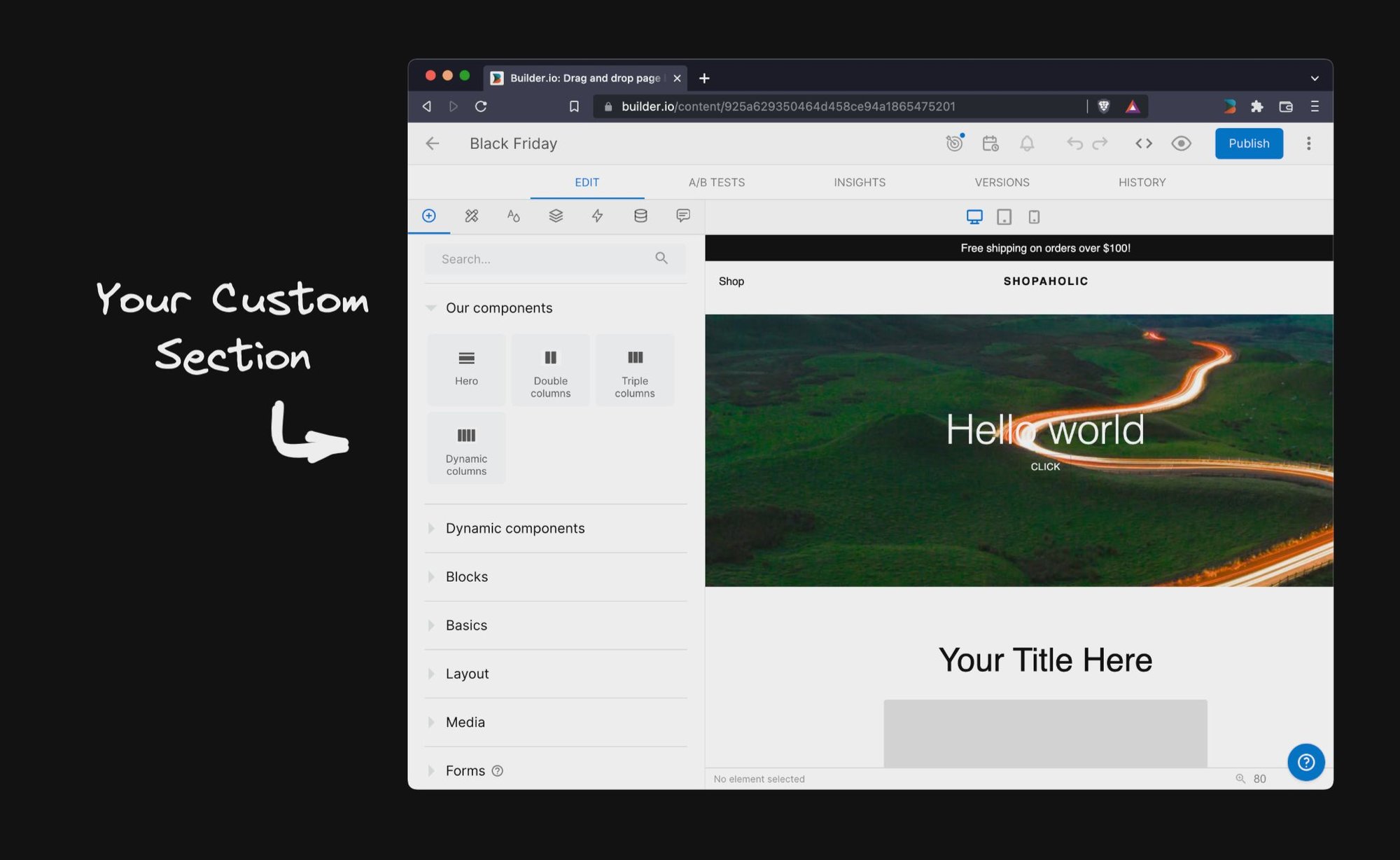
*
* @example
* ```js
* Builder.register('insertMenu', {
* name: 'Our components',
* items: [
* { name: 'Hero' },
* { name: 'Double Columns' },
* { name: 'Triple Columns' },
* { name: 'Dynamic Columns' },
* ],
* })
* ```
*
* You can make as many custom sections as you like
*
* See a complete usage example [here](https://github.com/builderio/builder/blob/main/examples/react-design-system/src/builder-settings.js)
*/
export interface InsertMenuConfig {
name: string;
priority?: number;
persist?: boolean;
advanced?: boolean;
items: InsertMenuItem[];
}
export declare function BuilderComponent(info?: Partial): (component: Class) => Class;
declare type Settings = any;
export interface Action {
name: string;
inputs?: Input[];
returnType?: Input;
action: Function | string;
}
export declare class Builder {
protected request?: IncomingMessage | undefined;
protected response?: ServerResponse | undefined;
/**
* @hidden
* @deprecated. This is buggy, and always behind by a version.
*/
static VERSION: string;
static components: Component[];
static singletonInstance: Builder;
/**
* Makes it so that a/b tests generate code like {@link
* https://www.builder.io/blog/high-performance-no-code#__next:~:text=Static%20generated%20A%2FB%20testing}
* instead of the old way where we render only one test group at a time on the
* server. This is the preferred/better way not and we should ultimately make it
* the default
*/
static isStatic: boolean;
static animator: Animator;
static nextTick: typeof nextTick;
static throttle: typeof throttle;
static editors: any[];
static trustedHosts: string[];
static plugins: any[];
static actions: Action[];
static registry: {
[key: string]: any[];
};
static overrideHost: string | undefined;
/**
* @todo `key` property on any info where if a key matches a current
* key it gets removed
*/
static register(type: 'insertMenu', info: InsertMenuConfig): void;
static register(type: string, info: any): void;
static registryChange: BehaviorSubject<{
[key: string]: any[];
}, any>;
static registerEditor(info: any): void;
static registerPlugin(info: any): void;
static registerAction(action: Action): void;
static registerTrustedHost(host: string): void;
static isTrustedHost(hostname: string): boolean;
static runAction(action: Action | string): void;
static fields(name: string, fields: Input[]): void;
private static _editingPage;
static isIframe: boolean;
static isBrowser: boolean;
static isReactNative: boolean;
static isServer: boolean;
static previewingModel: string | false | null;
static settings: Settings;
static settingsChange: BehaviorSubject;
/**
* @deprecated
* @hidden
*
* Use Builder.register('editor.settings', {}) instead.
*/
static set(settings: Settings): void;
static import(packageName: string): any;
static isEditing: boolean;
static isPreviewing: boolean;
static get editingPage(): boolean;
static set editingPage(editingPage: boolean);
private static prepareComponentSpecToSend;
static registerBlock(component: any, options: Component): void;
static registerComponent(component: any, options: Component): void;
private static addComponent;
static component(info?: Partial): (component: Class) => Class;
static isReact: boolean;
static get Component(): typeof Builder.component;
private eventsQueue;
private throttledClearEventsQueue;
private processEventsQueue;
env: string;
sessionId: string;
targetContent: boolean;
contentPerRequest: number;
allowCustomFonts: boolean;
private cookies;
private cachebust;
private overrideParams;
private noCache;
private preview;
get browserTrackingDisabled(): boolean;
get canTrack(): boolean;
set canTrack(canTrack: boolean);
private canTrack$;
private apiKey$;
private authToken$;
userAttributesChanged: BehaviorSubject;
get editingMode(): boolean;
set editingMode(value: boolean);
editingMode$: BehaviorSubject;
get editingModel(): string | null;
set editingModel(value: string | null);
private findParentElement;
private findBuilderParent;
editingModel$: BehaviorSubject;
setUserAgent(userAgent: string): void;
userAgent: string;
trackingHooks: TrackingHook[];
/**
* Set a hook to modify events being tracked from builder, such as impressions and clicks
*
* For example, to track the model ID of each event associated with content for querying
* by mode, you can do
*
* builder.setTrackingHook((event, context) => {
* if (context.content) {
* event.data.metadata.modelId = context.content.modelId
* }
* })
*/
setTrackingHook(hook: TrackingHook): void;
track(eventName: string, properties?: Partial, context?: any): void;
getSessionId(): string;
visitorId: string;
getVisitorId(): string;
trackImpression(contentId: string, variationId?: string, properties?: any, context?: any): void;
trackConversion(amount?: number, customProperties?: any): void;
autoTrack: boolean;
private get isDevelopmentEnv();
trackInteraction(contentId: string, variationId?: string, alreadyTrackedOne?: boolean, event?: MouseEvent, context?: any): void;
static overrideUserAttributes: Partial;
trackingUserAttributes: {
[key: string]: any;
};
component(info?: Partial): (component: Class) => Class;
get apiKey(): string | null;
set apiKey(key: string | null);
get authToken(): string | null;
set authToken(token: string | null);
constructor(apiKey?: string | null, request?: IncomingMessage | undefined, response?: ServerResponse | undefined, forceNewInstance?: boolean, authToken?: string | null);
private modifySearch;
setTestsFromUrl(): void;
resetOverrides(): void;
getOverridesFromQueryString(): void;
private messageFrameLoaded;
private blockContentLoading;
private bindMessageListeners;
observersByKey: {
[key: string]: BehaviorSubject | undefined;
};
noEditorUpdates: {
[key: string]: boolean;
};
get defaultCanTrack(): boolean;
init(apiKey: string, canTrack?: boolean, req?: IncomingMessage, res?: ServerResponse, authToken?: string): this;
get previewingModel(): string;
getLocation(): Url;
getUserAttributes(userAgent?: string): UserAttributes;
protected overrides: {
[key: string]: string;
};
protected queryOptions: {
[key: string]: string;
};
private getContentQueue;
private priorContentQueue;
setUserAttributes(options: object): void;
/**
* Set user attributes just for tracking purposes.
*
* Do this so properties exist on event objects for querying insights, but
* won't affect targeting
*
* Use this when you want to track properties but don't need to target off
* of them to optimize cache efficiency
*/
setTrackingUserAttributes(attributes: object): void;
get(modelName: string, options?: GetContentOptions & {
req?: IncomingMessage;
res?: ServerResponse;
apiKey?: string;
authToken?: string;
}): BehaviorSubject;
queueGetContent(modelName: string, options?: GetContentOptions): BehaviorSubject;
requestUrl(url: string, options?: {
headers: {
[header: string]: number | string | string[] | undefined;
};
}): Promise;
get host(): string;
private flushGetContentQueue;
private testCookiePrefix;
private processResultsForTests;
private getTestCookie;
private cookieQueue;
private setTestCookie;
getCookie(name: string): any;
setCookie(name: string, value: any, expires?: Date): false | void | Cookies;
getContent(modelName: string, options?: GetContentOptions): BehaviorSubject;
getAll(modelName: string, options?: GetContentOptions & {
req?: IncomingMessage;
res?: ServerResponse;
apiKey?: string;
}): Promise;
}
export {};