# aislopfixer
> Find and fix **AI-generated slop** in web projects — hallucinated dependencies, security holes, swallowed errors, leftover chat residue and LLM marketing prose. Terminal UI + CI mode. Fully offline, rule-based, no API keys.
[](https://www.npmjs.com/package/@mertsoylu/aislopfixer)
[](https://pypi.org/project/aislopfixer/)
[](https://www.python.org/)
[](LICENSE)
**Current version: 0.3.0** — [npm](https://www.npmjs.com/package/@mertsoylu/aislopfixer) / [PyPI](https://pypi.org/project/aislopfixer/)
AI-generated code ships with a recognizable class of defects — and they are not the old "As an AI language model…" giveaways. Today's models hallucinate package imports that break your build (and invite [slopsquatting](https://en.wikipedia.org/wiki/Slopsquatting) attacks), wrap everything in `try/catch` and silently swallow the error, store JWTs in `localStorage`, build SQL with template literals, leave `// ... rest of the code ...` elision markers behind, and coat every landing page in "It's not just a tool — it's a game changer" prose.
**aislopfixer** scans your project for exactly this class of mistakes, ranks each finding by confidence, and lets you fix them one keystroke at a time — or gate your CI on them.
Everything runs **locally**. No network calls, no LLM, no telemetry. Deterministic rules you can read.
---
## Install
```bash
npm install -g @mertsoylu/aislopfixer
aislopfixer ./path/to/project
```
Requires **Python ≥ 3.11** on your machine. On first run the npm launcher builds a small isolated Python environment under `~/.aislopfixer/` (needs internet once), then starts instantly thereafter.
Or straight from PyPI / source:
```bash
pip install aislopfixer # or: pip install -e . from a checkout
aislopfixer ./path/to/project
```
## What it detects
Only mistakes that **current-generation models still make** — trivial lint is deliberately out of scope.
| Category | What | Why it matters |
|----------|------|----------------|
| 🧨 **Hallucinated imports** | `import x from 'pkg'` where `pkg` is in no `package.json` on the path to the root (monorepo-aware; Node built-ins, tsconfig `paths`, `@/`-style aliases all respected); named imports the target module demonstrably never exports; unused leftover imports | Build breaks; typo-squatted registry names are a supply-chain attack vector |
| 🔓 **Security** | XSS sinks (`innerHTML`, `dangerouslySetInnerHTML`, `v-html`), SQL built by interpolation/concat, command injection, `eval`, disabled TLS validation, wildcard CORS, weak crypto, `Math.random()` secrets, hardcoded real keys (AWS/GitHub/OpenAI/Stripe/…, JWTs, PEM blocks, high-entropy literals), tokens in `localStorage`, `postMessage(…, '*')` | Roughly half of generated snippets carry a known weakness; these are the concrete, offline-detectable shapes |
| 🕳️ **Swallowed errors** | `catch (e) {}` and `.catch(() => {})` — including comment-only bodies; log-only catches (`catch (e) { console.error(e) }`); catches that silently `return null`/`[]`/`{}` | The try/catch-everything habit makes failures vanish silently |
| ✂️ **Broken pastes** | Elision markers (`// ... existing code ...`), not-implemented stubs, `debugger;`, leftover ``` fences from chat, unresolved merge conflict markers | The file is literally incomplete or unparseable |
| 🔑 **Placeholder secrets** | `YOUR_API_KEY_HERE`, `sk-xxxx…`, `password: "changeme"` | Fails at runtime and normalizes hardcoding credentials |
| 🗑️ **Placeholders / dummy data** | lorem ipsum, `[Your Company Name]`, `example.com`, fake API endpoints (`api.yourdomain.com`), 555-phones, `href="#"`, placeholder images | Ships as-is embarrassingly often |
| 💬 **AI chat residue** | "As an AI language model…", "Certainly! Here is…", "I hope this helps" | Copy-pasted chat answers in production copy |
| 📢 **LLM prose tells** | "It's not just X — it's Y", "Whether you're … or …", "delve", "seamlessly", em-dash overuse, buzzword density, emoji-headed README sections, checkmark feature lists | The house style of machine marketing copy |
| 🎨 **AI slop design** | The stock purple→pink hero gradient (Tailwind and raw CSS), invented social proof ("Trusted by 10,000+ developers"), emoji-decorated UI copy (🚀✨⚡ feature lists) | The instantly recognizable AI landing-page aesthetic |
| 🖼️ **Image accessibility** | Missing or generic (`alt="image"`) alt text | The one a11y mistake generators still make |
| 📋 **Cross-file duplicates** | The same (or lightly reworded) marketing paragraph pasted across pages; the same helper function re-emitted into several files instead of imported once | Word/token-shingle Jaccard clustering |
| 💤 **Over-commenting** | Files where every other line is a `//` narration comment (directives like `eslint-disable` excluded) | The step-by-step-narrator habit of generated code |
Context-aware by construction: `eval(` inside a string or comment is not flagged, buzzwords only count in human-visible prose (never identifiers), `[id]`/`[a-z]`/`[...slug]` framework tokens are never "placeholders".
## Use it interactively (TUI)
```bash
aislopfixer ./my-site
```
### 1 · Point it at a project
Confirm the target folder (pre-filled from the command line), watch the scan run:
| Splash | Scan |
|--------|------|
|  |  |
### 2 · Triage the findings

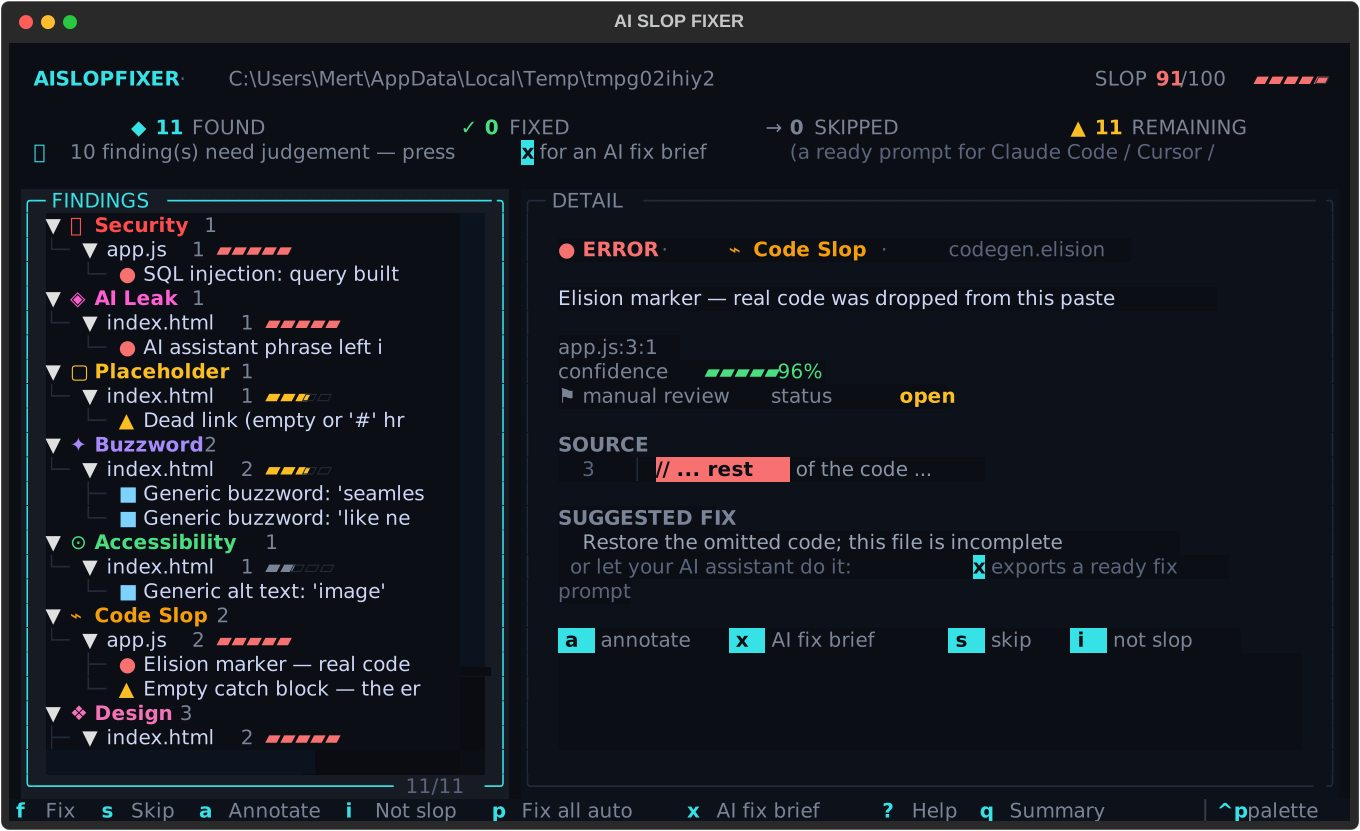
Left: findings grouped by **category → file**, each file with a mini slop bar, each finding with its severity and fix-type icon. Right: the selected finding in full — confidence meter, the offending source lines with the match highlighted, and a preview of exactly what a fix would change. Handle each finding with one key (`?` shows this list in-app):
| Key | Action |
|-----|--------|
| `f` | fix selected finding (auto, or prompts you for the value) |
| `p` | fix **all** safe automatic findings at once |
| `a` | annotate in source |
| `s` | skip (re-surfaces next scan) |
| `i` | not slop — remembered forever, never reported again |
| `x` | export — fix brief / JSON / SARIF |
| `1 2 3` / `0` | filter by severity / clear |
| `c` | cycle the confidence floor (all → 45 → 60 → 75%) |
| `h` | hide already-handled findings |
| `q` | summary |
Three fix types: **auto** deletes/replaces outright (chat residue, lorem ipsum, `debugger;`) — every touched file is backed up to `.aislopfixer.bak` first; **prompt** asks you for the real value (URLs, emails, alt text) and inserts it; **manual** (security, hallucinated imports) is a judgement call — annotate, fix by hand, or export it (next step).
### 3 · Hand what's left to your AI assistant

Half the findings need judgement — exactly what a coding agent is good at once it's told *precisely* what's wrong and where. `x` opens the export picker:
- **`b` fix brief** (`fix-prompt.md`, also copied to the clipboard) — every open finding with exact location, source excerpt, per-rule fix guidance, and guardrails so the agent fixes only what was found without introducing new slop. Paste it into Claude Code, Cursor or Copilot; the brief ends by telling the agent to verify with `aislopfixer --check`. The detector stays deterministic — the AI only executes a vetted work order.
- **`j` JSON** (`findings.json`) / **`s` SARIF** (`findings.sarif`) — the same machine-readable output as `--json` / `--sarif`.
Everything lands in `.aislopfixer/`, which is never itself scanned.
### 4 · Summary

Slop score, severity breakdown, animated per-category fixed/found bars — plus where the report went and what to do next (`b` back · `r` rescan · `n` new folder · `q` quit).
### It learns your project
Everything you resolve or dismiss is remembered in `/.aislopfixer/`:
- **allowlist** — "not slop" verdicts, keyed by content so they survive edits and apply across files;
- **ledger** — fixed/annotated findings never come back; skipped ones intentionally do;
- **noise demotion** — a rule you dismiss 3+ times gets its confidence halved in that project;
- **report.md** — human-readable snapshot after each scan.
## Use it in CI / pre-commit
```bash
aislopfixer . --check # print findings, exit 1 if any warning+
aislopfixer . --check --fail-on error # only hard errors gate the build
aislopfixer . --json # machine-readable output
aislopfixer . --sarif > slop.sarif # SARIF 2.1.0 for GitHub code scanning
aislopfixer . --fix # apply safe auto-fixes, then report the rest
aislopfixer . --check --min-confidence 0.8
aislopfixer . --fix --prompt > fix-brief.md # auto-fix the safe ones, brief your AI on the rest
```
Exit codes: `0` clean, `1` findings at/above `--fail-on` (default `warning`), `2` usage error. The project's `.aislopfixer` memory applies in CI too — vetted false positives stay silent (disable with `--no-store`).
GitHub Actions — one step, PR annotations included via code scanning:
```yaml
- uses: mertsoylu/aislopfixer@main
with:
path: .
fail-on: error
sarif-file: slop.sarif # optional
- uses: github/codeql-action/upload-sarif@v3 # optional, annotates the PR
if: always()
with: { sarif_file: slop.sarif }
```
Or plain pip:
```yaml
- uses: actions/setup-python@v5
with: { python-version: "3.12" }
- run: pip install aislopfixer
- run: aislopfixer . --check --fail-on error
```
pre-commit:
```yaml
repos:
- repo: https://github.com/mertsoylu/aislopfixer
rev: v0.3.0
hooks:
- id: aislopfixer
```
## Configuration
Optional `.aislopfixer.toml` at the project root — CLI flags always win:
```toml
disable = ["design.emoji_ui", "buzzword.delve"] # rule-id prefixes to turn off
ignore = ["legacy/**", "third_party/**"] # path globs to skip entirely
fail_on = "error" # headless exit-code threshold (info|warning|error|never)
min_confidence = 0.5 # headless reporting floor, 0..1
```
`disable` and `ignore` apply to the TUI and headless mode alike.
## Scoring
Every finding carries a confidence (0–1) from a per-rule table, falling back to category × severity. Weak signals **corroborate**: when several independent AI-authorship tells co-occur in one file (an elision marker + a stub + a debug log), every finding there gets boosted. File score is a noisy-OR; the project score is a self-weighted mean, so one sloppy file isn't diluted by fifty clean ones. Confidence gates bulk auto-fix (≥ 0.60) and is yours to threshold in CI.
## Supported files
`.html .htm .jsx .tsx .js .ts .mjs .cjs .vue .svelte .astro .md .mdx .css` — skips `node_modules`, build output, hidden dirs, repo-meta docs (README/LICENSE/CLAUDE/AGENTS…), files > 2 MB.
## Architecture
```
src/aislopfixer/
├── cli.py # entrypoint: TUI by default, --check/--json/--sarif/--prompt/--fix headless
├── headless.py # CI mode: text/JSON/SARIF/fix-brief rendering, exit codes, batch auto-fix
├── pipeline.py # the one scan pipeline both front-ends share
├── prompter.py # findings → fix brief for an AI coding assistant
├── config.py # .aislopfixer.toml: disable rules, ignore globs, thresholds
├── app.py # Textual App, screen orchestration
├── scanner.py # dir walk → SourceFile (ext/ignore/size filters)
├── fixer.py # AUTO/PROMPT/MANUAL fixes, backups, diff preview
├── store.py # .aislopfixer/ project memory (allowlist, ledger, report)
├── engine/
│ ├── runner.py # run rules → dedupe → collapse → containment → corroborate
│ ├── scoring.py # confidence table, noisy-OR file score, project score
│ ├── context.py # prose regions + string/comment masking (the FP killer)
│ └── rules/ # ai_leaks, placeholders, buzzwords, prose_tells, duplicates,
│ # accessibility, codegen, design_slop, markdown_tells,
│ # merge_conflicts, secrets, security, imports (13 modules)
├── screens/ # splash → path → scan → results → summary
└── widgets/ # animations, counters, logo, stats
```
Rules self-register via `@file_rule` / `@cross_rule` decorators; most are declarative `Pattern` lists (regex + severity + fixability + string/comment masking flags + optional guard). Adding a detector is ~30 lines plus a test and a labeled bench case — `tests/test_bench.py` enforces 100% recall on the corpus and **zero** false positives on clean files.
## Development
```bash
pip install -e ".[dev]"
pytest # 275 tests
PYTHONPATH=src python -m bench.run # calibration: recall + clean-FP metrics
PYTHONPATH=src python scripts/shots.py # regenerate the README screenshots
```
Stack: Python ≥ 3.11, [Textual](https://textual.textualize.io/) ≥ 0.80.
## License
[MIT](LICENSE) © mertsoylu