micro-frame-sse & micro-frame-slot
SSE stream support for micro-frame
# Installation
```console
npm install @micro-frame/marko
```
# How it works
Similar to ``, the package exposes `` and `` tags in order to initiate SSE stream and placement of streaming content.
It works the same way as [micro-frame](../../../README.md) when used in browser vs in node server.
## Why
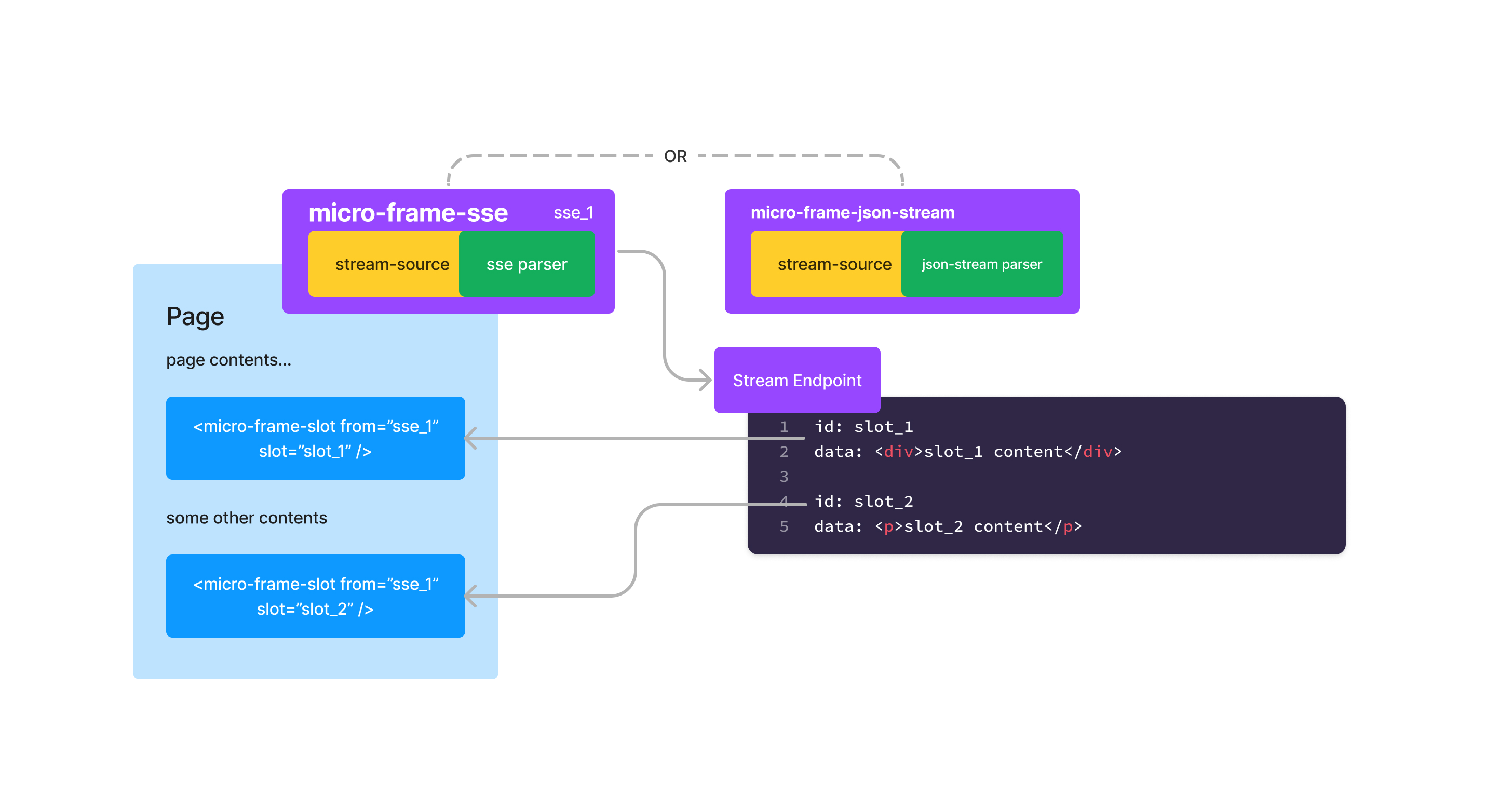
In addition to the benefits from [micro-frame](../../../README.md), `` allows short living server-sent event to steam content into designated slots within single http request. In another word, `micro-frame-sse` enables multiplexing of `micro-frame`.
Considering SSE is only one kind of streaming formats, `micro-frame` could potentially support all kinds of streaming formats like `json-stream` with a proper `parser`.
# Example
`micro-frame-sse` tag is required to put into earlier stage of page rendering (mainly at beginning of the page), who will initiate the SSE request as soon as page starts. `micro-frame-slot` is where content being injected and can be placed at any desired location.
```marko
<@loading>
Loading...
<@catch|err|>
Uh-oh! ${err.message || err}
content in between
```
# `` API
## (required) `src`
A path to SSE endpoint.
```marko
```
## (required) `name`
A unique name for the stream which matches slot's [from](#required-from). A page can have multiple streams.
```marko
```
## `read`
A function to parse the event which returns slot ID and streamed content as an array (optionally an isDone flag). The input is `MessageEvent`, please refer to [MessageEvent](https://developer.mozilla.org/en-US/docs/Web/API/EventSource/message_event#event_properties) for details. Return `undefined` will force this event to be skipped.
```typescript
function read(ev: MessageEvent) {
if (ev.lastEventId === "someId") {
// event with id: someId will be skipped
return;
}
return [ev.lastEventId, ev.data, true];
}
```
Note that isDone flag is important when progressive rendering is in-order, because unfinished slot will block content streaming below the tag.
By default, below logic will be used if no `read` provided in the attribute:
```typescript
// default logic if read not provided
function read(ev: MessageEvent) {
return [ev.lastEventId, ev.data, true];
}
```
```marko
```
## `headers`
Optionally provide additional http headers to send. Only the object form shown below is supported.
```marko
```
> Note that be default on the server side headers are copied from the current incoming request, the `headers` option will be merged with existing headers.
## `fetch`
Optionally provide function to override default `fetch` logic.
```marko
{
resolve({
ok: true,
body: new Readable({read() {}}).push('my own fetch logic (node server)').push(null)
})
// more basic usage:
// const response = myOwnFetch(...args);
// resolve(response);
})
} />
```
## `cache`
Mirrors the [`Request.cache` options](https://developer.mozilla.org/en-US/docs/Web/API/Request/cache) (works on both server and client renders).
```marko
```
## `timeout`
A timeout in `ms` (defaults to 30s) that will prematurely abort the request. This will trigger the `<@catch>` if provided.
If set to `0` the request will not time out.
```marko
```
# `` API
## (required) `slot`
Unique ID for the slot which is used to receive streaming content from the SSE.
```marko
```
## (required) `from`
Stream source name matching [name](#required-name) attribute of ``.
```marko
```
## `client-reorder`
Flag indicate if the slot need to be streamed out-of-order. Please refer to [client-reorder](https://markojs.com/docs/core-tags/#await) in `` tag.
```marko
```
### `client-reorder="after-first-chunk"`
There is an additional value supported here which is `after-first-chunk`. When set, the slot will be rendered in-order before first chunk and will convert to out-of-order while streaming. This is useful when loading indicator is controlled inside stream.
```marko
```
## `timeout` in slot
A timeout in `ms` (defaults to 30s) that will prematurely abort the slot. This will trigger the `<@catch>` if provided.
If set to `0` the request will not time out.
```marko
```
## `<@catch|err|>`
An [attribute tag](https://markojs.com/docs/syntax/#attribute-tag) rendered when there is a network error or timeout.
Error happens in `` will be emitted to `` which can be catched here.
If there is no `@catch` handler the error will be emitted to the stream, similar to the [``](https://markojs.com/docs/core-tags/#await) tag.
```marko
<@catch|err|>
error: ${err.message}
```
## `<@loading>`
An [attribute tag](https://markojs.com/docs/syntax/#attribute-tag) rendered when while the request is still being streamed.
It is removed after the request has either errored, or successfully loaded.
```marko
<@loading>
We are loading the nested app...
```
## `class`
Optional `class` attribute which works the same way as [Marko class attribute](https://markojs.com/docs/syntax/#class-attribute).
```marko
```
## `style`
Optional `style` attribute which works the same way as [Marko style attribute](https://markojs.com/docs/syntax/#style-attribute).
```marko
```
## `no-refresh`
Boolean value controls whether the slot should refresh when its stream source src change.
# Communicating between host and child
Communicating between host and child works the same way as [micro-frame](../../../README.md).
# Code of Conduct
This project adheres to the [eBay Code of Conduct](./.github/CODE_OF_CONDUCT.md). By participating in this project you agree to abide by its terms.