# 
[](https://www.npmjs.com/package/@thi.ng/sexpr)

[](https://mastodon.thi.ng/@toxi)
> [!NOTE]
> This is one of 210 standalone projects, maintained as part
> of the [@thi.ng/umbrella](https://github.com/thi-ng/umbrella/) monorepo
> and anti-framework.
>
> 🚀 Please help me to work full-time on these projects by [sponsoring me on
> GitHub](https://github.com/sponsors/postspectacular). Thank you! ❤️
- [About](#about)
- [Status](#status)
- [Related packages](#related-packages)
- [Installation](#installation)
- [Dependencies](#dependencies)
- [Usage examples](#usage-examples)
- [API](#api)
- [Tokenize only (iterator)](#tokenize-only-iterator)
- [AST generation](#ast-generation)
- [Interpreter](#interpreter)
- [Custom syntax](#custom-syntax)
- [Authors](#authors)
- [License](#license)
## About
Basic, but configurable and extensible
[S-Expression](https://en.wikipedia.org/wiki/S-expression) tokenizer,
parser, AST builder and runtime / interpreter skeleton for custom,
sandboxed DSL implementations.
The following default syntax rules are used:
- **whitespace**: space, tab, newline, comma
- **expression delimiters**: `(`, `)`
- **numbers**: any float notation valid in JS, hex ints prefixed w/ `0x`
- **string delimiters**: `"`
- **line comments**: `;`
Everything else is parsed as is, i.e. as symbol.
## Status
**STABLE** - used in production
[Search or submit any issues for this package](https://github.com/thi-ng/umbrella/issues?q=%5Bsexpr%5D+in%3Atitle)
## Related packages
- [@thi.ng/lispy](https://github.com/thi-ng/umbrella/tree/develop/packages/lispy) - Lightweight, extensible, interpreted Lisp-style DSL for embedding in other projects
- [@thi.ng/parse](https://github.com/thi-ng/umbrella/tree/develop/packages/parse) - Purely functional parser combinators & AST generation for generic inputs
## Installation
```bash
yarn add @thi.ng/sexpr
```
ESM import:
```ts
import * as sexpr from "@thi.ng/sexpr";
```
Browser ESM import:
```html
```
[JSDelivr documentation](https://www.jsdelivr.com/)
For Node.js REPL:
```js
const sexpr = await import("@thi.ng/sexpr");
```
Package sizes (brotli'd, pre-treeshake): ESM: 876 bytes
## Dependencies
- [@thi.ng/api](https://github.com/thi-ng/umbrella/tree/develop/packages/api)
- [@thi.ng/checks](https://github.com/thi-ng/umbrella/tree/develop/packages/checks)
- [@thi.ng/defmulti](https://github.com/thi-ng/umbrella/tree/develop/packages/defmulti)
- [@thi.ng/strings](https://github.com/thi-ng/umbrella/tree/develop/packages/strings)
Note: @thi.ng/api is in _most_ cases a type-only import (not used at runtime)
## Usage examples
Two projects in this repo's
[/examples](https://github.com/thi-ng/umbrella/tree/develop/examples)
directory are using this package:
| Screenshot | Description | Live demo | Source |
|:---------------------------------------------------------------------------------------------------------------------------|:----------------------------------------------------------|:----------------------------------------------------------|:---------------------------------------------------------------------------------------|
| 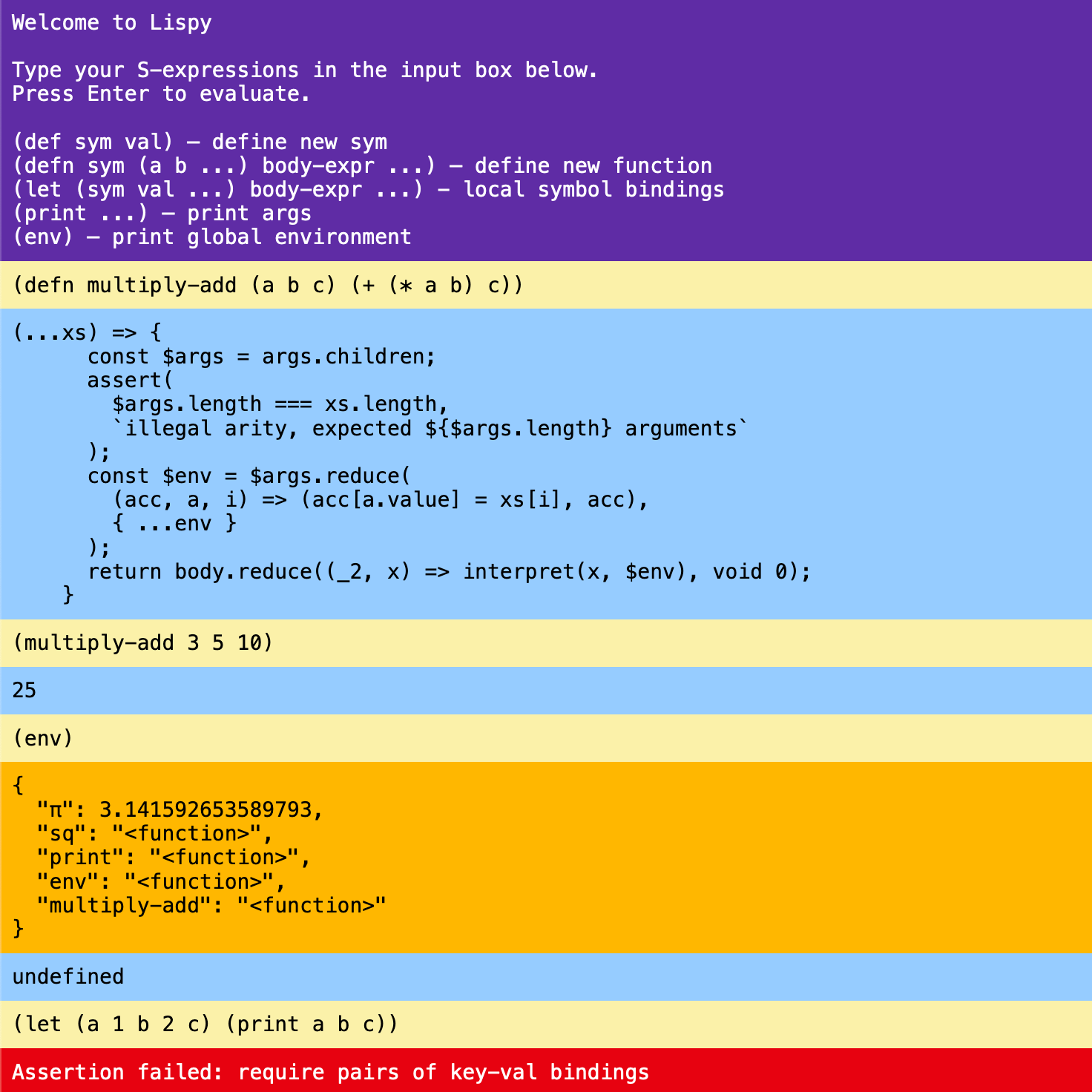 | Browser REPL for a Lispy S-expression based mini language | [Demo](https://demo.thi.ng/umbrella/lispy-repl/) | [Source](https://github.com/thi-ng/umbrella/tree/develop/examples/lispy-repl) |
|
| Browser REPL for a Lispy S-expression based mini language | [Demo](https://demo.thi.ng/umbrella/lispy-repl/) | [Source](https://github.com/thi-ng/umbrella/tree/develop/examples/lispy-repl) |
| 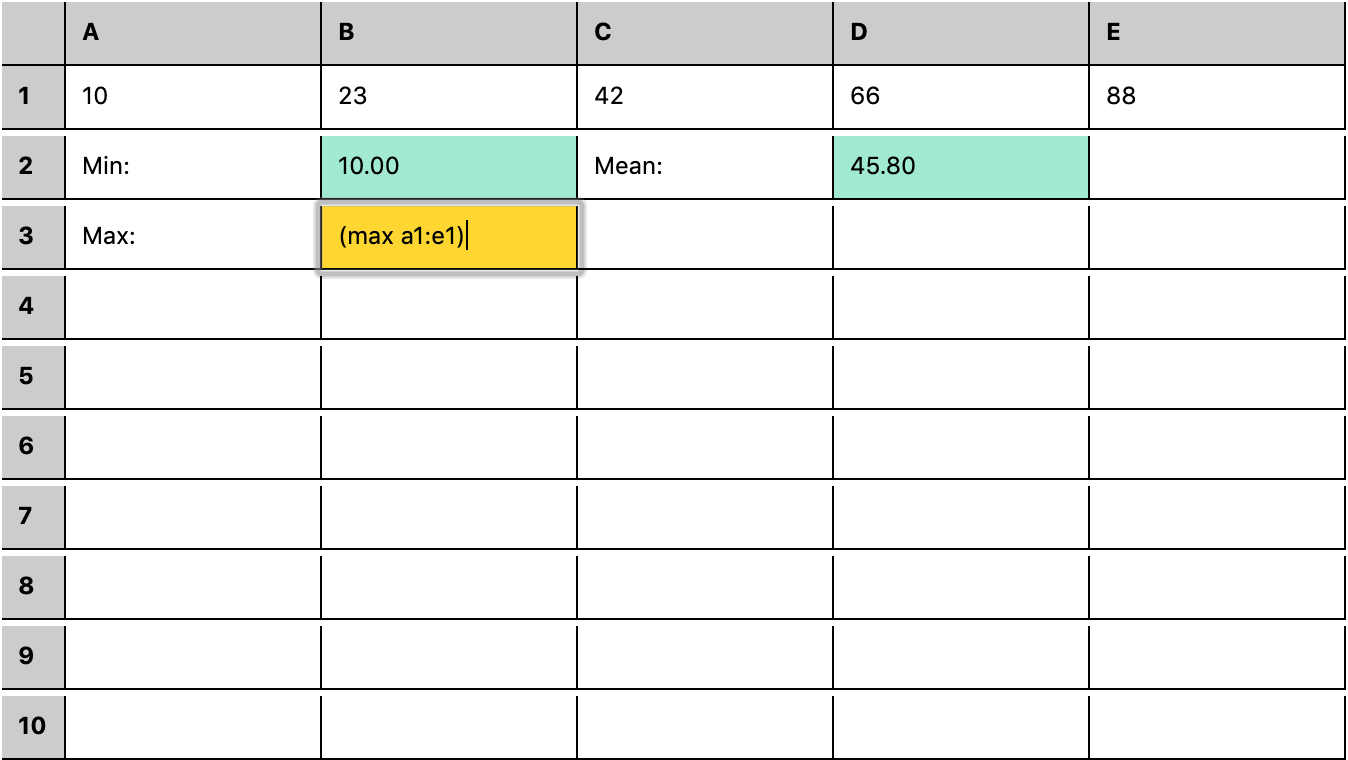 | rstream based spreadsheet w/ S-expression formula DSL | [Demo](https://demo.thi.ng/umbrella/rstream-spreadsheet/) | [Source](https://github.com/thi-ng/umbrella/tree/develop/examples/rstream-spreadsheet) |
## API
[Generated API docs](https://docs.thi.ng/umbrella/sexpr/)
### Tokenize only (iterator)
The `tokenize` function returns an iterator of tokens incl. location
details. Any whitespace is skipped and whitespace characters are
configurable.
```ts
import { tokenize } from "@thi.ng/sexpr";
[...tokenize(`(* (+ 3 5) 10)`)];
// [
// { value: '(', line: 0, col: 0 },
// { value: '*', line: 0, col: 1 },
// { value: '(', line: 0, col: 3 },
// { value: '+', line: 0, col: 4 },
// { value: '3', line: 0, col: 6 },
// { value: '5', line: 0, col: 8 },
// { value: ')', line: 0, col: 9 },
// { value: '10', line: 0, col: 11 },
// { value: ')', line: 0, col: 13 }
// ]
```
### AST generation
The `parse` function takes a source string or iterable of tokens and
parses it into an AST.
```ts
import { tokenize, parse } from "@thi.ng/sexpr";
parse(tokenize(`(* (+ 3 5) 10)`));
// or directly from string
parse(`(* (+ 3 5) 10)`);
```
```json
{
"type": "root",
"children": [
{
"type": "expr",
"value": "(",
"children": [
{
"type": "sym",
"value": "*"
},
{
"type": "expr",
"value": "(",
"children": [
{
"type": "sym",
"value": "+"
},
{
"type": "num",
"value": 3
},
{
"type": "num",
"value": 5
}
]
},
{
"type": "num",
"value": 10
}
]
}
]
}
```
### Interpreter
The below code example implements a small Lisp-like language, complete with
interpreter and can be used an the basis for an easily extensible (and more
optimized) setup. Even this barebones implementation allows for defining of
symbols & functions, lexical scoping, FFI via providing externally defined
functions via the global environment, variadic math ops...
```ts tangle:export/readme.ts
import type { Fn, Fn2 } from "@thi.ng/api";
import { DEFAULT, defmulti, type MultiFn2 } from "@thi.ng/defmulti";
import {
parse, runtime,
type ASTNode, type Expression, type Implementations, type Sym
} from "@thi.ng/sexpr";
// evaluator: parses given source string into an abstract syntax tree (AST) and
// then recursively executes all resulting AST nodes using the
// `interpret()` function defined below. Returns the result of the last node.
const $eval = (src: string, env: any = {}) =>
parse(src).children.reduce((_, x) => interpret(x, env), undefined);
// build runtime (interpreter) w/ impls for all AST node types. the generics are
// the types of the custom environment and the result type(s) of expressions.
// this is a multiple-dispatch function (see thi.ng/defmulti) which chooses
// implementations based on the AST node type
const interpret = runtime, any, any>({
// for expression nodes (aka function calls) delegate to builtins
// (implementations are defined further below)
expr: (x, env) => builtins(x.children, env),
// lookup symbol's value (via its name) in environment
sym: (x, env) => env[x.value],
// strings and numbers evaluate verbatim
str: (x) => x.value,
num: (x) => x.value,
});
// another multiple-dispatch function for DSL builtins. we will call this
// function for each S-expression node and it will delegate to the actual impl
// based on the expression's first item (i.e. a symbol/fn name)
const builtins: MultiFn2 = defmulti((x) => x[0].value);
// helper function which interprets all given AST nodes and returns an array of
// their result values
const evalArgs = (nodes: ASTNode[], env: any) =>
nodes.map((a) => interpret(a, env));
// helper function for basic math ops variable arity.
// with 2+ args: (+ 1 2 3 4) => 10
// and special cases for 1 arg only, i.e.
// `(+ 2)` => 0 + 2 => 2
// `(- 2)` => 0 - 2 => -2
// `(* 2)` => 1 * 2 => 2
// `(/ 2)` => 1 / 2 => 0.5
const mathOp =
(fn: Fn2, fn1: Fn) =>
([_, ...args]: ASTNode[], env: any) => {
const first = interpret(args[0], env);
return args.length > 1
? // use a reduction for 2+ args
evalArgs(args.slice(1), env).reduce((acc, x) => fn(acc, x), first)
: // apply special case unary function
fn1(first);
};
// implementations of built-in core functions
builtins.addAll({
"+": mathOp((acc, x) => acc + x, (x) => x),
"*": mathOp((acc, x) => acc * x, (x) => x),
"-": mathOp((acc, x) => acc - x, (x) => -x),
"/": mathOp((acc, x) => acc / x, (x) => 1 / x),
// count returns the length of first argument (presumably a string)
// (e.g. `(count "abc")` => 3)
count: ([_, arg], env) => interpret(arg, env).length,
// concatenates all args into a space-separated string and prints it
// returns undefined
print: ([_, ...args], env) => console.log(evalArgs(args, env).join(" ")),
// defines as new symbol with given value, stores it in the environment and
// then returns the value, e.g. `(def magic 42)`
def: ([_, name, value], env) =>
(env[(name).value] = interpret(value, env)),
// defines a new function with given name, args and body, stores it in the
// environment and returns it, e.g. `(defn madd (a b c) (+ (* a b) c))`
defn: ([_, name, args, ...body], env) => {
// create new vararg function in env
return (env[(name).value] = (...xs: any[]) => {
// create new local env with arguments bound to named function args
// (i.e. simple lexical scoping)
const $env = (args).children.reduce(
(acc, a, i) => ((acc[(a).value] = xs[i]), acc),
{ ...env }
);
// execute function body with local env, return result of last expr
return body.reduce((_, x) => interpret(x, $env), undefined);
});
},
// add default/fallback implementation to allow calling functions defined in
// the environment (either externally or via `defn`)
[DEFAULT]: ([x, ...args]: ASTNode[], env: any) => {
const name = (x).value;
const f = env[name];
if (!f) throw new Error(`missing impl for: ${name}`);
return f.apply(null, evalArgs(args, env));
},
});
// testing our toy Lisp DSL...
// define symbol and use in another expression
$eval(`(def chars "abc") (print (count chars) "characters")`);
// 3 characters
// define function (multiply-add) and test
$eval(`(defn madd (a b c) (+ (* a b) c)) (print (madd 3 5 (* 5 2)))`);
// 25
// pre-define function via environment, then use in DSL
$eval(`(print (join " | " (+ 1 2) (* 3 4) (- 5 6) (/ 7 8)))`, {
join: (sep: string, ...xs: any[]) => xs.join(sep),
});
// 3 | 12 | -1 | 0.875
// testing lexical scoping...
// function `foo` has `a` as local (with precedence over global) binding,
// but function `bar` correctly uses binding of the outer env, even if
// called from `foo`...
$eval(`
(def a 1)
(defn foo (a) (print "foo" a "bar" (bar)))
(defn bar () (+ a 1))
(print "root #1" a)
(foo 100)
(print "root #2" a)
`);
// root #1 1
// foo 100 bar 2
// root #2 1
```
See
[test/](https://github.com/thi-ng/umbrella/tree/develop/packages/sexpr/test/)
for a more in-depth version of this example...
### Custom syntax
```ts tangle:export/readme2.ts
import { parse } from "@thi.ng/sexpr";
// define syntax overrides (keep default whitespace rules)
const syntax = {
scopes: [["<", ">"], ["{", "}"]],
string: "'"
};
console.log(JSON.stringify(parse(``, syntax), null, 2));
```
Resulting JSON output:
```json
{
"type": "root",
"children": [
{
"type": "expr",
"value": "<",
"children": [
{
"type": "sym",
"value": "nest"
},
{
"type": "expr",
"value": "{",
"children": [
{
"type": "sym",
"value": "a"
},
{
"type": "str",
"value": "2"
},
{
"type": "sym",
"value": "b"
},
{
"type": "num",
"value": 3
}
]
}
]
}
]
}
```
## Authors
- [Karsten Schmidt](https://thi.ng)
If this project contributes to an academic publication, please cite it as:
```bibtex
@misc{thing-sexpr,
title = "@thi.ng/sexpr",
author = "Karsten Schmidt",
note = "https://thi.ng/sexpr",
year = 2019
}
```
## License
© 2019 - 2025 Karsten Schmidt // Apache License 2.0
| rstream based spreadsheet w/ S-expression formula DSL | [Demo](https://demo.thi.ng/umbrella/rstream-spreadsheet/) | [Source](https://github.com/thi-ng/umbrella/tree/develop/examples/rstream-spreadsheet) |
## API
[Generated API docs](https://docs.thi.ng/umbrella/sexpr/)
### Tokenize only (iterator)
The `tokenize` function returns an iterator of tokens incl. location
details. Any whitespace is skipped and whitespace characters are
configurable.
```ts
import { tokenize } from "@thi.ng/sexpr";
[...tokenize(`(* (+ 3 5) 10)`)];
// [
// { value: '(', line: 0, col: 0 },
// { value: '*', line: 0, col: 1 },
// { value: '(', line: 0, col: 3 },
// { value: '+', line: 0, col: 4 },
// { value: '3', line: 0, col: 6 },
// { value: '5', line: 0, col: 8 },
// { value: ')', line: 0, col: 9 },
// { value: '10', line: 0, col: 11 },
// { value: ')', line: 0, col: 13 }
// ]
```
### AST generation
The `parse` function takes a source string or iterable of tokens and
parses it into an AST.
```ts
import { tokenize, parse } from "@thi.ng/sexpr";
parse(tokenize(`(* (+ 3 5) 10)`));
// or directly from string
parse(`(* (+ 3 5) 10)`);
```
```json
{
"type": "root",
"children": [
{
"type": "expr",
"value": "(",
"children": [
{
"type": "sym",
"value": "*"
},
{
"type": "expr",
"value": "(",
"children": [
{
"type": "sym",
"value": "+"
},
{
"type": "num",
"value": 3
},
{
"type": "num",
"value": 5
}
]
},
{
"type": "num",
"value": 10
}
]
}
]
}
```
### Interpreter
The below code example implements a small Lisp-like language, complete with
interpreter and can be used an the basis for an easily extensible (and more
optimized) setup. Even this barebones implementation allows for defining of
symbols & functions, lexical scoping, FFI via providing externally defined
functions via the global environment, variadic math ops...
```ts tangle:export/readme.ts
import type { Fn, Fn2 } from "@thi.ng/api";
import { DEFAULT, defmulti, type MultiFn2 } from "@thi.ng/defmulti";
import {
parse, runtime,
type ASTNode, type Expression, type Implementations, type Sym
} from "@thi.ng/sexpr";
// evaluator: parses given source string into an abstract syntax tree (AST) and
// then recursively executes all resulting AST nodes using the
// `interpret()` function defined below. Returns the result of the last node.
const $eval = (src: string, env: any = {}) =>
parse(src).children.reduce((_, x) => interpret(x, env), undefined);
// build runtime (interpreter) w/ impls for all AST node types. the generics are
// the types of the custom environment and the result type(s) of expressions.
// this is a multiple-dispatch function (see thi.ng/defmulti) which chooses
// implementations based on the AST node type
const interpret = runtime, any, any>({
// for expression nodes (aka function calls) delegate to builtins
// (implementations are defined further below)
expr: (x, env) => builtins(x.children, env),
// lookup symbol's value (via its name) in environment
sym: (x, env) => env[x.value],
// strings and numbers evaluate verbatim
str: (x) => x.value,
num: (x) => x.value,
});
// another multiple-dispatch function for DSL builtins. we will call this
// function for each S-expression node and it will delegate to the actual impl
// based on the expression's first item (i.e. a symbol/fn name)
const builtins: MultiFn2 = defmulti((x) => x[0].value);
// helper function which interprets all given AST nodes and returns an array of
// their result values
const evalArgs = (nodes: ASTNode[], env: any) =>
nodes.map((a) => interpret(a, env));
// helper function for basic math ops variable arity.
// with 2+ args: (+ 1 2 3 4) => 10
// and special cases for 1 arg only, i.e.
// `(+ 2)` => 0 + 2 => 2
// `(- 2)` => 0 - 2 => -2
// `(* 2)` => 1 * 2 => 2
// `(/ 2)` => 1 / 2 => 0.5
const mathOp =
(fn: Fn2, fn1: Fn) =>
([_, ...args]: ASTNode[], env: any) => {
const first = interpret(args[0], env);
return args.length > 1
? // use a reduction for 2+ args
evalArgs(args.slice(1), env).reduce((acc, x) => fn(acc, x), first)
: // apply special case unary function
fn1(first);
};
// implementations of built-in core functions
builtins.addAll({
"+": mathOp((acc, x) => acc + x, (x) => x),
"*": mathOp((acc, x) => acc * x, (x) => x),
"-": mathOp((acc, x) => acc - x, (x) => -x),
"/": mathOp((acc, x) => acc / x, (x) => 1 / x),
// count returns the length of first argument (presumably a string)
// (e.g. `(count "abc")` => 3)
count: ([_, arg], env) => interpret(arg, env).length,
// concatenates all args into a space-separated string and prints it
// returns undefined
print: ([_, ...args], env) => console.log(evalArgs(args, env).join(" ")),
// defines as new symbol with given value, stores it in the environment and
// then returns the value, e.g. `(def magic 42)`
def: ([_, name, value], env) =>
(env[(name).value] = interpret(value, env)),
// defines a new function with given name, args and body, stores it in the
// environment and returns it, e.g. `(defn madd (a b c) (+ (* a b) c))`
defn: ([_, name, args, ...body], env) => {
// create new vararg function in env
return (env[(name).value] = (...xs: any[]) => {
// create new local env with arguments bound to named function args
// (i.e. simple lexical scoping)
const $env = (args).children.reduce(
(acc, a, i) => ((acc[(a).value] = xs[i]), acc),
{ ...env }
);
// execute function body with local env, return result of last expr
return body.reduce((_, x) => interpret(x, $env), undefined);
});
},
// add default/fallback implementation to allow calling functions defined in
// the environment (either externally or via `defn`)
[DEFAULT]: ([x, ...args]: ASTNode[], env: any) => {
const name = (x).value;
const f = env[name];
if (!f) throw new Error(`missing impl for: ${name}`);
return f.apply(null, evalArgs(args, env));
},
});
// testing our toy Lisp DSL...
// define symbol and use in another expression
$eval(`(def chars "abc") (print (count chars) "characters")`);
// 3 characters
// define function (multiply-add) and test
$eval(`(defn madd (a b c) (+ (* a b) c)) (print (madd 3 5 (* 5 2)))`);
// 25
// pre-define function via environment, then use in DSL
$eval(`(print (join " | " (+ 1 2) (* 3 4) (- 5 6) (/ 7 8)))`, {
join: (sep: string, ...xs: any[]) => xs.join(sep),
});
// 3 | 12 | -1 | 0.875
// testing lexical scoping...
// function `foo` has `a` as local (with precedence over global) binding,
// but function `bar` correctly uses binding of the outer env, even if
// called from `foo`...
$eval(`
(def a 1)
(defn foo (a) (print "foo" a "bar" (bar)))
(defn bar () (+ a 1))
(print "root #1" a)
(foo 100)
(print "root #2" a)
`);
// root #1 1
// foo 100 bar 2
// root #2 1
```
See
[test/](https://github.com/thi-ng/umbrella/tree/develop/packages/sexpr/test/)
for a more in-depth version of this example...
### Custom syntax
```ts tangle:export/readme2.ts
import { parse } from "@thi.ng/sexpr";
// define syntax overrides (keep default whitespace rules)
const syntax = {
scopes: [["<", ">"], ["{", "}"]],
string: "'"
};
console.log(JSON.stringify(parse(``, syntax), null, 2));
```
Resulting JSON output:
```json
{
"type": "root",
"children": [
{
"type": "expr",
"value": "<",
"children": [
{
"type": "sym",
"value": "nest"
},
{
"type": "expr",
"value": "{",
"children": [
{
"type": "sym",
"value": "a"
},
{
"type": "str",
"value": "2"
},
{
"type": "sym",
"value": "b"
},
{
"type": "num",
"value": 3
}
]
}
]
}
]
}
```
## Authors
- [Karsten Schmidt](https://thi.ng)
If this project contributes to an academic publication, please cite it as:
```bibtex
@misc{thing-sexpr,
title = "@thi.ng/sexpr",
author = "Karsten Schmidt",
note = "https://thi.ng/sexpr",
year = 2019
}
```
## License
© 2019 - 2025 Karsten Schmidt // Apache License 2.0