---
name: server-side-calls
description: Call tRPC procedures directly from server code using t.createCallerFactory(router) and router.createCaller(ctx) for integration testing, internal server logic, and custom API endpoints. Pass the context as an object or a function, e.g. an inner context without a request. Catch TRPCError and extract HTTP status with getHTTPStatusCodeFromError(), report errors with createCaller's onError option. Don't use a caller inside another procedure; share a plain function instead.
requires:
  - server-setup
sources:
  - www/v11/docs/server/server-side-calls.md
metadata:
  type: core
  library: trpc
  library_version: 11.23.0
---

<!-- Generated from www/v11/docs/server/server-side-calls.md by www/build/skills.ts. Edit the docs instead. -->

# Server Side Calls

From https://trpc.io/docs/server/server-side-calls

You may need to call your procedure(s) directly from the same server they're hosted in, `createCallerFactory()` can be used to achieve this. This is useful for server-side calls and for integration testing of your tRPC procedures.

> [!NOTE] Info
>
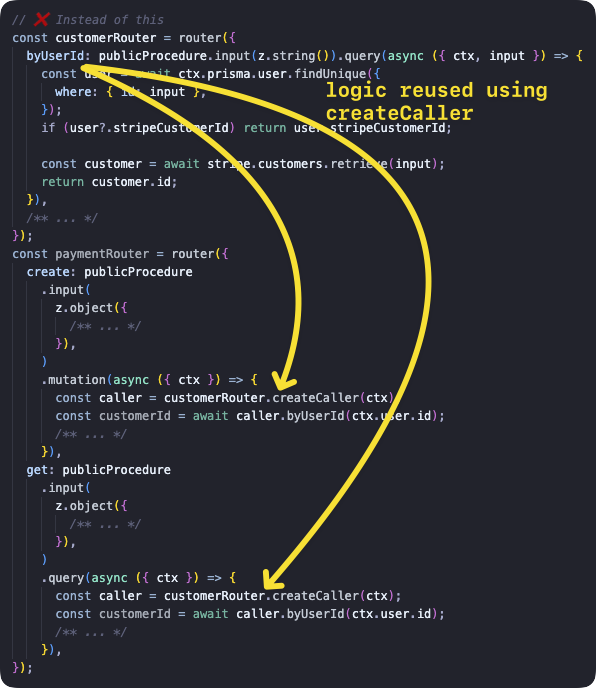
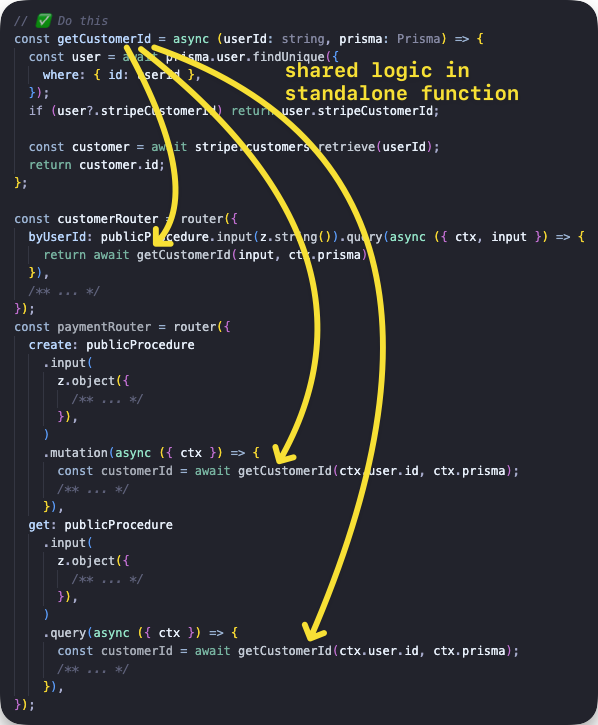
> `createCaller` should not be used to call procedures from within other procedures. This creates overhead by (potentially) creating context again, executing all middlewares, and validating the input - all of which were already done by the current procedure. Instead, you should extract the shared logic into a separate function and call that from within the procedures, like so:
>
> <div class="flex gap-2 w-full justify-between pt-2">
>   <img src="https://assets.trpc.io/www/docs/server/server-side-calls/bad.png" alt="Instead of this: procedures in paymentRouter call customerRouter.createCaller(ctx).byUserId(ctx.user.id) to reuse its logic" class="w-[49.5%]" />
>   <img src="https://assets.trpc.io/www/docs/server/server-side-calls/good.png" alt="Do this: a standalone getCustomerId(userId, prisma) function holds the shared logic, and every procedure calls it with values from ctx and input" class="w-[49.5%]" />
> </div>


## Create caller

With the `t.createCallerFactory`-function you can create a server-side caller of any router. You first call `createCallerFactory` with an argument of the router you want to call, then this returns a function where you can pass in a `Context` for the following procedure calls.

### Basic example

We create the router with a query to list posts and a mutation to add posts, and then we call each method.

```ts no-check
import { initTRPC } from '@trpc/server';
import { z } from 'zod';

type Context = {
  foo: string;
};

const t = initTRPC.context<Context>().create();

const publicProcedure = t.procedure;
const { createCallerFactory, router } = t;

interface Post {
  id: string;
  title: string;
}
const posts: Post[] = [
  {
    id: '1',
    title: 'Hello world',
  },
];
const appRouter = router({
  post: router({
    add: publicProcedure
      .input(
        z.object({
          title: z.string().min(2),
        }),
      )
      .mutation((opts) => {
        const post: Post = {
          ...opts.input,
          id: `${Math.random()}`,
        };
        posts.push(post);
        return post;
      }),
    list: publicProcedure.query(() => posts),
  }),
});

// 1. create a caller-function for your router
const createCaller = createCallerFactory(appRouter);

// 2. create a caller using your `Context`
const caller = createCaller({
  foo: 'bar',
});

// 3. use the caller to add and list posts
const addedPost = await caller.post.add({
  title: 'How to make server-side call in tRPC',
});

const postList = await caller.post.list();
```

The caller doesn't run your adapter's `createContext`, so pass everything your procedures and middlewares expect. An [inner context](https://trpc.io/docs/server/context#inner-and-outer-context) works well here, as it doesn't need a request.

Instead of a context object, you can also pass a function that returns the context, or a promise of it. The caller calls it for every procedure call, so cache it (e.g. with React's `cache()`) if it's expensive:

```ts no-check
const createCaller = t.createCallerFactory(appRouter);

const caller = createCaller(async () => createContext());
const greeting = await caller.hello();
```

### Example usage in an integration test

> Taken from [https://github.com/trpc/examples-next-prisma-starter/blob/main/src/server/routers/post.test.ts](https://github.com/trpc/examples-next-prisma-starter/blob/main/src/server/routers/post.test.ts)

```ts no-check
async function testAddAndGetPost() {
  const ctx = await createContextInner({});
  const caller = createCaller(ctx);

  const input: inferProcedureInput<AppRouter['post']['add']> = {
    text: 'hello test',
    title: 'hello test',
  };

  const post = await caller.post.add(input);
  const byId = await caller.post.byId({ id: post.id });
}
```

## `router.createCaller()`

With the `router.createCaller({})` function (first argument is `Context`) we retrieve an instance of `RouterCaller`.

### Input query example

We create the router with an input query, and then we call the asynchronous `greeting` procedure to get the result.

```ts no-check
import { initTRPC } from '@trpc/server';
import { z } from 'zod';

const t = initTRPC.create();

const router = t.router({
  // Create procedure at path 'greeting'
  greeting: t.procedure
    .input(z.object({ name: z.string() }))
    .query((opts) => `Hello ${opts.input.name}`),
});

const caller = router.createCaller({});
const result = await caller.greeting({ name: 'tRPC' });
```

### Mutation example

We create the router with a mutation, and then we call the asynchronous `post` procedure to get the result.

```ts no-check
import { initTRPC } from '@trpc/server';
import { z } from 'zod';

const posts = ['One', 'Two', 'Three'];

const t = initTRPC.create();
const router = t.router({
  post: t.router({
    add: t.procedure.input(z.string()).mutation((opts) => {
      posts.push(opts.input);
      return posts;
    }),
  }),
});

const caller = router.createCaller({});
const result = await caller.post.add('Four');
```

### Context with middleware example

We create a middleware to check the context before executing the `secret` procedure. Below are two examples: the former fails because the context doesn't fit the middleware logic, and the latter works correctly.

<br />

> [!NOTE] Info
>
> Middlewares are performed before any procedure(s) are called.


<br />

```ts no-check
import { initTRPC, TRPCError } from '@trpc/server';

type Context = {
  user?: {
    id: string;
  };
};
const t = initTRPC.context<Context>().create();

const protectedProcedure = t.procedure.use((opts) => {
  const { ctx } = opts;
  if (!ctx.user) {
    throw new TRPCError({
      code: 'UNAUTHORIZED',
      message: 'You are not authorized',
    });
  }

  return opts.next({
    ctx: {
      // Infers that the `user` is non-nullable
      user: ctx.user,
    },
  });
});

const router = t.router({
  secret: protectedProcedure.query((opts) => opts.ctx.user),
});

{
  // ❌ this will return an error because there isn't the right context param
  const caller = router.createCaller({});

  const result = await caller.secret();
}

{
  // ✅ this will work because user property is present inside context param
  const authorizedCaller = router.createCaller({
    user: {
      id: 'KATT',
    },
  });
  const result = await authorizedCaller.secret();
}
```

### Example for a Next.js API endpoint

> [!TIP]
>
> This example shows how to use the caller in a Next.js API endpoint. tRPC creates API endpoints for you already, so this file is only meant to show
> how to call a procedure from another, custom endpoint.


```ts no-check
type ResponseData = {
  data?: {
    postTitle: string;
  };
  error?: {
    message: string;
  };
};

export default async (
  req: NextApiRequest,
  res: NextApiResponse<ResponseData>,
) => {
  /** We want to simulate an error, so we pick a post ID that does not exist in the database. */
  const postId = `this-id-does-not-exist-${Math.random()}`;

  const caller = appRouter.createCaller({});

  try {
    // the server-side call
    const postResult = await caller.post.byId({ id: postId });

    res.status(200).json({ data: { postTitle: postResult.title } });
  } catch (cause) {
    // If this a tRPC error, we can extract additional information.
    if (cause instanceof TRPCError) {
      // We can get the specific HTTP status code coming from tRPC (e.g. 404 for `NOT_FOUND`).
      const httpStatusCode = getHTTPStatusCodeFromError(cause);

      res.status(httpStatusCode).json({ error: { message: cause.message } });
      return;
    }

    // This is not a tRPC error, so we don't have specific information.
    res.status(500).json({
      error: { message: `Error while accessing post with ID ${postId}` },
    });
  }
};
```

### Error handling

A procedure called through a caller throws its error as a `TRPCError`; errors that weren't thrown as one become an `INTERNAL_SERVER_ERROR` with the original error as their `cause`.

The `createCaller` function can also take an error handler through the `onError` option, for example to log or report errors. The caller still throws the error after the handler runs. Its options also take a `signal`, which your procedures receive as `opts.signal`.
The handler is called with the same arguments as an error formatter would be, except for the shape field:

```ts no-check
interface OnErrorShape {
  ctx: unknown;
  error: TRPCError;
  path: string | undefined;
  input: unknown;
  type: 'query' | 'mutation' | 'subscription' | 'unknown';
}
```

```ts no-check
import { initTRPC } from '@trpc/server';
import { z } from 'zod';

const t = initTRPC
  .context<{
    foo?: 'bar';
  }>()
  .create();

const router = t.router({
  greeting: t.procedure.input(z.object({ name: z.string() })).query((opts) => {
    if (opts.input.name === 'invalid') {
      throw new Error('Invalid name');
    }

    return `Hello ${opts.input.name}`;
  }),
});

const caller = router.createCaller(
  {
    /* context */
  },
  {
    onError: (opts) => {
      console.error('An error occurred:', opts.error);
    },
  },
);

// The following will log "An error occurred: Error: Invalid name", and then throw the error
await caller.greeting({ name: 'invalid' });
```

## Related skills

- `server-setup` (https://trpc.io/docs/server/overview): `npx @tanstack/intent@latest load @trpc/server#server-setup`