# dsh-llm-local-token
A [DeepSeek Harness](https://github.com/deepseek-ai/deepseek-harness) plugin that serves LLM
calls with the OAuth tokens your **local CLIs already hold** — no separate API key, no extra
login. If you are signed in to the Codex CLI or to Claude Code, those subscriptions become
usable model routes inside DSH.
| Provider route | Credential source | Endpoint |
| --- | --- | --- |
| `openai-codex` | `~/.codex/auth.json` (ChatGPT OAuth, shared with the `codex` CLI) | `https://chatgpt.com/backend-api` |
| `anthropic` | `~/.claude/.credentials.json`, else the macOS Keychain item `Claude Code-credentials` | `https://api.anthropic.com` |
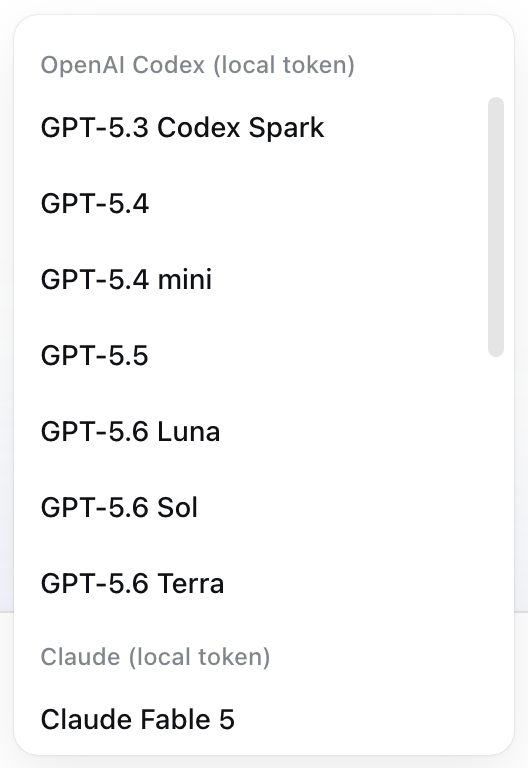
Both routes appear in the model picker as soon as the plugin loads. A route whose credential is
missing is skipped instead of failing the boot.
Both subscriptions as routes in the model picker
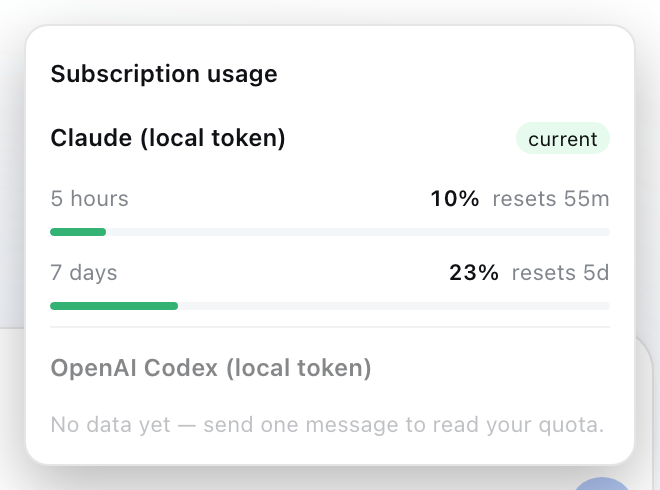
Subscription usage, read from provider rate-limit headers
## Why it exists
DSH resolves a provider's key through its credential seam, which expects an API key. Personal
Codex / Claude subscriptions are OAuth-only, so the keys simply do not exist. This plugin
resolves the token per request from the file the CLI maintains, refreshes it when it is close to
expiry, and hands it to the pi-ai engine that DSH already ships.
## Install
```bash
dsh plugin --profile web add dsh-llm-local-token
# or straight from git
dsh plugin --profile web add https://github.com/tianxia--/dsh-llm-local-token.git
```
Then restart `dsh` — that is the whole install. The package declares a profile
bundle (`dsh.bundle.patch` → [`cordis.patch.yml`](cordis.patch.yml)), so DSH
inserts the loader row for you; you do **not** have to hand-edit the profile's
own `cordis.patch.yml`.
Enabling it by hand instead
If you vendored the plugin, or you want to pin its `config` in your own patch
layer, append the row yourself to `~/.dsh/profiles/web/cordis.patch.yml`. Your
profile's layer is applied after every bundle layer, so restating the id here
also lets you override the bundle's defaults:
```yaml
- insert:
- id: llm-local-token
name: dsh-llm-local-token
```
To make it the default model:
```yaml
# ~/.dsh/settings.yaml
agent-default-model:
provider: openai-codex
model: gpt-5.6-terra
reasoningEffort: medium
```
## Configuration
All keys are optional; the defaults match a stock CLI install.
| Key | Default | Meaning |
| --- | --- | --- |
| `codexAuthPath` | `$CODEX_HOME/auth.json`, else `~/.codex/auth.json` | Codex credential file |
| `claudeAuthPath` | `~/.claude/.credentials.json` | Legacy Claude Code credential file |
| `claudeKeychainService` | `Claude Code-credentials` | macOS Keychain service holding the Claude OAuth payload |
| `requireClaude` | `false` | Fail activation when no Claude credential is found, instead of skipping the route |
| `codexTransport` | `"sse"` | Streaming transport for the Codex route: `sse` / `websocket` / `websocket-cached` / `auto`. **The quota badge depends on `sse`**: pi-ai's default `auto` streams over WebSocket, and the `x-codex-*` quota headers exist only on the SSE response, so the badge stays empty under WS. Set `auto` to prefer WebSocket and accept no Codex quota data. |
## Subscription usage badge
Both providers return their quota state in response headers, so the plugin reads it for free —
no polling, no extra endpoint hits. A badge appears in the composer bar next to the context
ring; click it for the breakdown.
| Provider | Headers read | Shown |
| --- | --- | --- |
| `openai-codex` | `x-codex-primary-*`, `x-codex-secondary-*`, `x-codex-plan-type`, `x-codex-credits-balance` | plan, used % per window, reset countdown, credit balance |
| `anthropic` | `anthropic-ratelimit-unified-{5h,7d}-{utilization,reset,status}` | used % for the 5-hour and 7-day windows, reset countdown |
The badge is green under 60%, amber under 85%, red above. Usage is whatever the **last real
request** reported, so a freshly started host shows "no data yet" until you send one message.
The browser half polls `GET /llm-local-token/usage` every 15s; that route only reads the
in-memory snapshot.
The badge shows **only the provider serving the currently selected model**: pick Codex and you see
Codex's windows, switch to Claude and it swaps — the two are never mixed into one number. When the
selected model belongs to another adapter (a plain API key, another plugin) the badge hides itself,
because that quota is not this plugin's to report. The popover still lists every route, with the
active one first and marked "current" and the rest dimmed. The selection comes from
`ctx.modelDirectories`; a composition without that service (non-Web) falls back to the previous
union-of-all-routes view.
## Requirements
- Node.js **22.13+** (DSH's own floor; `--use-system-ca` needs it too)
- `dsh-base` in the profile — it already provides `@deepseek-ai/dsh-llm-pi-ai` and `@earendil-works/pi-ai`
- A signed-in CLI: `codex login` for the Codex route; Claude Code for the Anthropic route
- The Claude Keychain lookup is macOS-only. On Linux/Windows only the file store is consulted.
## Token handling
- Read per request, never cached in memory beyond the call
- Refreshed when less than 5 minutes of life remain, then **written back to the same file** the
CLI reads, so the CLI stays logged in (single-flight: concurrent requests trigger one refresh)
- Written atomically with `0600` permissions
- Never logged, never sent anywhere except the provider endpoint
## Troubleshooting
### `UNABLE_TO_GET_ISSUER_CERT_LOCALLY`
Your traffic goes through a TLS-inspecting proxy (Zscaler, Netskope, corporate MITM). Node does
not trust its root CA even when the OS does. Start DSH with either:
```bash
node --use-system-ca … # trust the OS store (Node 22.13+)
NODE_EXTRA_CA_CERTS=/path/to/root-ca.pem dsh … # or point at the proxy's root cert
```
### `Provider is not configured: openai-codex`
Means the pi-ai provider refused an API-key override. This plugin already attaches an api-key
auth method to the OAuth-only Codex provider; seeing this error again implies a pi-ai version
whose `resolveProviderAuth` changed — open an issue with your `@earendil-works/pi-ai` version.
### The model list shows no Codex/Claude entries
Check the boot log for `llm-local-token: registered …`. If it names only `openai-codex`, no
Claude credential was found (expected when Claude Code was never used on this machine).
## Caveats
- Uses your **personal subscription quota** (ChatGPT Plus/Pro, Claude Pro/Max). Respect the
provider's terms; this is not a way to share one seat across a team.
- `chatgpt.com/backend-api` is the Codex client's own endpoint, not a documented public API. It
can change without notice; pin the pi-ai version if you need stability.
## License
MIT