CHAPTER 3
Existing approaches to conservation
The above-mentioned developments in the discipline of heritage conservation could be encapsulated in these two approaches, developed since the birth of the discipline to present: a material-based and a values-based approach. These approaches, though appearing at different periods of time, are both applicable today (see also Poulios 2010a; Poulios 2014).
3.1. A material-based approach
Presentation
A material-based approach (also referred to as ‘authorised heritage discourse’: Smith 2006, 29 − 34; 299) shows an extreme focus on the preservation of the material/fabric. Examples of a material-based approach are: the early approach to conservation marking the birth of the discipline in the nineteenth century and the early twentieth century (such as the Cambridge Camden Society, the ‘conservation movement’, and the work of philosophers like Alois Riegl), and the development of the World Heritage concept and adoption of the World Heritage List (UNESCO 1972; see also Simmonds 1997; Byrne 1991). A material-based approach is best epitomised in the Venice Charter (ICOMOS 1964; see also Jokilehto 1998, 230).
A material-based approach is an expert-driven approach. The exclusive responsibility over the definition and conservation of heritage is in the hands of heritage authorities (mostly state-appointed), manned by political officials and especially conservation professionals. Community is not taken into account (see UNESCO 1988; 1992; 1994c, paragraph 14) (figure 3).
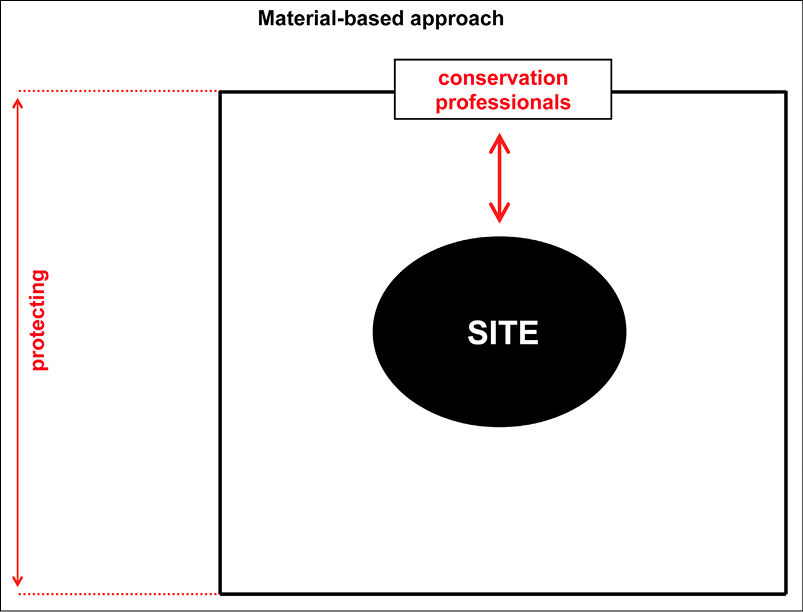
Figure 3: A material-based approach: conservation professionals and heritage site. No community involvement.
The significance of heritage, namely defined in archaeological/historic and aesthetic terms, is seen as intrinsic/inherent in the fabric. The use of heritage (by communities) is considerably limited to ensure its protection (by conservation professionals), and is conducted strictly with reference to modern scientific-based conservation principles and practices (ICOMOS 1964). The preservation of the fabric allows for only minimal interventions into heritage, with respect to the physical, material structure. Thus, fabric is seen as a non-‘renewable’ resource. The aim of conservation is to preserve heritage, seen as belonging to the past, from human practices of the present that are considered to be harmful, and transmit it to the future generations. In this way, a form of discontinuity is created between the monuments and the people, and between the past and the present. The development of the broader area based on the exploitation of heritage is sought exclusively in accordance with the interests of the heritage authorities.
Critique
A series of successes in the preservation of the fabric of the monuments – which was the primary objective of conservation at the end of the nineteenth and the largest part of the twentieth century, mostly due to the long periods of political instability and the armed conflicts as well as the out-of-scale reconstruction and development that followed – are credited to the application of a material-based approach.
The most significant weakness of a material-based approach is linked to the exclusive power of the conservation professionals, who are seen as the ‘experts’. This means that the conservation process, as well as its results, depends to a large extent on the specific persons/individuals that comprise the team of the ‘experts’. Another weakness of a material-based approach is related to its exclusive dependency on state support and funding (and not on a broader community consensus), which is not always feasible in the long-term. Furthermore, the approach does not embrace indigenous/non-Western communities’ (eg. spiritual and religious) associations with the sites, nor their management systems and maintenance practices. As a consequence, the application of the approach in non-Western places has resulted in the breaking of communities’ associations with their sites and in the long term in the harming of these sites, while on a theoretical level it has been often seen as an attempt towards the imposition of Western-based views on the non-Western world, in a colonial context (see above). On the basis of these weaknesses, a material-based approach is today considered out-of-date, and thus conservation professionals prefer not to follow it; yet, it is still considered the prominent approach in a variety of places across the world.
A characteristic example of a site that may reveal the weaknesses of a material-based approach is Angkor in Cambodia (a World Heritage Site). In the last decades, the heritage authorities of the site have heavily promoted the tourism development of the site. The local communities and the monks of the site have been gradually restricted on the site and occasionally even removed from it, and their association with the site has been altered: the local villagers are now becoming increasingly interested in the financial aspect of the site through their involvement in the tourism industry, while becoming a priest is now seen as a form of investment (Miura 2005).
3.2. A values-based approach
Presentation
A values-based approach focuses on the values that society, consisting of various stakeholder groups / interest groups, ascribes to heritage. A value can be defined as ‘a set of positive characteristics or qualities’, while a stakeholder group / interest group is ‘any group with legitimate interest in heritage’ (Mason 2002, 27; Mason and Avrami 2002, 15; De la Torre 2005, 5; de la Torre, MacLean and Myers 2005, 77). A values-based approach has been developed since the 1980s, within the developments of post-processual archaeology (a form of archaeological theory that is related to the broader development of postmodernism, which encouraged conservation professionals to become more engaged in a world beyond academia and to recognise other values, voices and perspectives in the practice and interpretation of archaeology: Hodder 1991; Trigger 1989; see also Demas 2002, 50; 34–35), and is considered the current most preferred approach to heritage conservation. An example of a values-based approach is the attempt of the World Heritage concept to evolve and open towards non-Western/indigenous communities and cultures (see above; UNESCO 1994a, article 4; UNESCO 1994b; 1996 / 1999, paragraph 14). A values-based approach is largely based on the Burra Charter (ICOMOS Australia 1999), and has been further developed and advocated through a series of projects of the Getty Conservation Institute (De la Torre 1997; Avrami, Mason and De la Torre 2000; Teutonico and Palumbo 2002; De la Torre 2002; Agnew and Demas 2002; De la Torre, MacLean, Mason and Myers 2005).
In the context of a values-based approach, through the concepts of stakeholder groups and values, community is considered to be placed at the core of conservation. Heritage is not self-evident, with intrinsic/inherent values, as in a material-based approach; it is people / stakeholder groups that ascribe (subjective) values to it and define heritage, and thus heritage is seen as an extrinsic and social process. Therefore, the main aim of conservation is not the preservation of heritage itself, but the protection of the values imputed to it by the stakeholder groups (Mason and Avrami 2002, 25 and 22). A values-based approach tries to engage the whole range of stakeholder groups early on and throughout the conservation process, and resolve conflicts that inevitably arise between them assuring subjectivity and equity of conflicting stakeholders and different values (Mason and Avrami 2002, 19−23; De la Torre 2005, 4−8; Demas 2002, 49). Stakeholder groups are involved in a variety of ways: through consultation or, more often, through active participation or even through a (formally/legally established) interactive, joint management scheme with the heritage authorities, as in the cases of the World Heritage Sites of Kakadu National Park in Australia and Chaco Culture National Historical Park in USA, often cited as key examples of the successful application of a values-based approach at an international level (on Kakadu National Park: Flood 1989, 87; Press and Lawrence 1995, 1–8; Sullivan 1985, 141–144; Wellings 1995, 242–244; Jones 1985, vi; 299–300; on Chaco Culture National Historical Park: de la Torre, Mac Lean and Myers 2005).
Critique
The most significant contribution of a values-based approach to the discipline of heritage conservation is linked to the encouragement and promotion of the involvement of communities in the conservation process, with important benefits for the communities themselves. Furthermore, the approach embraces the indigenous/non-Western communities’ (spiritual, and religious) associations with the sites, their management systems and maintenance practices.
The most considerable weakness of the approach is related to the power of the conservation professionals. Conservation professionals do not have the exclusive power in the conservation process (as in a material-based approach), but retain particularly increased power. Conservation professionals continue to favour the preservation of the tangible – rather than the intangible – heritage elements, and thus conservation continues to reflect mostly Western-based views.
In this context, a values-based approach attempts to expand the concepts of a material-based approach, without yet substantially challenging them (see in detail Poulios 2010a, 172−175). Specifically, stakeholder groups are involved in the conservation process, yet in most of the cases within the framework and under the supervision of the conservation professionals (Demas 2002, 48−49; Mason and Avrami 2002, 16). Thus, though in theory conservation professionals may be seen as one of the stakeholder groups, in practice they are the managing authority themselves, supervising the stakeholder groups (figure 4). Hence, the concept of stakeholder groups (i.e. the key concept of a values-based approach), as defined and applied in a values-based approach, proves to be rather problematic, obtaining meaning and existence through conservation professionals’ power. Furthermore, new stakeholder groups such as local and indigenous communities are also included (ICOMOS Australia 1999, articles 12 and 26.3), but the most favoured stakeholder groups tend to remain those associated with the preservation of the fabric (De la Torre 2005, 7). Values associated to the safeguarding of intangible heritage elements, such as user or social value, are also taken into account (see ICOMOS Australia 1999, preamble; articles 7.1 and 24.1−2), but their safeguarding is incorporated within and is serving the preservation of tangible remains (De la Torre 2005, 8). The traditional care of heritage by the communities is also recognised (ICOMOS Australia 1999, preamble, articles 7.1 and 24.1−2) yet only to the extent that it does not undermine modern scientific-based conservation principles and practices of conservation professionals. Heritage use (by communities) is generally accepted to the extent that it does not undermine heritage protection (by conservation professionals). More flexible recommendations are adopted in conservation practice such as varied approaches allowing reconstruction depending on the nature and values of heritage (ICOMOS Australia 1999, preamble, articles 7.1 and 24.1−2), yet it is mostly minimal interventions in the heritage fabric, with respect to the physical and material structure, that are allowed. Thus, the fabric is still preserved as a non-‘renewable’ resource (De la Torre 2005, 8). Therefore, the aim of conservation remains the preservation of heritage, considered to belong to the past, from the people of the present, for the sake of the future generations (discontinuity). Development potentials based on the exploitation of heritage are sought in an attempt to serve the interests of the various stakeholder groups, yet with an emphasis on the interests of the conservation professionals and under their control.
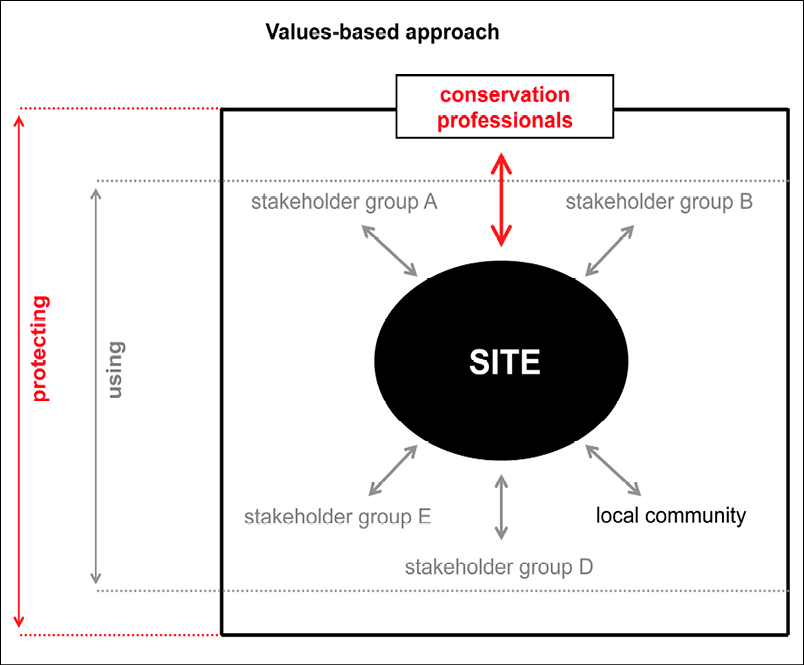
Figure 4: A values-based approach: conservation professionals, stakeholder groups and heritage site. Stakeholder groups are equally involved in the conservation process, under the supervision of a strong managing authority, which is in most of the cases the conservation professionals. Local community is seen as one of the stakeholder groups.
A characteristic example of a site that may demonstrate the weaknesses of a values-based approach is the Chaco Culture National Historical Park (CCNHP) in New Mexico in USA (a World Heritage Site) (de la Torre, MacLean and Myers 2005). The history of the site is inextricably linked to the presence of Navajo [Indian] indigenous communities, who settled in the area in the late sixteenth or the early seventeenth century and developed strong family, cultural and religious ties to the site. In designating the site as a National Monument and as a National Historical Park at the beginning of the twentieth century, the Park authorities (following a material-based approach) recognised officially only the aesthetic and age values of the archaeological remains, and moved the remaining Navajo communities out of the designated Park area. In the last decades, however, the Park authorities (following a values-based approach) have shown a consistent interest in the consultation and the active participation of Navajo communities in the conservation and management of the site through a joint management scheme, though still within their own rules and under their supervision and control. From the 1980s onwards, ‘New Age’ groups claimed the right to perform rituals on the site, which were seen by the Navajo communities as violating their own religious beliefs. Faced with this conflict between these two stakeholder groups, the Park authorities felt they had only two alternatives: either allow both groups to perform rituals or ban them totally. Favoring one group over another in religious issues would be considered discrimination on the basis of religion, according to the American Constitution. As a result, the Park authorities decided to prohibit all religious ceremonies in places regarded as sacred. Therefore, despite the attempts on the part of the Park authorities in the last decades, the primary aim has always been the protection of the tangible remains of the site.
Conclusion
The key principles of the discipline of heritage conservation, as developed along with a material-based approach and maintained by a values-based approach, may be summarised as follows (see also McBryde 1997, 94; Clavir 2002, xxi; Jones 2006, 111): first, the responsibility for the operation and management of sites is in the hands of the conservation professionals; second, the authenticity of heritage is primarily associated with the fabric of the sites despite the increasing recognition of intangible elements, and the emphasis on the original meanings and uses of the sites despite the increasing recognition of the later developments in the history of the sites; and third, heritage is considered a monument of the past that has to be protected from the present community, for the sake of the future generations.