CHAPTER 8
The conservation and management of Meteora (1960 to present): presentation
8.1. Overview
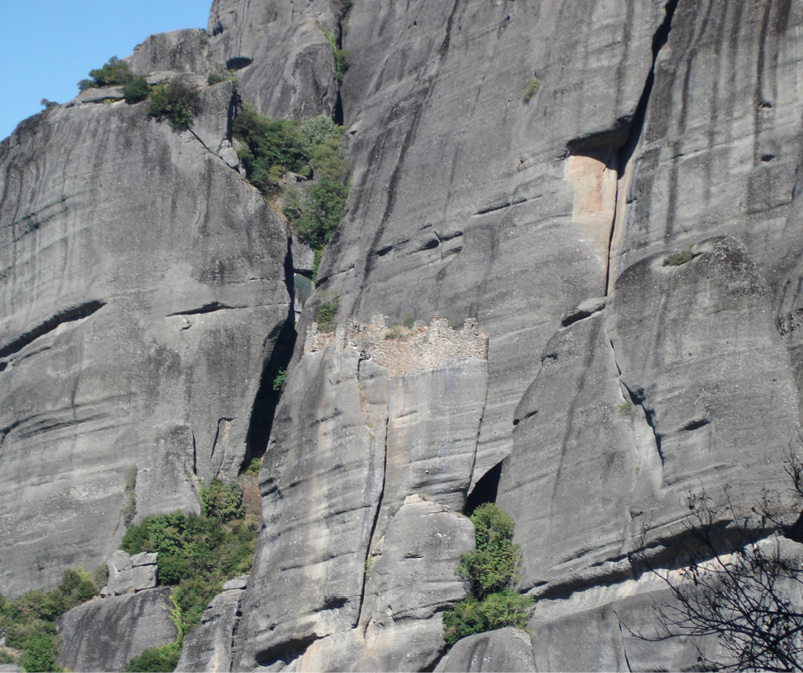
From the end of World War II (1945) and the Civil War (1946-1949) most monasteries at Meteora were not in use, and the rest, such as the Great Meteoron and the Varlaam monasteries, had very few monks. The monasteries, already in a dilapidated condition because of the wars (Tzimas 2000, 395), further suffered during the period of the monastic absence: for example, the Hagia monastery collapsed (figure 27), while the Holy Trinity and the Roussanou monasteries suffered from theft (Theotekni 1978, 86−87; Tetsios 2003, 342; Tzimas 2000, 404; Meteora Monasteries 1980a; Meteora Bishopric 2002; pers. comm. Holy Trinity Monastery; pers. comm. Roussanou Monastery).
From the early 1950s to the early 1960s the State (through the Ministry of Reconstruction and Development, and the Hellenic Tourism Organisation) allocated money for the restoration of the monasteries. The interest of the State was to rescue the monasteries from collapse and also to develop tourism at the site:
We believe that Meteora should be dealt with as follows: a) as monuments of Byzantine art and architecture and Christian history, b) as the only tourist area of special interest for the connection of the route of Athens-Larissa with the route of Athens-Delphi-Ioannina-Metsovo … so that the necessary requirements for the maintenance of Meteora as a site that has tourism potential are not lost. (Hellenic Tourism Organisation 1951)
The above extract demonstrates that the State already had specific plans for the tourism exploitation of Meteora based on specific tourist routes in the 1950s. The interest of the State in developing tourism at the site is also illustrated by the construction of a very large and luxurious hotel by the standards of that time, named ‘Xenia’, in Kalampaka in the late 1950s (Chatzidakis 1993, 3).
In the context of developing tourism at the site, in the early 1960s, the State (through the Hellenic Tourism Organisation) constructed guesthouses within the monasteries, as in the case of the Great Meteoron (Meteora Bishopric 1960; pers. comm. Ioasaph). Thus, the Great Meteoron monastery was mainly used by visitors as a guesthouse, while at the same time the only monk living in the monastery at that time was isolated in a smaller part of the monastery leading his spiritual life. Bishop Dionysios of Meteora considered this guesthouse ‘profoundly incompatible to the holy character of the site’ (Meteora Bishopric 1960), while the current monks of the Great Meteoron Monastery note the oral tradition according to which the monk died of sorrow because he considered the guesthouse a sacrilege (pers. comm. Ioasaph).
In the early 1960s, mainly as a result of the initiatives of Bishop Dionysios of Meteora, the first organised monastic communities were re-established on the site (Tzimas 2000, 395-96; Tsiatas 2003, 162; pers. comm. Ioasaph). As Bishop Dionysios stated, asking for the cessation of the contract with the Hellenic Tourism Organisation regarding the guesthouse in the Great Meteoron monastery: ‘The Great Meteoron monastic community… is restructured and increasing in terms of size, and the space is absolutely essential for it’ (Meteora Bishopric 1961).
In the late 1960s, the Church (through a central Ecclesiastical Council and the local Bishopric), with the agreement of the developing monastic communities of Meteora, cleared part of the estate of the Church and of the monasteries and allocated money for their maintenance and development. The local community actively helped in the maintenance works in kind, without asking for money in return. It gradually became the congregation of the monasteries, with active participation in the ritual life.
These maintenance and development works, undertaken by the monastic communities with the help of the local community, were not scientifically-based, and were conducted without reference to contemporary conservation guidelines. As a consequence, the monastic communities significantly, and in some cases even irreversibly, damaged the original fabric and altered the original spatial arrangement of the monasteries, but still managed to rescue them from collapse. An example of this is the Holy Trinity monastery (Tzimas 2000, 395−396 and 403; pers. comm. Tetsios).
During the 1960s, there was an interest on the part of the State to further emphasise and establish the heritage significance of Meteora. Thus in 1967, the Ministry of Culture (which had previously protected some monasteries as individual monuments in the 1920s) assigned the site as a whole with single boundaries including the local village of Kastraki and part of the city of Kalampaka.
During the 1960s, visitors started arriving at Meteora in larger numbers. These visitors were mostly individuals rather than organised groups, and were mainly interested in the monastic life of the Monasteries as pilgrims (Kouros 1965, 46−47; Kotopoulis 1973, 12−20). The Meteora monks and nuns, with the exception of the Great Meteoron monks, accepted and embraced tourism from the very beginning, seeing it as a source of income through the donations from visitors, which would help towards the growth of their communities and the restoration of their monasteries. At that time the local community was primarily concerned with the ritual life of the site, and was cautious or even negative towards the phenomenon of tourism mostly on the grounds of its effect on the monastic character of the site (Kouros 1965, 44−45; Kotopoulis 1973, 13−20). It seems clear that at that time the local community had not recognised the economic benefits of tourism.
During the 1970s and the early 1980s the monastic communities increased in size with the support of the local Bishop (Tzimas 2000, 396). At the same time there was also an increase in the visitors to the site. The visitors in this period consisted not only of those interested in the ritual life of the Monasteries as pilgrims, but also those more interested in the landscape and the monastic buildings as an inseparable part of the landscape, and were increasingly visiting the site as a result of more organised tourism. The State supported the development of more organised tourism in an attempt to further develop and enhance its contacts with foreign, mostly Western European, states (Ministry of Coordination and Development 1980, 26−27 and 39; pers. comm. KENAKAP). The monastic communities continued to accept the development of tourism at the site, with an increasing recognition of the financial benefits of tourism. During this period admission charges for the non-Greek visitors were introduced (pers. comm. Great Meteoron Monastery). The local community, whilst continuing their involvement in the ritual life of the Monasteries as the congregation which had increased in size, also started to recognise the financial benefits of tourism, gradually becoming involved in tourism by opening shops, restaurants and small hotels in Kalampaka and Kastraki (Alexiadis 2004).
During the 1970s and the early 1980s the Ministry of Culture launched, through its local Ephorate, large-scale restoration projects, particularly at the Roussanou and the St Nikolaos Anapafsas monasteries. As a result of these projects these monasteries were rescued from collapse (Tetsios 2003, 342−344; Meteora Ephorate 1977; pers. comm. Lazaros Deriziotis). These projects were primarily a result of the State’s increasing interest in the protection of the monuments as part of national heritage, as well as its constant concern to maintain and increase tourism at the area.
The monastic communities developed smaller-scale projects at their monasteries through the income derived from tourism, and with the firm support of the local community which now started to be paid for its work. These projects aimed at the maintenance and development of the monasteries, the improvement of the communication of the monasteries with the outside world and the satisfying of the visitors’ needs. Thus, stairs were constructed for the easier access of the members of the monastic communities and the visitors to the monasteries, and small rooms were arranged for the protection and exhibition of the monastic treasures (Tzimas 2000, 396−397 and 399; Nikodimi 2001, 276). These works were mostly unauthorised, with considerable implications for the original fabric, as reflected in the views of the Ministry of Culture officials:
In very few years, if the allowance on the part of the authorities and the unauthorised [construction] activities on the part of the monks continue, it is scientifically certain that the [architectural] style of the Meteora monasteries will be irreversibly harmed. (Ministry of Culture 1982b)
By the early 1980s Ministry of Culture officials had begun to complain about not being informed about construction activity taking place in most of the Meteora monasteries, as in the Great Meteoron and Varlaam (Ministry of Culture 1982a). By the early 1980s Ministry of Culture officials described the complexities of the operation and management of Meteora as follows:
The Meteora monasteries are united against any danger/issue… They also have remarkable financial power, law consultants, covering from the Church and contacts with Mount Athos, etc. They also influence a large part of the local society, which willingly supports them in any initiative of theirs, regardless if it is right or wrong. (Ministry of Culture 1982b)
From the mid-1980s to present is the period of mass tourism at the site. Mass tourism developed with the constant support of the government agencies as well as the acceptance and encouragement of the monastic communities. The local community also became increasingly involved in tourism, with considerable implications for the local population and economy: The local economy changed its character, increasingly relying on tourism, where it had previously been based on agriculture and cattle-raising. During this period the rural population began moving from the surrounding villages to the city of Kalampaka (Kalyvas 2002, 97, 166 and 198−199).
From the mid-1980s until the mid-1990s, the State’s concern for the heritage protection of the site was strengthened. This concern was manifested mainly in two ways: first, through the funding of extensive restoration projects at the monasteries. This funding came mainly from the European Union, and was assigned through the Ministry of Culture and especially the Ministry for the Environment, Spatial Planning and Public Works for restoration works at the monasteries; and second, through the promotion of the World Heritage inscription of the site, which took place in 1988. It is important to note that the State initiated and completed the World Heritage nomination process of the site without any attempt to involve the monastic communities. The monastic communities did not show any willingness to participate in, or oppose, the process either. Nevertheless, in the nomination file the Ministry of Culture placed heavy emphasis on the monastic communities’ association with the site, clearly reflecting their views. It stressed that ‘this area [of Meteora] has been continuously used by the Meteora Monasteries since the end of the tenth century till now and it has been also continuously resided by monks and nuns’ (Ministry of Culture 1986, 2−3), and also attached a book written by a Meteora nun (Theotekni 1978).
The concern on the part of the State for the heritage protection of the site was also linked to the tourism exploitation of the site, given that both the allocation of money from the Greek government and the European Union and the World Heritage inscription of the site required that the monasteries would remain open to the public (see above; Greek Government 2002, article 11; Greek Government 1932).
The monastic communities continued to carry out maintenance and development works, increasingly on a much larger scale. From the late 1980s onwards, with the establishment of the current St Stephen monastic community comprising nuns of a higher educational status, the monastic communities started to show a greater concern to carry out scientifically-based studies, with reference to contemporary conservation guidelines (Tzimas 2000, 398). However, the monastic communities, because of their income through tourism, continued not to necessarily depend on the authorisation and the funding from the Ministry of Culture for their works (pers. comm. Meteora Ephorate).
From the mid-1990s onwards, Meteora became a popular tourist destination in Greece. As a result, the monastic communities have increased their income, which has ensured them financial independence from the State. This enables the communities to conduct almost any project they might desire often without the authorisation of the Ministry of Culture (Ereuna 2002), not only in the context of covering their monastic needs or even ensuring for them better and more convenient everyday life conditions but also in the context of a form of rivalry between the monastic communities towards giving their monasteries the strength and glory of the past (pers. comm. Meteora Ephorate). Such projects concern: first, the restoration or replacement of existing buildings, in certain cases also in an attempt to revive the monasteries’ function. For example, the Great Meteoron monastic community restored the monastery of the Coming of Christ, which today operates as its monastery dependency [metochi], and the Holy Trinity monastic community restored the St Nikolaos Badovas and the St Antonios skites, which also operate as its dependencies (Tetsios 2003, 341−342; Ioasaph 2002, 4−6; n. 10−11). And second, the construction of new buildings (pers. comm. Meteora Ephorate). The scale of the unauthorised works on the part of the monastic communities caused the following reaction on the part of the Ministry of Culture officials:
One can notice an act/situation of barbarism for the country, which tends to take the form of a severe illness… Aren’t the monks citizens of this state? Aren’t they subject to the state legislation and regulations? (pers. comm. Ministry of Culture, cited in Ereuna 2002)
8.2. Examples
Developing tourism at Meteora: the shooting of James Bond’s film (1980)
An international film company attempted to shoot scenes of James Bond’s film For Your Eyes Only (United Artists 1981) at Meteora and particularly in the Holy Trinity monastery. The tourist agencies and the local government were in favour of the project because it promoted the site to the tourists. The monastic communities, acting as one body, mainly at the initiative of the Abbot of the Great Meteoron Monastery and with support from the local Bishopric (Meteora Bishopric 1980), refused permission, considering this project a sacrilege to the holy character of the site. The monastic communities raised Greek and Byzantine flags on the Holy Trinity monastery, and temporarily closed the monasteries to all visitors. They also launched a campaign to stop the shooting of the film, motivating, and achieving support from, the official Church authorities and numerous ecclesiastical and monastic cycles within and outside Greece (Meteora Monasteries 1980a; Meteora Monasteries 1980b; Meteora Monasteries 1980c; Paradosi 1994, 402 and 424). Thus, ‘Meteora became a new symbol of resistance, national and pan-Orthodox’ (Paradosi 1994, 403).
The film company, with permission from the Ministry of Culture and support from the local community, shot a few general views of the area and the Holy Trinity monastery, and then completed the film in a studio with fake structures that were supposed to substitute the actual monastic buildings (Paradosi 1994, 421 and 423).
Developing tourism at Meteora: the KENAKAP study for the development of Meteora and the broader region (1994)
In 1994, the ‘Centre for the Development of Kalampaka and Pyli’ (KENAKAP)1 commissioned a study on the development of tourism at Meteora and the broader region (Xydias and Totsikas and Braoudakis 1994). The study attempted to reconcile the tourism operation with the monastic function of the site, proposing stricter controls over the tourist use of the site through a variety of measures: enclosure of the monastic complex with gates, restriction of the number of visitors entering the complex, introduction of a ticketing system for the entire complex, development of parking areas outside the complex and an internal bus-transfer system, and restricted opening hours of the complex. The study also proposed changes in the management status of the site, giving the monastic communities the primary role but suggesting at the same time an increased role for the local government (Xydias and Totsikas and Braoudakis 1994, xxiii-xxvi; 5/1, 10/33 and 4/1-5; pers. comm. Vassilis Xydias; pers. comm. Great Meteoron Monastery; pers. comm. St Stephen Monastery).
The study led to a major conflict between the local government and the monastic communities. The local government saw this plan as an ideal opportunity to gain more control over the tourism industry, at the expense of the monastic communities (Ta Meteora 1995a). The monastic communities, acting as one body (‘the Assembly of the Holy Monasteries of Meteora’, consisting of the Abbots and Abbesses of all Meteora Monasteries), at the initiative of the Abbot of the Great Meteoron Monastery, opposed the study on the grounds that it was threatening to impose tourism upon the monastic and holy character of the site. The monastic communities feared that the study would lead to an uncontrollable tourism exploitation of the site. They also saw the study as a potential weapon in the hands of groups with limited knowledge regarding the operation of the site and often without respect for the holy character of the site, i.e. the local government and private companies, to intervene in their territory and challenge their power. As a result, the monastic communities firmly opposed any changes to the existing management status of the site (Meteora Monasteries 1995, 11−26; Meteora Monasteries 1994c; Meteora Monasteries 1994b, 137−141; pers. comm. Great Meteoron Monastery; pers. comm. St Stephen Monastery).
The conflict between the two sides affected the other groups as well. The local Bishopric clearly took the side of the monastic communities (Meteora Bishopric 1994; Meteora Monasteries 1995, 4−5). The local community was unable to come to a single agreement about the study, proving disorganised and lacking the appropriate knowledge and experience to understand even the basic points of the study. Thus the local community was divided between the two sides (i.e. the monastic communities and the local government), caught within local ideological and political conflicts and personal contacts and subject to the influence of the monastic communities and the Bishopric (on the side of the local government: Ta Meteora 1995b; Kourelis and Kouroupas 1995; on the side of the monastic communities: Detziortzio 1994, 210−216). The Ministry of Tourism and the Ministry of Culture chose not to intervene in the conflict (pers. comm. Ministry of Tourism; pers. comm. Ministry of Culture; Ereuna 1995), while the local Ephorate took the side of the monastic communities (Meteora Ephorate 1995; pers. comm. Meteora Ephorate).
The monastic communities, led by the Abbot of the Great Meteoron Monastery, launched a campaign to oppose the conclusions of the study, and received support from the official Church authorities and numerous ecclesiastical and monastic cycles as well as political cycles and prominent personalities within and outside Greece (Meteora Monasteries 1995, 14−15; Paradosi 1994, 337 and 376−399; Kalokairinos 1995). As a result of the campaign, the KENAKAP study was rejected as a whole, and any further discussion about the existing complexities and future perspectives of the operation of the site ceased.
On a final note, it seems that the study was from the start restricted by the terms set by the local government, with an increased emphasis on its potential role in the management of the site. The study made some important points, particularly with regard to the reconciliation of the tourism operation with the monastic function of the site through the stricter control of tourism. The various groups of the site, however, saw the study as an opportunity to develop their own positions in the tourism operation of the site, also based on personal contacts and ideologies, without carefully considering the points of the study itself (also Marinos 1995). The easiest but not necessarily the best solution for the monastic communities was to reject the study as a whole and cease any further discussion.
Regulating the use of the site: the law on the holiness of the site (1995)
As a result of the monastic communities’ campaign to reject the conclusions of the KENAKAP study, and also their approaching to political cycles, the government passed a law that ‘recognised the area of Meteora as a holy site’ and ‘safeguarded its distinct religious character’ (Greek Government 1995, article 1; see also figure 8). On this basis, first, the law did not allow any use of the land or exploitation or exercise of any commercial activity that ‘would upset in any way the holy character of the area or obstruct the exercise of monastic life or the worship of God’ (Greek Government 1995, article 1). In this way, the law heavily favoured the monastic communities, in relation to the local community (Tzimas 1994, 335−336). Second, the law recognised the Assembly as the primary management body of the site. The Assembly, along with the Ministry of Culture of course, would also be responsible for any construction activity within the individual monasteries.
The issue of the operation of the Assembly, however, caused a disagreement between the Bishop and particularly the Great Meteoron monastic community: the Bishop felt that the Assembly should gather only on specific occasions, in cases of a serious issue or threat for the site, and strictly at his initiative and under his control (Meteora Bishopric 2000; pers. comm. Serapheim), while the Great Meteoron monastic community favoured a more permanent role for the Assembly, which would to some extent be independent from the local Bishop and would help develop a more effective, unified management of the site by the monastic communities (Great Meteoron Monastery 2000; pers. comm. Great Meteoron Monastery). The other monastic communities were divided between the Bishopric and the Great Meteoron monastic community, on the basis of spiritual and personal links among them rather than on the basis of a detailed calculation and analysis of the situation for the benefit of the site.
As a result of the differences between the monastic communities and the Bishop and also the differences among the monastic communities, the Assembly remains inactive to the present. This means that there is no unified management of the site by the monastic communities, with considerable implications for the operation of the site: First, there is no forward or long-term planning for common operational and management issues of the individual monasteries and the site as a whole. Second, the monastic communities’ attitude towards the other groups involved in the operation of the site, especially the local community, is not unified. Practically this means that anyone desiring to perform an activity at the site simply needs the unofficial or even silent consent of an Abbot or even a monk of the site. Third, there is no cooperation between the monastic communities with regard to construction activity at the monasteries. Finally, the failure of the monastic communities to manage the site in a unified way tends to leave a gap in the operation and management of the site, which other groups attempt, at least theoretically, to take advantage of in the future, with possible implications for the monastic function of the site (pers. comm. Great Meteoron Monastery).
Regulating the construction activity at the site: the re-definition of the buffer zone of protection (2002)
In 2002, the Ministry of Culture decided to extend the buffer zone for the heritage site and set stricter conditions on the non-monastic construction activity within it. The new regulations would make it difficult for the owners of the pieces of land within the buffer zone, mostly members of the local community, to exploit and also sell their land. The local community was clearly against this proposal, favouring a much more restricted buffer zone (Kalampaka Municipality 2002), but eventually had to accept the proposal under the pressure from the Ministry of Culture and the monastic communities (Meteora Ephorate 2002; Apostolakis 2001b, 540−554).
Developing tourism at Meteora: the widening of the road network (2005)
The Ministry of Tourism allocated funds (from the European Union) for the widening of the road network within the site in an attempt to respond to the increasing traffic levels and the increasing size of tourist buses (see ICOMOS Greece 2005). The monastic communities agreed to the project. The Ministry of Culture initially disagreed with the project on the basis of its considerable impact on the sensitive landscape of Meteora. However, it later accepted the partial widening of the road network, under the pressure from the Ministry of Tourism, the tourist agencies and the monastic communities. The project was eventually completed at full scale (figure 28).
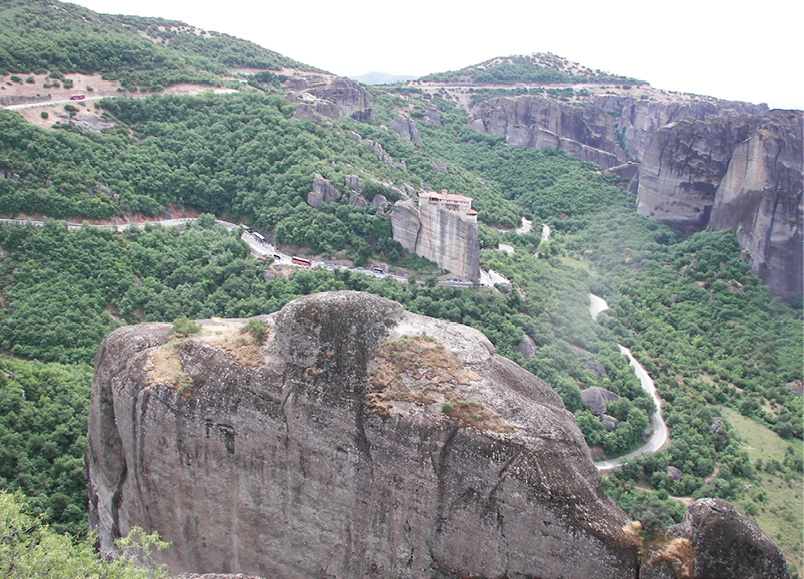
Figure 28: The road network at Meteora: its current state (source: photo of Kostas Liolios).
Erecting new structures in the Meteora monasteries: the Roussanou enclosed balcony (early 1990s)
Roussanou is the monastery with the smallest available ground surface at Meteora. The Roussanou monastic community had already made the maximum use of the available surface: eg. it constructed rooms with ceilings of different height adjusted to the rock surface, and used even the smallest areas of the monastery as storerooms. Despite these attempts, the monastic community still required more space to cover its everyday needs. As a result, the monastic community decided to expand the space of their monastery by constructing an enclosed balcony. The Ministry of Culture did not give its authorisation for this on the grounds that the proposed style and material of the balcony (iron framework with glass windows) did not conform to the existing architectural character of the monastery (figure 29). Despite the disagreement, the monastic community completed the project.
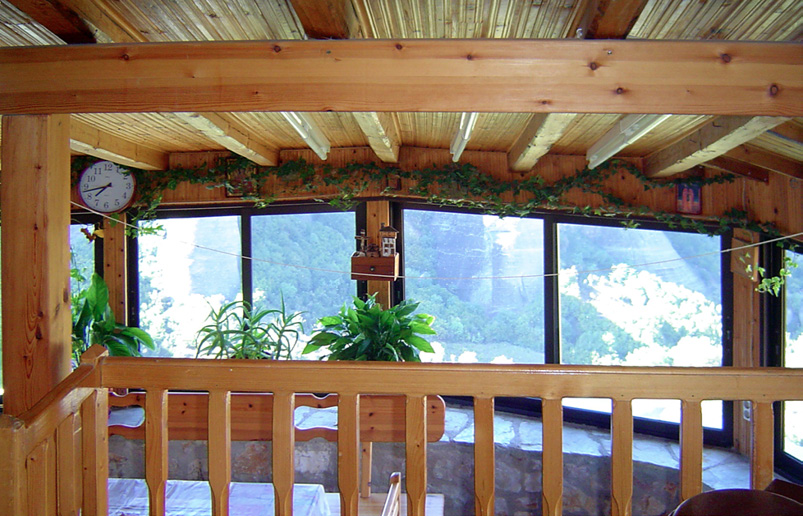
Figure 29: The Roussanou monastery’s enclosed balcony: internal view (source: author’s photo; for external views of the monastery see above, figures 13 and 20).
Replacing existing structures in the Meteora monasteries: the Roussanou access bridge (mid-1990s)
The Ministry of Culture decided to replace the access bridge to the Roussanou monastery, made of iron, with a new one, made of wood, which would be sympathetic to the landscape. The Roussanou monastic community was cautious that the material of the new bridge would be potentially dangerous for the members of the community as well as the visitors when it rains. The Ministry of Culture officials assured and eventually convinced the monastic community that this would not be the case, and replaced the bridge with the consent of the monastic community (figures 30 and 31). The monastic community now complains that the new bridge eventually caused the problems that it initially feared (pers. comm. Roussanou Monastery).
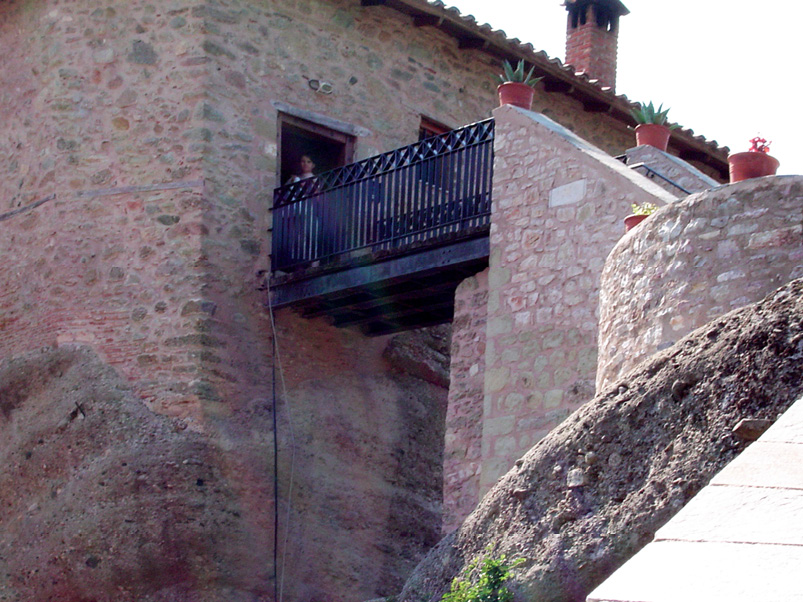
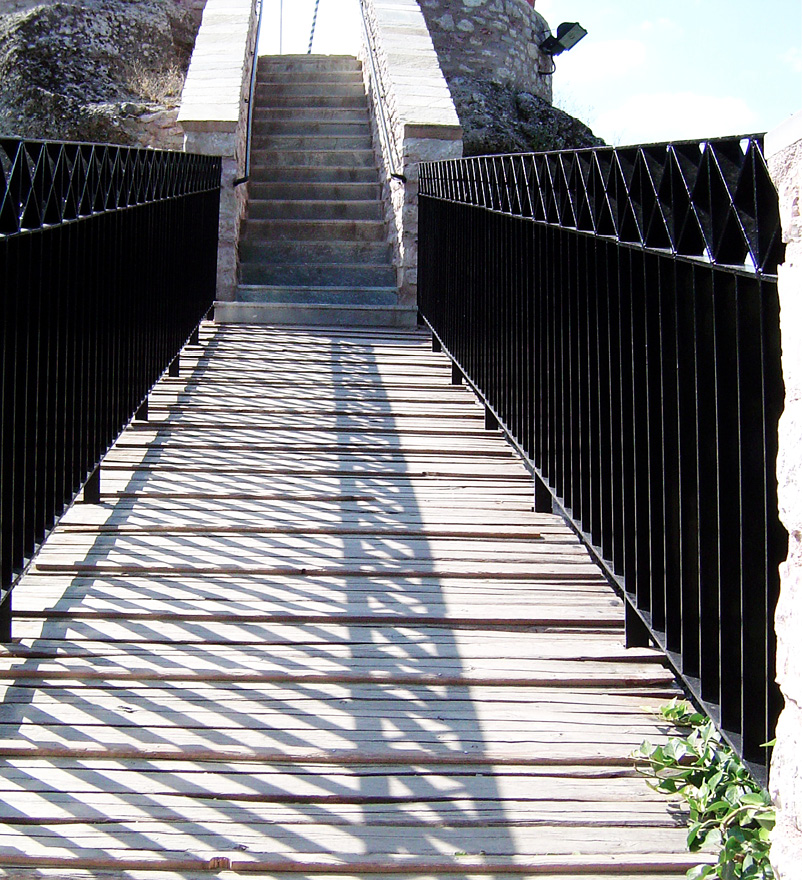
Figure 31: The Roussanou monastery’s access bridge after restoration: detail (source: author’s photo).
This example shows the different ways by which the Ministry of Culture officials and the monastic communities approach the fabric of the monasteries: The former place emphasis on style, while the latter are primarily concerned about function.
Erecting new structures in the Meteora monasteries: the Roussanou extension (mid-1990s to mid-2000s)
The Roussanou monastic community decided to erect new buildings because of its continuing need for more space for its everyday monastic needs. The construction of the enclosed balcony (see above) provided a temporary relief to the problem of space in the monastery. Actually, the problem of space increased with the gradual increase of the size of the monastic community (pers. comm. Maximi; Meteora Bishopric 2002; Ereuna 2002). The need to erect new buildings was, in addition to the need for more space, a result of the need for a new church, since the katholicon was always occupied by the visitors during the opening hours of the monastery (pers. comm. Maximi). Hence, the monastic community decided that a permanent solution had to be found.
The monastic community decided to expand the available space of their monastery by constructing a five storey and a two storey building on a piece of land that they owned next to the rock of the original monastery. The five storey building could easily stand and operate as a separate monastery on its own, comprising a church, fourteen cells, a large reception hall, a library, workshops for the making of icons, a small medical centre, guestrooms and a separate entrance from the road. The other two storey building would serve as a guesthouse and possibly as a future permanent residence of the local Bishop after his retirement. The five storey building would be connected with the original monastery through a tower-lift.
The monastic community initially asked for permission to build a much smaller building (and not the five storey one that it actually planned to build). The Ministry of Culture gave authorisation for this on the grounds that the proposed building complied with the architectural character of the original monastery. The monastic community started the construction of the supposedly proposed and authorised building, but, after the completion of its lower levels, decided to add more levels and also erect the other two storey building, for which the community did not have a permit. Furthermore, the monastic community, presenting their project to the Ministry of Culture and the local Ephorate, argued that the five storey building, the two storey building and the lift were separate steps that were taken over the course of time in a continual desperate attempt to adjust to the irregular surfaces of the rock. However, it seems clear, judging from the careful arrangement of the new buildings in such a limited and irregular surface and also from the connection among the buildings, that the five storey building, the tower-lift and the two storey building were steps connected in a single and unified plan.
The local Ephorate opposed any further construction activity apart from the officially proposed and authorised one, and two local residents filed a petition against the construction of the new buildings (Meteora Bishopric 2002). However, the monastic community, presumably making use of its contacts with members of the local government authorities and also receiving support from the local Bishop (see Meteora Bishopric 2002) and from a part of the local community, proceeded. Even the local judge, deciding on the residents’ petition, found the monastic community innocent. The central Ministry of Culture only seriously considered attempting to stop the project when the five storey building was nearing completion and the tower-lift was half complete (see Ereuna 2002). Nevertheless, the project was completed. The failure to stop the project seems to be the result of a number of reasons. First, the Ministry of Culture was reluctant to come into conflict with the monastic community, which had considerable power especially at a local level. Second, it seems that the Ministry of Culture officials considered, possibly under the influence of the Ministry of Tourism and the tourist agencies, that in the period prior to the 2004 Olympic Games in Greece it would not have been appropriate for the international tourism image of the country to have such a major project incomplete in one of the country’s most popular tourist destinations (pers. comm. Meteora Ephorate; pers. comm. Ministry of Culture). Third, the whole project was nearing completion, and it was de facto too late to seek alternative solutions. It is surprising, however, that the Ministry of Culture retrospectively authorised the tower-lift (but not the five storey building and the two storey building).
The end result, despite the conflict between the monastic community and the Ministry of Culture, was the erection of the buildings that the community wanted. Thus, the monastery is now in three parts: the original monastery on the top of the rock, the five storey building next to the rock, with a tower-lift connecting it with the original monastery, and a two storey building close to the five storey one (figures 32 and 33).
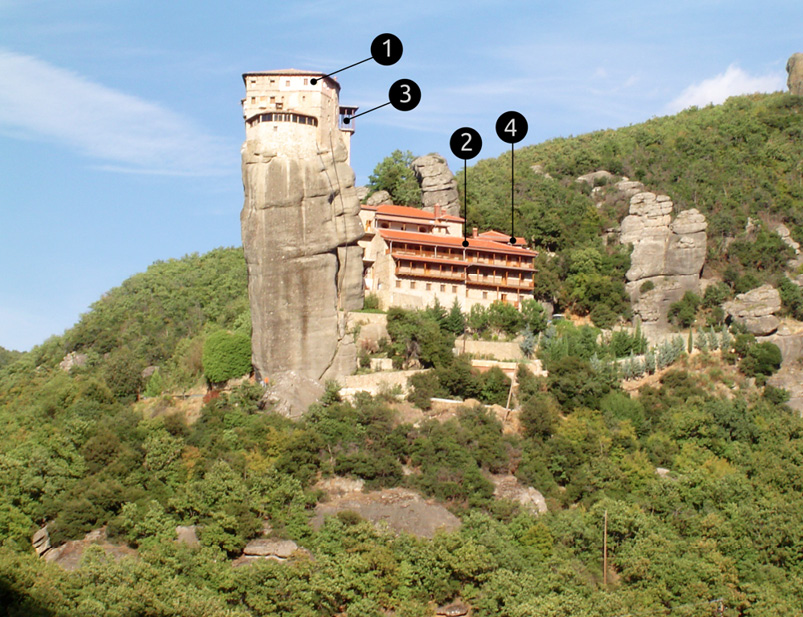
Figure 32: The Roussanou monastery after the construction of the new buildings (source: author’s photo). Today the Roussanou monastery consists of the following parts: the original monastery, on the top of the rock (number 1); the five storey building, next to the rock of the original monastery (number 2); the tower-lift, attached to the rock of the original monastery, connecting the five storeybuilding with the original monastery (only the top part of the tower-lift is shown: number 3); the two storey building, next to the five storey one (only the roof of the two storey building is shown, on the top right of the five storey building: number 4).
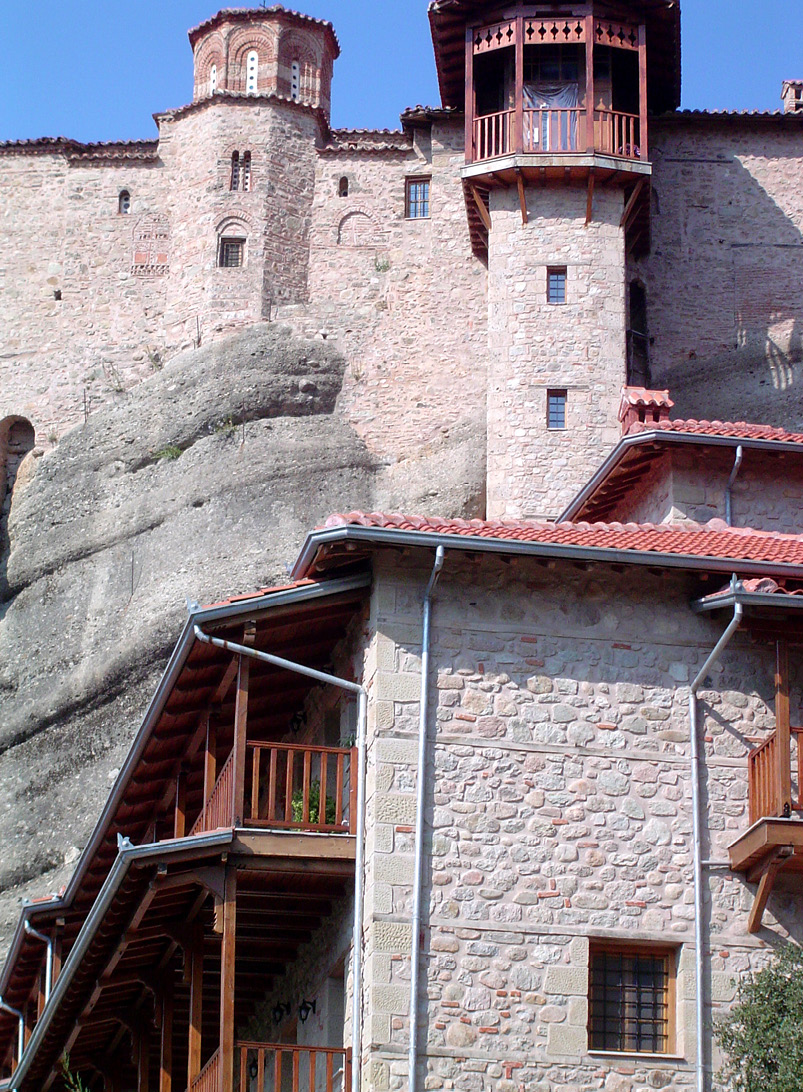
The construction of the new buildings causes a series of problems: The disproportionate size and prominent position of the new buildings significantly affect the character of the Roussanou monastery. The monastery may no longer be considered a meteoron, i.e. ‘floating/suspended in the air’. In addition to this, the huge new space created and the great variety of needs covered by the construction of the new buildings poses the danger that the new buildings might potentially replace to a considerable extent the original monastery in terms of function. Thus, it appears that the construction of the five storey building and the two storey building was not based on a well-defined plan regarding their specific function: the monastic community rather intended to simply create a new, huge space that would cover any of its current and potential needs for space, and would then define the precise function of each specific part of the new buildings.
The needs of the monastic community that led to its decision to erect new structures (i.e. the need for more space and the need for a new church) are reasonable in the first place. However, the Ministry of Culture, on the one hand, seems to have never actually realised the scale of these needs, approaching the proposed construction activity of the monastic community with an immense emphasis on the preservation of the original fabric and space. The Roussanou monastic community, on the other, never seriously discussed their needs with the Ministry of Culture officials in order to seek advice on the best way to cover them. It seems that the monastic community, instead, made use of these reasonable needs as an excuse for a disproportionate construction on the site.
Replacing existing structures in the Meteora monasteries: the Varlaam bell tower (mid-1990s)
The Varlaam monastic community decided to replace its bell tower, which was made of iron and was thus not compliant with the architectural character of the monastery, with a new one made of stone. The monastic community, however, chose stone which was easier to cut and cheaper but was still not compliant with the architectural character of the monastery. The Ministry of Culture initially disagreed, but eventually gave into the pressure of the monastic community, and the new bell tower was constructed (pers. comm. Meteora Ephorate) (figure 34). Even the monastic community has now realised that the stone is not compliant with the architectural character of the monastery, but it does not appear to be eager to proceed with its replacement, at least in the near future, due to other continuing construction works in the monastery (pers. comm. Venediktos).
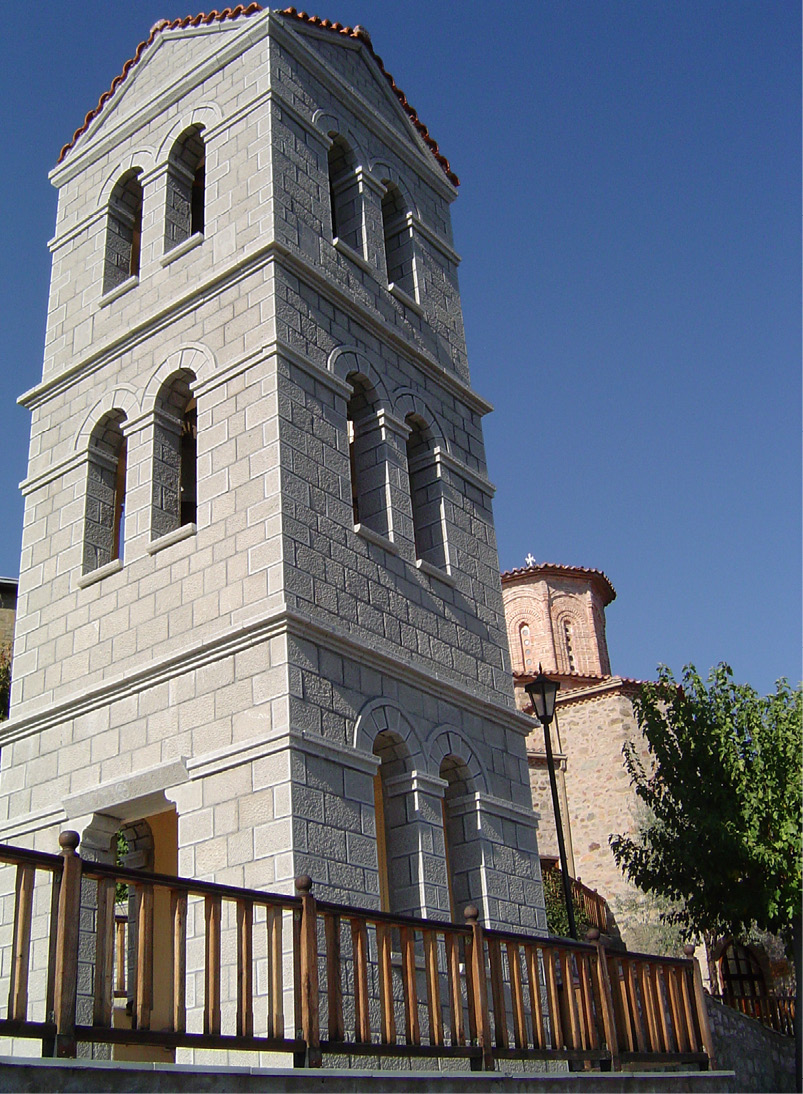
Figure 34: The Varlaam monastery: the new bell tower (source: author’s photo; for an external view of the monastery see above, figure 22). This figure can show the stark difference between the bell tower and the other monastic buildings (for example, the katholicon, on the background) in terms of fabric.
Notes
1 KENAKAP is a private company formed by, and operating under the supervision of, the Municipalities of the city of Kalampaka and other neighbouring villages (such as Pyli) that allocates financial resources of the European Union to the planning and implementation of projects for the development of the local community.