CHAPTER 15
A living heritage approach: planning process methodology
The application of a living heritage approach would require the following steps on the part of the conservation professionals in collaboration with the core community (figure 53). It is important to note that a living heritage approach may be also initiated and applied by the core community in collaboration with the conservation professionals; therefore, what actually matters is not who initiates-applies the process but on following the process.
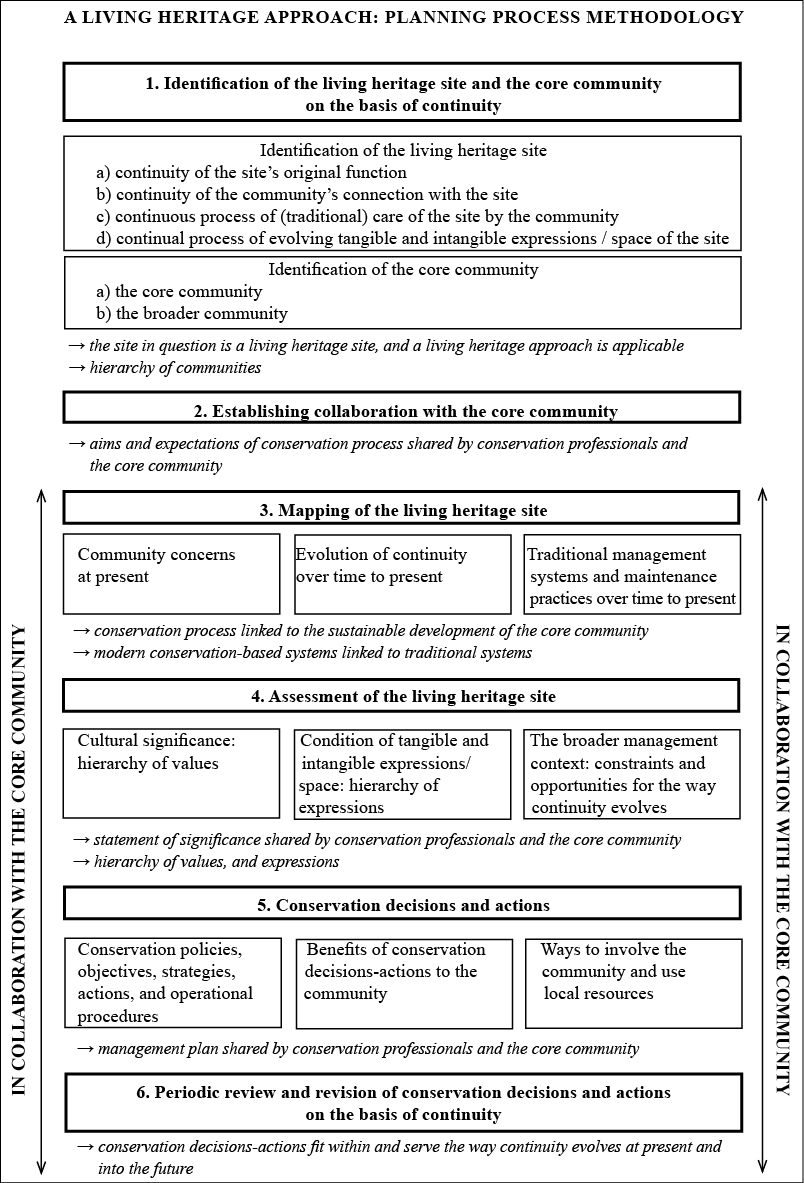
Step 1: Identification of the living heritage site and the core community
- Identification of the living heritage site on the basis of continuity, through the following criteria: a) the continuity of the heritage site’s original function; b) the continuity of the community’s connection with the heritage site; c) the continuity of the care of the heritage site by the community, as expressed through community’s management (and ownership) mechanisms and maintenance practices; and d) the continual process of evolving tangible and intangible heritage expressions / of the evolving space of the site. Tangible and intangible expressions would be seen as a unity.
- Identification of the community of the site: a) the core community; and b) the broader community. Also, taking into account the key management mechanisms and persons of the core community.
The aim of Step 1 is to determine whether the site in question can be considered a living heritage one, and thus confirm that a living heritage approach is applicable to the specific site.
Step 2: Establishment of collaboration with the core community
- Exploration of the core community, in terms of its identity, structure, and operation (way of life, decision-making processes, and material resources). Also, identification of the groups comprising the broader community, and exploration of the relationship between the core community and these groups.
- Establishment of a formula of collaboration with the core community. It is important that the collaboration with the core community would: a) involve a third person who would act as a ‘mediator’ between the conservation professionals and the core community. This person does not have to be a member of the core community — actually, it would be better if this person were outside the core community — but should be aware of the context and the concerns of the community, and should be respected and approved by the community. And b) take a legally binding form, making use of the core community’s key management mechanisms, persons and decision-making processes. The collaboration would also involve the key groups comprising the broader community.
The aim of Step 2 is to establish a formula of collaboration with the core community, and develop shared aims and expectations of the conservation process.
Step 3: Mapping of the living heritage site (in collaboration with the core community)
- Mapping of the core community’s present concerns: about life in general (such as human conflict, and unemployment) and about the site. Also, mapping of the interests of the groups comprising the broader community, and linking of the broader community’s interests to the core community’s concerns.
- Mapping of the way continuity (all four criteria: see above) of the site has evolved over time to present. This would include the following: a) identifying the factors (at local, national and international level) that affect continuity, b) examining the impact of these factors on continuity in relation to the boundaries as set by the traditional parameters of continuity and in accordance with the original function of the site, c) examining the consequences of this impact on the conservation and management of the site, and d) suggesting ways to manage this evolution of continuity in the present/future, as well as the impact of this evolution on the conservation and management of the site in the present/future.
- Mapping of the traditional (or established over time) management mechanisms and maintenance practices of the core community. Also, communicating the relevance and importance of the traditional management mechanisms and maintenance practices (of the core community) to the conservation professionals, and similarly communicating the relevance and importance of the modern scientific-based systems (of the conservation professionals) to the core community. Then, linking of the modern scientific-based systems (of the conservation professionals) to the traditional mechanisms and practices (of the core community).
The aims of Step 3 are to link the conservation process to the sustainable development of the core community, and link the modern scientific-based systems to the traditional ones.
Step 4: Assessment of the living heritage site (in collaboration with the core community)
- Assessment of the cultural significance of the site. This would involve a hierarchy of heritage expressions and values, with an emphasis on those of the core community.
- Assessment of the condition of the tangible and intangible expressions / the space of the site.
- Assessment of the broader management context of the site (including legislation, and the relationship between the core community and the conservation professionals and the broader community), and its impact on the way continuity evolves.
The aim of Step 4 is to develop a shared (with the core community) statement of significance. Also, to establish a hierarchy of values, and of expressions.
Step 5: Conservation decisions and actions (in collaboration with the core community)
- Definition of conservation policies, objectives, strategies, actions, and operational procedures (in short-, medium-, and long-term).
- Identification and communication of the benefits brought by the conservation decisions-actions to the core community, in other words identifying the possible ways in which the conservation decisions-actions can fit within and serve the community’s concerns (as described above). Also, identification and communication of the benefits of the conservation decisions-actions to the groups comprising the broader community, and linking of the broader community’s benefits to the core community’s ones.
- Identification of specific ways to involve the core community, by mobilizing the community and utilizing local material resources. Also, identification of ways to involve the groups comprising the broader community, and linking of the ways to involve the broader community to those to involve the core community.
The aim of Step 5 is to develop a shared management plan.
Step 6: Periodic evaluation/review and revision of conservation decisions and actions on the basis of continuity (in collaboration with the core community)
Conservation decisions-actions would be reviewed and revised on the basis of their impact on the continuity of the site (all four criteria).
The aim of Step 6 is to guarantee that conservation decisions-actions fit within and serve the way continuity evolves at present and into the future, and thus further understand and manage this evolution.