A living heritage approach tends to radically redefine the existing concept of heritage and the principles of heritage conservation by challenging, for the first time in the history of conservation, very strong assumptions established over time in the field, which were developed along with a material-based approach and were maintained by a values-based approach (see Part 1; see also Poulios 2014). More specifically, according to a living heritage approach, first, the power in the conservation process is longer in the hands of the conservation professionals, but passes on to the communities. Second, emphasis is no longer be on the preservation of the (tangible) material but on the maintenance of the (intangible) connection of communities with heritage, even if the material might be harmed. Third, heritage is not considered a monument of the past that has to be protected from the present community, for the sake of the future generations; heritage is now seen and protected as an inseparable part of the life of the present community. Thus, past and present-future are not separated (discontinuity), but unified into an ongoing present (continuity). Therefore, a living heritage approach attempts to mark the shift in heritage conservation from monuments to people, from the tangible fabric to intangible connections with heritage, and from discontinuity to continuity.
These three approaches to conservation (table 1) reflect different strategies. From the perspective of strategy, a living heritage approach, by radically redefining the existing concept of heritage and the practice of heritage conservation, can be seen as an example of ‘Strategic Innovation’ (introducing a new ‘who’-‘what’-‘how’: see Poulios 2014). Specifically, a living heritage approach proposes a different concept of heritage and conservation, based on the community’s original connection with heritage / continuity and with an emphasis on the intangible elements rather than the tangible ones (a new ‘what’); it points at a different community group as responsible for the definition and protection of heritage, i.e. the core community (a new ‘who’); and it proposes a different way of heritage protection through community empowerment and through prioritising traditional care over modern scientific-based conservation (a new ‘how’).
|
material-based approach |
values-based approach |
living heritage approach |
|
|
the meaning of heritage and the aim of conservation |
fabric |
values |
living heritage / continuity |
|
tangible and intangible values, mostly separated from each other |
tangible and intangible heritage expressions, seen as an inseparable unity |
||
|
all values equal, but emphasis on the tangible ones (fabric) |
not equal heritage expressions; emphasis on the intangible ones |
||
|
the community group responsible for heritage definition and protection |
heritage authorities (conservation professionals) |
stakeholder groups |
core community (that retains its original connection with heritage/ continuity) |
|
all groups equal, but emphasis on those associated with the fabric |
not equal groups; priority to the particular community (continuity) |
||
|
the way heritage is protected by the relevant community group |
power in the conservation professionals- no community involvement |
community involvement under the supervision of conservation professionals |
community empowerment, with the support of conservation professionals |
|
a top-down approach |
tries to be bottom-up but often ends up being top-down |
a bottom-up approach |
|
|
dependent on legal frameworks of protection |
dependent on legal frameworks of protection |
dependent on community empowerment |
|
|
primary aim of conservation: preservation of heritage |
primary aim of conservation: preservation of heritage |
primary aim of conservation: maintenance and enhancement of continuity (preservation of heritage within the maintenance of continuity) |
|
|
heritage significance based on ‘expert’ values |
heritage significance based on ‘expert’ values and including stakeholder values |
heritage significance based on core community values and including ‘expert’ values and broader community (stakeholder) values |
|
|
treating fabric as a non-‘renewable’ resource |
treating fabric as a non-‘renewable’ resource |
treating fabric as a ‘renewable’ resource |
|
|
only minimal interventions to heritage, with respect to the material structure |
mostly minimal interventions to heritage, with respect to the material structure |
even major interventions to heritage, with little respect to the material structure |
|
|
development potentials on the basis of conservation professionals’ interests |
development potentials on the basis of stakeholder groups’ concerns, but under conservation professionals’ control |
development potentials on the basis of core community’s concerns and connection with heritage, with conservation professionals’ support |
|
|
the philosophy of conservation |
expert-driven approach: power in the conservation professionals- no community involvement |
expert-driven approach: community is involved, but power is in the conservation professionals |
community-driven approach: power is in the community, with the support of conservation professionals |
|
discontinuity: preservation of heritage considered to belong to the past, from the present community, for the sake of the future |
discontinuity: preservation of heritage considered to belong to the past, from the present community, for the sake of the future |
continuity: preservation of heritage as part of the present community, by the present community, for the sake of the present community |
Table 1: A living heritage approach in relation to a material-based and a values-based approach (in detail) (see Poulios 2014).
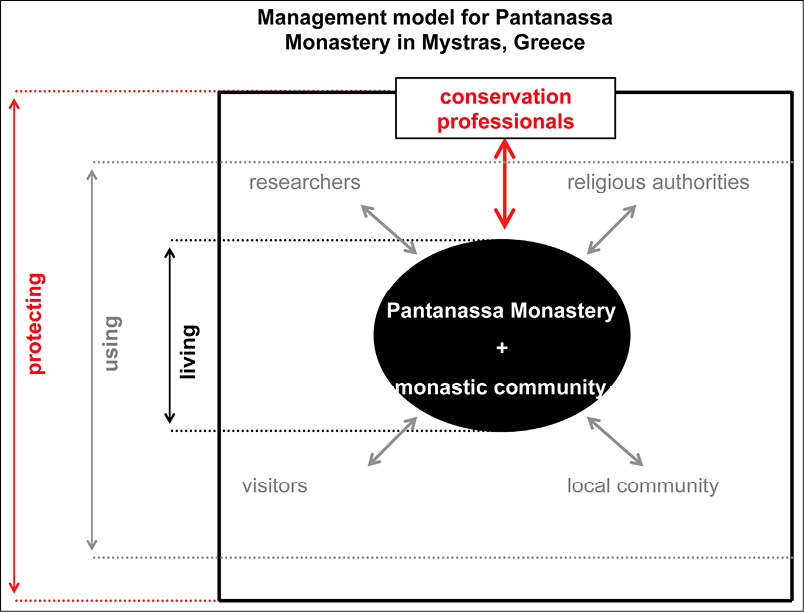
Despite the differences between a living heritage approach and a values-based approach, there are cases in which the management of a site would require the combination of (elements of) both approaches, depending on the specific conditions at site level and more specifically on the way continuity has evolved over the course of time to present (see above). Such a combined approach (figure 54; see Poulios 2010c) has been suggested for the management of the living Pantanassa Monastery within the necropolis of Mystras (where the monastic community has remained to present, yet adjusts its life on the basis of the regulations defined by the State, with severe restrictions on its spatial arrangement and its opening hours: see above, figures 49 and 50). However, the existence of such cases does not mean that a living heritage approach is the same with a values-based approach.
Figure 54: The approach that has been suggested for the management of the Pantanassa Monastery of Mystras in Greece (Poulios 2010c) is a combination of a living heritage approach (figure 52) and a values-based approach (figure 4). The monastic community is considered an inseparable part of the Monastery and is responsible for the issues of the (monastic) function of the Monastery – and is thus the ‘core community’, while the other communities that participate in the operation of the Monastery (the figure mentions some indicative examples of such communities) consist the ‘broader community’ (i.e. on the basis of a living heritage approach). Yet, the conservation professionals have the supervision and control over the entire operation of the archaeological site of Mystras, including the Monastery (i.e. on the basis of a values-based approach).
The current theoretical framework and practice of heritage conservation, in the context of a material-based and also a values-based based approach (based on discontinuity between the sites, considered to belong to the past, and the people of the present), and a living heritage approach (based on functional continuity) tend to see and safeguard authenticity in different and even conflicting ways (see also Poulios 2010). According to a material-based and a values-based approach, authenticity is considered to lie in the past and to be associated mostly with the (tangible) fabric of a site. According to a living heritage approach, authenticity is in the present, and is associated mostly with the communities’ (intangible) association with a site. A material-based and a values-based approach concentrates on the preservation of a site, as an obligation to the past generations and also in the name of the present public and the future generations. A living heritage approach places emphasis on the continual process of creation of a site by the core community, as an inherent obligation of the community to the site, and places protection within creation. A material-based and a values-based approach mostly see heritage as a ‘product’, and treat any change in the fabric as something to be avoided, while a living heritage approach sees heritage as a process, considering change of the fabric as an inseparable part of this process. Thus, a living heritage approach accepts that, even if the physical, material structure of a site may be harmed, the authenticity of a site would not actually be harmed as long as the process of creation, in accordance with its original function, would continue. For a material-based and a values-based approach the past is mostly regarded as ‘dead’, and seeking authenticity is unattainable, while for a living heritage approach the past is part of the ongoing present, or rather there is only present (the boundaries between the past, the present and the future are eliminated), and authenticity can never be lost thanks to the continual process of the creation of a site. Thus, it could be argued that, according to a material-based and a values-based approach, conservation professionals seek, and try to preserve, an ‘aura’ of authenticity (Lowenthal 1989, 846; Holtorf and Schadla-Hall 1999, 231; Cunha 1995, 262−263), whereas, according to a living heritage approach, the actual authenticity is continually defined by a site’s core community everyday presence in, and creation of, a site. Therefore, a values-based approach tends to see and preserve a site as ‘heritage’, while a living heritage approach sees and enhances the further creation of a site as a ‘living reality’.
The difference between the concepts of ‘heritage’ and ‘living reality’ may be shown in Buffy Saint-Marie’s song ‘…now that my life is known as your heritage’ (Saint-Marie 1966) and in Ndoro’s words, with reference to Great Zimbabwe in Zimbabwe ‘Your Monument Our Shrine’ (Ndoro 2001). This difference is raised, with reference to Australia, as follows:
Archaeologists and others involved in the study of Aboriginal culture, past or present, should ask themselves what is more important, the preservation of a few relics of the recent past, or the active continuation of that living culture? (Bowdler 1988, 523).
A living heritage approach suggests that the discipline of conservation does not simply attempt to expand within its current theoretical framework and practice (as defined by a values-based approach), but is substantially changed. Conservation should move towards a completely different context of understanding and safeguarding heritage: shifting the focus from preservation towards creation. Conservation needs to ‘escape’ from the discontinuity created between the monuments, considered to belong to the past, and the people of the present and also from the attachment to the fabric, and move towards the embracement of people’s associations with sites and the continual process of creation of the sites in the context of these associations. The focus, therefore, should not be on how to limit the impact on the fabric for the sake of the preservation of the past, but on how to support, manage and guide the evolution of people’s association with sites over time and into the future. The aim is to change the entire way heritage is perceived, protected and, more importantly, further created.