Introduction
To the layman, the phrase ‘living heritage’ might sound like an oxymoron. Is not ‘heritage’ something inherited from the past? Is it not, almost by definition, no longer ‘living’?... The emergence of this concept [of ‘living sites’] seems important in its own right as a step in the evolution of conservation thinking... Or is it, in fact, merely a recognition of the obvious – that many places deemed to be of heritage significance are still foci of traditional cultural practices? (Stanley-Price 2005, 1)
The problem
Since World War II there has been an increasing tendency towards the formulation of laws and conventions for the protection and management of heritage sites at national level and increasingly at an international level. Conservation approaches, however, often prove to be simplistic and linear in relation to the much more complicated living dimension at some heritage sites. Furthermore, despite the increasing rhetoric about the importance of recognising this living dimension of heritage sites and the need to involve local communities in site management, accompanied by a growing use of the term ‘living heritage sites’, in practice conservation professionals often seem to marginalise local communities and exclude them from site management.
At the Orthodox monastic site of Meteora in Greece, in particular, there are currently six monastic communities, consisting of approximately sixty monks and nuns, devoted to the worship of God (figure 1). It is thanks to the permanent presence of this religious community that the site is still living, as the visitor-sign at the entrance of the Great Meteoron monastery clearly demonstrates (figure 2):
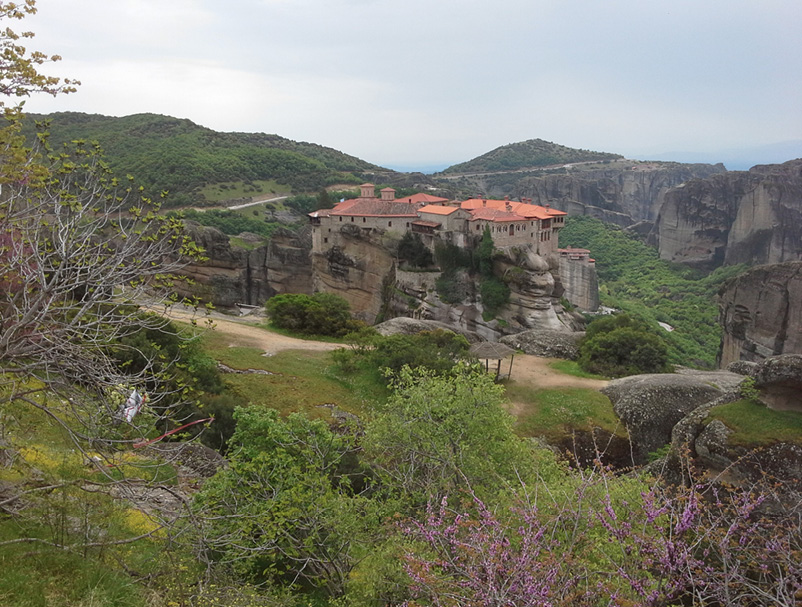
Figure 1: The monastic site of Meteora in Greece: a general view of the site, with the Holy Trinity monastery on the left (source: photo of Vasso Chantzis).
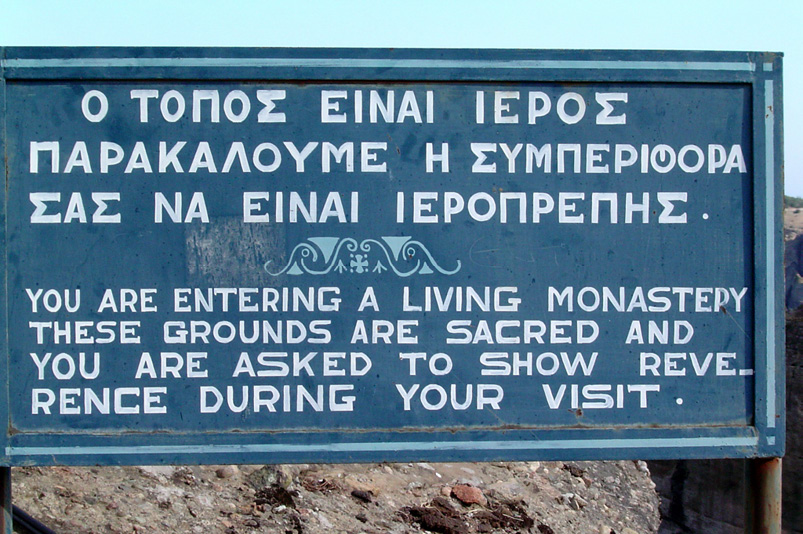
Figure 2: The Great Meteoron monastery: entrance sign (source: author’s photo). The inscription says, in Greek and English: ‘You are entering a living monastery. These grounds are sacred and you are asked to show reverence during your visit’. It should be noted that the phrase ‘you are entering a living monastery’ is written only in English but not in Greek, which could imply that it is considered that the Greek visitors are aware of the living function of the monastery.
You are entering a living monastery. These grounds are sacred and you are asked to show reverence during your visit.
The monks and nuns continue to lead their monastic-ritual life on a site that is gaining increasing significance as a heritage site and also as a tourist attraction due to changing wider circumstances. The use of Meteora as a tourist and a heritage site has a remarkable impact on the everyday life of the monks and nuns. At the same time, the permanent presence of these sixty persons significantly affects the use of the site by the other thousands of people involved in its tourism exploitation and heritage protection at local, national and international level. The relationship between the living (monastic) function of the site, its heritage protection and its use as a tourist attraction becomes in practice a question of who is in charge of the operation and management of the site on an everyday basis.
Research subject, objectives, questions, and case study
The present study deals with the complexities of the operation and management of living heritage sites. The main objective of this research is to reconcile their continual and evolving process of use and creation with the protection of their heritage significance. The main questions that this research addresses are:
- What is understood as a ‘living heritage site’, and how does this understanding conflict with other definitions of the term?
- What are the complexities in the operation and management of living heritage sites, how do they differ from other sites in terms of operation and management? What are the problems faced by conservation professionals in dealing with these sites?
- Can the operation and management of living heritage sites fit within the current principles and practices of conservation, particularly in the strict World Heritage context?
- If the operation and management of living heritage sites lie outside currently understood principles and practices, what approach can be suggested for the management of these sites?
In order to explore the aforementioned questions, the present study focuses on the site of Meteora (a World Heritage Site) as its case study, while comparisons will be made with various other sites from different parts of the world. Emphasis is on World Heritage Sites because these sites, given their increased recognition in a national and international context, tend to reveal at a greater scale and with greater clarity the mechanisms and complexities of heritage management, as well as the conflicts between the different community groups in terms of values, power, and ethics.
Meteora is chosen as the case study because it can explicitly demonstrate the complexities of the operation and management of living heritage sites at an international level. Specifically:
- Meteora monasteries have a complicated ownership status. As monuments of the past, they are part of the national heritage of Greece and belong to the Greek state, which protects them with a specific interest in their archaeological and art-historic value. The state has a well-established and strict system for the protection of its antiquities, which is historically attached to the Classical past. At the same time, as living monasteries, they belong to the Orthodox Church of Greece, which concentrates on their ritual function. Orthodox Christianity is the predominant religion of the Greek state, still followed by the vast majority of Greek citizens and with considerable influence in the everyday life of society. The Orthodox Church maintains strong historic links with the State but frequently develops a policy that is contradictory to that of the State. Finally, the monasteries are owned, inhabited and used by the monastic communities. The monastic communities have a strong influence upon the life of local society. Also, though being part of the Church in administrative as well as spiritual terms, they frequently hold their own views.
- Meteora monastic communities are very powerful in terms of administration as well as financial wealth, which further complicates the attempt to reconcile the monasteries’ continual process of creation with the protection of their heritage significance. The power of the monastic communities is often manifested, for example, in the extensive unauthorised construction on the site, with considerable implications for the fabric and space of the site and subsequently for its national and World Heritage status.
- Meteora poses significant challenges regarding the reconciliation of monasticism, heritage protection and tourism. Meteora is a typical Byzantine site in Greece in terms of administration (unlike Mount Athos, for example, which is a semi-independent region in Greece), and thus faces all the issues that any Byzantine site in Greece may possibly face. In terms of operation, however, Meteora should be differentiated from other Byzantine sites, given the magnitude and complexity of the issues it faces, such as: As a monastic site, Meteora is one of the largest complexes in Greece (second only to Mount Athos) containing six monastic communities with often conflicting views concerning the development of the site, which causes significant complexities in its operation. As a heritage site, Meteora has been inscribed on the World Heritage List as a site of outstanding cultural and natural significance, and is affected by developments in archaeology and heritage management at a state and international level. As a tourist site, Meteora is one of the most popular tourist destinations in Greece. This causes considerable problems for the everyday life of the monastic communities. It also brings significant financial benefit to them, frequently with consequences for the protection of the heritage significance of the site.
In an attempt to understand and face the aforementioned complexities of the living heritage site of Meteora, research was undertaken into the international theoretical principles and practical tools of conservation, mostly in the context of a values-based approach, as the current most preferred approach to conservation. However, through application of these international principles and tools to Meteora, it became clear that such an approach was inappropriate to the specific complexities of the site, and therefore there was a need to develop an alternative method for its operation and management.
Research outcomes
The contribution of this research may be summarised as follows:
- Suggesting a new interpretation of living heritage sites, clearly differentiating them from other sites, and also an innovative way of looking at the operational and management complexities of these sites.
- Suggesting a new, radical approach to conservation that goes beyond the current ones (and particularly beyond a values-based approach). The new approach concentrates on the creators of the site as an inseparable part of the site, and distinct from other groups of people protecting and using the site. This approach shifts the focus of conservation from preservation towards a continual and evolving process of creation of sites, attempting to change the way heritage sites are perceived, protected and, more importantly, further created. It is important to note that, though a series of recent international developments in the field of conservation (eg. indigenous archaeology) have originated from the non-Western world, this study demonstrates that there are cases in which international developments in the field can be associated to places of the Western world as well.
Research methodology, and sources of material
In developing a new conservation approach for living heritage sites, the following steps were undertaken:
A literature review allowed exploration and synthesis of the concept of a ‘living heritage site’. In addition to the literature review, discussions with individuals involved in the management of living heritage sites in different parts of the world helped the exploration of the operational and management complexities of such sites, with an emphasis on community involvement in the conservation process.
Visits to international organisations and institutions (UNESCO World Heritage Centre in Paris, UNESCO Intangible Heritage Sector in Paris, ICCROM in Rome, and the Getty Conservation Institute in Los Angeles) provided a firm understanding of differing conservation approaches, particularly concerning the living dimension of heritage and community involvement in site management, and helped the examination of whether living heritage sites can fit within the current principles and practices of conservation. These visits allowed the exploration of the underlying philosophy, the latest trends and the future perspectives of these differing approaches. It was decided that the present study does not include an analysis of the UNESCO Convention for the Safeguarding of the Intangible Cultural Heritage (UNESCO 2003) and of the associated issues (such as the policy behind its signing, its differences and similarities with the UNESCO Convention Concerning the Protection of the World Cultural and Natural Heritage and the potential as well as complexities of the merging of the two Conventions, and the difficulties of the implementation of the Convention), despite their relevance to a broader discussion of the living dimension of heritage. It was deemed that such an analysis would go beyond the size and the scope of the present study; this analysis could be the subject of a future study.
Field trips to India, Cyprus, Russia, and Greece allowed the study of living heritage sites in various parts of the world giving me the opportunity to make comparisons between these sites and Meteora in terms of their living dimension, and to examine diverse ways of dealing with this living dimension. The trip to India allowed the exploration of the very strong association of local communities with particularly religious sites in the context of a heritage protection system that is strongly influenced by colonialism. Added to this, was the context of a rapidly changing wider economic, political and social environment with concomitant implications for heritage. The visits to Russia and Cyprus resulted in an examination of differing systems and approaches towards the protection of Byzantine heritage. The material from the visits to specific heritage sites in Russia and Cyprus was eventually not included in the present study, for reasons related to its size. Other World Heritage Byzantine sites in Greece helped to place Meteora in the context of other sites within the same system of heritage protection.
The above allowed evaluation of Meteora in a wider framework which led to the formulation of a series of findings. These findings were then applied to the study of Meteora in the context of living heritage sites at an international level, giving a much broader context as well as a much greater perspective to the research.
Sources of data concerning the site of Meteora are as follows:
- The World Heritage listing documents of the site (World Heritage Centre in Paris).
- Publications of the monastic communities, studies for the tourist promotion of the site and the wider region, and local press.
- The archive of the Ministry of Culture, which includes: first, the archive of the Directorate of Restoration of Byzantine and Post-Byzantine Monuments (DABMM) concerning the operation and management of the site during the first decades after World War II (approximately 1950-1980); and second, the archive of the local Ephorate of Byzantine Antiquities that is responsible for the site of Meteora with regard to more recent management issues of the site. It is important to note that the archive of the Ministry of Culture is out-of-date particularly concerning the spatial arrangement of the monasteries, mainly because of the extensive scale of the monastic communities’ unauthorised (i.e. not approved by the Ministry) construction activity. To give an example, a five storey building has been erected at the Roussanou Monastery (see below), and the Ministry does not have a map or ground plan of it. Consequently, in order to examine changes in the use and arrangement of the space, analysis relied on a few ground plans that have been published (Papaioannou 1977, 30), which depict the ‘original’ arrangement of space without taking into account contemporary changes. It should also be noted that there is no management plan for the site.
- Discussions with community groups with an interest in the operation of Meteora at local and state level. These allowed an understanding of the way monasticism, heritage protection and tourism operate in Greece, and also the exploration of specific complexities in the operation of the site of Meteora in particular. Such discussions were either with specific individuals (cited in the text as, for example, ‘pers. comm. Maximi’ or ‘pers. comm. Antonis Piniaras’, and listed all together at the end of the present study) or with groups of people (cited in the text as, for example, ‘pers. comm. Roussanou Monastery’ or ‘pers. comm. Kalampaka city’). In the case of groups, members of authority within a group were approached to represent the views of the whole group (it was practically impossible to gather and talk to all the members of a group at a given time). There were also cases in which anonymity was requested and these were respected.
Structure
The present study consists of three parts and a conclusion.
Part 1 discusses existing approaches to conservation. Specifically:
Chapter 1 provides a definition of the discipline of conservation, and outlines the key developments in the discipline since its birth. Emphasis is on the concept of authenticity. Authenticity, seen as a product of Western European cultural history, is inextricably linked to a discontinuity imposed between the monuments, considered to belong to the past, and the people of the present, and also heavily focuses on the preservation of the fabric of the monuments.
Chapter 2 examines the attempts of the discipline of conservation to recognise and embrace the importance of the living dimension of heritage sites, in terms of communities’ association with sites and also the need for communities’ involvement in site management.
Chapter 3 presents existing approaches to conservation, in which the aforementioned developments in the discipline could be encapsulated: namely a material-based approach and a values-based approach. The weak points of the two approaches are pointed out.
Chapter 4 deals with the definition and management of a living heritage site. A variety of different uses of the term are presented. These suggest different types of communities’ association with sites, each of different strength, yet all under the heritage authorities’ control over a site. Then, a new approach is outlined, which links the concept of a living heritage site to that of the continuity of a community’s original association with the site. The strong points of this approach are presented, as well as certain points of concern.
The elements of this new approach that emphasises the concept of continuity are then further developed and expanded, through a detailed account of the conservation and management of the monastic site of Meteora in Greece (Part 2), towards a more holistic definition of a living heritage approach (Part 3).
Part 2 provides a detailed account of the conservation and management of Meteora. Specifically:
Chapter 5 offers a general description of the site, in terms of its landscape and its history. It is shown that initially, since the end of the tenth - the beginning of the eleventh century until approximately the 1960s, Meteora was exclusively a monastic site; From the 1960s onwards, Meteora retains its monastic function, while increasingly being used as a major heritage and tourist site at a national and international level.
Chapter 6 places Meteora within the systems of monasticism, heritage protection and tourism operation. The interdependence of monasticism, heritage protection and tourism operation is outlined. Emphasis is on the key role of the monastic communities in the tourism industry (as those who control the public access to the site) and the complexities this role poses to heritage protection.
Chapter 7 discusses the meaning of Meteora as an Orthodox monastic site. Emphasis is on the concept of the Tradition of the Orthodox Church (i.e. any teaching or practice that has been transmitted from generation to generation throughout the life of the Orthodox Church), which defines authenticity in the context of the Orthodox Church. An attempt is made to draw the link between God as believed and worshipped in the Orthodox Church and the specific monastic space and practices at Meteora. The way Tradition has been applied to the site of Meteora over time is analysed. Specifically, from the 11th century to approximately 1940, the original Tradition has been applied to the site. At that time, the monks focused on their personal salvation through the worship of God. From the 1960s to present, however, contemporary influences that were not strictly within the Tradition of the Orthodox Church, namely the externally originated philanthropic-missionary approach to monasticism, have been applied to the site. This approach seems to have altered the practicing of monasticism at the site, shifting the focus of the monks from their personal salvation (through worshipping God) towards the salvation of the WIDER society and towards the acceptance and encouragement of tourism development (through serving the visitors and the WIDER society).
Chapter 8 is dedicated to the presentation of the conservation and management of Meteora (1960 to present), through an examination of the way monasticism, heritage protection, and tourism operate. Reference is made to various examples, such as: the shooting of a James Bond film, studies for the tourism development of Meteora and the broader region, the widening of the road network, and unauthorised construction activity on the site.
Chapter 9 is dedicated to the analysis of the conservation and management of Meteora (1960 to present). The recent history of Meteora is divided into three broad phases, on the basis of the changing relationship between monasticism, heritage protection and tourism operation over time. It is demonstrated that the most important factor that has affected the site is the growth of the tourism industry.
Chapter 10 studies the use and arrangement of space at Meteora (1960 to present), as affected by the growth of the tourism and heritage industries. It is demonstrated that the monastic communities, as a result of their acceptance of tourism in the context of the philanthropic approach, have become increasingly restricted within their existing space, and therefore seek to create new space.
Chapter 11 summarises the key problems in the operation and management of Meteora, and suggests ways to deal with them. It is argued that the monastic communities, with the help of the heritage authorities and the other communities of the site, should move away from the philanthropic-missionary approach and concentrate more on the principles of the Tradition of the Orthodox Church. In this context, the focus would shift from the encouragement of tourism development back to the worshipping of God, and the challenge would be to incorporate tourism operation and heritage protection within monastic life.
Part 3 presents a living heritage approach. References are made especially to the site of Meteora, but parallels are drawn with a variety of sites from different parts of the world. References are mostly to religious sites, but other sites are also taken into consideration. Specifically:
Chapter 12 offers a new definition of a living heritage site, based on the further development of the concept of continuity (chapter 1.4) through a specific set of criteria and also embracing the way continuity has evolved over time to present.
Chapter 13 demonstrates that the current approaches to conservation (a material-based and a values-based approach) and especially the strict World Heritage concept, based on a discontinuity between the monuments of the past and the people of the present and heavily focusing on the preservation of the fabric (chapters 1.1 and 1.3), cannot embrace the criteria of the continuity of living heritage sites. Thus, a new conservation approach is required.
Chapter 14 presents the main principles of a living heritage approach. A living heritage approach recognises the criteria of continuity as primary drivers for the definition, conservation and management of heritage. It also studies and manages the way these criteria have evolved over time, in an attempt to guarantee the relevance of heritage to the contemporary society. Conservation in the context of a living heritage approach primarily aims at the maintenance and enhancement of continuity, and safeguards heritage within continuity, even if in certain occasions the fabric might be harmed.
Chapter 15 outlines a planning process methodology, in a series of specific steps, for the implementation of a living heritage approach by the conservation professionals. Emphasis is on the establishment of a formula of collaboration with the community of a living heritage site, the mapping of the way the continuity of the site has evolved over time to present, and finally on reviewing and revising conservation actions on the basis of their impact on the continuity of the site.
The conclusion of the study summarises the contribution of a living heritage approach to the discipline of conservation. It is demonstrated that a living heritage approach challenges, for the first time in the history of conservation, very strong assumptions established over time in the discipline (which were developed along with a material-based approach and were maintained by a values-based approach). The differences between a living heritage approach in relation to a material-based and a values-based approach are then presented in detail, with an emphasis on the different way a living heritage approach looks at the concept of authenticity. Finally, it is noted that a living heritage approach suggests that the discipline of conservation should not simply attempt to expand within its current theoretical framework and practice, but should move towards a completely different context of understanding and safeguarding heritage: shifting the focus from preservation towards creation.