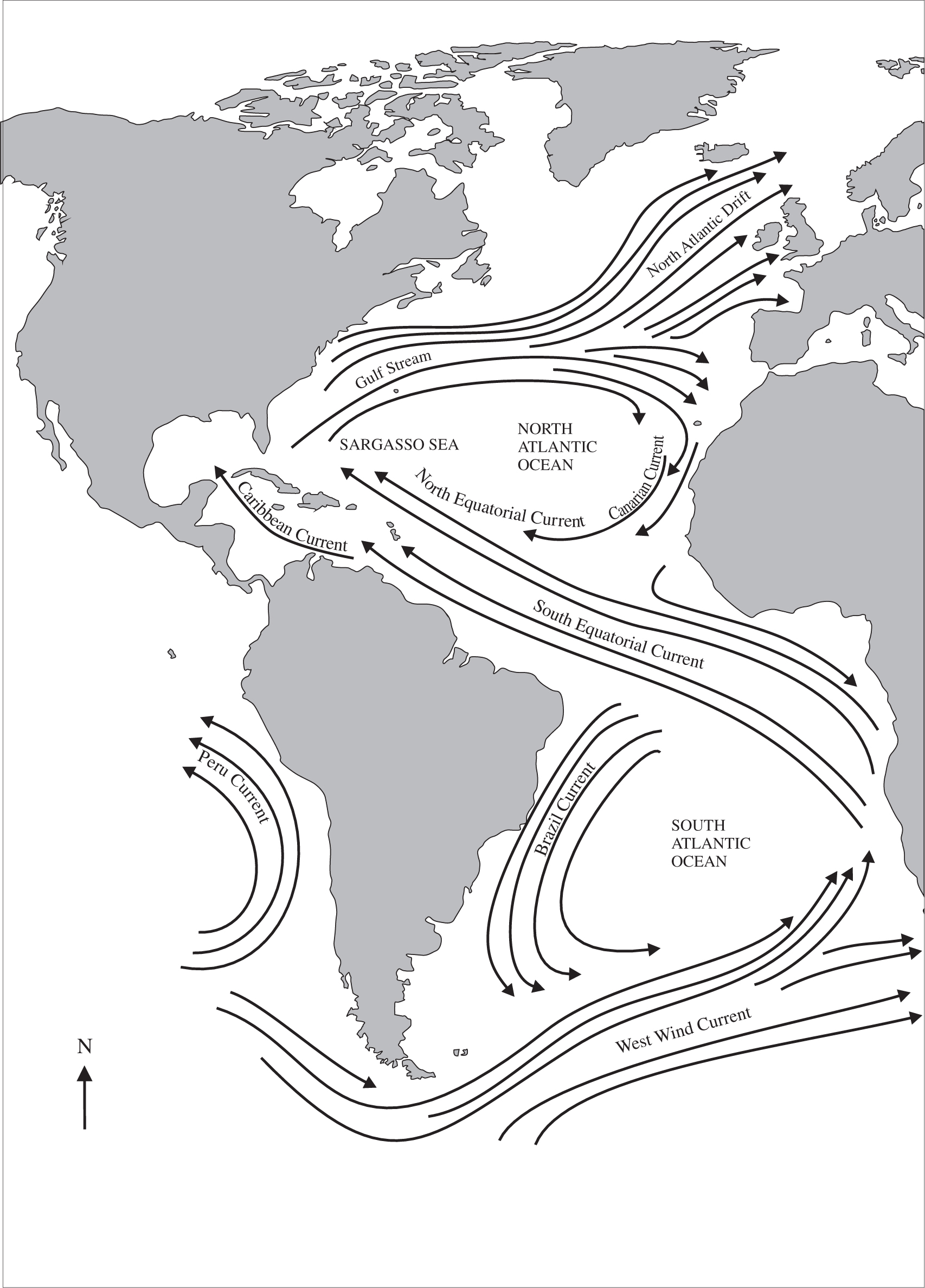
MAP 1. Major Atlantic currents.
Overseas mail systems before 1815 – Background for the development in speed
From the 17th century, merchant letters had arrived at British ports by private ships, while official correspondence was often carried by naval vessels. The arriving private ship letters were sent from the port of arrival to London, where they were marked up with three charges: the ship letter charge, the fee paid to the ship’s master for each letter handed over, and the inland postage according to the number of miles the letter had been conveyed by road from the port of entry via London to the place of address. The addressee could not receive his letter before having paid the total amount due.
At first, the only means of identifying incoming ship letters was from the endorsements in the manuscript on the letter, such as the name of the incoming ship or the name of her master. From the 1760s, the Post Office issued individually named ship letter handstamps to postmasters at ports in all parts of Britain. Similar kinds of arrival handstamps on ship letters were also introduced in France at about the same time.70 The purpose was to identify the letter as a ship letter and also name the specific port of entry, so that the inland postal charges on the mileage basis could be accurately assessed. These handstamps are often very useful for a historian who tries to reconstruct a ship letter’s voyage.
Between 1770 and 1840, hundreds of different arrival handstamps succeeded each other with a wide distribution of ports, large and small. In the days of sail, ships put in at convenient ports for shelter from the weather, for water and stores, and also to report safe arrival and receive orders at the first opportunity. As the letters carried were required by law to be handed over at the first port of call, any port or haven was a potential landing place for ship letters carried by the early sailing ships.
The outward letters were sent similarly by ship passengers, by courier or, in most cases, by masters of ships sailing from British ports. The agents of shipowners also accepted letters in their offices, and handed them to the care of their captains. In London and other major ports, the owners of coffee houses collected outward letters in a bag, which was then forwarded to the ship’s captain, who took them on board and delivered them in the port of destination to the local Post Office or coffee house, getting the nominal two pence charge per dispatched letter.
The unofficial system of private arrangement with ship masters continued to be the main channel through which letters to overseas destinations left from Britain throughout the 18th century. The Act of 1711 made it illegal to dispatch by private ships letters which could be sent by regular packets, but to places for which no Post Office packet service existed, ship masters were free to carry letters. Enforcement was difficult, and little respect was forthcoming from the letter-writing public.71
In 1799, a ship letter rate of four pence was imposed on single letters brought into Britain with a gratuity of two pence to the ship’s master. Outwards, the rate for private ship letters was fixed at one half of the packet ship postage, while the gratuity to the ship’s captain was increased from one penny to two pence. Merchants were encouraged to take their letters to the Post Office, which would undertake to find a suitable ship to carry them. Even though the Post Office repeated offers to the owners of coffee houses and taverns to become its salaried agents, the old practice continued as it had done for nearly two centuries. The coffee house proprietors were not interested, and the general public could not see any advantage in sending to the Post Office mail that was going out of Britain by private ships. Due to treasury needs after the war in 1814, the sea postage of incoming letters was raised from four to six pence, and a year later to eight pence, which was a very high rate, to be collected when the letter was delivered. The rate of outgoing private ship letters was decreased from one-half to one-third of what was charged by outgoing packets to make the government option more attractive, but to no avail.72
In addition to private merchant ships, British Post Office sailing packet services sailed from Falmouth at the south western coast of England to Halifax, Bermuda, the West Indies, Mexico and South America. The packet service started between Falmouth and Lisbon in 1689 and continued on that route until the Peninsula Steam Navigation Company, or the P&O, took over in 1837.
The Falmouth packets were speedier than the non-scheduled merchant ships, for which time was of little concern, while a fully loaded ship could bring the owners a satisfactory financial return. To carry only mail, as the government packets did, was primarily regarded as expensive misuse of shipping capacity. The armed mail packets carried just a few passengers, and fine freight like bullion and specie. The service was costly to maintain, and the Post Office packet charges to meet these costs were much greater than the nominal two pence charged by the master of a private ship. The public in general preferred private ships, thus avoiding the extra costs paid for Post Office packets according to the number of sheets and weight.73
The first transatlantic mail service from Falmouth to the West Indies was run monthly by Edward Dummer, a former Surveyor General of the Navy, in 1702–1711. This was the first mail contract, by which the government sponsored private shipowners for transatlantic mail transmission. The service, even though originally very promising from the viewpoint of speed and regularity of mail transport, collapsed due to problems in financial management and expenses caused by losses of several packets and replacement of them.74 Another early attempt to start a regular transatlantic packet service was made by William Warren, with sailings between Bristol and New York in 1709. This service ceased in 1711 or 1712.75
From 1755, a monthly mail service was usually carried out between Falmouth and the West Indies, with several unavoidable delays and interruptions during times of war. This route later included a variety of colonies – a rather difficult service, as the ports of call were so widely spread in the Caribbean. By 1810, six local West Indian mail boats supplemented the sailing packets that crossed the Atlantic. Communication from England was then bi-monthly. The packets were owned by private shipowners, usually the captains themselves, and they each had their separate contracts with the Post Office. The Postmaster organized the departures depending on the availability of vessels at port.76
The packet service from Falmouth to New York also started in 1755. The New York packets stopped regularly in Boston from 1773 onwards. A third leg for the service was established at Charleston, South Carolina, in the 1760s but remained occasional. After the American Revolution, the New York service was re-established in 1783. It was not conducted during the war years 1813 and 1814.77 From 1806, it was common practice to route the New York packets via Bermuda from November to February and via Halifax during the rest of the year to serve the British naval stations. Finally, a packet service for South America was added in the Falmouth schedules in 1808 and the service for Mexico in 1824.78 Many of these routes were reorganized several times during their history.
MAP 1. Major Atlantic currents.
The East India Company, or the EIC, had a long lasting monopoly in the East India trade until 1813 and on the China route until 1833, including a monopoly in the mail transmission between Britain and the Eastern trade ports.79
Background for the development of speed before 1815
From the early 18th century, not very much had happened to improve the speed of ocean going sailing ships. There were developments in cartography and hydrography, including the improvements in calculating the longitude, which made it possible to publish more accurate sea charts. A better knowledge of geography, as well as of prevailing winds and currents, helped the captains to take more advantage of them, and to avoid the most difficult sea areas.80
New technical equipment was slow in reaching ordinary ships. Unlike the exquisite but costly French chronometers, the English ones came gradually down in price until they were within the reach of ships’ captains. By 1815, England had produced 4,000 or 5,000 chronometers, compared with France’s 300, while in the 1790s only the EIC had equipped their ships with these costly devices. The company also had a hydrologist in their service and published charts of the Bay of Bengal. The Royal Navy did not issue chronometers to all its ships until 1825. In 1833 the French Navy had 44 chronometers for its 250 vessels, and the United States Navy had 54 in 1835. Not until the 1840s did the supply of chronometers catch up with the demand.81
Ship building improved slowly. One important invention was the copper sheathing of the planking beneath the waterline of vessels, which sheltered the bottom from the teredo worm. The wooden vessels were liable to be damaged by worms and they collected barnacles and ‘a kind of musillagenous stuff’, particularly in the West Indies, which retarded their sailing, while nothing could cling to a copper sheathing; it kept clean and resisted worms.82 The gradual modification of the ship’s hull finally created the large and efficient, extremely beautiful, fast clipper model – the ships which would make record sailings on the world’s longest sea routes from the mid-19th century.83
Even though heavy weather was always dangerous, sometimes even fatal, and caused long delays on the sea voyages, the other alternative was not much better. When it was calm, the ships did not move at all. The effect of prevailing winds was easily noticed in the duration of sea voyages across the North Atlantic, where the westbound journeys were always more difficult and the duration of sailings could be several weeks longer than on the eastbound journeys. In fact, a sailing vessel’s journey from Liverpool to New York was nearly 500 miles longer than a vessel’s journey from New York to Liverpool. This was due to the prevailing westerly winds. No sailing vessel could travel directly into the wind, and the extra 500 miles came from the tacking while the vessel tried to beat her way to the westward.84
During times of war, ship captures became everyday news. In May 1800, Lloyd’s List reported 60 captures or recaptures of British ships. To avoid losses, large convoys were collected from trade ships sailing in the same direction, and escorted by men-of-war. Thus, e.g. on 27 June, 1800, Lloyd’s List reported 69 ships arriving off Portsmouth in convoy from the different West Indian islands. Simultaneously, 30 ships arrived in Liverpool from the West Indies, and seven more at Lancaster. In total, the convoy had included more than 100 ships crossing the Atlantic together. The same day’s paper told readers that 46 ships had arrived at Jamaica from London, Clyde, Liverpool, Newcastle and Cork, one of the ships having been captured by a Spanish privateer.85
From 1803, all ships – including armed merchantmen – were compelled to cross the Atlantic in convoy. The convoys were strictly scheduled and no delays were permitted. If the ships were not ready to sail, they had to wait for the next opportunity, even if their cargoes were perishable. Mails were carried equally slowly, independent on which of the ships actually carried them. The convoy was as slow as the slowest ship involved. Collecting large fleets of merchant ships took time, and the protection that could be given was limited anyway. Ships could be captured on their way to the rendezvous, gales and fog could separate them from each other, and there was always a risk that a superior enemy force could destroy the whole fleet.86
It was not only the merchant ships that could be captured during troubled times, but also the Falmouth packets, which carried important mails and sometimes bullion worth many times the ship’s own value. Between 1793 and 1815, the packets were engaged by an enemy at least 128 times. Of the ships, 44 were totally lost to the enemy, and 31 were retaken or restored after a fight. 35 packets successfully fought off the attackers, and eight actually captured their attackers. As there were in total fewer than 100 Falmouth packets in service during those years, the record is quite impressive .87
The duties of the commander of a mail packet in the event of enemy action were prescribed as follows: ‘You must run where you can, you must fight when you can no longer run, and when you can fight no more, you must sink the mails before you strike.’88 This was often done, and thousands of letters and other important mail never reached their recipients.
Perhaps due to the continuous troubles caused by wars and privateers, the speed of information transmission by the government packet service hardly improved at all during the 18th century, while all efforts were concentrated in keeping the service going. Edward Dummer’s packets, in 1702–1711, made the trip between Jamaica and Falmouth in 42.8 days, on average,89 and the Post Office packets of 1795–97, almost 100 years later, made the same trip in 41.7 days, on average.90