V North Atlantic
The Great Innovation of Sailing on Schedule
The ‘regular’ Falmouth packets – New York–Liverpool becomes the main North Atlantic mail route – The line traffic starts – Effects on business information transmission
The ‘regular’ Falmouth packets
The war between Britain and the United States in 1812–1815 stopped the only official mail service which had been conducted between the Old World and New York. Due to the British trade blockade and the American counter actions, including privateering which was very common in the North Atlantic,91 the British Post Office mail service between Falmouth and New York was discontinued for two years, 1813 and 1814, starting again in 1815. The Halifax and Bermuda service continued through the war, but not all of the monthly sailings could be conducted. As the same packet ships were used on the other Post Office routes for Lisbon, the West Indies and South America and no less than 17 of the vessels were captured during 1813–1815, the mail service met a continuous series of problems.92
By that time, the Falmouth packets primarily served the naval station and the merchants in Halifax, which had become an important entrepôt of trade and shipping during the previous few years. This was naturally an unsatisfactory situation from the point of view of those who had urgent business letters to send to and from New York.
Even if the packet service was called ‘regular’ it did not mean much more than that the ships departed monthly. Originally, the packets had sailed from Falmouth on the first Wednesday of each month and left from New York on the first Thursday of the month thereafter, but ‘as time passed, the Falmouth departures had tended to be around mid-month’, as Arnell puts it in the Atlantic mails.93 For example in 1816, the sailing day from Falmouth was only once a Wednesday, while it was four times a Monday, twice a Tuesday, three times a Thursday and twice a Sunday. The departure dates varied between the 8th and 18th of the month. From New York the ships sailed between the 2nd and 18th of the month.94
TABLE 5. Falmouth packet round trips and the consecutive information circles, Falmouth–New York, 1817.
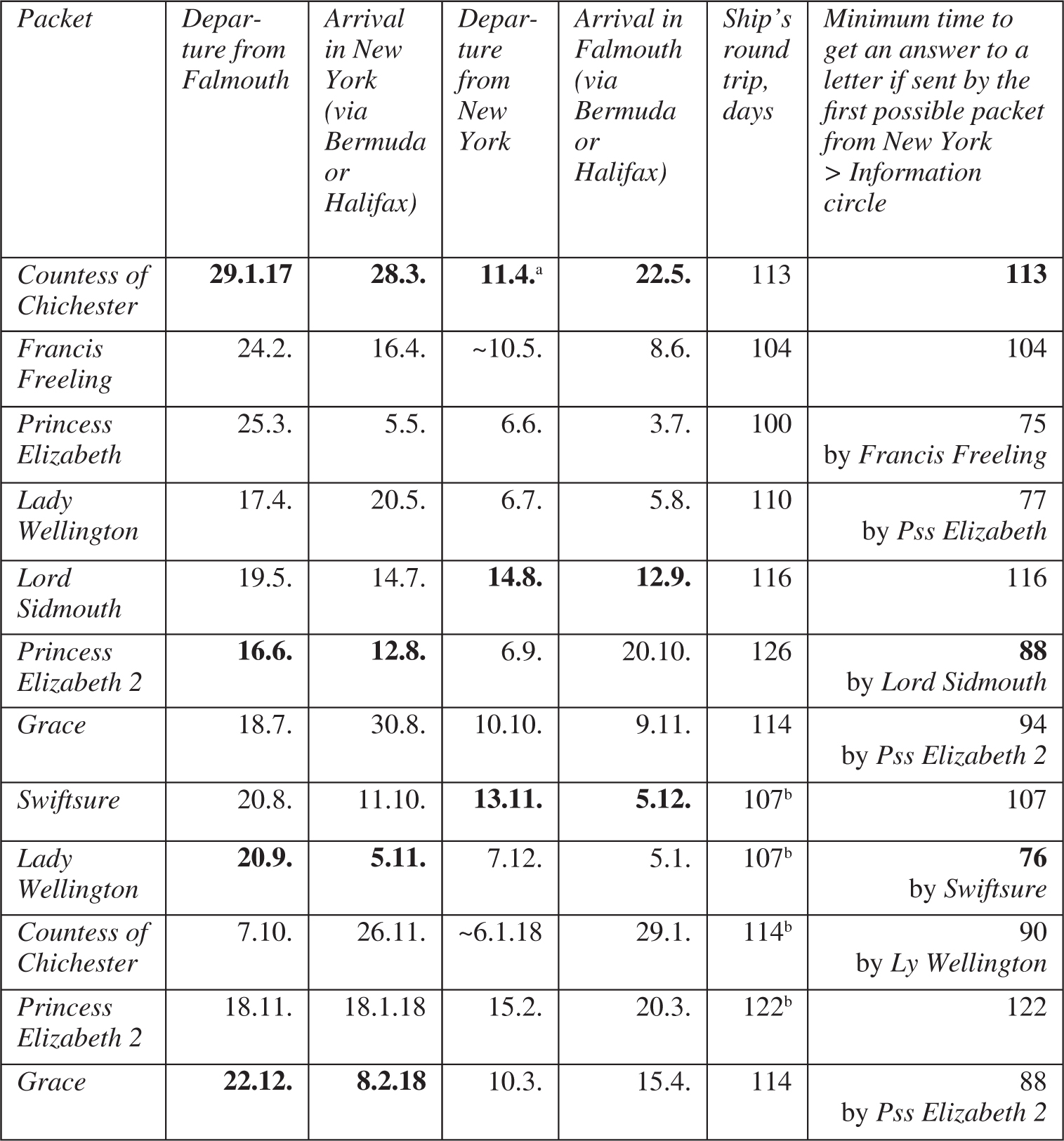
Source: Sailing lists of Arnell & Ludington, 23. – The figures in bold show the consecutive information circles enabled by the service if the first letter was sent from Falmouth on 29.1.1817.
~ Estimated departure date from New York.
a The earlier ship, Queensbury, had already departed on 17.3.1817.
b Direct homeward sailings from New York to Falmouth.
In 1816, the average trip from Falmouth to Halifax took 25 to 41 days, the stay at Halifax three to 13 days and the trip from Halifax to New York four to nine days. A merchant who sent a letter to New York could not know whether it would be received in 33 or 64 days. He could not even know when a ship would leave from New York carrying the answer to his letter. The stays at port in New York varied between 20 and 51 days.95
There was a major difference from the information transmission point of view whether the replies were bound to one ship’s round trip, or whether they could be sent by a vessel which departed earlier from New York.
When there was another mail packet leaving from New York to England before the last arrived ship’s departure, the time to receive an answer to a letter sent by the latter ship shortened markedly. The difference between a ship’s round trip and an information circle, in which the minimum time was used to send an answer by the next packet, can clearly be noticed in Table 5, which depicts the Falmouth packet service in 1817.
It can also be noticed that the number of consecutive information circles enabled by the system was only three if calculated from the beginning of the year, and three also if calculated from the February departure. However, if the first letter of the chain was sent on 25 March, it connected with a series of reliable sailings, which enabled four consecutive information circles within the year, the last one ending on 20 March, 1818.
The earlier packet had already departed from New York before the next mails arrived from England no less than five times out of twelve, thus causing long delays in replies. A letter sent by Princess Elizabeth on 25 March, 1817, from Falmouth could receive an answer on 8 June in 75 days, as the Francis Freeling was still at port in New York and departed a few days after the arrival of the English mails. But the answer to another letter sent by the Princess Elizabeth (2) from Falmouth on 18 November missed the Countess of Chichester’s departure in New York and was carried to England by the Princess Elizabeth (2) on her return voyage, arriving in Falmouth on 20 March, 1818, in 122 days.
The problem was also well-known at the other end of the journey. While the mail ships arrived at Falmouth very irregularly, the leaving packets did not wait for them. Therefore, when e.g. the Countess of Chichester arrived on 22 May, 1817, the Lord Sidmouth had departed just three days earlier. The next opportunity to send letters to New York by official mail was on 16 June, 3.5 weeks later. In England, the dates of mail arrivals and the next departures were somewhat better-coordinated than in New York, however.
The examples show that the speed of information transmission across the Atlantic could have been improved by several weeks by more careful schedule planning even in the days of slow sailing ships. It can also be asked, why this planning was not done. The answer was probably mainly in the complexity of the sailing packet system, as will be shown in Chapter VI.1.
The Falmouth packet service to Halifax, Bermuda and New York was an administrative compromise which should have served everybody, but which made nobody happy. It did not serve the British well due to its slowness and irregular schedules, and several days had to be added for the inland journey between Falmouth and London (or any other place) both outwards and homewards.96 The New York merchants felt that the stops at Halifax or Bermuda unnecessarily lengthened the duration of the journeys. The mails for Bermuda were carried most of the year from Halifax by naval sloops after the European mails had arrived, and the answers did not always reach Halifax in time to catch the packet leaving for England. Finally, the Halifax merchants were often in a situation where, because a packet departed for England a few days before another packet arrived from there, the answers to the mails could not be sent until three or four weeks later.97
In 1816, the average duration of the westbound sailings was 34 days between Falmouth and Halifax, and 39 days between Falmouth and Bermuda. The average stop at Halifax or Bermuda was five days, after which the rest of the trip to New York took about seven days. An average eastbound journey to Falmouth took 23 days from Halifax and 24 days from Bermuda. The speed of the government packet sailings did not improve during the following years. In 1816–1820, the average duration of the trip between Falmouth and Halifax was 34 days, and between Falmouth and Bermuda 39 days.98 The Falmouth packet system, with all the mail routes included, will be discussed further in Chapter VI.1.
New York–Liverpool becomes the main North Atlantic mail route
Falmouth had originally been chosen as the primary port for the government’s mail sailings in the 17th century due to its good geographical advantages for shipping. It was sufficiently far away from the French coast to prevent seizure of the packets by privateers and it offered good shelter from the weather and wind. The location was sufficiently well fortified to deter enemy raids and, due to being at the eastern end of the shortest Atlantic sea route, the port enabled the fastest passages and reduced the risks of shipwreck.99
In peace time, the advantages of Falmouth were less evident. The owners of the newly established American sailing packet companies hardly considered that port as an alternative when they decided to start regular sailings between New York and England. These decisions were made on a purely commercial basis, and the primary port of trade for them was Liverpool – although sailings were later added to London, and to Havre on the French side of the Channel.
Before looking at the regular line service started by the American shipping companies from 1818, a few words need to be said about the reasons why these two ports, New York and Liverpool, could play such an important role in the history of transatlantic trade as they did between 1820 and 1860.
Although New York had already become the leading port for American exports and imports by 1797, the city lost the lead once more to Boston. According to Albion, the first step in New York’s significant rise after the war was the British decision to ‘dump’ the bulk of their manufactures there instead of some other city. It seemed better for the purpose than Boston, where the British tolerated a reasonable amount of leakage in the blockade and which consequently had not been deprived of European goods to the extent of New York, where imported goods were scarce and prices high. Anticipating the peace news, the British sent a large number of well-laden merchantmen to Halifax, Bermuda, and other nearby places ready to sail for New York with the lifting of the blockade and take full advantage of the situation.100
Two years later, when it seemed probable that the British would turn their shipments from New York’s over-stocked market to somewhere else, New York took several steps to maintain its lead in the import business. Within a few years, it had drawn to itself three major trade routes: from Europe, from the southern ports and from the West. New auction legislation, aiming to attract more buyers, was passed at Albany on the same day as the Erie Canal bill. During the years when the canal was being constructed, a ‘cotton triangle’ – following the model of the old ‘flour triangle’ of the seventeenth century and the ‘sugar triangle’ of the later colonial period – was formed on the southern route. It diverted the commerce between Europe and the cotton ports some two hundred miles out of its normal course, in order to collect toll and at the same time to provide eastbound cargoes to Liverpool. These cargoes mainly included cotton, rice and naval stores.101
Without producing many articles of commerce itself, New York became an entrepôt where goods of every sort from every place were exchanged in the early 19th century. As Albion puts it in his history of the port of New York, ‘the New Yorkers grew rich from the profits, commissions, freights, and other excuses for levying toll upon that volume of the business’.102
In 1800, Philadelphia had been the largest city of the United States with a population of 69,000 compared with around 60,000 in New York. Ten years later, New York’s population was already 96,000 compared with Philadelphia’s 91,000.103 In his study of urban growth and information circulation, Allan Pred came to the conclusion that, by 1817, New York had clearly outdistanced Philadelphia and all other competitors by establishing an informational hegemony which led to complete domination of the entire American system of cities. According to Pred, this superiority was mainly based on the information and shipping frequency advantages of the city.104
Only shortly before the rise of New York, Liverpool had overtaken Bristol, which had long stood second only to London in terms of population and commerce. In the mid-1810s, Liverpool was a fast growing port town of around 100,000 inhabitants.105 In 1817, more than 6,300 vessels entered the port, their total tonnage being almost 693,000.106
Until the abolition of the British slave trade in 1807, Liverpool had been Britain’s centre of that business. Between 1795 and 1804, the Liverpool sailings accounted for 85% of the almost 1,300 slave voyages undertaken from British ports.107 Towards the end of the era, other trading activities were growing and it did not take many years to find new business for the former slave ships.108 Goods produced by slave labour in the Americas were imported via Liverpool in increasing amounts. For example, between 1810 and 1850, imports of raw cotton increased from 40,000 tons to just under 360,000 tons, American wheat from just over 8,000 tons to nearly 75,000 tons, flour from 900 tons to 103,000 tons, sugar from 46,000 tons to 52,000 tons and rum from 578,000 gallons to 726,000 gallons.109
In 1802, half of Britain’s cotton imports had arrived through Liverpool, mainly to supply the needs of the nearby cotton manufactories of Lancashire. By 1812, nearly 70% of Britain’s cotton imports arrived via Liverpool, and by 1830 Liverpool’s share of the imports had reached 90%.110 The city’s hinterlands included major industrial areas such as Lancashire, Yorkshire, the Midlands and the Black Country. Liverpool exported piece-goods – coal, iron bars, rails, hoops, rods and pigs, linen, manufactured goods, pottery and copper – to all parts of the world.111
During the period between 1815 and 1860, Liverpool had a somewhat larger volume of trade than New York, while New York had a somewhat larger ownership of shipping. In population the two ports were relatively equal. The cargoes which travelled the Liverpool–New York shuttle in the course of a year were doubtless the most valuable of any route in the ‘seven seas’.112
The line traffic starts
As the lively traffic between New York and Liverpool ensured that there was always cargo for the return voyage, shipowners were encouraged to start regular line traffic between the two ports. There would naturally have been no need for all the trouble involved in starting a packet line just to carry one’s own goods. The potential profits depended on how successfully the operators could fill up the rest of a packet’s hold with fine freight (instead of bulk) belonging to other merchants who had goods to ship. Most of the major commercial houses in New York had their own vessels, but the dry goods merchants, auctioneers and manufacturers’ agents were not interested in shipping itself. They only wanted to receive their goods from abroad as soon as possible.113
According to Albion, this service provided for shippers was the most important aspect in the development of the packets, and the main explanation for the success of the line principle. The rapid delivery appealed to the recipient and meant quicker financial returns for the shipper. While it had been necessary earlier to study the sailing notices of the various regular traders and transient ships and guess which one would be most likely to sail first, the packet service obviated that difficulty. Not only were the sailing dates known in advance, but the goods could be forwarded to one of the small group of operators or agents instead of a large and varying number of them.114
In addition to the merchant goods, mails and passengers, the American sailing packets soon carried large quantities of specie in both directions across the Atlantic. At that time, gold or silver coins were shipped in great amounts back and forth to balance inequalities in international trade, for the alternative was an excessive discount of premium in bills of exchange. This business – earlier taken care of by the Falmouth packets – was soon undertaken almost exclusively by the American packets and it was not uncommon for a ship to carry in her ‘strong room’ boxes or casks full of minted coins worth a quarter, or even a third, of a million dollars. If the Bank of England needed major amounts of specie or bullion to balance its reserves and meet the London bankers’ balances, it was shipped in several instalments by successive packets to reduce the risk of shipwreck.115
The New York packets began to draw business away from the less regular vessels for shipments not only to New York but also to other American ports. If a Manchester manufacturer wanted to send a consignment of woollens to Boston, Charleston or New Orleans, it was easier and generally quicker to ship it by packet to New York and have it sent to the final destination by one of the coastal packets than to search for vessels which might, sooner or later, sail directly to the other port.116
The importance of the American sailing packets may have been overestimated by American maritime historians like Albion, Cutler, or Lubbock,117 but it has certainly been underestimated by British scholars. For example, Francis E. Hyde hardly mentions the packets in his important study of the Liverpool Port.118
Compared with the slow and unpredictable Falmouth packet service, a direct regular line between New York and Liverpool was a most welcome improvement from the business information transmission point of view. The American packets sailed (mostly) regularly on the date announced, regardless of weather, and without waiting for a full cargo. The captains, as well as nearly all the seamen of the American packet lines, had learned to handle sail in the fast American privateers during the war and had developed techniques for speed. The first packets were small, about 400 tons, regular traders which had already been in service under the same ownership, or purchased second-hand. In the mid-1820s they were replaced by a larger and more uniform type, which increased gradually from about 500 to 800 tons.119
The first American sailing packet line – later known as the Black Ball Line due to the black ball on the company’s red house flag and a large black ball painted on the vessels’ topsail – started sailing simultaneously from New York and Liverpool in early January 1818. The line was owned by five New York merchants, all textile importers. Jeremiah and Francis Thompson were sons of a prosperous woollens manufacturer, Benjamin Marshall was in the textile importing business, while Isaac Wright and his son William were also in the importing and shipping business. They chose two old firms of the first rank – Cropper, Benson & Co. and Rathbone, Hodgson & Co. – to act as the Liverpool agents, each being responsible for two ships.120 This allowed the owners to send their own shipments by the fastest possible way, and take full advantage of the information their ships carried from Europe before it became public property.121
During the first year of their existence, the ‘Black Ballers’ sailed on the first day of each month from Liverpool and on the fifth day of the month from New York. This service marked the beginning of the practical application of the ‘line’ to ocean navigation, with several vessels under co-ordinated private management, sailing in regular succession on specified dates between specified ports.122
In keeping with their claim that the ships would leave on schedule ’full or not full’, the owners went to great lengths to ensure that the first packet would sail punctually. Despite a heavy snow storm in New York on 5 January, the James Monroe123 slid into the stream on time as advertised. However, the owners apparently failed to convince their Liverpool agents of the importance of such initial punctuality, for the Courier, which should have departed on 1 January, was three days late in leaving.124 The delay might have been caused by the chronic Liverpool complaint, the prevailing north-westerly winds, which often prevented ships from getting under way in winter. In fact, only a few packets sailed from Liverpool on their appointed days until towing became general.125
For an unknown reason, the scheduled departures of Black Ball Line vessels from New York were changed in the first year of operations from the 5th of each month to the 10th. The actual departures of the first year took place as follows: 5 January, 5 February, 5 March, 6 April, 11 May, date missing in June, 10 July, 12 August, 10 September, date missing in November, and 11 December. The sailing dates from Liverpool are totally missing because Lloyd’s List did not report them that year, but at least the James Monroe put back into port on 6 March, probably damaged by heavy weather, and arrived in New York as late as 30 April.126 Due to the late arrival, the vessel was again six days behind schedule when departing from New York on 11 May, 1818.127 This could even have been the reason for the overall change of sailing dates, if the company really wanted to show for PR reasons that their ships were sailing on schedule.
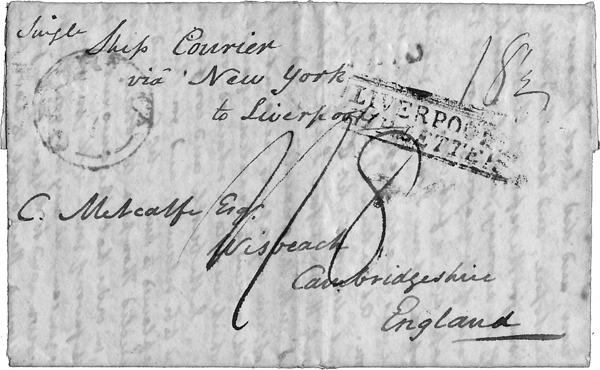
FIG. 4. The letter sent from Georgetown on 4.12.1819 to Cambridgeshire, England, was carried from New York to Liverpool by the pioneering Black Ball Line packet Courier on her sixth round trip. She departed from New York on 10.12.1819 and arrived in Liverpool on 5.1.1820, in 26 days.
Although not a complete success, the new American packet line was far more regular than the British government mail service and, due to the direct sailings with no time-consuming call at Halifax, the American packets were remarkably faster. An average eastbound sailing took 24.4 days from port to port. The fastest sailings took only 20 days, while the slowest took 29 days.128 The average duration of westbound trips was 43 days.129
Interestingly, the fastest eastbound trips of the Falmouth packets, in cases when they sailed directly from New York to Falmouth (the November–February departures from New York in 1816–1822), were sometimes even quicker than those of the Black Ball Line packets. The Falmouth packet Francis Freeling sailed from New York to Falmouth in 17 days in November 1818 and the Montague in 19 days in February 1819.130 But the average eastbound sailing from New York via Halifax or Bermuda took 38 days – a huge difference compared with an average Black Ball Line trip of 24 days, even if the Falmouth packets stayed seven days on average in Halifax or Bermuda before proceeding to Europe. An average westbound Falmouth packet trip all the way to New York took 50 days, including a three days’ stop at Halifax or Bermuda.
It is not known by how many days the Falmouth packet departures were delayed in each case from their original schedule, as there seems to have been no fixed sailing dates on the Halifax route. In the case of the Black Ball Line packets, it can easily be calculated. If the packets had really sailed on schedule, the mails would have been transmitted from New York to Liverpool in about 25 days. As they did not always do so, the average duration of mail transmission from the original sailing date in New York to the actual arrival date in Liverpool was almost 28 days. Letters could, of course, be processed for the packet’s mail bag as long as the ship stayed in port, but the bulk of the letters were written in order to leave at the scheduled time, and these mails naturally suffered from the delay. Westbound, the difference between theory and practice must have been even greater.
During the coming years, the speed and regularity of the new American packet line improved. According to Staff, an average sailing by the Black Ball Line packets during the first nine years of the company’s existence took 23 days eastwards, and 40 days westwards.131 The benefits for business information transmission were remarkable, especially because the success of the pioneering company soon attracted competitors to the same route.
The first sailings of the new line traffic were not noticed by Lloyd’s List, but Lloyd’s agents who always tried to find the fastest possible ways for their information transmission, started to use the Black Ball Line’s packets as their primary means of communication in the autumn of 1818.132 This can be verified by following the thread of incoming maritime intelligence published by Lloyd’s List. The New York port lists of ship arrivals and departures were still carried by merchantmen (not Falmouth packets!) in August and September.133 From then on, the lists were sent by the Black Ball Line packets if they were sailing rather soon – one monthly sailing was not enough for the newspaper’s needs, however.
Thus, the Black Ball Line packet James Monroe brought for Lloyd’s List the maritime intelligence of the New York port regarding the time period 27.8–10.9.1818. The ship departed from New York on 10 September and arrived in Liverpool 26 days later, on 6 October. The intelligence was published in Lloyd’s List on 9.10.1818.134 The Amity brought the intelligence for the period 25.9–10.10.1818 (exact sailing date from New York not published by Lloyd’s List), while the Courier brought the intelligence for 6–9.11.1818 in 21 days, and the Pacific the intelligence for 5–9.12.1818 in 24 days.135 The lists in between were sent by the fastest merchantmen. For example, the 9–19.10.1818 list was sent by the Hercules in 24 days, the 21–27.10.1818 list by the Ann in 26 days, and the 30.10–4.11.1818 list by the Falmouth packet Francis Freeling, which sailed from New York to Falmouth in 17 or 18 days.136
The examples show clearly that there was no real difference between the existing options concerning the speed of transport. Even if the speed of the Falmouth packets also improved during the coming years, while new and faster ships were built for the purpose, the American sailing packet line service became the most important means of business information transmission especially because of its frequency and regularity.
Even if the Black Ball Line’s performance in 1818 cannot be reconstructed accurately by using the sources available, a theoretical construction can easily be made based on the line’s general schedule. It was built in a safe way to enable exact sailing dates. A departure from both sides of the Atlantic on the first of each month allowed a two-month sailing westwards and a one-month sailing eastwards – targets which could be met in almost any circumstances. During the period 1818–1832, only 11 out of 521 journeys took more than 60 days on the Liverpool – New York route.137 Even if the ship left a few days late, which sometimes happened, it could easily come back on schedule at the other end, and there would be enough time for the merchants to answer their letters before the next packet departure from the port.
By this simple organizing of regular line traffic, with the same number of annual sailings as the Falmouth packets made, and with the same problems with prevailing winds and rough weather, the tiny American sailing packet line was able to notably improve the transatlantic information transmission from its very first year. Instead of the three consecutive information circles enabled by the Falmouth packets, information could now circle four times back and forth across the Atlantic during a year. However, to achieve the full benefit of the regular traffic, more ships were needed on the route – and they would be there soon.
The first announcement of new competition for the Black Ball Line came in early January, 1822, from Byrnes, Trimble & Co., a New York firm engaged principally in the Chesapeake flour trade. The partners had been operating regular traders to Liverpool for several years and now started line traffic with four packet ships from 25 January. The monthly service included sailings from New York on the 25th and from Liverpool on the 12th of each month. In 1823, the dates were changed to the 24th and 8th respectively. The line was soon named the New Line or Red Star Line138, while the Black Ball Line became the Old Line. The Black Ball owners quickly met this first challenge with an announcement of doubled service. They expanded the line from four to eight ships and stated that they would maintain sailings twice instead of once a month, departing on the 1st and 16th of the month from each port. This service started in mid-March, 1822.139
For the Black Ball Line, the new competitor was not the only blow that year. In April, their packet Albion was dashed to pieces on the Irish coast with heavy loss of life140 and in July, their Liverpool sank on her maiden voyage after striking an iceberg, though no lives were lost. Despite the threatened loss of public confidence from these disasters, and the expense involved just at the very time when they were expanding their service, the Black Ball Line managed to survive the year with its prestige intact.141
Five days after the sinking of the Liverpool, the newspapers of 30 July published an announcement concerning another new Liverpool line. This would be known as the Swallowtail Line, or the Fourth Line, as the added Black Ball service had already been considered as the third line. The agents in whose name the advertisement appeared were Fish & Grinell, who, under the later names of Fish, Grinell & Co., and Grinell, Minturn & Co., would become the foremost packet and general shipping house in New York. Two years later, in 1824, the company started a packet service to London by the same name. For recognition, the Liverpool line packets carried a blue and white swallowtail house flag, while the London line packets carried a red and white one, thus giving the following names to the lines: the Blue Swallowtail Line and the Red Swallowtail Line. Additionally, another packet line to London was established in 1824, the Black X Line. Both London lines operated via Portsmouth. Three packet lines were also established for the New York–Havre route in 1822–1823: the Old Line, or later Union Line, the Havre-Whitlock Line which was later merged with the Union Line, and the Havre-Second Line.142
After some readjustments, the traffic was organized as follows: the Black Ball Line packets departed from both New York and Liverpool on the 1st and 16th of each month, while the Red Star Line packets departed from New York on the 24th and from Liverpool on the 8th of each month. The Blue Swallowtail departures used an opposite schedule, sailing on the 8th from New York and on the 24th from Liverpool. Thus, there was a weekly sailing from both ports all year round. All the packets made three round trips per year, compared with only two of most merchantmen. There was a great difference in efficiency, as the American packet owners could share their capital costs between three instead of two annual voyages, and some extra income could also be gained during the winter months when most other transatlantic vessels lay idle.143 In 1824, an average packet round trip on the New York – Liverpool route took fewer than 84 days, while the Falmouth packets made their Falmouth – New York round trip in 118 days, on average.
By 1824–1825, the regularity of the line sailings had improved markedly. Hard competition made the companies try their best to keep to their schedules, and speed records were followed intensively by the public on both sides of the Atlantic. Table 6 shows how punctual the packet departures from New York – the ships’ home port where a good reputation was most important – were in these years.
As can easily be noticed by one glance at the table, the departure dates from New York were very punctual in the mid-1820s. Of the 76 departures published by Lloyd’s List 1824–1825,144 only 17 sailings were delayed or changed, while 59 departures were made exactly on the date announced. The delay was usually only one day. To compare with the Liverpool departures, see Table 7.
The losses of the Black Ball Line packets Amity in April 1824 and Nestor in December 1824 caused a gap in the schedule only for the January 1825 departure.145 Timetables were reorganized and both wrecked ships were soon replaced by new, larger vessels. The 520 tons Florida sailed for her first voyage already in early November 1824 and the 560 tons Manchester in May 1825. The Silas Richards replaced the Blue Swallowtail Line’s smallest vessel Robert Fulton, which was sold in 1824.146
Departures from Liverpool were never as punctual as those from New York. At least 23 out of 47 departures were delayed in 1825.147 The autumn and winter sailings in particular could be delayed by several days due to bad weather. It often happened that the clearing at the Customs House of Liverpool was done in time for sailing on schedule, but the ship departed several days later. There were also second or, in later years, even fifth clearances before the ship really sailed, probably caused by the late arrival of important freight.148
TABLE 6. Mail carrying American sailing packets, dates of departure from New York, 1824–1825.
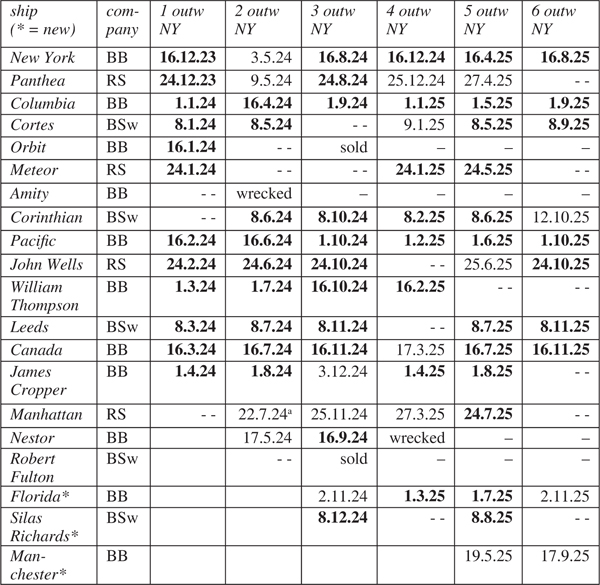
Source: Lloyd’s List 1824–1825. BB = Black Ball Line, scheduled sailing dates 1st and 16th of each month; BSw = Blue Swallowtail Line, sailing date 8th; RS = Red Star Line, sailing date 24th. Sailings which took place on the scheduled date are marked in bold.
- - = data missing – = not sailed
a This date may be incorrect. The packets hardly departed before scheduled date.
TABLE 7. Delays of the American sailing packets at the port of Liverpool, 1825.
| Packet and shipping line |
Scheduled sailing date |
Clearing date |
Factual sailing date |
Delay, days |
| Canada, BB |
1.1. |
1.1. |
4.1. |
3 |
| Manhattan, RS |
8.1. |
8.1. |
10.1. |
2 |
| James Cropper, BB |
16.1. |
15.1. |
22.1. |
6 |
| Silas Richards, BSw |
24.1. |
24.1. |
26.1. |
2 |
| New York, BB |
1.2. |
1.2. |
- - |
- - |
| Panthea, RS |
8.2. |
(8.2.); 2nd clear. 10.2. |
13.2. |
5 |
| Columbia, BB |
16.2. |
16.2. |
16.2. |
0 |
| Cortes, BSw |
24.2. |
23.2. |
24.2. |
0 |
| Meteor, RS |
8.3. |
8.3. |
8.3. |
0 |
| Pacific, BB |
16.3. |
16.3. |
16.3. |
0 |
| Leeds, BSw |
(16.3.) |
(14.3.); 2nd clear. 15.3. |
(16.3.) |
- -* |
| Corinthian, BSw |
24.3. |
24.3. |
24.3. |
0 |
| William Thompson, BB |
1.4. |
31.3. |
- - |
- - |
| John Wells, RS |
8.4. |
8.4. |
8.4. |
0 |
| Florida, BB |
16.4. |
16.4. |
17.4. |
1 |
| Canada, BB |
1.5. |
30.4. |
- - |
- - |
| Manhattan, RS |
8.5. |
7.5. |
10.5. |
2 |
| James Cropper, BB |
16.5. |
16.5. |
16.5. |
0 |
| Silas Richards, BSw |
24.5. |
24.5. |
24.5. |
0 |
| New York, BB |
1.6. |
1.6. |
8.6. |
7 |
| Panthea, RS |
8.6. |
8.6. |
9.6. |
1 |
| Columbia, BB |
16.6. |
16.6. |
16.6. |
0 |
| Cortes, BSw |
24.6. |
24.6. |
27.6. |
3 |
| Manchester, BB |
1.7. |
1.7. |
- - |
- - |
| Meteor, RS |
8.7. |
8.7. |
8.7. |
0 |
| Pacific, BB |
16.7. |
16.7. |
16.7. |
0 |
| Corinthian, BSw |
24.7. |
23.7. |
24.7. |
0 |
| William Thompson, BB |
1.8. |
1.8. |
1.8. |
0 |
| John Wells, RS |
8.8. |
8.8. |
11.8. |
3 |
| Florida, BB |
16.8. |
16.8. |
- - |
- - |
| Leeds, BSw |
24.8. |
24.8. |
24.8. |
0 |
| Canada, BB |
1.9. |
1.9. |
1.9. |
0 |
| Manhattan, RS |
8.9. |
8.9. |
9.9. |
1 |
| James Cropper, BB |
16.9. |
16.9. |
16.9. |
0 |
| Silas Richards, BSw |
24.9. |
24.9. |
28.9. |
4 |
| New York, BB |
1.10. |
1.10. |
1.10. |
0 |
| Panthea, RS |
8.10. |
8.10. |
12.10. |
4 |
| Columbia, BB |
16.10. |
15.10. |
23.10. |
7 |
| Cortes, BSw |
24.10. |
24.10. |
5.11. |
12 |
| Manchester, BB |
1.11. |
1.11. |
8.11. |
7 |
| Meteor, RS |
8.11. |
- - |
10.11. |
2 |
| Pacific, BB |
16.11. |
16.11. |
17.11. |
1 |
| Corinthean, BSw |
24.11. |
24.11. |
29.11. |
5 |
| William Thompson, BB |
1.12. |
1.12. |
1.12. |
0 |
| John Wells, RS |
8.12. |
8.12. |
8.12. |
0 |
| Florida, BB |
16.12. |
16.12. |
21.12. |
5 |
| Leeds, BSw |
24.12. |
- - |
27.12. |
3 |
Table 7, sources: Lloyd’s List 1825; Liverpool Customs Bills of Entry, 1825. – Sailings which took place on the scheduled date are marked in bold.
* The Leeds had sailed from Liverpool on 4.1. but ran on the Banks (at Mersey) and sustained great injury. (See Lloyd’s List 7.1.1825, 11.1.1825, 14.1.1825.) She was now leaving after repairs, having stayed in port for over three months. This was probably the reason why there was no Blue Swallowtail Line departure on 24.4.
As can be noticed from Table 7, it should never be assumed that clearing dates were automatically the same as the final sailing dates. A comparison between the official sailing dates published by the companies, the dates of clearing at customs and the final sailing dates shows significant differences. This is also a good example of the diversity of information received when using different sources in calculating the duration of information transmission.
A calculation based on Tables 6 and 7 gives the result that the average delay of the departure of an American sailing packet at the port of Liverpool in 1825 was about two days, while the delay in New York was just a half day. As can be noticed from Table 7, the ships were in each case cleared at customs at the right time for a scheduled departure, but the delays took place when the ship was due to leave the port. During the worst winter months, only two vessels managed to leave on the scheduled date from Liverpool.
Despite these delays, there was now more frequency and regularity in North Atlantic communications than ever before. The speed of the packets varied, especially on westbound trips, but the averages were extraordinary: 24 days eastwards and 36 days westwards in 1825.149
Effects of the regular sailing packet service on business information transmission
What did all this mean from the business information transmission point of view? It can be illustrated by examining the consecutive information circles enabled by the service.
As can be seen from Table 8, a letter sent from Liverpool by the Red Star Line packet Manhattan on 10 January (the ship was delayed two days from its original schedule), arrived in New York on 20 February, and if the recipient was in New York, he or she was able to answer quickly enough to send the letter by the same company’s John Wells, which departed from New York on 24 February (or a few days later, but not earlier than that). This letter arrived in Liverpool on 20 March, only 69 days after the departure of the original letter from that port. If the recipient was in Liverpool, he could again answer this letter quickly enough to send it by the Blue Swallowtail packet Corinthian, which departed on 24 March. Within one year, five letters could be sent successively back and forth across the Atlantic, while a sixth one would already be on its way when the year ended.
TABLE 8. Consecutive information circles enabled by the American sailing packets between Liverpool and New York, 1825.
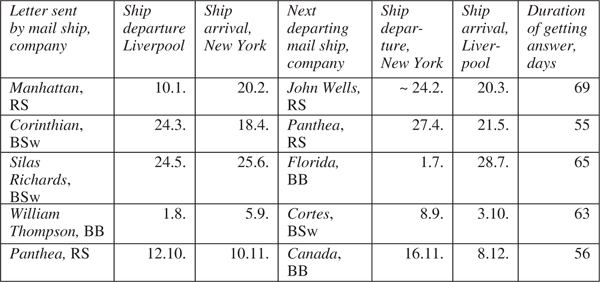
Sources: Lloyd’s List 1825; Liverpool Customs Bills of Entry, 1825. ~ = scheduled date.
By way of comparison, the information circulation enabled by the Falmouth packets in one year (1825) was as follows:
TABLE 9. Consecutive information circles enabled by the Falmouth packet service in 1825, an example.
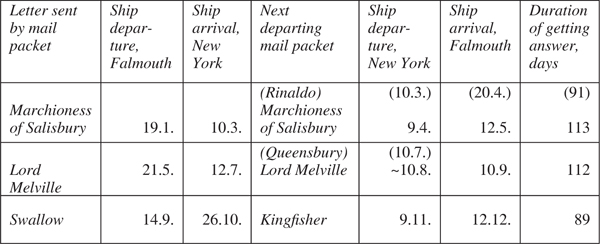
Sources: Sailing lists of Arnell & Ludington, 37–39. ~ = estimate.
The example shows that the government mail service was not very well co-ordinated even in 1825, although the British merchants now seemed to have had better chances to answer the letters before the next packet departure. At the other end, there were still problems. The mails sent by the Marchioness of Salisbury arrived in New York on the same day as the packet to England departed. Somebody might have been able to send a quick answer immediately, but it is also possible that the mails were not handled and delivered from the Post Office before the deadline for answers to be brought in to catch the departing vessel.150
Thus the answers to the January mails could primarily be sent by the arriving packet, Marchioness of Salisbury, on her way homewards. The next round was inconvenient as well. The Queensbury had left from New York two days before the May mails arrived by the Lord Melville. But the September mails carried by the Swallow could be answered during the next two weeks and carried by the Kingfisher, which departed from New York on 9 November. Sending a letter and getting an answer to it took 105 days on average and only three consecutive information circles could be achieved within that year.
From this we can draw two important conclusions. Compared with the Falmouth packet service, the speed of information circulation across the North Atlantic was notably improved when the American packet lines started their better organized sailings. Instead of three round trips of letters by the Falmouth packets, information could be circulated more than five times within a year by the American sailing packets. A second conclusion is that Liverpool and New York enjoyed the cumulative advantage of faster communications compared with other ports due to slow inland communications. If further inland transmission was needed, the next packet had already sailed long before the answer was at the port of departure.
Even though there was also a packet service between New York and London, as well as New York and Havre, these services were never as effective as the weekly departures on the New York – Liverpool route. The service for London and Havre was most of the time only twice a month, and it was conducted by smaller ships – many of the Red Swallowtail Line packets had first served on the more important Liverpool line, and been replaced there by newer and larger vessels.151 The average duration of westbound passages during 1818–1857 was 35 days from Liverpool (1,993 trips), 36 days from London (928 trips), and 38 days from Havre (1,239 trips).152 Consequently, important outgoing letters were often sent from London by inland mail directly to Liverpool to be forwarded to the next departing packet, and incoming letters vice versa.153
Due to the superiority of the American sailing packet service, Liverpool became the de facto information centre for Britain on the Atlantic side without the government taking any measures. Instead, the Post Office closed up the Falmouth packet mail service to New York at the end of 1826. The American ships had literally driven the Falmouth packets from the route, and even the official mail of the General Post Office in London, destined for the Canadian General Post Office, was carried by the American packets instead of their own mail service.154 Yet the Falmouth packet service for Halifax and Bermuda continued until the Cunard Line steamers took it over in 1840.
TABLE 10. Number of mail-carrying American packets from New York, 1820–1855.
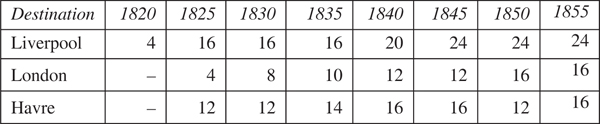
Source: Albion (1938), 274. – The number of vessels varied within these frames due to replacements, etc.
The American sailing packets accepted letters from England to the United States at two-pence a letter, irrespective of the weight or number of enclosures. The packet line agents provided mail bags in their Liverpool and London offices, and the bags were sealed when the vessel was due to sail, and taken on board. The same procedure was usual at Havre and Bordeaux on the French side. In England the practice was widespread and used by the majority of merchants throughout the kingdom. Special messengers of the different companies would carry their bags to Liverpool, and although this was a direct infringement of the Post Office monopoly for the carriage of mail within Britain, little could be done about it. The practice had become so usual and was done so openly that it became an accepted procedure. In the late 1830s it was revealed by Roland Hill, the Secretary of the Post Office, when advocating his postal reform, that the American sailing packets carried some 4,000 letters each westbound voyage, none of which had passed through the Post Office.155
On their arrival at New York or Boston, letters for the United States went into the Ship Letter Office to be rated for postage. If addressed to a place at the port of arrival, six cents was charged. For anywhere beyond, a ship letter rate of two cents plus the inland postage was levied. The letters for Canada were sent to the New York Post Office or via Boston, and then forwarded to the exchange office at the Canadian border, where the Canadian Post Office accepted them. The postage charge was made up of the ship rate, the United States postage to the border, and then the Canadian inland postage. By this means, a letter to Quebec would cost 47 cents instead of 92 if it was brought by the Post Office packet. Likewise, the postage on a letter from London to Montreal and York, instead of being 96 cents, and one dollar 12 cents respectively, would cost 31 cents, and 47 cents. Apart from the notable benefits to the merchants, this cheap means of communications was a blessing to the emigrants who could thus more easily keep in touch with their relatives at home.156
A letter from a Bible Society member in Montreal to a colleague in London gives a good example of the general thinking: ‘I would again recommend your writing us by the New York and not the English packets as by it much time will be saved as well as the saving in postage of the value of two or three Bibles.’157
Indeed, the British Post Office’s losses of postage rates were a major reason for the decision to start subsidizing transatlantic mail steamship services in the coming years.
There is one more important and rather confusing aspect to be discussed regarding the American packets and their central role in business information transmission during their heyday: the unpredictability of the duration of sailings. As already noticed, the actual sailings did not always take place accurately on schedule, but that was a minor problem compared with the discomfort caused by the common unawareness of the duration of each voyage. The passengers on board were normally betting upon the length of the voyage, with a ten-day range. That was about the normal spread.158
The unknown length of the voyage was not only an inconvenience to the passengers. While the date for outgoing mail was set in advance at the ports of New York and Liverpool, no one knew the date when the mails would arrive from overseas. The staff in the Post Offices on both sides of the Atlantic had to be ready for emergencies, for sometimes several packets could arrive on the same day due to delays caused by rough weather or other problems at sea.
For example, one day in August 1827 the New York Post Office received two incoming Black Ballers, one line packet from London and Havre each, as well as a few regular traders. Two years later, more than 17,000 letters came in on a single week, three Black Ballers and some other packets having arrived at the port during the same time. Some of the mails were for New York, while the rest were to be handled and forwarded to other parts of the country.159
When the well known New Orleans packet line owner Edward Knight Collins started his Dramatic Line between New York and Liverpool in 1837, the rush in the Post Offices became even more frequent as the line decided to use the same sailing dates (the 16th from New York and the 1st from Liverpool) as the Black Ball Line. The race between the two companies’ ships at sea often ended with both packets arriving on the same day.160 From a business information transmission point of view, this arrangement was not really satisfactory. Even if the competition between the two companies might have shortened the duration of a single trip by a few days, it gave no possibility to send mail across the Atlantic more often. Even if the monthly Dramatic Line sailings increased the number of regular transatlantic sailing packet journeys from 48 to 60 per year, the number of annual information circles remained at five, as it had been since the early 1820s.
TABLE 11. Consecutive information circles enabled by the American sailing packets between Liverpool and New York, 1838 .
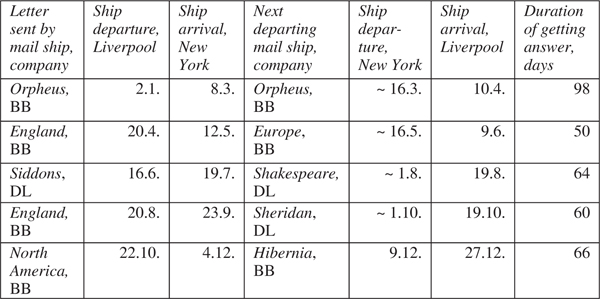
Sources: Lloyd’s List 1838. – If the exact departure days from New York have not been recorded by Lloyd’s List, the line’s general sailing date has been used as an approximate. This does not affect the calculation of the information circles.
~ = scheduled.
Another problem which caused stagnation in the development of transatlantic mail services was that the speed of an average trip could not really be improved. Despite the rather punctual departures and hard driving, better knowledge about sea routes and currents, or technical improvements, the packet arrival dates always depended heavily on the winds at sea. Even if the eastbound sailings were more predictable, the westbound trips could take anything between three and eight weeks, or even more.
The slow trips generally occurred in the winter when gales or ice sometimes stretched out a trip even to ten or 12 weeks. The slowest passage of all was the 89-day crossing of the Blue Swallowtail Line’s Patrick Henry late in the sailing packet period. Another slow passage, depicting the effects of prevailing winds, was the 69-day crossing of the Black Ball Line’s South America in the winter of 1833–1834. Although she had one of the fastest general averages of all packets, and her Captain Robert H. Waterman later set up a series of all-time speed records as a clipper commander, there were only about a dozen packet journeys slower than that in the whole 40 years.161
Diagram 1 clearly illustrates this key problem of the sailing packet service. The average length of a westbound journey was 34 days, but it varied very much from one journey to another. Even though there were slower and faster vessels,162 one and the same ship could make a westbound trip in 41 days and the following one in 22. It was not unusual that the vessels arrived in another order than they had left from the port of departure, even if there was one or two weeks difference between the sailing dates. Though it was true that winter sailings were harder and often longer than those of the spring or autumn163 (summer sailings often suffered from fog on the North American coast), even the winters were variable.
The mid-1830s until 1838 were the heyday of the American sailing packets. In 1834, all three companies on the Liverpool route again replaced one of their older and smaller ships with a new one: the Black Ball Line replaced the New York of 516 tons with the Columbus of 663 tons, the Blue Swallowtail Line replaced the Silas Richards of 454 tons with the Independence of 732 tons, and the Red Star Line replaced the John Jay of 502 tons with the England of 729 tons. The new vessels were not necessarily faster than the old ones, as can be seen from Diagram 1, but they were certainly more attractive from the passengers’ point of view. The wage costs did not seem to be a major problem during this phase. While the old ships of 450 to 500 tons had sailed with 18 to 26 men on board, the new ones needed 30.164.
As it was always impossible to predict the duration of each trip, duplicates of letters were often sent to ensure the fastest possible dispatch of the information. For example in 1837, the Dramatic Line’s Sheridan sailed from Liverpool on the same day as the Black Ball Line’s Columbus. Both ships were delayed – according to the original schedules, the Sheridan should have sailed on the 12th or 16th and the Columbus on the 16th March165 – and they both sailed on the 19th. Johan Snellman’s philatelic collection includes a cover with two separate letters written in Liverpool on 17 and 18 March 1837, sent by the Sheridan. According to the hand marking made by the writer of the letters, they were duplicates, while the originals were sent by the Columbus. The duplicate cover arrived faster than the original, and was handstamped in New York on 16 April, while the Columbus arrived in New York on 17 April. The recipients have not marked the arrival date in Richmond, but the letter was answered already on 21 April.166
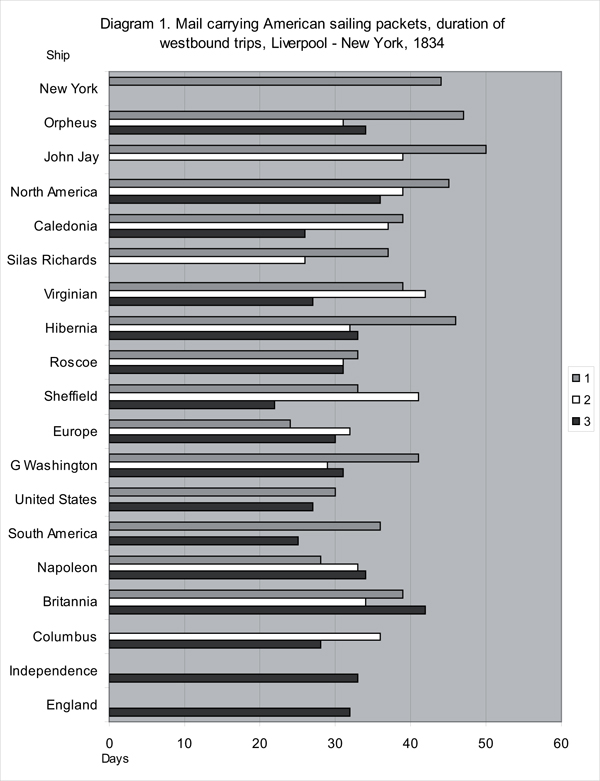
Sources: Lloyd’s List 1834; Liverpool Customs Bills of Entry, 1834. All scheduled sailings were made, but in some cases the sailing data is missing from the sources. The selection of which regular traders have been included in the figures as mail-carrying packets is based on the list published by Staff, 121–127.
The example shows again how useful it was to be involved in business at the main port cities. The latest information could be written or added to existing letters even after the ship’s scheduled sailing date. Also, by using duplicates, the fastest possible answer was ensured.
Until the introduction of ocean-going steamships, the American sailing packets offered a superior mail service compared with any other world trade route. Surprisingly, they could also keep their position for one more decade during the shift period from sail to steam, as can be noticed in the following chapter.
Wind vs. Steam – a Decade of Struggle
Early experiments – The start of the transatlantic steamship service – The origins of the North Atlantic mail contract – The early years of the Cunard Line – Competition between early transatlantic mail carriers – Wind vs. steam – the finale
Early experiments
Steam technology was transferred from land to sea in the early 19th century. The earliest commercially successful steamboat was built by Robert Fulton in 1807. His 18-horsepower engine steamer made the passage from New York to Albany in 33 hours. In Britain, the first steamboat was launched on the Clyde in 1811. In 1814 there were still only two steamboats in Britain, in 1816 there were 15, in 1825 there were 163, in 1835 there were already 538 and in 1839 as many as 840. A similar development was seen in the United States, where approximately 1,300 steamboats were built during 1808–1839.167
Steamboats replaced sailing packets in the British Post Office coastal services in the early 1820s. The mails for Ireland were carried by steamboats from Holyhead to Dublin over the Irish Sea from May 1821 and the mails for the continent from Dover to Calais from the end of the same year. The Milford station was converted to steam in 1824, though the receipts from mail and passengers were rather slight. The Bristol Chamber of Commerce bombarded the Post Office with reasons for transferring the Milford packets to the port of Bristol, which could easily become a busy packet station due to the demands of commercial activities. The Post Office ignored these demands, but added Liverpool as a new packet port on the west coast of England.168
The steam packet service from Liverpool to Dublin started in 1826. Previously, the Liverpool letters to Ireland had gone first to Chester and from there joined the London mails on their way to Holyhead. This was rather inconvenient as the mails had to leave from Liverpool before the business day was over, and the letters were on their way for 24 hours. The direct steam ship traffic between Liverpool and Dublin reduced the time to some 12 hours. Liverpool also had a steam-powered mail service to the Isle of Man.169
Even though there were already private steamship companies serving on the coastal routes, the British Post Office ignored them and built a competing steam packet service. The reason was, according to Francis Freeling, the Secretary of the Post Office, that private owners ‘would have no inducement to avoid delay or irregularity, and that the safety of the mails was so important that it could not be left in private hands’. Due to these investments, the annual expense for the services, which had been about £78,000 in 1817, more than doubled during the next ten years.170
A report by the Commissioners of Revenue in 1830 showed that the expenses for the first eight years of the Post Office steam packet service had amounted to over £620,000 while the receipts were less than £243,000.171 It seemed to be a poor business for the Post Office to build steamboats and run the mail service. These figures, together with the public pressure to reduce the high postage rates,172 were among the most important reasons when the Post Office later decided to change its policy and ‘outsource’ the overseas mail services to private, subsidised steamship companies.
Before any transatlantic steamers became reality, steam vessels were already in use for a regular foreign mail service on shorter sea routes, such as crossing the North Sea between London and Holland or Hamburg. The steamship service shortened the trip notably compared with the horse-drawn mail coach to Harwich and crossing of the North Sea by sailing packets. The 170-year-old Harwich mail service was given up, and mails to Holland were carried by the General Steam Navigation Company. This line, founded in 1824, received its first mail contract in 1831. The steam packets would depart regularly from London for Rotterdam and Hamburg, reaching Rotterdam in 28 hours and Hamburg in 54. By the mid-1830s, steam packets were leaving from London twice a week. The mails for Sweden were sent across the North Sea via Hull from 1840.173
In France, the first regular steam packet service was established on the Saône in 1826, after many fruitless attempts. In 1833 there were only 75 steamboats in France; in 1835 there were 100; and in 1838 still only 160. The French started their Mediterranean mail steamship service between Marseilles and Constantinople in 1837.174
The first steamship to cross the Atlantic was the American Savannah in 1819. Her trip from Savannah, Georgia, to Liverpool took 29 days, and the engine was used for only 100 hours of the total of 700 spent at sea. The ship had no passengers or cargo on board during the trip, despite advertising in the local press before the voyage. Even though the trip could be called nautically successful, the result clearly indicated that ocean-going steamships were not yet economical.175
The Royal William was another vessel which crossed the North Atlantic eastbound once. She even carried passengers on her voyage. The ship was originally built for Quebec–Halifax–Pictou traffic in 1831, but in 1833 the owners decided to send her across the Atlantic to be sold in Europe. The eastbound trip took 22 days to Cowes and 25 days to London, including all the stoppages due to a problem common for the early steamers: the fires under the boilers had to be put out for hours several times during the trip to remove the salt crystals which came from the sea water that was used for cooling.176
A few more transatlantic trips at least partly under steam were recorded during the 1820s and 1830s on the southern route: the Conde de Patmella from Liverpool via Lisbon to Brazil in 1820; the Rising Star to Valparaiso, Chile, in 1822; and the Curaçao from Antwerp to the Dutch West Indies in 1827, after which she probably made two or three more round trips before becoming a man-of-war in Belgium in 1830. The City of Kingston sailed from London for Madeira, Barbados and Jamaica in 1837, continuing later to New York but ending up in Baltimore due to a heavy storm.177
The start of the transatlantic steamship service
A discussion about the possibility of making a westbound voyage across the North Atlantic by steamship continued in Britain throughout the 1830s. It was asserted by sceptics that the boiler would be completely clogged by using sea water for such a long time, the vessel could not carry enough coal for a trip of over 3,000 nautical miles while still leaving enough room for passengers, crew, freight and stores, and the necessary fuel, when loaded, would destroy the trim of the vessel. The Atlantic crossing might be done only if the shortest possible distance between the two continents was used, from the west coast of Ireland to Halifax.178
The famous race between the steamers Sirius and Great Western from Britain to New York in April 1838 was finally the start of a commercial transatlantic steamship service. The Sirius was a wooden paddle steamer of 700 tons and a substitute for the British and American Steam Navigation Company’s (B&A) British Queen, a much larger vessel designed for regular North Atlantic service. The launching of the British Queen was delayed by several months due to the bankruptcy of the company that should have delivered the engines, and the B&A decided to charter the Sirius for a transatlantic journey to save the honour of the company, as they had already announced the commencement of this traffic.179
According to Stephen Fox, the voyage of the Sirius was ‘just a headless, dangerous publicity stunt, a desperate gambit by sore losers, and hardly worth the historical attention it had received ever since’.180 Even so, the ‘publicity stunt’ was very successful, as the amount of attention paid to it shows. This was not the first time, and would not be the last time, that shipping companies took risks in the North Atlantic for publicity and reputation – and not all cases had a happy ending.
The rival Great Western was a much larger and more efficient ship of 1,340 tons. She was owned by the Great Western Steamship Company and was built together with the Great Western Railway, which was opened in its full length between London and Bristol in 1841. Isambard Kingdom Brunel, the well-known chief engineer, was responsible for both these projects.181
In April 1838 both steamers were ready for their first Atlantic crossing. Due to damage caused by a fire in her engine, the Great Western did not sail from Bristol as scheduled. She finally left on 8 April, four days after the Sirius, which departed from Cork, Ireland, on 4 April. The Great Western was so much faster that she arrived in New York on 23 April, only a few hours after the Sirius’s wildly celebrated arrival.182 The Sirius brought with her 94 passengers but the Great Western only seven, while 50 others had cancelled their bookings when they heard about the engine fire and the beaching on a sand bank on the way to Bristol. On the way back, people crowded onto the faster and larger vessel, and the Great Western carried home 68 passengers.183
Both steamers were equipped with an important innovation made in 1834, a circulating freshwater cooling system that eliminated any need for stoppages to scrape the caked salt from the boiler’s interior.184 The Great Western took 600 tons of coal when departing from Bristol, and still had 155 tons a board upon arrival, having burnt an average of 29 tons of coal per day.185 The Sirius ran short of coal and was forced to burn wooden fittings and a good deal of resin to keep her engines going. On the eastbound voyage she had to make an extra call at Falmouth for coal, and it was from there that her mails were forwarded by land to the recipients.186
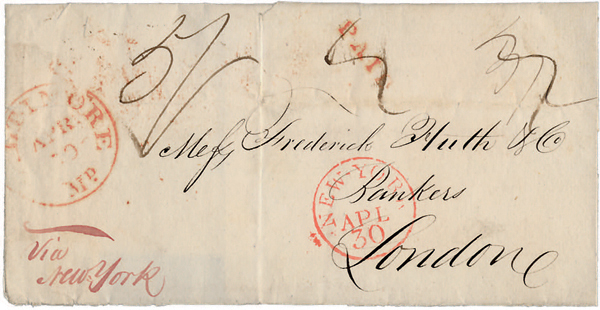
FIG. 5. The letter sent from Baltimore on 28.4.1838 was carried by the Sirius on her first voyage on the way back home. She left from New York on 30.4. and had to make an extra call at Falmouth on 18.5. for coaling. The mails were sent from there by land to London. ‘PAID’ and the rate marking have been struck out, and only the inland 5s postage has been charged from the recipient. On the reverse, ‘SHIP LETTER FALMOUTH’ (used in 1835–1840) and the London arrival handstamp of 21.5.1838.
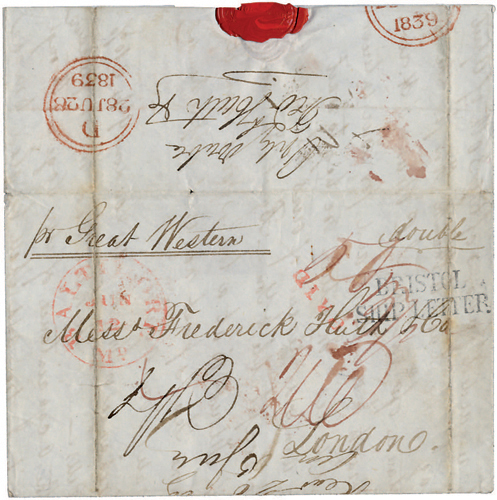
FIG. 6. The letter sent from Baltimore on 11.6.1839 was carried by the Great Western on her 8th round trip. She left from New York on 13.6. and arrived in Bristol on 27.6. The letter arrived in London on 28.6., in 17 days.
Both ships carried mail on board. These letters are usually regarded as the first transatlantic steamship letters in postal historical collections.187 There are no records of the number of letters carried on the ships’ westbound journeys, but on the way back the Sirius carried some 17,000 and the Great Western some 20,000 letters.188 According to a newspaper columnist of the Albion in New York on 5 May, 1838, no charge was taken for the mails.
The loss of profit this caused for the Sirius owners was calculated at up to $4,000 – or £1,000 – a sum that would have paid for a large part of the costs of the voyage. According to the paper, the letter bags would have been more profitable for the company than the 28 cabin passengers carried.189
According to Tyler, the Sirius brought with her some Liverpool newspapers of 3 April and Cork newspapers of 4 April, while the Great Western brought London newspapers of 6 April and one from Bristol of 7 April. An employee of the New York Courier & Enquirer found the Great Western’s mails on arrival and managed to get off with the newspapers and mail bags. The Courier’s editors kept them for several hours, went through the contents and published a special foreign news edition. The other newspapers were greatly annoyed, and so was the British Minister in Washington, whose mail was thus delayed.190
Although somewhat unplanned, this was the start of the regular steamship mail and passenger service between Britain and New York. As a mail carrier, the Great Western took letters westward at ship letter rates. From New York the rate was the same as on the American sailing packets, 25 cents each, and her captain received 2d from the British Post Office for each single letter he landed at Bristol.191
The Sirius made only two round trips across the Atlantic, and then returned to coastal service. The Great Western made more than 40 North Atlantic round trips during 1838–1846, and was then sold to the Royal Mail Steam Packet Company for the British – West Indian service. In 1855, she was used as a troop carrier in the Crimean War, and in 1856 was finally sold to be scrapped.192
The Sirius and the Great Western were soon followed by other transatlantic pioneers. The Royal William of the City of Dublin Steam Packet Co. entered the traffic in July 1838 and the Liverpool of the Transatlantic Steam Ship Co. in October 1838. The British and American Steam Navigation Company’s British Queen, which had chartered the Sirius for the first Atlantic voyage, entered the traffic in July 1839 (see Fig. 7).193
In 1838–1839, these five steamers made 26 transatlantic round trips in total. While the average westbound trip of the American sailing packets between Liverpool and New York took 34.3 days during 1833–1847,194 the average trip by the pioneering steamers was made in 17.7 days during 1838–1839 – in about half of the time.195
Despite the good start and great publicity, several of the pioneering steamers appeared to be non-profitable and they had to be taken out of service after a few trips. The Royal William ended her last voyage in February 1839. The British Queen was also short-lived in this service, primarily due to the financial problems caused to the company by the loss of its new flagship the President, which sailed from New York for Liverpool in March 1841 with 136 people on board and was never heard of again.196 The only long-lived pioneering steamer in the North Atlantic service was the Great Western.
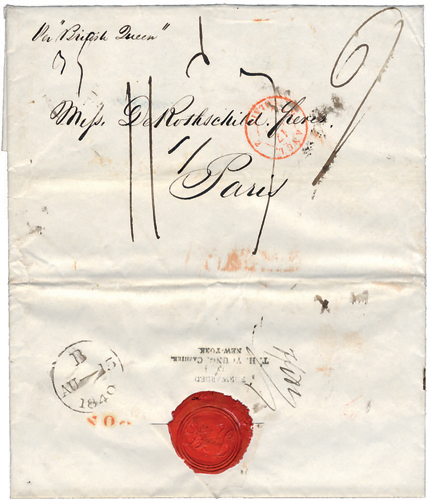
FIG. 7. The letter sent from New York on 31.7.1840 to the Rothschild banking company in Paris, was carried by the British Queen on her 6th round voyage. She departed from New York on 1.8. and arrived in Portsmouth on 15.8. The letter was forwarded to the ship in New York by ‘T. H. Young, Cashier’. It was carried across the English Channel on 17.8.1840 and must have arrived in Paris within a couple of days, in about 19 days in all.
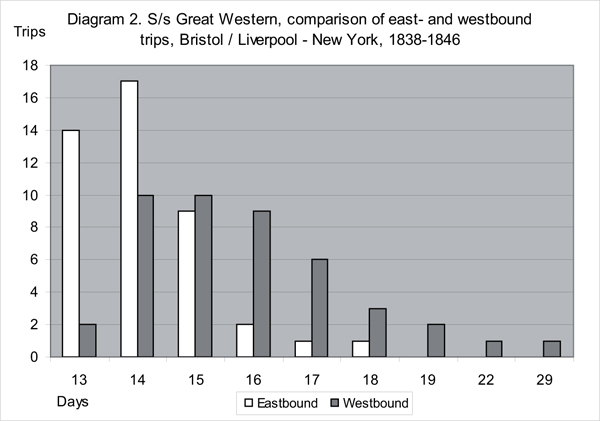
The Great Western was clearly the fastest of all the pioneering steamers. She made her westbound trips in 15.8 days on average in 1838–1842, and in 16.4 days in 1843–1846. Her eastbound trips took 13.7 days on average in 1838–1842, and 14.8 days in 1843–1846.197
It has been argued that steamships offered ‘a huge advantage of independence from the wind’ and that they maintained a regular schedule regardless of the weather.198 Even if this was very much true compared with the sailing ships, the pioneering steamship traffic was not regular in the sense of line service. The Great Western sailed from both ports at about seven-week intervals, staying approximately ten days at port, on average.199 The duration of the trip was still unpredictable, even if the journeys were generally faster than by the sailing packets. Winds and streams also affected the steamers. Diagram 2 shows the difference between the duration of the Great Western’s westbound and eastbound sailings between 1838 and 1846.
Source: Sailing lists of Tabeart (1997), 17–19 .
TABLE 12. Consecutive information circles enabled by the pioneering transatlantic steamers in 1839.
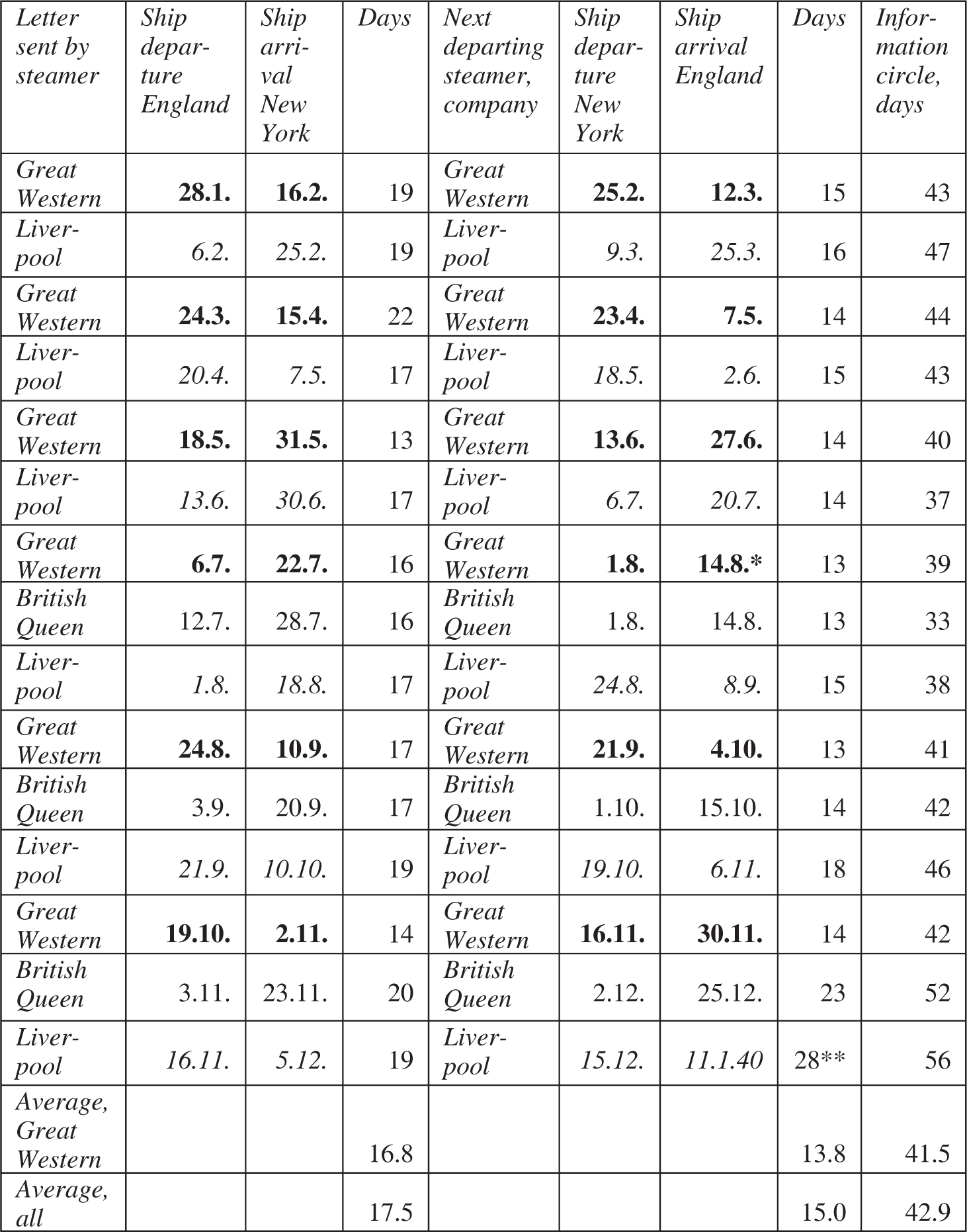
Source: Tabeart (1997), 17. The consecutive information circles enabled by the sailings of the Great Western are marked in bold and those enabled by the Liverpool in italics. The Great Western sailed from Bristol; the Liverpool from Liverpool; and the British Queen from Portsmouth.
* The date is corrected here according to Fox, 82–83; Pond, 180–181. Tabeart’s date is 15.8.
** This was the Liverpool’s last transatlantic voyage. She ran short of coal and had to replenish at Fayal, Azores, which caused a notable delay. See Tabeart (1997), 17.
The Great Western made most of her westbound voyages in 14, 15 or 16 days, a notable difference compared with the sailing ships. Not all the trips were fast, however. While a record voyage was twice made in 13 days, the longest trip took 29 days in February–March 1843. In the 1840s, the Great Western was not in use all year round but stayed at port during the mid-winter months. The eastbound trips normally took 13 to 15 days, with only a few exceptions. There is a visible difference in the duration of east- and westbound voyages.
How did the pioneering steamship service affect the duration of business information transmission? Table 12 shows the flow of the consecutive information circles during 1839. Compared with the five consecutive circles enabled by the American sailing packets in 1838, with an average information circle of 64.4 days (varying between 50 and 98 days),200 the pioneering steamers enabled six consecutive circles, the average being 41.5 days if the letters were carried by the Great Western and 44.5 if carried by the Liverpool. The shortest information circle was conducted by the British Queen, which carried the answers to letters sent from England in only 33 days. She stayed in New York for only four days on her maiden voyage, so as to be able to rush away simultaneously with the Great Western. They arrived at Bristol and Portsmouth within two hours of each other.201
As can be seen in Table 12, both the Great Western and the Liverpool made six round trips to New York during 1839. Each of the two vessels alone enabled six consecutive information circles for the letters and answers of the British merchants. The port stays were short at both ends, and the length of one information circle varied between 33 and 56 days.
The speed of communications was clearly improved by the introduction of the pioneering steamers. The westbound trips in particular were made faster than ever. The steamers made 11 North Atlantic round-trips in 1838 and 15 in 1839. Winter sailings were avoided. For example, between 16 November 1839 and 20 February 1840, no steamer left from British ports on the North Atlantic route.202
There were now four independent shipping companies running the service to New York from several British ports, and the sailings were mostly organized in ways that complemented each other. Yet there were no regular sailing dates, and the unpredictability of the system was still a problem. The next step would be similar to that which had made the American sailing packets so revolutionary two decades earlier: the organizing of line traffic across the ocean.
The origins of the North Atlantic mail contract
From the early 1820s, the superiority of the American sailing packets had been a cause of harm to the British Post Office, not only due to lost postage income but also lost prestige. The government packets were a subject of continuous complaint in the media. Not only were they slower and less regular than the American sailing packets, but their seaworthiness was also publicly suspected, and not without reason.203
The problems dated from the period after the Napoleonic wars, when the Admiralty took over the Falmouth packet service. In connection with the establishment of peace there was a need for a considerable reduction in the number of ships and men in the Royal Navy. By transferring the Post Office packet service to the Admiralty, the surplus men and ships could be kept in use, and they would – at least in theory – be ready for active service in the future. The Treasury supported the plan in the hope of financial savings, and despite the strong opposition by the Post Office, the transfer took place in April, 1823. The contracts and agreements made between the Post Office and the individual Falmouth packet captains were transferred to the Navy Board, and as each contract expired, a naval packet took the place of the privately owned hired vessel. This was a long process, and the last hired packet remained in service until 1839.204
The sailing ships that the Admiralty brought into use in the packet service were ten-gun brigs and sloops, later packet brigs. The first category of packets was small men-of-war, mainly 230–240 tons, and built for general naval purposes in the 1820s. These ships were not designed for the packet service, and each vessel had to be modified and re-equipped, including a reduction in armaments to six guns in many cases. The packet brigs were built in the 1830s for the packet service. They were bigger, about 360 tons, and more seaworthy than the older ones.205
Between 1827 and 1840, no fewer than nine of the 25 naval packets of the first category were lost at sea for varying reasons, mainly a combination of the ships’ poor sailing qualities, bad weather and ice. Several ships just disappeared. Public concern was strongly expressed in the newspapers. The Admiralty packets were called ‘the very refuse and ridicule of the navy’, ‘the lowest vessels that swim the seas’, ‘these official bum-boats’, ‘death ships’ and ‘coffin ships’. In 1827–1828, a total of 102 officers and crew were lost in three different packet disasters, as well as 19 passengers and all mails and bullion carried.206 The press advised the Admiralty that ‘…it would be better if we cannot build safe vessels ourselves to buy a score or two of the New York packets.’207
After 1826 there was no British packet service to New York, only to Halifax and Bermuda, from where the mails to the British Ambassador in Annapolis, Maryland, were carried by a mail boat. The service had been conducted by Samuel Cunard of Halifax since 1827, this being his first mail contract with the British government. Later during the same year the service was altered to carry the British mails from Halifax to Boston, and in 1833 the contract expanded to provide a second mail boat service between Halifax and Bermuda.208
Content removed from the open access version of this book
FIG. 8. Meeting the Sirius in mid-Atlantic on her first voyage ensured the people a board the Admiralty packet Tyrian that it was time to establish a regular steamship mail service across the Atlantic. © National Museums Liverpool (Merseyside Maritime Museum).
In May 1838, when the Sirius steamed homeward on her first transatlantic trip (see Fig. 8), she met the Admiralty mail brig Tyrian at sea, which was returning from Halifax. As the Tyrian was rolling in the flat calm several hundred miles from her home port, the captain decided to send his mails by the steamer. A distinguished Nova Scotian by the name of Joseph Howe was on board and evidently the meeting in the middle of the ocean made a deep impression on him as immediately after arriving he started to press the Colonial Secretary for steam communication between Britain and the North American colonies. New Brunswick and Quebec joined with Nova Scotia, asking for twice-monthly communications with British North America.209
The purpose of these suggestions was mainly political. There were open rebellions in Canada at that time, and information reached England slowly and incompletely. The Admiralty felt uncomfortable about the fact that the British mail transmission depended so largely on the American sailing packets.210 The outcome of the debate and the positive experiences of the pioneering steamers was an advertisement by the Admiralty in November 1838 asking for tenders for a steamship mail service between England and Halifax, with an additional link between Halifax and New York. The service was to be performed by steamers of no less than 300 hp. Voyages should be monthly, and the home port should be Liverpool, Bristol, Plymouth, Falmouth or Southampton.211
Two tenders were submitted in response. The first one was from the St. George Steam Packet Company, which owned the Sirius, offering a service from Cork and connected to a feeder service from Liverpool by smaller vessels. There would also be a similar link between Halifax and New York. The other tender was from the Great Western Steamship Company, offering a monthly service between Bristol and Halifax by 1,000-ton iron steamers or 1,500-ton wooden steamers. The service was to Halifax only, with no further link to New York.212
These tenders were not exactly what the Admiralty wanted to receive, and negotiations were opened with Samuel Cunard of Nova Scotia, who had arrived in Britain with a new suggestion.213 Cunard, born in Halifax in 1787, was well known in the shipping business also in Britain due to the mail services between Halifax–Boston and Halifax–Bermuda at that time. The family had been involved in the shipbuilding business in Halifax, and Samuel Cunard had also worked for a time in Boston, learning the business of ship-broking before joining his father’s and brothers’ company.214
Samuel Cunard had been a shareholder in the first Royal William before she crossed the Atlantic in 1833. He also had interests in the General Mining Association, which ran the Cape Breton coal mines in Sydney, Nova Scotia, and was the Halifax agent for the company. Due to this arrangement, Cunard’s ships could later be supplied with relatively cheap coal from this source.215
In 1839, Samuel Cunard spent several months in Britain searching for partners and collecting capital for a new steamship company that could fulfil the Admiralty’s needs. With the help of friends, he was introduced to some Cabinet members. He was also introduced to Robert Napier, a marine engineer who already had a well-known shipbuilding company in Glasgow; to two Glasgow merchants, David and Charles MacIver; and to James and George Burns, who operated a small fleet of coastal steamers to Liverpool. These men became the main partners of the new British and North American Royal Steam Packet Company shipping line, soon to be known as the Cunard Line.216
In May 1839, the first contract was made with the Admiralty for carrying mail regularly ‘with all possible speed’ from Liverpool to Halifax by three steamships of at least 300 hp each, and also taking care of the mail transport to Boston. In addition, the company carried mails from Halifax to Quebec twice a month in smaller steamers to connect with the transatlantic ships, when the St. Lawrence River was free of ice. The mail contract was to last for seven years with an annual subvention of £55,000.217
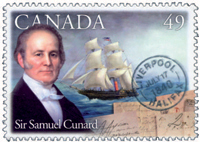
This was not exactly what the Admiralty had originally wanted either. However, Samuel Cunard was aware that a line between Liverpool and Halifax alone would probably not get enough passengers and freight to be profitable, as Halifax had already lost a lot of its commercial importance to American cities. The rapid development of Boston made that port a good choice for a new steamship connection. Moreover, the run from England to New York via Halifax was much longer than to Boston, and this route would have placed Cunard at a disadvantage in competition with the ships that crossed the Atlantic directly to New York without calling at Halifax. The change was approved by the Admiralty without major problems.218
But suspicions surfaced among the Cunard Line’s shareholders concerning the profitability of the new business. The company had bound itself to pay the Admiralty £500 in addition to other fines for every 12 hours that the ships might be late from their prescribed fortnight schedule, on each side of the ocean. This meant that an average of only one day’s delay for each sailing during the year would practically cancel all revenue to be derived from the subsidy. Such a commitment was considered to be a heavy risk in the unpredictable North Atlantic conditions.219
The contract did not mean that all trips should be made in 14 days. For example, the Great Western had been able to manage only three of her eleven westbound journeys in a fortnight or less in 1838–1839. None of the other steamers had made it even once. But, according to the schedule, the ships should leave twice a month from both ports. Even this was considered too risky, if only three vessels were involved in the service, as it would have meant continuous running with about two weeks at sea and one at port – rather unrealistic at that time.
There was no assurance that the Cunard Line would win passengers and freight from the competing steamship companies or the popular sailing packet lines, which would be necessary for profitable business. The counter arguments stressed the fame of Robert Napier’s reliable engines, as well as the fact that America was rapidly expanding westward, starting new industries and attracting more emigrants and travellers from Europe. The company did not have to win business from the sailing packets; it could create business of its own.220
MAP 2. North Atlantic mail steamship routes in the mid-19th century.
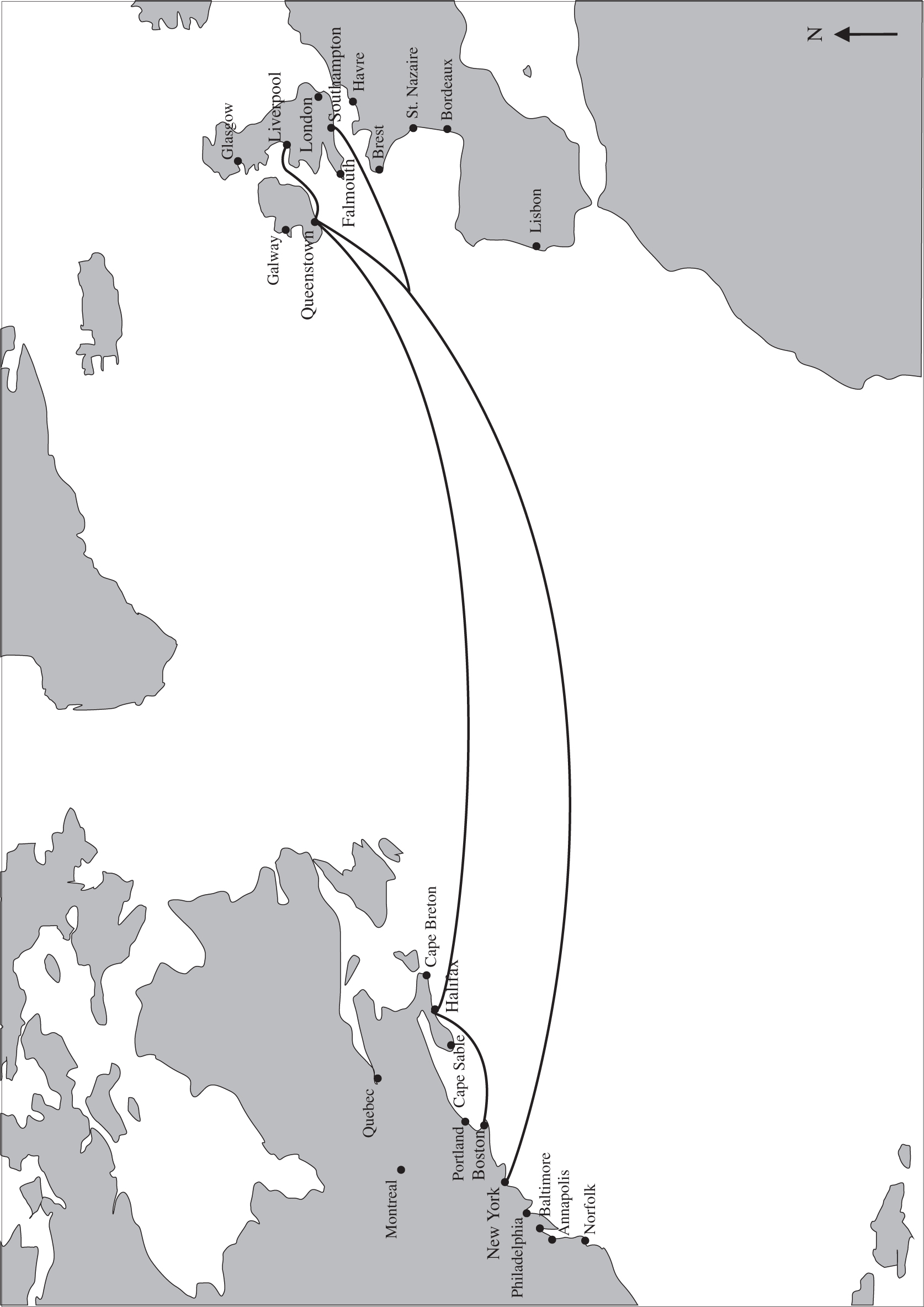
The Cunard shareholders were finally convinced that the opportunity was worth the risk, and the company obtained much more capital than had been planned when the original ships were ordered from Napier. With four ships instead of three they could ensure a bi-monthly sailing from each side of the ocean, and extend the regular service all the way to Boston, making only a call at Halifax, as the chief merchants and businessmen of Boston had strongly desired. They considered that the new line was of great importance for the city’s trade, and had been extremely disappointed to learn that Boston would only be served by a branch from Halifax. This would have meant that passengers and freight to and from Europe would have to be transhipped at extra cost by small steamers at Halifax.221
The Canadians were naturally unhappy with the change in final destination. From their point of view, it showed that Cunard was, strictly speaking, an American packet line instead of a Canadian one.222 The Admiralty approved Cunard’s suggestion however, and a new agreement on government subsidies totalling £60,000 was signed in July, 1839.223
The Admiralty also made a similar contract with the newly established Royal Mail Steam Packet Company for carrying mails between Britain and the West Indies in 1839, to Mexico in 1842 and to South America in 1851. A third contract was made with Peninsular and Oriental Steam Navigation Company, or P&O, for carrying mails between Britain and Alexandria in 1840, via Suez to Calcutta in 1842, and to Penang, Singapore and Hong Kong in 1845. From 1852, P&O also carried mails to Australia.224 Additionally, a steamship mail route was opened to Cape Town, South Africa in 1850.225 These mail routes and their development will be examined in Chapters VI and VII.
The early years of the Cunard Line
The Cunard Line’s first Atlantic crossing was made by the Unicorn, a small steamer that was purchased for feeder service between Pictou, Nova Scotia, and Quebec on the St. Lawrence River during the months when the river was navigable. The Unicorn also carried mail during her trip, thus starting the Cunard mail service across the Atlantic. The first contract steamer Britannia started on the route on 4 July, 1840.226
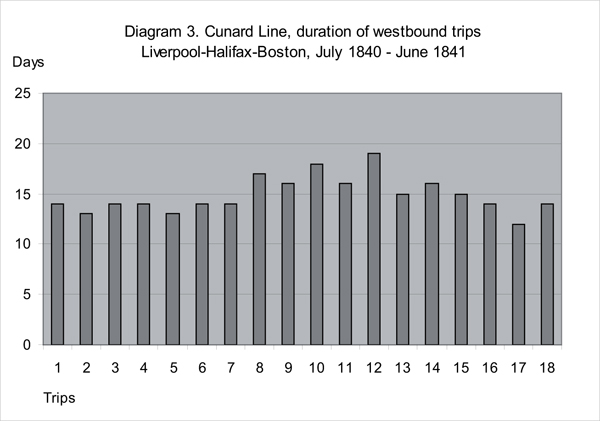
Source: Sailing lists of Hubbard & Winter, 17–18.
During the first year of the company’s transatlantic mail business, the Cunard Line’s ships made the westbound trip from Liverpool to Boston in 13 or 14 days in summer conditions. This included the required stop at Halifax. In November–March, there was only one trip per month in each direction. During the most difficult winter season from early December to the end of March, the westbound journey took 16 to 19 days.
All the eastbound trips except one were made in 13 to 15 days. In May 1841, the Britannia ran upon the rocks off Halifax, which caused a ten-day delay to that journey, as can be noticed in Diagram 4.227
All the four Cunard steamers in the North Atlantic service – the Britannia, Acadia, Caledonia and Columbia – were new and equal in size, each of them ca. 1,150 tons. They were wooden paddle steamers with a clipper bow, one funnel and three masts. They all had a two-cylinder side-lever engine of 420 hp, and an average speed of nine knots. The ships accommodated 115 first class passengers each. In accordance with the Admiralty agreement, gun platforms and bases were also installed on the ships’ decks to be prepared for military purposes in case of war.228
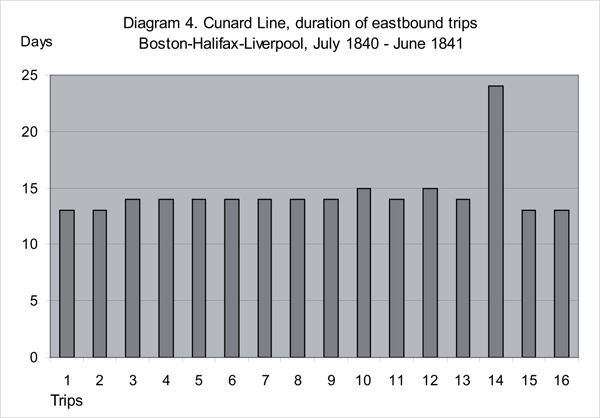
Source: Sailing lists of Hubbard & Winter, 17–18. – The similarity of the four vessels was an obvious advantage. All the voyages could be conducted within the same schedule, which made the service more regular and reliable.
Due to the ships’ identical size and efficiency, they were able to make comparable voyages, which was convenient for the shipping management as well as for the mail service. Their performance was more predictable and reliable than if they had all been different – one of the obvious benefits of giving the mail contract to one shipping line. The average westbound trip on the Liverpool–Halifax–Boston route took 14.9 days. The Britannia made a westbound trip in 15.0 days on average, the Acadia in 15.2 days, the Caledonia in 14.8 days and the Columbia in 14.3 days .229
In the eastbound direction, the differences were even smaller. The average duration of the voyages between July 1840 and June 1841 were as follows: the Britannia 13.9 days (excluding the ill-fated voyage of May 1841), the Acadia 13.8 days, the Caledonia 13.8 days and the Columbia 14.0 days.230
The agreement on a bi-monthly schedule caused no major problems for the Cunard Line. The departures from Liverpool regularly took place on the 4th and 19th of each month from April to October, and on the 4th during the winter months. In the eastbound direction the ships departed from Boston on the 1st and 16th of each month, and on the 1st in the winter.231 The ships made 29 round trips during the first 1.5 years of the line’s existence. Of the 58 departures, two from Boston were one day late with no reason given, and one from Liverpool was two days late due to an order by the British Postmaster General to wait for a late arrival of mail dispatches.232
This was the first time in the world that any shipping company could organize a relatively fast and punctually departing, reliable and rather predictable service in both directions between Europe and North America. Compared with anything else, the Cunard Line’s performance was superior.
A Cunard round trip from Liverpool to Boston via Halifax and back home was normally run in about 40 days. The duration of the stay at the home port was normally approximately 20 days. In 1840, the schedule was tight, as not all of the four steamers had yet been launched. The Britannia stayed only five days in Liverpool between her two transatlantic voyages in October 1840, and so did the Caledonia.233 It is worth noting that the steamers could be unloaded, loaded and coaled for a new transatlantic nautical voyage of 3,000 nautical miles within five days at the port of Liverpool, if necessary. The port had invested, and would invest, notable sums in new docks enabling the berthing of steamships. The advantages of Liverpool soon became so obvious that even the Great Western made the port her regular terminus.234
The Cunard steamers were mainly built for passenger and mail service, but they also carried freight, and the coaling took time as well. It was proposed that the ships would carry twice the amount of coal necessary for the Atlantic crossing.235 The economic balance of the three different businesses – passengers, mail and freight – varied during the years. On eastbound trips, the steamers met hard competition from the American sailing packets. While Cunard ships were able to charge £7 a ton for freight from Liverpool to New York, it was only on rare occasions that cargo could be obtained for carriage homewards, and during the winter months there was very little cargo to carry at all.236 The early years of the line saw a series of financial crises and the contract with the Admiralty was modified several times. Only after a few years’ service could the line turn profitable.237
Competition between early transatlantic mail carriers
Maritime historians have criticised the Cunard Line’s mail contracts for killing the competition and making rival businesses non-profitable.238 However, many opinions are based on aspects that were only relevant some 20 years later, when there were competing companies that really could afford a similar service. Occasional trips by various steamship companies were not an answer to the requirements of a fast, regular and reliable mail service.239
The only pioneering steamship that could compete with the Cunard steamers in speed was the Great Western. Diagram 5 depicts her performance compared with Cunard’s Britannia during 1840–1846, when they both were in regular North Atlantic service.
As can be noticed, the performance of the two ships was almost equal, even though the Great Western was a somewhat larger ship of 1,340 tons compared with the 1,150-ton Britannia. Both ships made only one westbound trip in 13 days during 1840–1846. The Britannia made a few more voyages in 14 or 15 days than the Great Western. Eastbound, the Britannia made three voyages in 12 days, while the Great Western made none. In total, the Britannia made 23 eastbound voyages in 14 days or less, while the Great Western made 20.
It is obvious that the Great Western would have been able to carry the mails under Government contract as well as the Cunard steamers. But the Admiralty wanted a regular bi-monthly service across the Atlantic, and the Great Western Steamship Company could not afford that. In modern terms, the Admiralty had organized a competitive bidding to outsource some of their services – mail transport, as well as building and maintaining fast steamers, and a competent crew for a potential crisis situation – and chosen one company to take care of it. A fast and reliable service would also draw postage income from the American ships, thus bringing in more revenues to the British Post Office. As the Cunard vessels sailed under a mail contract, letters could be sent by them only via the official post organization.
As there was no co-ordination between the official mail service and the pioneering steamers on the same route, the new potential of faster business information transmission could not always be used in an optimal way. The post offices were not able to handle this kind of situation. In November 1842, the problem was discussed by some leading cotton importers at a Committee meeting of the American Chamber of Commerce in Liverpool, and as a result, a memorial was sent to the Postmaster General representing ‘the grievance and praying’ that arrangements would be made to secure the posting of letters to a departing mail steamer as late as possible.240
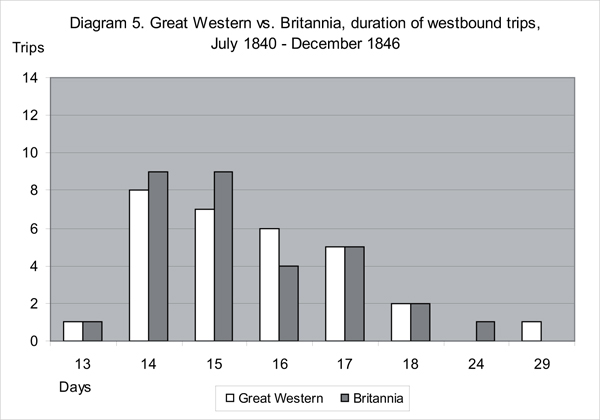
Sources: Sailing lists of Tabeart (1997), 17–19 and Hubbard & Winter, 17–21. – The Great Western served on the Bristol / Liverpool–New York route and the Britannia on the Liverpool–Halifax–Boston route.
The memorial depicts the problem: ‘For example, on the 4th November instant, the day of the departure of the Acadia Steamer for Halifax, the letter box was closed at 8 a.m. but on payment of a small fee, letters were received until 9, after which all letters were refused, although the letter bags did not leave the Post Office until a quarter before 12, and the Packet did not get under weigh until 20 minutes past 12. Thus nearly four hours elapsed of the Mail from the Post Office, and the Packet remained in Port upwards of three hours after the latest period of which letters were received at the Post Office upon any terms. It not infrequently happens, especially when the Halifax packet leaves early in the day, that letters which it is of greatest importance to despatch cannot be delivered at the Post Office until within a short time of the departure of the Packet, such for instance as Foreign letters addressed to persons in Liverpool to be forwarded to Correspondents in America received from London or elsewhere by the Morning’s Post.’241
The memorial continues with an example: ‘In illustration, we would state that the letters by the British Queen, which had been some days due, reached Liverpool on the morning of the sailing of the Acadia but as the delivery of the letters at the Post Office did not commence until a quarter before nine, it was impossible to answer them or even to acknowledge the receipt before the final closing of the Halifax Mail at nine. Under these circumstances, as the Post Office refused to receive letters, there was the strongest completion, amounting in some cases to an overpowering necessity to send letters in the only way in which they could be conveyed, by the hands of Passengers, and even those who were most anxious to conform to the law were in a manner compelled to evade it.’242
According to the memorial, the number of clerks employed in the Liverpool Post Office was inadequate, even for ordinary business, and on packet days the increased influx of letters was quite overwhelming. ‘In cases where the tide is so early as to make it necessary for the packet to leave the port at or about noon, the merchants would gladly pay any reasonable fee for the privilege of an extra hour. We would respectfully request that your Lordship will cause such arrangements to be made as may afford the public the advantage of posting letters within the shortest practicable period before the sailing of each packet for Halifax,’ the merchants suggested.243
Unfortunately this was not the only occasion when the American Chamber of Commerce in Liverpool had to contact the Postmaster General for better ship mail service. In September 1840, two queries were made about the mails that were sent from Liverpool to Southampton for the British Queen to be carried to New York. There were serious doubts about the faith of those letters.244 In February 1846, there were complaints about ‘the delay which exists in the despatch of business in the Liverpool Post Office owing to the want of a sufficient number of clerks and particularly calling attention to the delay in the delivery and despatch of ship letters…’245
There were obviously things to improve in the logistics of overseas mail transmission. Not only was it important that the sea voyages were as fast as possible and frequent enough, but the inland network should also enable the best possible use of the potential. If the answers to the letters sent from New York on 8 October were not taken on board the Acadia, which departed simultaneously with the incoming mails on 4 November, the next option was to send them by the Columbia, which departed 15 days later on the 19th. While the Acadia made the trip in thirteen days, the Columbia’s trip took 17 days, thus causing an extra four days delay.246 The answers to the letters of 8 October would have arrived in New York in 40 days by the Acadia but in 59 days by the Columbia. Thus, one or two hours flexibility in the Post Office routines could make an almost three weeks difference in the speed of information without any changes in the speed of the vessel or the frequency of ship departures.247
The Cunard Line sailings improved the number of consecutive information circles from five by the American sailing ships and six by the pioneering steamers to almost eight per year in 1841, the first whole calendar year of the company’s operations. An example from the mid-1840s shows the strong and weak points of the service:
One of the obvious strengths in the Cunard Line’s performance was the punctuality of the departures throughout the year. Yet the early steamers were not able to run equally long voyages, even if their independent averages were very close to each other. This meant that the unpredictability of one single voyage was still a problem, although hardly considered as such by contemporaries, who had never experienced anything better. As can be seen in Table 13, the duration of the westbound voyages included in this particular chain of consecutive information circles varied between 11 and 20 days. Eastbound the duration varied between 12 and 17 days.
As can be noticed by comparing Tables 12 and 13, the pioneering steamers could sometimes enable shorter one-time information circles than the Cunard Line, as they did not need to wait for a fixed sailing date before leaving from New York. Thus, the regularity could also be an obstacle to faster information circulation.
There was no co-operation with the Great Western Steamship Company steamers but instead they were sailing almost side by side. From the business information transmission point of view this naturally meant a series of lost opportunities compared with a situation where the sailings would have complemented each other. From this angle the pioneering steamers (See Table 12) were better organized during the time before government sponsored mail sailings. It seems that the Great Western Steamship Company’s strategy was to induce as many passengers and freight customers as possible to use their direct sailings from New York instead of the Cunard Line’s sailings from Boston. The Great Western and the Great Britain typically departed one or a few days before the Cunard sailings. However, their sailings were so much slower that the benefit was not great, as can be noticed in Table 13.
TABLE 13. Consecutive information circles enabled by the transatlantic mail steamers in 1845.
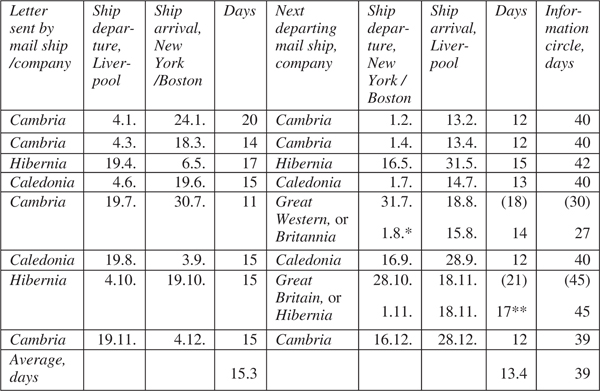
Sources: Sailing lists of Hubbard & Winter, 20–21; and Tabeart (1997), 19. All the other vessels were owned by the Cunard Line, except the Great Western and the Great Britain owned by the Great Western Steamship Company.
* See note.248
** Hibernia run aground off Cape Race, Newfoundland, and had to put into St. John’s for about two days. (Hubbard & Winter, 21.)
The Cunard Line’s privileged position as the official mail line was often claimed to be the reason for the financial problems of its competitors. But the company’s success was not due to the government subsidies alone. It was based on the same qualifications that had made the American sailing packets successful two decades earlier: the regularity and frequency of their sailings, the speed and reliability. These requirements would not have been fulfilled without good shipping management, regardless of government subsidies.
To counter the competition from Cunard, the Great Western Steamship Company had launched a new iron-screw steamer in July 1845, the 3,450-ton Great Britain, which was three times larger than any of the Cunarders. The ship’s performance did not fill the high expectations, however. She met continuous difficulties and, in September 1846 on her fifth outward voyage, went aground off Ireland and was only refloated the following summer. The company was not in a financial position to recondition her and she was sold for £24,000 – about one-fifth of her original cost.249
The Cunard mail contract was renewed in 1846, despite all claims to the Halifax and Boston Mails Committee, which was investigating the issue. Cunard’s plan to make New York the western terminus for their transatlantic service was complained of as ruining the Great Western Steamship Company, which had served on the route carrying mails for eight years without government subsidies. A member of the Select Committee proposed that the contract for the New York mails would be opened to public tender, but this was not acceptable to the majority of the Committee.250
The Great Western Steamship Company would, of course, have been financially more successful had they received at least part of the government subsidies, but the contract was for regular mail service and some naval readiness, and the Admiralty had already received what they needed. Why should the government have provided subsidies to every company who wanted to carry mail across the Atlantic?
In the light of the early experiments by the Post Office as an owner of mail steamboats, it was not a poor idea to outsource the service to a private company. In the absence of government support, there would have been no regular mail steamship service across the Atlantic for years. Small companies with one or two steamers departing from different ports when they had full cargo could not be called a line service. The situation would later change dramatically, due to technical improvements that enabled emigrant transport by steamships in the late 1850s, as will be described in Chapter V.3.
The Cunard Line’s new contract included two routes, one to New York and another one to Halifax and Boston. The sailings would be bi-monthly from each port on alternate Saturdays eight months in the year, and monthly during the winter. The New York service began in January 1848, in good time before the Americans would start their own mail steamship service on the same route.251
Four new steamships – America, Niagara, Europa and Canada – were built for the purpose, at a final cost of about £90,000 each. As Fox notes, most of the capital for these steamers came from private investors, while the mail subsidy mainly provided ‘seed money’ and the prestige of a government contract.252 As with all the other companies, the mail contract lines built ships on private risk capital, and new investments were continuously needed to meet the requirements of faster and more reliable voyages. During the coming years, many shipping companies would fail, even if they were mail carriers on behalf of their national governments.
For the Cunard Line, the decision to invest in the New York service seemed to be right from the beginning. In 1848, the duties collected on Cunard cargoes in New York averaged $10,500 and in Boston $29,500. In 1850 the respective figures were $118,000 in New York and $63,000 in Boston.253
The Great Western Steamship Company gave up the struggle and sold the Great Western to the Royal Mail Steam Packet Line for the West Indian service. The Great Britain started a new career on the Australian route.254
Wind vs. steam – the finale
The start of the Cunard Line’s New York service has been called the final end of the period of importance for the American sailing packets. Even if there had already been steamers on the North Atlantic route for ten years, their schedules had mainly been those of regular traders, not of liners. As long as Cunard was sailing to Boston instead of New York, the packets could hold their own in the competition, but the line’s coming to New York was too much for them. The packets could compete rather successfully against steamships that operated singly, but when the steamships adopted the line principle, the old ‘canvasbacks’ had to give way.255
The steamships’ speed alone had not been enough to displace the sailing packets from the North Atlantic traffic. Even if the most important mails as well as bullion and specie had been transferred to steamers from the very beginning,256 they were not able to carry much freight, and the passengers preferred the comfort of the sailing ships. Also the bulk mail, especially eastbound, was still carried in great amounts by the sailing packets.
The size of the sailing packets reached their peak during the early 1850s in conjunction with the boom in the emigrant business. The first sailing packets of over 1,400 tons were built in the late 1840s. In 1860 the average size of the packets on the New York – Liverpool route was 1,320 tons – three times the size of the first Black Ballers in the 1820s. Some of these ships had a capacity for 800 or 900 steerage passengers. The largest of all regular packets was the Amazon of 1770 tons, built in 1854.257 Even though this was the period when the American clippers were world famous for their speed, the Chinese tea race and various adventures in distant waters, the information transmission on the North Atlantic route was steadily being transferred to the steamers.
TABLE 14. Average size of the mail-carrying American sailing packets, in tons.
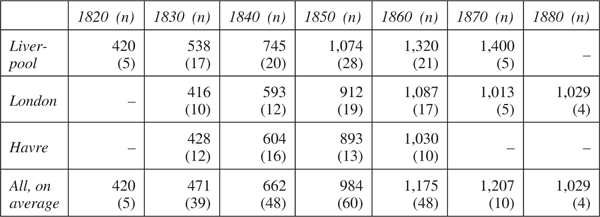
Source: Calculated from the lists of mail-carrying packets published by Staff, 121–127. – The number of packets differs somewhat from Albion’s figures in Table 10 as the table above also includes replacements made during that particular year.
Even if the size of the sailing packets grew markedly, their service speed did not follow the trend after the introduction of steamships on the route in the late 1830s. As can be seen in Diagram 6, the proportion of 20–29 days and 30–39 days for westbound packet trips was about the same – even somewhat smaller – in 1845 than in 1835, and the proportion of the longest trips of 40–49 or 50–59 days had grown correspondingly.258 There seems to be no signs of speed improvements after 1835.
Another phenomenon which indicates that the sailing packets were losing their hold on the first class business – mail, fine freight and cabin passengers – was that they no longer cared about the punctuality of the sailing dates as much as they did in the 1830s. If the reliability of a mail ship service is measured by the regularity of sailings and the safety records, the performance of the American sailing packets in the mid-1840s was noticeably below such expectations.
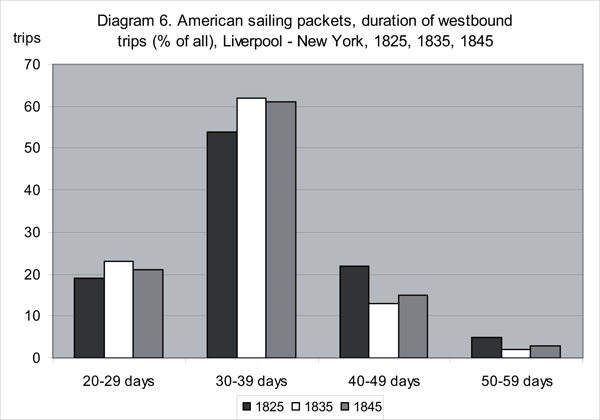
Source: Lloyd’s List 1825, 1835, 1845; Liverpool Customs Bills of Entry, 1825, 1835. The number of sailings included is 37 in 1825, 47 in 1835 and 66 in 1845.
As can be seen in Table 15 (in the end of the book, p. 426), the departures from Liverpool were mostly delayed from their scheduled sailing dates in 1844–1845. Only 25 sailings out of 147, or 17%, took place on the scheduled date. The number of disasters at sea had also grown alarmingly.
Despite one of the poorest records in sailing regularity, the Red Star Line advertised in the Liverpool Mercury in January 1845: ‘Sails on the 26th of every Month… These ships are all of first class, recently built in the city of New York, and for strength, beauty of model, punctuality and swiftness of sailing, as well as for extent and comfort of cabin accommodations, are not surpassed by any in the trade, and their commanders are men of great experience… To insure punctuality in sailing, no goods can be received onboard unless they are down two days before the day of sailing.’259
The Black Ball Line and the New Line did not mention punctuality in their advertisements, despite being the most punctual of all the sailing packet lines in 1844–1845. The sailing dates were naturally expressed. Also their ships were ‘of first class’ and commanded by ‘men of character and experience’ or ‘men of experience and ability’. Each sailing packet line offered the Atlantic crossing in their ‘elegant and commodious’ cabins for £25, everything included except wines and spirits, which could be procured from the steward.260
The Dramatic Line, managed by Edward K. Collins, later to be an important steamship line owner, had appeared in the transatlantic traffic in 1836. Albion calls the line ‘a group of splendid ships that momentarily threw most of the others in the shade’.261 So did the company’s advertisement, too: ‘Line of Packets for New York. Sailing of the eleventh of every month… These ships are all of the first and largest class, built in the city of New York, of the best materials, and with such improvements as to combine great speed with unusual comfort for passengers, and they are commanded by men of experience and ability... The utmost punctuality will be observed as on the day of sailing to insure which, no goods can be received after the 9th of each month…’262
On the same page, the Cunard Line announced that ‘British and North American Royal Mail Steam Ships of 1200 tons, and 440 horses’ power each, Appointed by the Admiralty to sail between Liverpool and Boston, calling at Halifax to land and receive passengers and Her Majesty’s Mails’ would depart from Liverpool on the 4th of each month and from April (when the summer season began) additionally on the 19th. Passengers’ luggage should be on board the day prior to sailing. The price for the passage was 38 guineas, including provisions but without wines and liquors, which could be obtained on board. The steward’s fee was one guinea, and dogs were charged £5 each. At the end of the advertisement, there was an important note: ‘All Letters and Newspapers intended to be sent by these vessels must pass through the Post-office, and none will be received at the Agent’s Offices.’263
Cunard’s advertisement did not mention comfortable accommodation or experienced commanders, even though each captain’s name was well pointed out in the advertisement, and they were in fact very experienced.264 The accommodation on the early steamers was again one of their greatest disadvantages and nothing to advertise when compared with the sailing packets.
The advertisements in the Liverpool Mercury on that day265 included two sailing packets that had sailed from Liverpool on 26 November and 1 December 1844, and were never heard of again. The United States of the Red Star Line and the England of the Black Ball Line met a tremendous storm and were lost with several other ships, including the Havre Line packet Normandie as well as the Boston Line packet Dorchester, the crew of which was saved by the New Line packet Rochester on her way to New York.266 The companies kept the schedules of the United States and the England in their advertisements until 21 March. By then, the Red Star Line had replaced the United States by a transient ship called the Empire and the Black Ball Line had replaced the England by its own packet named Oxford, which should have sailed two weeks later and arrived in Liverpool on the same day as the newspaper was published.267
The Cunard Line’s advertisement also included a replacement. One of the company’s original steamers, the Columbia, had been wrecked off Nova Scotia in July 1843, fortunately without loss of life or mail.268 Her replacement, the Cambria, mentioned in the advertisement, had just left on her maiden voyage and was now advertised as departing for the following one.269 Cunard had also purchased a fifth vessel for the transatlantic route; the Hibernia was launched just before the loss of the Columbia and took her place until the new ship was ready for the route.270
In the pressure of hard competition, packet schedules were tightened when reorganizing sailings due to disasters, new launchings, etc. In 1844–1845, several ships made three-month round trips instead of the traditional four months, calculated from one Liverpool departure to the following one. All these ships – the Virginian and Waterloo of the Red Star Line as well as the Independence and Patrick Henry of the Blue Swallowtail Line271 – were among the fastest on the North Atlantic route.272 However, these short round trips did not depend on speed, which was in all cases average, but just changes in the schedule. The efficiency of the packet sailings could apparently have been improved by tightening schedules, but it would also have increased the risk of problems and delays.
As can be seen in Table 15 (in the end of the book, p. 426), westbound sailings involved a high risk of disasters. Of the 143 recorded trips of 1844–1845, at least a dozen ended in reported losses or other problems. Additionally, one loss of ‘main top-mast etc.’ was also reported from an eastbound voyage.273 Interestingly, five of these misadventures happened to the same ships, the Virginian and the Independence, which were among the speediest of all in packet history, and made the three-month round trips.274 Also the lost England was one of the fastest vessels. They had all sailed from Liverpool to New York in three weeks or less. The United States was in the medium speed class in packet records of 1818–1858.275
According to Albion’s calculations, nearly one packet in six was totally lost in service. The figure could also be put more nicely: only 22 of nearly 6,000 packet crossings ended in such wrecks.276 It seems, however, that the hard competition between the sailing packet lines as well as between sail and steam made the packet captains take more risks than they did in the earlier years. Most of the wrecks took place during the period when the competition between sail and steam was hardest.
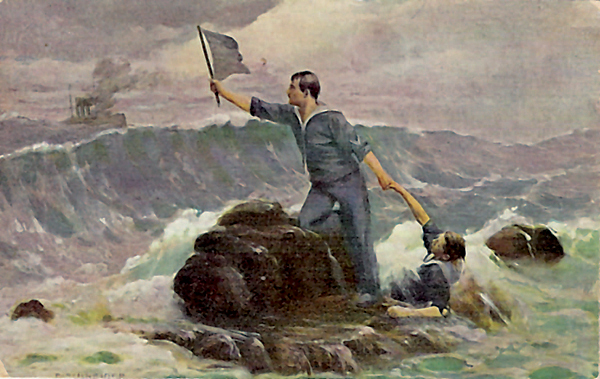
FIG. 10. In case of a disaster at sea, the only hope for saving the people on board and the mails was that another ship would pass by and pick them up before it was too late. – An old German postcard ‘Rettung naht’ (by E. Schneider).
From a mail transmission point of view, the trend was most alarming. Between 1838 and 1847 no less than 21 mail-carrying ships were lost on the North Atlantic route – two each year on average. Two of the ships were Falmouth packets and two were steamers, while 17 were American sailing packets. Eight were on the New York–Liverpool route, two on the Boston–Liverpool route, two on the New York–London route, and five on the New York–Havre route. Six of the ships just disappeared, and were lost with all hands.277 It is notable that two out of every three wrecks took place in November–February, indicating that the packet captains took too heavy risks, especially during the rough winter sailings.
The only precautionary measure to ensure solid business information transmission across the Atlantic was to send duplicates. This was very typical during the shift period. The duplicates also ensured the fastest possible dispatch of information.
It is not easy to find relevant numbers of North Atlantic merchant correspondence from this period. For example, there is almost nothing in the Liverpool archives. Fortunately, the huge correspondence of the London-based banking firm, Frederick Huth Co., was partly saved from being burnt during the wartime energy crisis by a philatelist, and these letters can easily be discovered in the philatelic exhibitions of today.278 A sample of Huth’s correspondence from the period 1836–1850, including 74 transatlantic letters to London, interestingly depicts the change from sail to steam:279
As can be seen in Table 16, business information transmission by sailing ships did not end in 1838 when the mail-carrying steamships started their regular trade across the Atlantic. The sample here is naturally too small to give any reliable figures on the share of each means of communications during the period. It is too small even to tell anything about these shares in the incoming mail of Frederick Huth Co. However, it clearly demonstrates that a great part of the bulk mail – especially eastwards – was still carried by sailing ships during the first decade after the launching of the transatlantic steamship service.
TABLE 16. From sail to steam. A sample of Frederick Huth’s correspondence, 1836–1850.
| Year |
Merchant ship |
American sailing packet |
Steamer |
Total |
| 1836 |
– |
3 |
– |
3 |
| 1837 |
1 |
4 |
– |
5 |
| 1838 |
– |
4 |
1 |
6 |
| 1839 |
1 |
2 |
3 |
6 |
| 1840 |
1 |
3 |
2 |
6 |
| 1841 |
– |
5 |
5 |
10 |
| 1842 |
– |
4 |
2 |
6 |
| 1843 |
– |
2 |
1 |
3 |
| 1844 |
– |
1 |
2 |
3 |
| 1845 |
2 |
1 |
1 |
4 |
| 1846 |
– |
1 |
3 |
4 |
| 1847 |
– |
1 |
5 |
6 |
| 1848 |
– |
– |
3 |
3 |
| 1849 |
– |
– |
3 |
3 |
| 1850 |
– |
– |
7 |
7 |
| total |
5 |
31 |
38 |
74 |
Source: Letters received by the Frederick Huth & Co. in the following postal historical collections: SRLC, JSC, JAC, STC, and RWC.
There is no reason to believe that any part of this material would have been preferred in the philatelic collections. They are all bulk mail and carry no prepaid postage stamps, which would make them especially attractive or valuable. The letters are collected because of their postal markings: routes, ship names, rates and forwarding markings, and none of them should have caused distortion in the sample. Even if the proportions might be slightly different in a larger sample, it seems obvious that the American sailing packets dominated the mail route until the steamship traffic started and that they kept a good share of it for several years before the steamers finally took over the business.
The sample also shows that merchant ships were still used for information transmission on the North Atlantic seaway, even if this was uncommon. One of the letters was sent from Buenos Aires by a merchant ship instead of a government packet, and another one was sent directly from New Orleans instead of using the coastal route to New York, from where the letters were normally forwarded to Liverpool by the American sailing packets.
Interestingly, most letters were sent via Liverpool, even if Frederick Huth Co. was located in London and there would have been direct packet services to London as well. Three of the five merchant ship letters, 25 of the 31 packet letters, and 32 of the 38 steamship letters arrived via Liverpool – 57 of 74 letters in all. Additionally, it happened twice that the original routing was via Liverpool, but the forwarding agent in New York had sent the letter by an earlier departing London packet instead.
Regarding the steamship letters, the reason is naturally that Liverpool was the home port of the Cunard Line as well as of the short-lived pioneering steamer Liverpool, and that the Great Western had also used Liverpool as her home port since 1843. For most of the sailing packet arrivals, there is no explanation other than the more frequent schedules of the Liverpool packets, and maybe the reputation for faster sailings. Since the railway was opened for the whole distance between Liverpool and London in 1838,280 the letters usually arrived in the City on the following day after the ship had entered the port at Liverpool. If the ship arrival fell on a Saturday, the letters were dispatched in London on Monday.281
At least 19 of the 74 letters were duplicates, or originals of which a duplicate had been sent by another vessel. In some cases, it is mentioned in the letter by which ship another one of the letters had been sent. In several cases it remains unknown, however.
Up to 1838, duplicates of letters were normally sent by two different sailing packets from New York. None of the duplicates mentions merchantmen, and none of the letters by merchant ships indicates that it would be a duplicate. It seems that merchant ship letters were not alternatives to normal mail on the North Atlantic route but were used on special occasions, probably as consignee’s letters in cases where their own cargo was sent by the same trader. As the Falmouth packet service to New York had been closed down in the 1820s, this alternative as a duplicate was out of the question.282
From 1838, it was common to send one of the letters by a steamship and the other one by a sailing packet. From 1844, in all cases where a duplicate records a ship name, both letters were sent by steamers.
A particularly interesting duplicate was the one of which the original, dated 23 November, 1850, in Havana, Cuba, had been sent on the day of writing by the Royal Mail Line’s steamer Conway to St. Thomas, where it arrived on 2 December. The letter proceeded on the next day by the same company’s mail steamer Avon, which arrived at Southampton on 22 December, 1850. Meanwhile, the duplicate letter was continued by the writer in Havana on 2 December, and sent by another route to Frederick Huth & Co. in London. The letter was carried by the United States Mail Steamship Company’s steamer Georgia, which departed from Havana on the day of writing the continuation, and it arrived in New York on 7 December. From there, it was forwarded by an agent, A.C. Rossire & Co., to the Cunard Line steamer Europa, which departed from Boston on 11 December and arrived at Liverpool on the 21st. The letter was received in London on the 23rd – probably simultaneously with the original, which had departed from Havana nine days earlier.283 This can indeed be called professional use of existing international mail steamship services at that time.
As many of the letters arrived from distant places like Havana or New Orleans, forwarding agents were often used to ensure that the information was sent by the fastest possible means.284 If the writer was not sure of the ship schedules, he could write ‘per first Packet’ or ‘per first Steamer’ on the cover and the forwarding agent, often a well-known merchant house, took care of the rest. In these cases the letter was sometimes addressed to the forwarding agent, who struck off his name and address and sent the letter forward to the final recipient.
New York agents in the Huth correspondence were, for example, Aldrick & Kruger, William W. De Forest & Co., Goodhue & Co. and Meyer & Stucken. Letters could also be forwarded by Hale’s Foreign Letter Office or Gilpin’s Exchange, Reading Room and Foreign Letter Office. In New Orleans at least Hermann & Co. was one of the used forwarding agents; in Boston, Shelton Brothers & Co. and J. Winslow & Sons.285
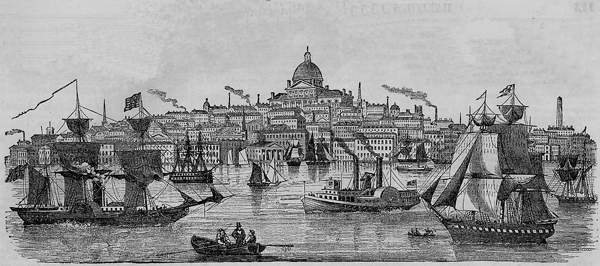
FIG. 11. The port of Boston. (Ballou’s Pictorial, 1856.)
In addition to the Frederick Huth Co. correspondence, a sample of transatlantic business letters from the same period can be found in the collection of Rathbone Bros & Co. This small portion of letters, only 23 from the period 1841–1849, gives rather similar results to the sample above. Ten of the letters are from the years 1841–1842. Two of them were sent by sailing packets, and the rest by steamers. Of the 13 letters from 1848–1849, 11 were sent by Cunarders and two by other mail-carrying steamships.286
At least five of the ten earlier period’s letters refer to duplicates in one way or another. William Rathbone Jr., the writer of the letter dated New York, 30 April 1841, notes: ‘Dear Sirs, I wrote on the 28th instant pr Columbia with such information as I could collect of your friends here, which however was not definite enough to make it worthwhile to send a duplicate…’287 Three of the letters are duplicates or enclose duplicates, and in one case the writer tells that he will write ‘more fully by the steamer which will probably reach you before this’. This letter was sent by a sailing packet and received on 28 July, while the steamer Britannia arrived in Liverpool one day later, on 29 July.288
Although it caused much trouble in the company routines to send duplicates and even triplicates of letters across the Atlantic, and the postage rates were rather high, the cost was considered acceptable because of the general unpredictability of the sailings.289 The examples above were all from eastbound journeys. The difference between sailing packets and steamers was more evident westbound.
In 1845, there were no less than 102 mail ship departures from Liverpool to New York / Boston. All mail-carrying North Atlantic steamships departed from Liverpool that year, in addition to no less than five American sailing packet lines.290 Compared with the situation ten years earlier, the improvement in the scale of options in business information transmission was remarkable.
In addition, some of the regular traders called themselves ‘packets’ or were hired as transients by the packet lines for a few voyages, and they could and often did carry letters and newspapers on board as well. ‘News and Observations, American News’ in the Liverpool Mercury of 31 January 1845 gives a good example: ‘The New York packet ship Sea, Captain Edwards, arrived on Monday, bringing New York papers to the 11th inst. Their contents are unimportant both politically and commercially…’291
Even though most ‘American News’ of that time was carried by Cunard steamers, a fast sailing packet could still be a news-bringer eastbound in 1845, especially in winter when there were not many steamship sailings. The Sea is not listed as a line packet by Albion or Staff, but Cutler mentions her as one of the New Line’s vessels that year.292
It can easily be noticed in Diagram 7 why the sailing packets lost the competition against steamers in mail transmission, especially westwards. The benefits of steam power in the struggle against the westerly winds were so obvious that there was practically no reason to send letters by sailing ships any more. There were few situations where the next sailing packet would have had an even theoretical chance of arriving in New York before the next steamer. Instead of sending an original by a steamer and a duplicate by a packet, or vice versa, duplicates were now being sent by two successive steamers to ensure solid information transmission, even in the case of misadventures at sea.
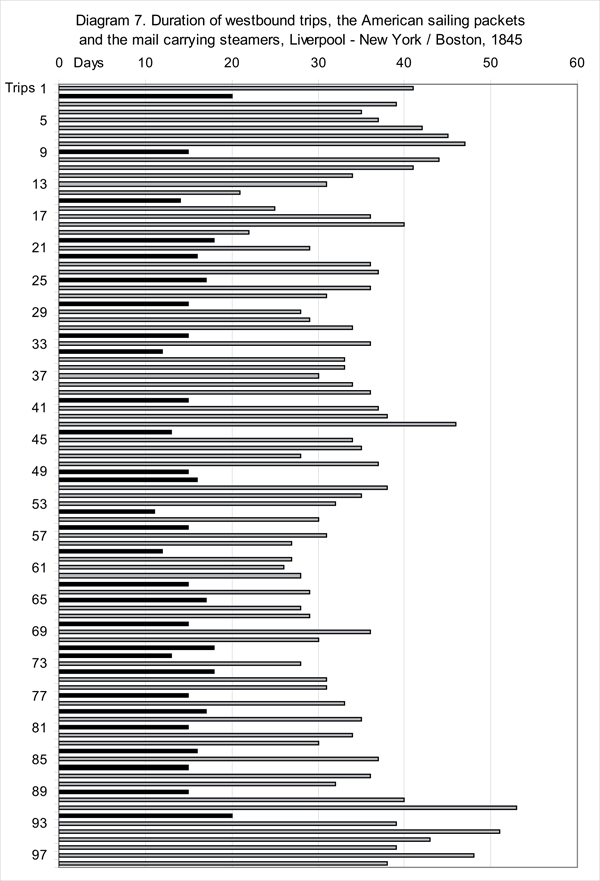
Source: Lloyd’s List 1845; sailing lists of Tabeart, 19. – The difference between sail and steam was remarkable on westbound voyages. The black pillars depict the sailings of the mail-carrying steamers from Liverpool to New York or Boston in 1845: the Cunard vessels and the pioneering steamers Great Western, Great Britain and Massachusetts (an American steamer, which only made two round trips). The light pillars depict the sailing packet voyages. Their departures on 18.2.1845, 22.9.1845, 29.10.1845 and 7.11.1845 are missing from the table. They should have been placed between trips 11 & 12, 73 & 74, 82 & 83 and 84 & 85.
Even though the Cunard Line’s monthly winter sailings were the only ones conducted by steamers in the mid-1840s, using them in business information transmission was notably faster than using the sailing packets.
Table 17 shows the different options for business communications from November 1844 to February 1845. During those four winter months, at least 30 mail-carrying line vessels sailed from Liverpool to New York or Boston. In November there were eight ships, in December seven, in January seven and in February seven – approximately two each week.
The duration of the New York packets’ westbound sailings varied between 27 and 51 days, and the duration of eastbound sailings between 16 and 31 days. The respective figures for the Cunard Line steamships were 15 to 20 days westbound and 12 to 16 days eastbound. The steamers were so much faster that it was normally better to keep the letter or its duplicate waiting for the next steamship departure instead of sending it by any sailing packet that would leave before that date.
If, for example, a letter had been sent from Liverpool to New York by the Cunard steamer Britannia on 5 November 1844, the answer to it would have arrived in Liverpool on 16 December. An answer to that letter could have been sent by the Cambria on 4 January, 1845, and the answer to that letter would have been in Liverpool on 13 February. If the sender had instead used the sailing packet Queen of the West for carrying the original letter, he would have received the first answer to it only on 13 February, 1845, by the same vessel.293 The steamship service enabled two consecutive information circles for correspondence compared with only one by the sailing packets.
This can be called the ‘leverage effect’ of steamship communications. It was not only the single fast crossing of the ocean that counted. As communication is basically a two-way activity, this effect doubled the impact of the regular steamship mail service, being thus even more revolutionary than has generally been estimated in historical research. And, as will be demonstrated later, not only could the technology be improved but also the whole system of communications.
TABLE 17. Mail sailings on the Liverpool–New York / Boston route, winter 1844–1845.
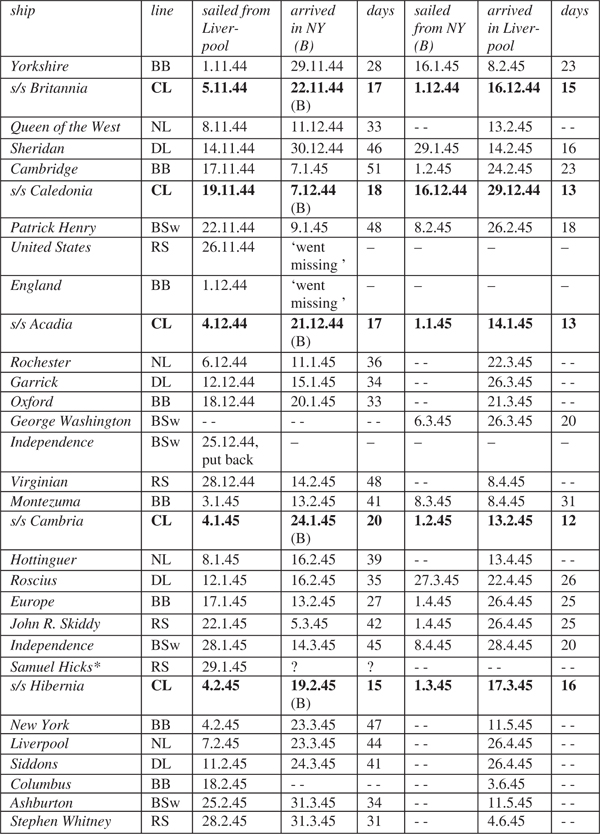
Source: Lloyd’s List 1844–1845. – Steamship departures are marked in bold. Only the Cunard Line had winter sailings at that time.
* The sailing of Samuel Hicks 29.1.1845 was advertised by the company in the Liverpool Mercury as one of the line’s regular sailings. She might have been a transient. (Liverpool Mercury 24.1.1845)
Benefits of Competition
New mail contract lines – Cunard Line vs. Collins Line – Ocean Line and Havre Line, the forgotten contract companies – Competition and business information transmission – Changes in the transatlantic mail services in the late 1850s – Emigrant lines take their share of mail transport – Effects on business information transmission – Open competition, the new deal on mail contracts – In search of glory - reputation and real life – What happened to the speed of business information transmission?
New mail contract lines
Actually, the Cunard Line never had a monopoly in the North Atlantic mail transmission. Until the late 1840s, the company competed with the American sailing packets and the pioneering steamers, and after that with foreign contract mail carriers.294 As letters carried by the competitors in the 1840s are not considered rarer in philatelic collections than those carried by the Cunard steamers, the amount of mail carried must have been large by all these means of communications. One reason for using alternatives to mail contract vessels was the high postage rates, which could be partly avoided by private shipments.
It did not take long before other governments adopted the British model for their transatlantic mail services, not so much for faster communications but for the commercial interest and the prestige of the country, as the French Minister Thiers put it in the French Parliament in 1840.295 In April 1847, after a few years’ hesitation, the French Government announced that it had made a ten-year contract with Compagnie Générale des Paquebots Transatlantiques, or the Hérout & de Handel, for a mail service from Havre directly to New York. The Government also provided the use of four paddle-wheel transport steamships of the French Navy and a substantial financial subsidy.296
The line planned to start its operations from Havre on 31 May 1847, but the basin at Havre had to be dredged before it could support steamships. As a result, the first voyage had to be delayed, and the next seven voyages started from Cherbourg. The company’s small steamships proved to be unsuitable for the North Atlantic route. They were slow, had frequent machinery problems, and often ran short of coal before the intended voyages were completed. Later historians have not found much positive to say about the company’s performance. According to Staff, ‘the line was so ill managed and its ships got themselves into so many ludicrous situations that it lasted less than a year. Its effect in the field of competition cannot be said to have been serious.’297
It was not only the speed that was important. Albion describes the Hérout & de Handel Line’s performance as a comedy of errors: ‘The first trip was almost the only one completed in a satisfactory manner. Ship after ship ran out of coal and had to finish the trip under sail, while the New York–Havre sailing packets sped past them. Some clumsy accidents occurred in New York harbor, where the helmsmen, not knowing English, did not understand the pilots’ orders. French pride was hurt by the constant jokes on the subject; some eighty of New York’s most prominent French residents held a meeting to inquire into the matter. The hearing revealed one shortcoming that was regarded as more unforgivable than running out of coal or bumping brigs. It was at least to be expected that Frenchmen could feed their passengers well, but that was apparently not the case. Lieutenant Maury [the well known oceanographer] told the tale of one of the French liners putting to sea without sugar; when this was discovered, the captain offered to put back to New York but, as Maury remarked, it was too late: the passengers had already become sour. This sugar business broke up the line.’298
Of the sailings conducted, the average westbound journey took 18.1 days, and the eastbound 17.0 days.299 In February 1848, the Hérout & de Handel Line suspended operations having lost the government subsidy due to the poor performance. The service was not restarted, and it was 16 years before another French steamship company would be established on the North Atlantic route for mail service.300
There was aroused interest in the United States, too, in establishing their own steamship mail services, when it became evident that the sailing packets had lost their superiority on the North Atlantic route to the British steamers. In October 1845, the U.S. Postmaster invited tenders for a mail steamship service from New York to various European ports. Encouraged by Cunard’s example six ship operators wanted to start a transatlantic mail service. Of these tenders, three were accepted. The mail route from New York via Southampton to Bremerhaven – or Havre on alternate voyages – would be taken care of by Edward Mills, a promoter unknown in the shipping world. The contract with the Ocean Steam Navigation Company, or the Ocean Line, required four vessels and bi-monthly mail service. This was changed to a monthly service to Bremerhaven with only half of the subsidy appropriated. The service started in June 1847 and the contract was later extended for a second five-year period.301
The mail contract for the Havre route was signed with the New York & Havre Steam Navigation Company, or the Havre Line. It was a monthly service with a call at Southampton on each voyage. The line started operations in October 1850.302
The most important mail service between New York and Liverpool was granted to Edward K. Collins, whose Dramatic Line had been running sailing packets on the same route since 1836 and earlier packets between New York and Vera Cruz, Mexico, as well as between New York and New Orleans.303 The ten-year contract with the New York & Liverpool United States Mail Steamship Company, or the Collins Line, was made to construct and equip four steamers for a bi-monthly mail service at least eight months a year, with a monthly service during the winter. In 1852 the contract was changed to a bi-monthly service throughout the year.304
In the autumn of 1850, the North Atlantic mail and passenger steamship service looked very different from what it had been only a year earlier. The American mail steamship tonnage clearly beat the Cunard Line’s, whose seven vessels in traffic were rather small compared with the new rivals.
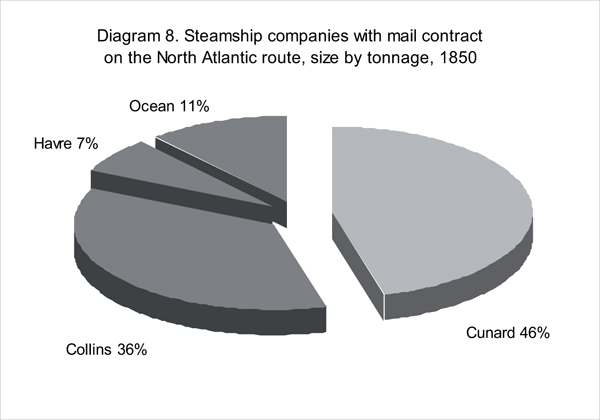
Source: Staff, 129–131. The total tonnage of the mail-carrying steamship lines on the North Atlantic route in late 1850 was 31,824 tons.
Cunard Line vs. Collins Line
Edward K. Collins started his mail steamship service between New York and Liverpool in late April, 1850. The competition between the two shipping companies, the Cunard Line and the Collins Line, has aroused more passionate feelings among contemporaries and maritime historians than probably any other period of transatlantic history. Not only was it a contest between two popular companies, but there were also strong political passions and national prestige involved.305
This study will focus on the effect of the Cunard-Collins contest on the speed of business information transmission. Both companies were generously subsidised by their governments and carried mail on the same route, but only one of them survived.
According to several maritime historians, it was agreed from the outset that the Collins service should beat the Cunarders.306 At the time when the Collins Line started its service, the Cunard steamers could occasionally make the westbound trip between Liverpool and Boston in 12 days, including the stop in Halifax. In 1850, Cunard’s new steamship Asia made the voyage to New York in 11 days.307 This was the starting point for Edward Collins, who promised that his vessels would make the trip faster than any others.
The Collins steamers were notably larger than Cunard’s – wooden paddle-wheelers of about 2,850 tons with excellent accommodations including, for example, the first steam heating system on board.308 The Collins Line’s first steamship, the Atlantic, entered service in April and the Pacific in May 1850. The two other ships, the Arctic and the Baltic, made their first voyages in October and November of the same year. They were all sister ships and carried 200 cabin passengers each.309
Calculations from the sailing lists show that the Collins Line could reach its target of being faster than any other – crossing the Atlantic in 11 days or less – only occasionally in 1850–1851. In fact, 43.2% of the line’s westbound and 32.4% of its eastbound voyages lasted 12 days or more. The Cunard Line’s figures on the Liverpool–New York route were 72.5% and 35.0% respectively.310
Despite misfortunes and delays in the beginning, Edward Collins’ PR efforts impressed his contemporaries, who believed that the Cunard Line was playing a losing part in the contest by clear figures. Even Lawrence Babcock, the latter company’s historian, wrote in the 1930s: ‘From this time on, the fastest passages were made by the Collins ships without a single Cunard victory to even the contest.’311
In fact, the speed of the two companies was more identical than could be expected, but the public image was different. From the beginning, PR and reputation at the home port was considered more important than the image on the other side of the Atlantic. Thus, the Collins steamers always strove to sail fast voyages westbound towards New York, their home port, even though it caused them problems in the form of broken machinery and major disasters. Too hard or careless driving was said to be typical of the Collins Line’s captains, many of whom were former sailing packet commanders. The vessels achieved high speed at the cost of abnormally heavy wear and tear on the engines, and it was not unusual that the mechanics worked day and night on repairs during the time spent in New York.312
The Cunard steamers made a few more fast eastbound trips than the Collins Line, although the larger Collins vessels would probably have been able to beat them in that direction as well, if the company had felt it was important.
As can be seen in Diagram 9, the Collins Line made several faster westbound voyages than Cunard in 1850–1851. However, the spread of the duration of voyages was notable. The Collins Line made most trips in 10 to 12 days and the Cunard Line in 11 to 13 days, but the voyages could sometimes last even 17 or 18 days. The average westbound Collins Line voyage took 11.9 days, while the Cunard Line took 12.5 days.
Eastbound, Cunard made a few faster trips than Collins. During the first 1.5 years of the contest, Cunard’s ships made seven eastbound trips in ten days versus the Collins Line’s four and almost as many 11-day voyages as the Collins Line. All trips were made in 10–13 days. The average eastbound voyage of both shipping lines took 11.3 days.
The complementing services of the British and American mail contract lines now enabled a well-working communications system across the Atlantic.313 In addition to the remarkable improvement in speed, the business world derived benefit from the markedly increased frequency of mail ship departures. The circulation of business correspondence in 1851 is depicted in Table 18, the starting point being a letter sent from Liverpool to New York on 1.1.1851.
While the regularity of the Cunard Line vessels and their winter sailings had enabled an improvement in information circulation from six times per year by the pioneering steamers to eight times, the frequency of sailings was the following step. From 1848, when the Cunard Line started the additional mail route directly to New York, the combination of the line’s services – 22 annual round trips to Boston and 22 to New York – alone enabled ten consecutive information circles between Liverpool and New York, whether via Boston or directly to New York. However, these sailings were not coordinated in the best possible way. It often happened that the ship for England had only just departed when the next one arrived, or she departed on the same day.314
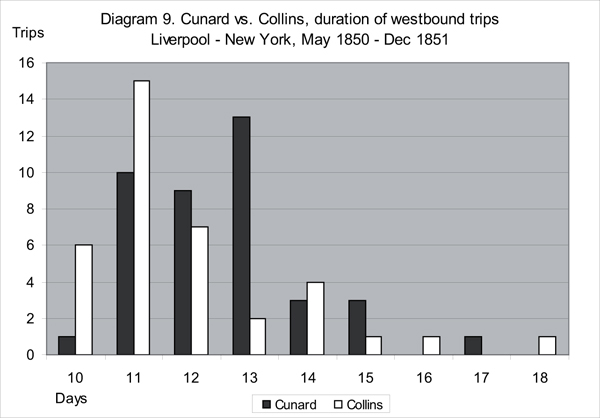
Source: Sailing lists of Hubbard & Winter, 28–30; 98–99.
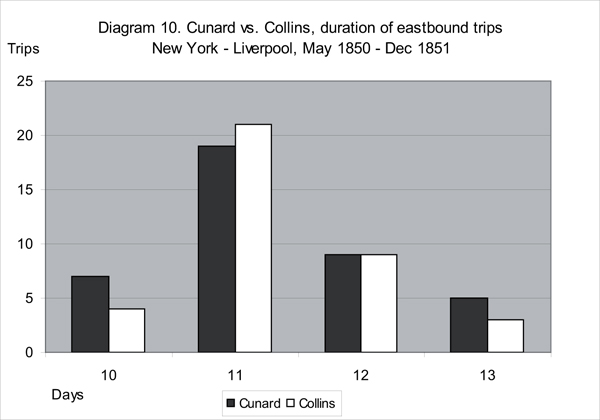
Source: Sailing lists of Hubbard & Winter, 28–30; 98–99.
The tight competition with the Collins Line also forced the Cunard Line to improve its service. At that time, the Cunard Line operated with seven vessels of various sizes. Of the original four ships built in 1840, the Columbia was wrecked in 1843 and the others were sold abroad at the end of the decade. When the Collins Line started its transatlantic service, Cunard still had in traffic the old 1,420 tons Hibernia, which had replaced the Columbia in 1843, Hibernia’s sister ship the Cambria from 1845, the four sisters’ series of 1848 – the America, the Niagara, the Europa and the Canada, all approximately 1,830 tons – and the new 2,230-ton Asia, which made her maiden voyage in May 1850.
The Asia’s sister ship Africa started the service in October 1850, replacing the Hibernia, which was sold to Spain. All the seven ships in traffic served
both mail routes, Liverpool–New York and Liverpool–Halifax–Boston. Compared with the Collins Line’s four new, large steamers sailing only the direct Liverpool–New York route, the Cunard Line’s position was really challenging.315
Cunard did not perhaps ‘trim’ its vessels to move faster like Collins did, even if this has been doubted. The company’s main doctrine was clearly expressed as safety first,316 and the records are superior to any other company. To date, the Cunard Line – still afloat – has lost no passengers’ lives and hardly any mail during its 165-year history, excluding the two world wars.
Several arrangements were made by the Cunard ship management in the early 1850s to improve the company’s position in the competition. Originally, all Cunard ships had served on both routes evenly, except the old Hibernia, which served only on the Boston route, and the new Africa, which served only on the more important and visible New York route.317
In 1851, the new ships Asia and Africa made 65% of the New York trips, while the other five ships only made 35% in total. The speed of the new vessels was thus utilized on the New York route in the maximum way. These two ships were the only ones that could compete with the Collins Line’s vessels and make the westbound trip in 12 days or less, while the other Cunard ships made it in 13 to 15 days on average.318 These arrangements enabled an improvement in the speed of the company’s westbound voyages.
TABLE 18. Consecutive information circulation enabled by transatlantic mail steamers in 1851.
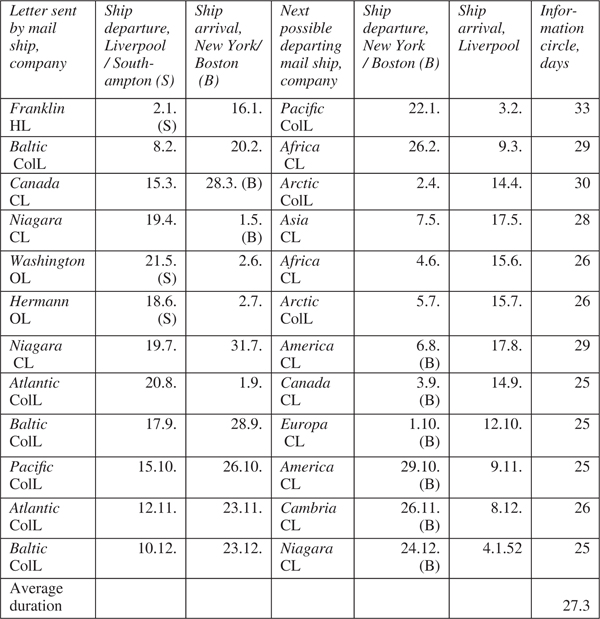
Sources: Sailing lists of Hubbard & Winter, 29–30, 87, 99, 111. ColL = Collins Line, CL = Cunard Line, HL = Havre Line, OL = Ocean Line. – An average westbound journey took 12.3 days, varying between 11 and 14 days, while the average eastbound journey took 11.1 days, varying between 10 and 12 days. – Note that one extra day has been added to the information circle in those cases where the ship departed from Southampton, as this caused an extra one-day inland journey from Liverpool.
In 1852, the Collins service was at its best and the line’s ships averaged the westbound crossing nearly a day faster than the Cunarders. While the enthusiasm over the line’s speed performance was still high, Collins determined to take full advantage of it. In the summer of 1852, after what Albion calls ‘his masterpiece in lobbying’, the United States Congress raised the line’s subsidy from the original $385,000 to $858,000 a year.319 In comparison with the $33,000 a voyage received by the Collins Line, the Ocean Line received only $16,666 and the Havre Line only $12,500. Pleading penury, they refused the Postmaster General’s request to increase the number of their voyages to 26.320 And Congress did not increase their subsidies, on the grounds that no national interest was involved, since they had no foreign competitors.321
Even in the new situation, the Cunard Line carried most of the mail: 2,613,000 letters in 1851, compared with 843,000 carried by Collins, 313,000 by the Ocean Line, and 139,000 by the Havre Line. But passengers preferred the Collins ships’ prestige, speed, comfort and meals. During the first 11 months of 1852, the Collins liners carried 4,300 passengers, and the Cunarders nearly 3,000.322
This was a successful period for the Collins Line. No major problems were met at sea. The good luck continued until the autumn of 1854, when the Arctic, which had been driven ashore off Liverpool in November 1853 without damage and struck a submerged object off the Irish coast and been obliged to put back in the summer of 1854, collided with the French steamer Vesta in fog near Cape Race, Newfoundland, at the end of September and sank in four or five hours. Only two lifeboats with 35 of the crew and 14 passengers were rescued, plus one survivor from a raft from which 75 others had been washed overboard in a heavy gale. Among the more than 300 lives lost were the wife, the only son and a daughter of Edward Collins, as well as five family members of the Collins Line president and financier James Brown.323 The crew’s behaviour was later strongly criticized; instead of attempts to save the vessel, there had been panic and lack of discipline that led to the abandonment of floundering women and children. The rush to the lifeboats caused serious injury to some of them during the launching.324
In 1855 there was no contest on the Liverpool–New York route as the Cunard Line was obliged to provide several of their vessels for Crimean War troop transport and could only serve the Liverpool–Halifax–Boston mail route. By January 1856, the line was able to resume the weekly sailings to New York and Boston.325
The Collins Line recovered from the loss of the Arctic and continued their service with the three remaining vessels. However, another catastrophe soon occurred. On 23 January 1856, the company’s Pacific departed from Liverpool, and was never heard of again. It was generally thought that she had foundered after colliding with an iceberg. Nearly 200 perished.326
The loss of the Pacific so soon after the Arctic was a blow from which the company never fully recovered. An additional reason for the Collins Line’s difficulties was the delay in launching the new 4,150-ton steamer Adriatic, which had been ordered after the loss of the Arctic.327 The new vessel cost $1,200,000. In August 1857 the Collins Line was given six months’ notice of their government subsidy being reduced from the annual $858,000 to the original figure of $385,000.328
The Congress decision to reduce the Collins Line subsidy was the subject of furious debate and it has been regarded by some historians as one of the most serious mistakes ever made in U.S. maritime history. Some others have stated that the unfortunate events affecting the American merchant fleet were mainly related to the Civil War and its consequences.329
Whatever the consequences of the decision, it was obvious that the Collins Line did not meet expectations as a mail contract company. Diagram 11 shows the difference between the last good years of the line compared with the two years after the loss of the Pacific. No nine or ten-day voyages were made in 1856–1857, and only eight 11-day voyages, compared with 17 in 1853–1854. Almost 50% of the trips took 14 days or more.
The company also lost its grip on the service eastbound. The number of short ten to 11-day trips decreased from 36 to 18, and ten journeys were made in two weeks or even more.
The reason for the company’s poor performance during the last period can easily be noticed from Diagram 12. Since the loss of the Pacific, the Collins Line had had to use chartered vessels to keep the service going. The company’s own two ships, the Atlantic and the Baltic, could not make all the voyages, especially because the Baltic was out of traffic from 5 February to 16 August 1857 due to prolonged repairs – as was the Atlantic from 5 March to 20 June. Between 1 April and 27 May no ship under the Collins flag departed from Liverpool, as there were no ships to run.330
The chartered steamships were the Ericsson of 1,920 tons, the Alps of 1,275 tons and the Columbia of 1,900 tons. Of these, the Ericsson made nine trips during the period presented in the diagram, the Alps made one and the Columbia two. One trip (trip 20 in Diagram 12) was not made at all, apparently due to lack of capacity.331
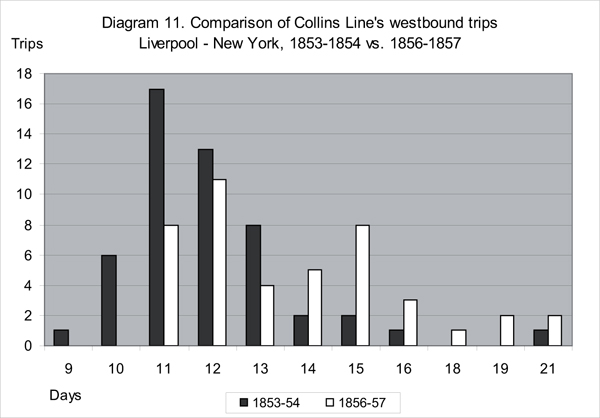
Source: Sailing lists of Hubbard & Winter, 101–103 and 107–108. – The profile of Collins Line’s westbound sailings changed remarkably during the last difficult years. The number of trips included in the calculation was 51 in 1853–1854 and 44 in 1856–1857.
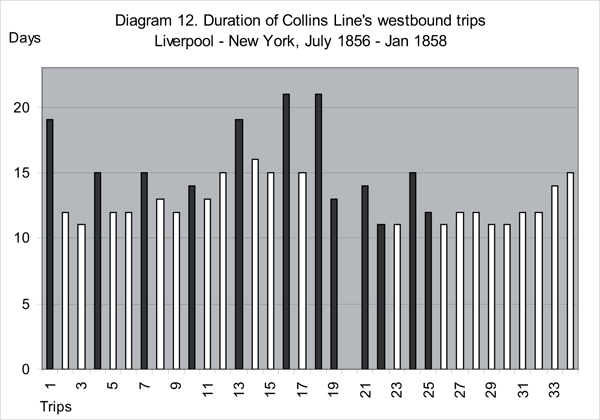
Source: Sailing lists of Hubbard & Winter, 107–108. – The dark columns depict trips made by chartered vessels. It is easy to notice their negative impact on the profile of the Collins Line’s sailings.
It can be noticed in the diagram that most of the delays were caused by the chartered ships, while the company’s own vessels’ performance was still acceptable even in these abnormal circumstances. On the other hand, not all the voyages made by the chartered vessels were slow, and not all the voyages made by the Collins ships were fast. An average westbound voyage by a chartered vessel took 15.6 days, while an average trip by a Collins ship took 12.7 days.
The company’s new Adriatic was scheduled to start service in February 1857. In April, however, her trials were rescheduled for June and her maiden voyage for July. New valves and condensers, the main cause of the delay, were in the process of being fitted. In July, it was stated that she was unlikely to be ready until the autumn, if then. At this point, the U.S. Congress decided on the reduction of the subsidy.
The Adriatic, one of the finest wooden paddle steamers ever built for the North Atlantic service, sailed from New York in late November with only 37 passengers. Her maiden voyage homewards is illustrated in Diagram 12 as trip 32. This was the only voyage that the Adriatic made for the Collins Line, which closed down in January 1858. Trip 33 in the diagram was the Atlantic’s and trip 34 the Baltic’s last voyage in the company’s service.
It is interesting to compare the performance of two vessels, the Collins Line’s Atlantic and the Cunard Line’s Asia, during the years of tight competition. The Atlantic was the Collins Line’s first steamer, brought into use in April 1850. She was in traffic until the final closure of the company in 1858. Her west- and eastbound transatlantic sailings are depicted in Diagrams 13 and 14. As can be seen, her performance did not change very much during the years, except the temporary lengthening of trips in 1856 after the loss of the Pacific.
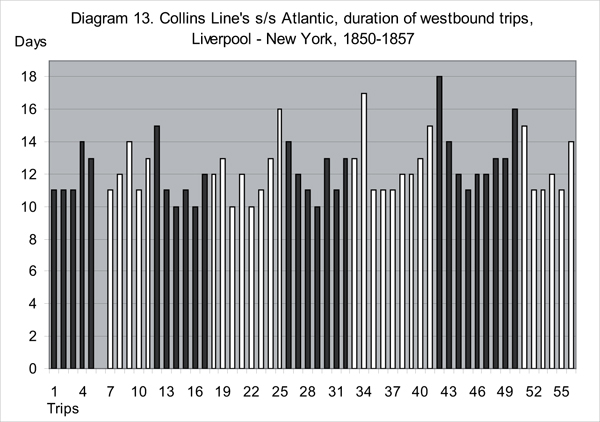
Source: Sailing lists of Hubbard & Winter, 98–108. Even years are shown in dark colour to make it easier to distinguish the different years from each other.
While the westbound sailings were more prolonged during the winter months, the differences in the eastbound sailings were smaller. But the eastbound sailings were also approximately one day longer in 1856 than in any other year. The extra care followed the company’s second total loss within two years. The line’s reputation, as well as the government subsidy, was seriously endangered. In 1857, the Atlantic made shorter voyages – maybe to balance the poor performance of the chartered vessels.
Interestingly, the Atlantic was able to make nine round trips in 1856–1857, when she did not make a single ten-day voyage, whereas her service was limited to six to eight round trips, or even less, during the years when she made her speediest averages. Saving the engines would have made the ships more efficient and profitable, and probably saved the company.
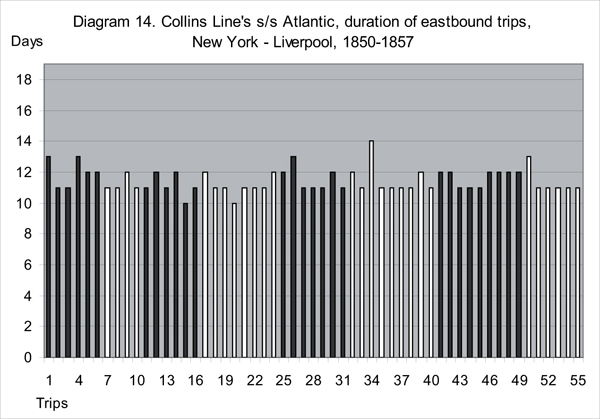
Source: Sailing lists of Hubbard & Winter, 98–108.
As can be seen from Diagram 14, the Atlantic only made two ten-day voyages eastbound during her lifetime, compared with five such voyages westbound, although they were more difficult to achieve. Each company’s public image was chiefly measured at the home port, which can also be noticed in Diagrams 17 and 18.
The Cunard Line’s steamship Asia made her maiden voyage in May 1850, and continued in service until 1867, making 120 round voyages. Her west- and eastbound trips in 1850–1857 are depicted in Diagrams 15 and 16.
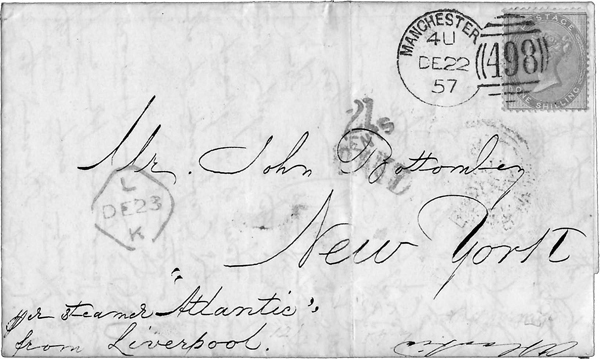
FIG. 12. The letter sent on 22.12.1857 from Manchester to New York, was carried by the Collins Line’s Atlantic, which sailed from Liverpool on 23.12. and arrived in New York on 6.1.1858. This was the ship’s last voyage under the company’s flag, and the second last voyage of Collins Line before its collapse.
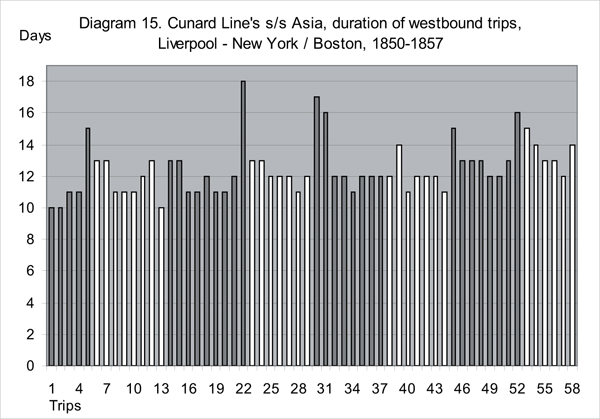
Source: Sailing lists of Hubbard & Winter, 28–41. – Trips 1,2,13 and 37–44 were made to Boston instead of New York.
It is worth to notice that the Asia made no 10-day voyages after 1851, and only two 11-day voyages after mid-1854. Eastbound, there was also a great difference between the performances of the two competing vessels. Compared with only two 10-day voyages eastbound by the Atlantic, the Asia made 14 such voyages. Note the clear change also on the eastbound voyages from 10-day trips in 1850–1851 to 11-day trips in 1852–1855 and 12-day trips from 1856.
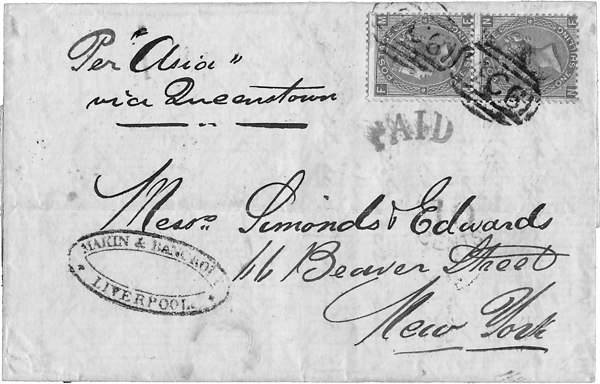
FIG. 13. The letter sent from Liverpool on 16.2.1867 to New York, was carried by the Cunard Line’s Asia on her 119th, or second last, westbound Atlantic crossing. She arrived in Boston on 3.3. and the letter was received in New York on 4.3.1867.
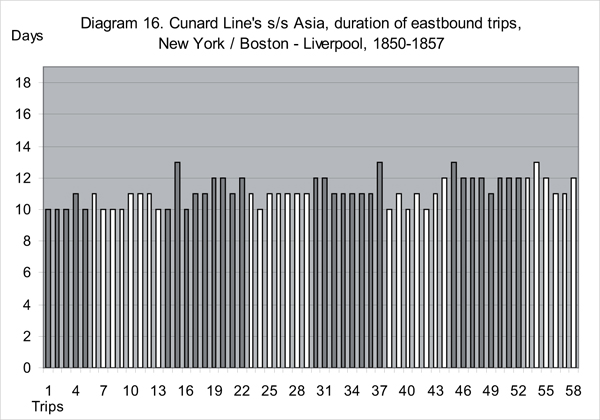
Source: Sailing lists of Hubbard & Winter, 28–41. – Trips 1, 2, 13 and 37–44 were made to Boston instead of New York.
Did the Cunard Line race? Yes, very clearly in 1850–1851. But in 1852 the company seems to have changed its policy. The trips became slower, and in 1856 and 1857 the Asia was about two days behind her records of 1850.
The trend should not be examined independent of the historical context. The losses of the Collins Line’s Arctic and Pacific were not the only serious disasters at sea during those years. The Havre Line lost both their original vessels in 1853–1854; the Humboldt was wrecked in dense fog off Halifax in November 1853 and her sister ship the Franklin went aground in similar conditions at Long Island in July 1854. The Inman Line lost two of their three ships, the City of Glasgow and the City of Philadelphia, during the same year 1854. The City of Glasgow ‘went missing’ in March 1854 with 480 lives lost. Additionally, the emigrant ship Powhatan of Baltimore was lost in the spring of 1854 on her way from Havre to New York along with about 250 lives. Several other serious disasters took place during the latter part of the 1850s.332
The Cunard Line kept to its ‘safety beyond speed’ policy, even in the time of tight competition, with the possible exception of the years 1850–1851, while other companies constantly took more risks at sea. The weather conditions were the same for all ships and the Cunard’s vessels were also involved in several incidents during these years,333 but their captains did not take unnecessary risks for a faster journey. In addition to their risk-averse policy, the Cunard Line management avoided extra costs wherever possible.334
The Cunard Line’s annual subsidy from the British Admiralty had increased to £188,040, or $940,200, after the opening of the New York route, including a weekly service to New York and Boston on alternate voyages all year round. Collins received $858,000 for 26 annual round trips from New York to Liverpool.335 It has been estimated that in 1855, a year before the loss of the Pacific, the company’s possible fate without the subsidy would have been bankruptcy.336 As Tyler has pointed out, the winner of the North Atlantic contest required not only the best record for speed and regularity, but also a low level of costs.337
The average expense for a round trip by a Collins Line steamer had constantly increased over the years. Coal prices were reported as having risen between 1852 and 1855 – partly because of the Crimean War – by 50% in Britain and by 75% in the U.S. Seamen’s wages had increased by 33%, the cost of provisions by 25%, and repairs to machinery by 30%.338 In February 1855, when the House of Representatives dealt with the continuation of the Collins Line subsidy, the reasons given for the huge sums of money needed for the service were the extra cost of coal (400 more tons per voyage at $7 per ton, making $2,800) and the cost of repairs ($5,000 per voyage) that were needed for higher speeds.339
The speed certainly caused extra costs in coal consumption. It was calculated for the U.S. Congress that, given calm winds and smooth sea and a distance of 3,060 nautical miles westbound, a Collins steamer would consume 850 tons during a ten-day voyage, 700 tons during an 11-day voyage, 590 tons during 12 days, 500 tons during 13 days and 440 tons during 14 days. Thus, lengthening the voyage from ten to 12 days would have saved about 30% in coal costs. It was argued by the Americans that the Cunard steamers saved costs by running at slower speeds, and, as they replenished their coal supply in Halifax, they could leave Liverpool with less coal on board and consequently take that much more freight, earning more revenues.340
The Cunard Line’s capital costs were obviously lower than the Collins Line’s. American shipbuilding was highly priced compared with their British counterparts, and, in contrast to the Cunard Line, Collins and his associates had borrowed two-thirds of their capital. The operating costs of the two companies also differed remarkably. In total, the cost of an average round trip by a Collins Line steamer was claimed to exceed $42,300, while a Cunard vessel made a similar trip for less than $13,300.341
The British Post Office received notable revenues from postage, compensating for the subsidy paid to the Cunard Line. According to the postal treaty signed in London in December 1848, the postage on mail between Britain and the U.S. was to be shared, depending on the nationality of the mail-carrying ship. The basic postage remained at one shilling, or 24 cents, per half-ounce. This was split into three parts: ocean postage 16 cents, the U.S. inland postage five cents and British inland postage three cents. Exchange offices were established at the ports used by the liners of both countries, and letters were stamped with special postmarks denoting the postage due to either the U.S. or the British Post Office.342
Thus, from the one shilling paid on a single letter carried by a Cunarder, the British Post Office received ocean postage of 16 cents plus inland postage of three cents, making a total of 19 cents, and leaving the American inland postage of five cents to be credited to the U.S. Post Office. When carried by an American ship, the U.S. Post Office received 16 cents plus five cents, leaving three cents for the credit of the British Post Office. Double weight had double costs.343
TABLE 19. Postal income from letters carried by the Cunard Line and the Collins Line 1851–1854.
| Company |
Year ending June 30, 1851 |
Year ending June 30, 1852 |
Year endingJune 30, 1853 |
Year ending June 30, 1854 |
| Cunard |
$537,000 |
$565,600 |
$578,000 |
$589,200 |
| Collins |
$205,800 |
$228,900 |
$233,300 |
$265,200 |
Source: ‘Revenue received by the United States under the Postal Treaty with Great Britain of the 15th of December, 1848’, in Speech of Edson B. Olds… 18–19.
Of this postage, the British Post Office received a total of $1,913,800, while the US Post Office received $1,279,400.344 In addition to this, there were the ‘closed mails’, e.g. to Prussia by an American mail steamer. The mail bags containing these mails were guaranteed to be sealed and delivered directly to the Prussian Post Office. The postage on closed mails carried by Collins Line steamers amounted to $3,900 during the first year mentioned, $11,900 during the second year, $30,700 during the third year and $33,600 during the last year mentioned. The newspapers are missing from the table above. The postage on newspapers carried by Collins Line steamers amounted to $4,500 during the first year mentioned above, $5,600 during the second year, $6,100 during the third year and $8,900 during the last year mentioned.345 The Cunard Line’s respective figures are not included in the report.
It was claimed by the Americans that the British Post Office not only held letters over for the Cunard Line, but also arranged its schedules so that it could bring all letters from the continent to the Post Office just in time to meet the sailings of the Cunard steamers.346 Whether this was meant to be a restriction on competition or just wise logistics – or both – cannot be answered in this connection.
Another restriction on competition was carried out by the companies themselves. A modern-day discovery of key documents has proved that the two shipping lines had had a secret working arrangement for the pooling of earnings on the carriage of passengers and cargo from the beginning. The agreement did not obviate the competition in service between the companies, but it did help to maintain the levels of rates and to balance the fluctuations in earning capacity. The ‘grey eminences’ behind this arrangement were the two brothers – James Brown, the senior partner of Brown Brothers & Co. in New York and the most important investor in the Collins Line, and William Brown, the senior partner of Brown, Shipley & Co. in Liverpool and a major investor in the Cunard Line. After the loss of the Pacific, the agreement was not renewed in 1856, as Collins could not adhere to the terms before the new Adriatic would be ready for service.347
The cartel only included freight and passenger rates, while the postal agreements with the governments gave the economic frames for mail transmission. But what happened to the speed of information transmission during this colourful and historically strongly emphasized period? Did the contest between the two shipping lines improve the speed of the mail service on the North Atlantic? Actually, no.
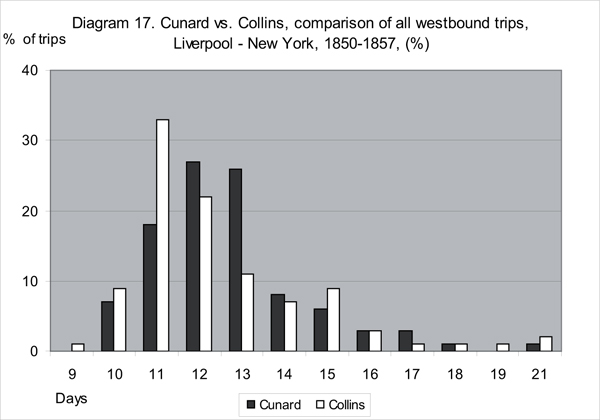
Source: Sailing lists of Hubbard & Winter, 28–41, 98–108.
During the whole period of 1850–1857, the Collins ships clearly made faster westbound voyages than the Cunarders, as can be seen in Diagram 17. The company made 43% of their westbound voyages in 11 days or less, while Cunard’s ships managed to do this on every fourth trip. The average westbound voyage by Collins ships took 12.4 days compared with the Cunard Line’s 12.7 days.
Eastbound, the Cunarders made the Atlantic crossing 33 times in ten days or less, while the Collins ships only made it 17 times. In other words, 20% of Cunard’s trips were made in ten days or less, while the percentage of Collins trips was only nine. An average Collins trip took 11.5 days and a Cunard trip 11.2 days.
This makes the comparison of all Atlantic crossings look somewhat different from the common expectations. The percentage of the Cunard Line’s fast voyages to the company’s total number of sailings was larger than that of the Collins Line.348 But in the long run, their performance was rather similar. An average trip was made in 12 days by both companies. The weakened performance of the Collins Line during the last years of the company’s existence naturally negatively affected the statistics for the whole period.
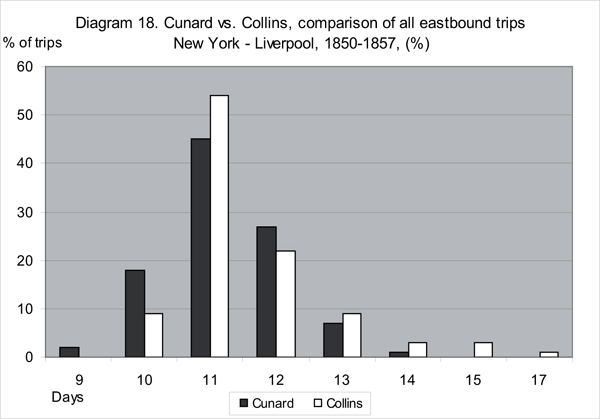
Source: Sailing lists of Hubbard & Winter, 28–41, 98–108.
TABLE 20. Duration of all transatlantic voyages of the Cunard Line and the Collins Line, Liverpool–New York / New York–Liverpool, 1850–1857, (%).
| Company |
10 days or less |
11 days |
12–13 days |
14 days or more |
| Cunard Line |
13.4% |
31.5% |
43.6% |
11.3% |
| Collins Line |
9.5% |
43.8% |
31.9% |
14.9% |
Source: Sailing lists of Hubbard & Winter, 28–41, 98–108.
While in 1850–1851 the Collins ships had made more than 50% of their westbound trips in 11 days or less, in 1857 the figure dropped below 30%. The percentage of eastbound trips made in 11 days or less dropped from 70–80% to about 50%.
Although the Cunard Line’s westbound performance was weaker in 1857 than in 1850–1851, their eastbound performance was stronger. The improvement followed the entrance of the company’s new steamship Persia, which immediately made new speed records in both directions in 1856, keeping the Blue Riband for the next seven years.349
It can be said that the tight competition between the two shipping lines cost much extra money for the respective governments, and the lives of several hundred people who perished in disasters at sea, but caused no remarkable improvement in the general speed of communications. Even though the competition forced both companies to build larger and faster ships – the Persia for the Cunard Line and the Adriatic for the Collins Line – their specific influence cannot be noticed in the annual records. Actually, a much more important factor than the speed was that the number of mail sailings doubled, generating real benefit from a business information transmission point of view. And it should be noted that in the shadow of the struggle of the Titans, three other American steamship lines were also conducting a mail service to Europe under a U.S. Government contract.
Ocean Line and Havre Line – the forgotten contract companies
The Ocean Line, which was established in 1847, carried mail between New York and Bremen, via Southampton, monthly throughout the year.350 In the late 1840s Bremen was already the main continental port for the U.S. trade, handling about one third of German tobacco and one quarter of its rice, whaling oil and cotton imports. It had held a trade agreement with the United States since 1827, with an American consul in Bremen, and Bremen had established consulates in New York (1815), Baltimore (1818), Philadelphia (1827) and New Orleans (1840). Additionally, Bremen had become an important hub in the emigrant trade. The required capital for the new shipping company was collected with the help of some influential German-Americans, while Bremen and other German states offered to lower transit duties for American goods in Germany, improve navigation on the Weser, speed up railway construction in north-west Germany and build a new dock with a wider lock so that paddle steamers had access to the new harbour.351
When the mail contract with the U.S. Government had been signed and the traffic started, the Bremen City Post was named the U.S. Postal Agency on the continent, through which all mails on the New York–Bremen route, and later also the routes to and from Russia and Scandinavia, would be sent at postal rates below those via England. However, not all the German states were included, while Baden, Württemberg and the Thurn und Taxis posts did not join in with the transit rate reductions, requiring higher postal rates for them! .352
The Ocean Line’s steamers, the Washington and the Hermann, built in the United States, were described as the ugliest (by the Americans as ‘the most beautiful’ and by the Germans as ‘the largest’) ships ever put to sea, and they were slower than the Cunard’s old Britannia. Despite the drawbacks, the service was conducted for two five-year periods until the U.S. Government changed their subsidies policy in 1857 along with the closing of the Collins Line.353
The first arrival of the Washington in Bremerhaven in June 1847 raised great excitement and interest, even though the ship could not bring her passengers or mails closer than that. Due to the inappropriateness of the port, everything had to be off-loaded onto auxiliary steamers for a 3.5-hour trip up the river Weser to the city of Bremen. On the way back home, the Washington had machinery problems and had to put back to Southampton. She finally arrived back from her maiden voyage 35 days after her departure from Bremerhaven.354
In Britain, the reception of the first American mail steamer arriving at Southampton was very cool, and the Government indeed took measures to protect the British Post Office services against competition. By direction of the Lords of the Treasury, all letters carried to England were charged as if they had been conveyed by British steamers, thus making the postage rate double. The discrimination against American mail steamers continued for several months and led to a counter-action by the U.S. Congress. The new law, generally known by postal historians as the ‘reprisal’ or ‘retaliatory’ act, led to a situation where all packet mail between the two countries required double sea postage (see Fig. 14). After a period of strong reactions and protests, negotiations were opened and a postal treaty between the two countries was signed in December 1848.355
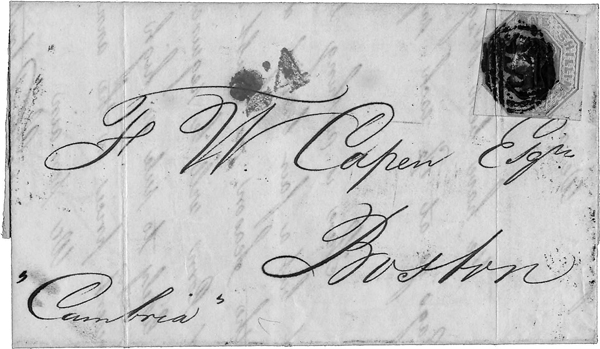
FIG. 14. The letter sent from Liverpool on 23.9.1848 was carried by the Cunard Line’s Cambria during the retaliatory period. She sailed from Liverpool on 23.9. and arrived in Boston on 6.10.1848. The letter was prepaid by a one shilling postage stamp, equivalent to 24 cents. Another 24 cents (note the handstamp) has been charged in Boston for the same letter due to the Reprisal Act.
Although one could say that the Ocean Line’s performance did not warrant all the measures taken, the British government reacted as they did because they knew that more American competition would appear in the North Atlantic very soon. The service of the two Ocean Line ships was filled with engine problems, incidents and extra calls for coaling due to lengthened voyages. The line’s performance, especially westbound, was far from regular, and it was not satisfactory in the other direction, either. The average westbound trip took 15.9 days and the eastbound 14.6 days. Two to four days should be added for the trip between Southampton and Bremen, including the stay in Southampton, for the duration of the whole voyage.356
As Scholl has put it, Bremen in effect became America’s continental post office. In 1848 the Ocean Line ships carried 80,000 letters to Bremen, and five years later the number had risen to 350,000.357 Not all mails were carried by the line’s vessels however. From late 1849 the United States took advantage of the U.S. British Postal Convention of 1848 to send closed mails via England to Bremen when regular Bremen packets were not available. In addition to the Bremen Closed Mail, there was also the Prussian Closed Mail carried by contract ships other than the Ocean Line’s. In 1849 and 1850 five closed mails were sent to Bremen by Cunard and Collins vessels; in 1851 there were 11 extra mails, most of them carried by the Havre Line; and in 1852 there were no less than 34 extra mails to Bremen by other mail ships – mainly by the American contract lines the Collins Line and the Havre Line – while the Ocean Line only conducted 12 sailings during the year.358
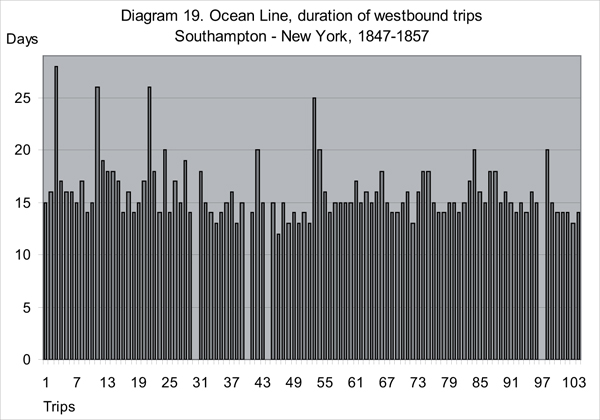
Source: Sailing lists of Hubbard & Winter, 84–90. – The profile of the Ocean Line’s westbound sailings clearly illustrates the unpredictability of the company’s service.
The Havre Line started the transatlantic service between New York and Havre via Southampton (Cowes) in October 1850. The company’s two original steamships, the Franklin and the Humboldt, were both wrecked in 1853–1854. They were replaced by chartered vessels until the new ships, the 2,240-ton Arago and the 2,300-ton Fulton, were ready for service in June 1855 and February 1856. They both had berths for a total of 350 passengers in first and second class, and they could also carry 800 tons of cargo.359
As Bonsor notes, the Arago and the Fulton were probably the most successful of the American transatlantic wooden paddle steamers. Even though they both lost one round voyage in 1859 due to machinery breakdowns, they normally sailed with commendable regularity until the end of 1861, when the U.S. War Department took them up during the Civil War. They were returned to the North Atlantic in late 1865.360
In 1866, the company restarted its service between New York and Havre via Falmouth, but gave up in 1867 due to several reasons, ‘not the least of which’ was ‘the bad commercial policy of the United States Government, which has already caused so much American tonnage to slip into foreign hands’.361 Of the three ocean steamship lines established under the U.S. Government subsidy in the late 1840s, the Havre Line was the only one to survive ten years after the subsidies were removed, thus showing that the service was not impossible without it, if the company’s business was on somewhat healthy grounds.362
Compared with all the prestige and publicity that followed the Collins Line from beginning to end, the Havre Line has certainly not received all the attention it would have deserved. It was owned by Messrs. Fox & Livingston, who had extensive experience with sailing packets running between New York and Havre as owners of the Old Line, one of the Havre sailing packet pioneers from the early 1820s.363
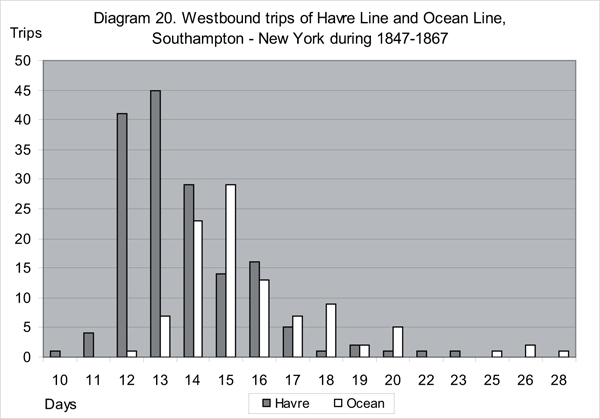
Source: Sailing lists of Hubbard & Winter, 84–90, 111–120.
As can be seen in Diagram 20, the Havre Line’s performance was very different from the Ocean Line’s. The company made most of their westbound sailings in 12 or 13 days, some even faster. The spread of the duration of sailings was broad, however, so that the service could not be called regular by any means.
The Havre Line had originally received half of the Government contract originally meant for the Ocean Line, which was not able to organize the alternate trips to Havre. Of the original contract of $350,000 per year, the line to Bremen received $200,000 and $150,000 was left for the Havre Line.364 In June 1857, when the contracts for these two lines expired, only temporary one-year contracts were offered by the Postmaster General, based on the compensation for sea postage only.365
The Ocean Line’s ships were in service from June 1847 to July 1857 and the Havre Line’s from October 1850 to December 1861, and again from November 1865 to December 1867. After the American Civil War, the Havre Line’s ships called at Falmouth instead of Southampton in 1866–1867. In 1867 the company sailed in a joint venture with the New York Mail Steamship Company.366 In total, the Havre Line made 161 and the Ocean Line 100 westbound trips.
The quantity of mail carried by the Havre Line steamers was rather humble compared with the big contract mail lines. The published figures are from the early 1850s. In 1851, the Cunard Line carried 2,613,000 letters, the Collins Line 843,000 letters, the Ocean Line 313,000 letters and the Havre Line 139,000 letters.367 From that year on, postage for mail carried by the Havre Line varied as follows:
TABLE 21. Postal income from letters carried by the Havre Line 1851–1854 .
|
Year ending June 30, 1851 |
Year ending June 30, 1852 |
Year ending June 30, 1853 |
Year ending June 30, 1854 |
| Postage |
$37,300 |
$80,800 |
$53,400 |
$63,300 |
| Closed mails |
$1,100 |
$6,500 |
$5,400 |
$10,600 |
| Newspapers |
$80 |
$100 |
$100 |
$2,200 |
| Total |
$38,420 |
$87,400 |
$58,900 |
$76,100 |
Source: ‘Revenue received by the United States under the Postal Treaty with Great Britain of the 15th of December, 1848’ in Speech of Mr. Edson B. Olds...18–19.
During 1852–1854, the Havre Line and the Ocean Line carried almost similar quantities of mails. The postage on mails carried by the two companies decreased in 1853 compared with 1852, and did not return to that level even in 1854, while the postage for the Cunard Line and the Collins Line steadily increased.368 Undoubtedly, the mails arrived faster in Havre or Bremen by the more frequent ships via Liverpool and from there by railway than if they had waited in New York for the next direct shipping to those countries.
Competition and business information transmission
The frequency of steamship mail sailings from New York and Boston to Europe was now really satisfactory compared with anything earlier. There were two weekly departures by steamers, which normally made the trip in less than two weeks, even in ten days.
As can be seen in Table 22, the American contract mail sailings departed from New York each Saturday and the Cunarders every Wednesday from New York or Boston alternately. The eastbound sailings in April–May 1853 mostly took about 11 days, with the exception of the Ocean Line’s Washington, which sailed to Southampton (Cowes) in 14 days.
TABLE 22. Frequency of mail steamship sailings from New York and Boston (B) to Europe, April–May 1853.
| Ship |
Shipping line |
Departure |
Arrival |
| Baltic |
Collins Line |
April 2 Saturday |
April 14, Liverpool |
| Asia1 |
Cunard Line |
April 6 Wednesday |
April 17, Liverpool |
| Franklin |
Havre Line |
April 9 Saturday |
April 20, CowesApril 21, Havre |
| Niagara |
Cunard Line |
April 13 Wednesday (B) |
April 25, Liverpool |
| Atlantic |
Collins Line |
April 16 Saturday |
April 27, Liverpool |
| Europa |
Cunard Line |
April 20 Wednesday |
May 1, Liverpool |
| Washington |
Ocean Line |
April 23 Saturday |
May 7, CowesMay 10, Bremen |
| America |
Cunard Line |
April 27 Wednesday (B) |
May 9, Liverpool |
| Arctic |
Collins Line |
April 30 Saturday |
May 11, Liverpool |
| Arabia |
Cunard Line |
May 4 Wednesday |
May 14, Liverpool |
| Humboldt |
Havre Line |
May 7 Saturday |
May 18, CowesMay 19, Havre |
| Canada |
Cunard Line |
May 11 Wednesday (B) |
May 22, Liverpool |
| Pacific |
Collins Line |
May 14 Saturday |
May 24, Liverpool |
| Asia |
Cunard Line |
May 18 Wednesday |
May 29, Liverpool |
| Hermann |
Ocean Line |
May 21 Saturday |
June 2, CowesJune 4, Bremen |
| Cambria |
Cunard Line |
May 25 Wednesday (B) |
June 6, Liverpool |
| Baltic |
Collins Line |
May 28 Saturday |
June 7, Liverpool |
Source: Hubbard & Winter, 33, 87, 101, 113, 383. – Within a few years the sailings of the various mail contract companies had been organized into a perfectly matching combination of services.
How did the sailings serve business? One of the companies that could really benefit from fast business communications was Rathbone Bros & Co. which had the advantage of being located at both ends of the best working sea connections of the time. The correspondence between Rathbones in Liverpool and their New York agency, opened in 1851,369 was very active. A sample of 113 incoming letters from Henry Wainright Gair, an agent and partner in Rathbone Bros & Co. in New York in 1853370, shows that national priorities had very little influence when choosing the mail-carrying ship. Instead, reputation and the expected speed of the carrier seem to have most affected the choice.
Of the letters, 77 were sent by the Cunard Line’s ships, 44 via Boston and 33 directly from New York, while 31 of the letters were sent by the Collins Line’s vessels. Only three letters were sent by the Havre Line and two letters by the Ocean Line, which both operated via Southampton.
The average delivery time from the date of the letter to its arrival in Liverpool was 12.3 days from New York, independent of the mail-carrying company – the Cunard Line or the Collins Line. The inland journey via Boston or via Southampton added an extra day to the delivery time. Thus the trips via Boston by the Cunard Line and via Southampton by the Havre Line or the Ocean Line took 13.3 to 13.5 days on average.371 All the letters were carried on eastbound trips, which were less challenging for seafaring; more differences would probably have been seen on the westbound run.
Some details from the sample can be selected for further examination. Six letters written between 24 February and 4 March, 1853 were sent by two different steamers, the America of the Cunard Line from Boston on 2 March and the Arctic of the Collins Line on 5 March directly from New York. The letters, which were written between 24 February and 1 March, were dispatched in Liverpool 12 days after the America had departed from Boston. Their total delivery time from writer to recipient varied between 13 and 18 days due to different waiting times at port, without the shipping line having anything to do with it.
Two letters, dated 1 and 4 March, were sent by the Arctic, which sailed from New York on 5 March and arrived in Liverpool on the 16th. The total delivery time of the letters varied between 12 and 15 days, showing that the whole duration of information transmission still depended on the sender as well, not only the mail-carrying vessel.
The Rathbone practice shows that letters were regularly written to be sent by the next day’s ship and last-minute information was sent on the sailing day. Of the 113 letters, 68 were written the day before ship departure – 21 of them via Boston – and ten letters were written on the same day as the ship departed. An express service took care of the urgent letters to the Boston steamer, and indeed, one of the letters was written on the same day as the ship departed from Boston.372
TABLE 23. Examples of differences in total delivery time depending on the sender, letters from New York to Liverpool, 1853.
| Ship |
Shipping line |
Date of letter |
Date of ship departure |
Date of ship arrival. Liverpool |
| America |
Cunard |
24.2. |
Boston 2.3. |
14.3. |
| America |
Cunard |
28.2. |
Boston 2.3. |
14.3. |
| America |
Cunard |
28.2. |
Boston 2.3. |
14.3. |
| America |
Cunard |
1.3. |
Boston 2.3. |
14.3. |
| Arctic |
Collins |
1.3. |
5.3. |
16.3. |
| Arctic |
Collins |
4.3. |
5.3. |
16.3. |
Source: Letters to Rathbone Bros & Co. in Rathbone Collection, RP XXIV.2. (SJ)
Changes in the transatlantic mail services in the late 1850s
During the Crimean War, while the Cunard Line was withdrawn from the New York route, ‘Commodore’ Cornelius Vanderbilt, a well-known shipowner in the New York region, submitted a low bid to the Postmaster General. His ships would carry mail between New York and Liverpool semi-monthly, alternating with the Collins Line, to form a weekly communication. His company would conduct the service for $15,000 each round trip, with a contract to exist for five years. No contract was made, but Vanderbilt started the traffic at his own expense. His steamers North Star and Ariel served the route between New York and Havre, including a call at Southampton, with departures every third week, starting from April 1855.373
Although Vanderbilt’s service was not really regular when examined in the sailing lists, it easily beat the Ocean Line in both directions.374 In June 1857, when the second five-year contract with the Ocean Line for monthly voyages to Bremen expired, the Postmaster General awarded a temporary contract to Vanderbilt for service on the Bremen route for one year, 13 round voyages. Compensation was U.S. inland and sea postage on the mails carried. Temporary contracts were continued after the Collins Line suspended operations.375
The Ocean Line declined this type of compensation, which was considerably less than it had received under the previous contract, and desired continuation of the former subsidy. When this was rejected, the company suspended operations in July 1857.376 The vessels were sold for what was said to be about a tenth of their original value for use on the Pacific coast, and the stockholders only received about a third of their investment. However, in contrast to the Collins Line, the company had at least paid dividends in 1853 and 1854 of 7% and 10% respectively.377
The Vanderbilt Line continued with temporary contracts in 1858, when also the Collins Line had suspended operations. From May 1858 Cornelius Vanderbilt was awarded temporary contracts for single trips for the Havre route as well.378 At the end of 1858 an Act was passed that foreign overseas mails should be carried for the postage – i.e. the inland and sea postage if by an American ship, or the sea postage only, if by a foreign ship.379
The Vanderbilt Line would hardly be remembered in maritime history without their steamer Vanderbilt, which entered the traffic in May 1857, immediately challenging the Collins Line’s Atlantic and the Cunard Line’s new iron paddle wheeler Persia. The Vanderbilt could accommodate 400 first and second class passengers, and carry 1,200 tons of cargo and 1,400 tons of coal, her consumption of which was 100 tons per day.380
The Vanderbilt created a sensation on her third eastbound voyage by steaming from New York to the Needles (on the Isle of Wight) in nine days and eight hours at an average speed of 13.87 knots. The company claimed that this was faster than the Persia’s record trip, but due to claimed errors in the method of comparison, the Vanderbilt could not obtain the Blue Riband from the Persia. This was one of the three voyages which the Vanderbilt ran in head-on competition with the Collins Line’s Atlantic, leaving New York on the same day. During all these three trips, the Vanderbilt called at Southampton and arrived at Havre on the same day as the Atlantic arrived at Liverpool. According to Hargest, the U.S. Postmaster General ‘appears to have been extremely co-operative with Vanderbilt, for despite the fact that a heavy subsidy was being paid to the Collins line for carrying the mail, nevertheless, mails were sent to Southampton and Havre by the Vanderbilt.’381
The speed of the Vanderbilt was equal to the Cunard Line’s new Persia while in service during 1857–1859, calculated from May 1857, when the latter entered the traffic. The Persia’s average westbound trip took 11.4 days, while the Vanderbilt’s average was 11.0 days. Eastbound, the figures were 10.1 and 10.5 days respectively. Again, both vessels steamed homewards faster than their competitors in the same direction.
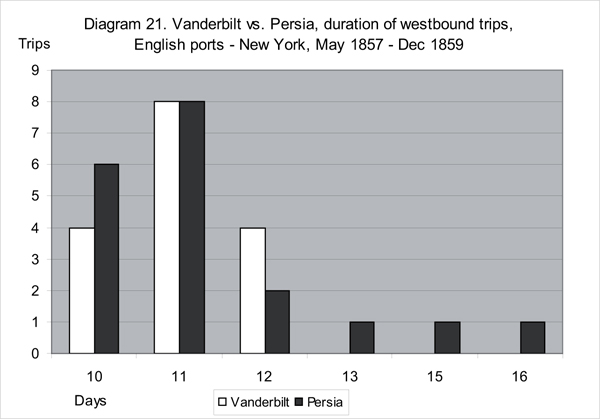
Source: Sailing lists in Hubbard & Winter, 38–44, 163–165.
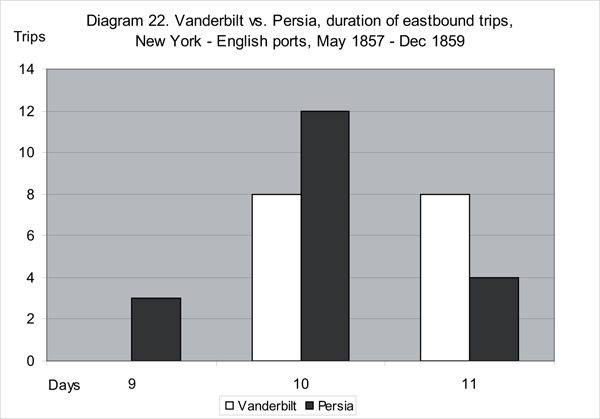
Source: Sailing lists in Hubbard & Winter, 38–44, 163–165.
As can be noticed in the diagrams, the performance of the two vessels was clearly better than any other ships before that date. The Persia even made three nine-day crossings eastbound, from port to port. The regularity of the ships was excellent compared with anything ever seen on the Atlantic. During her career as a mail steamer, the Vanderbilt never took more than 12 days for an Atlantic crossing. It should be noticed, however, that she was out of traffic during the worst winter months.382
Cornelius Vanderbilt showed that it was possible to run a mail service without government subsidies and even conquer the best performance of a subsidized vessel. The competition between the Vanderbilt and the Cunard Line service was parallel with the contest between the Great Western and the Cunarders ten years earlier. But one speedy vessel was not sufficient for a regular and reliable mail service if the other ships of the company did not meet the expectations. As can be noticed from Diagram 23, the Vanderbilt Line’s performance varied a great deal depending on which ship made the journey.383
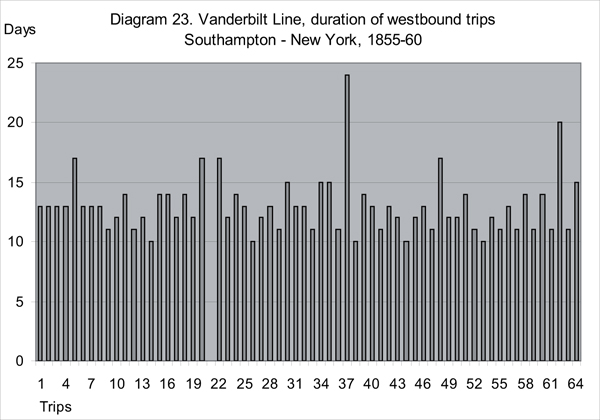
Source: Sailing lists of Hubbard & Winter, 163–165. – The profile of the westbound sailings of the Vanderbilt Line looks very different to the flagship’s performance.
With the outbreak of the American Civil War, Vanderbilt’s steamships were taken for charter by the Federal Government, and the Vanderbilt European Line’s service was never started up again. Commodore Vanderbilt transferred his capital and interest to the railway business .384
Within about ten years, between 1857 and 1867, the American mail steamship companies disappeared from the North Atlantic service. Two of the original contract lines, the Ocean Line and the Collins Line, had to close down for lack of sufficient government subsidies, accompanied by poor management of ships and finances.
It has often been pointed out that the main reason for the collapse of the Collins Line was the cut in subsidy at a time when the company had just lost two of its four vessels. However, the Havre Line lost both its original vessels but could still continue in traffic, even after the Civil War. The line also lost its subsidies at the same time as all the other American shipping companies, only receiving compensation based on postage on the mails carried.
When comparing the Collins ships’ and the Vanderbilt’s performance, it can also be noticed that a fast, regular service did not necessarily mean continuous, long-lasting and expensive repairs. The Vanderbilt regularly stayed in New York for only seven to 14 days between her voyages, with the exception that the company had no service during the worst winter months, mainly January–February, even March, when all the line’s ships stayed in the home port.385
The 3,350-ton Vanderbilt was somewhat larger than the Atlantic and her sisters, which were 2,850 tons each. The Persia was 3,300 tons. They were all wooden paddle steamers, except the Persia, which was Cunard’s first iron ship built for the Atlantic service. The Collins ships and the Persia had two side-lever engines each, while the Vanderbilt had two beam engines. The American ships were built in their home country, the Persia in Britain.
The engines of the Collins ships (built in 1850) could produce 2,000 ihp, while those of the Persia (built in 1856) were already producing 3,600 ihp.386 It seems that, among several other things that caused the collapse of the Collins Line, Edward Collins was somewhat ahead of his time and failed partly due to the same reason as the builders of the Great Eastern did on a larger scale.387 The technology was not yet advanced enough to meet the expectations of the shipowners. Technological improvements would not only enable a faster service speed but would also reduce the machinery problems at sea. It did not seem possible, however, to speed up development too much. Neither the size and capacity, nor the speed of the vessels, could be increased before the technical solutions were in place, and that always took years, even though the engineers were working full days for further improvements.
Tyler has collected some interesting figures about technical efficiency development in steamships over 16 years, comparing the Cunard Line’s first mail steamer Britannia with the Persia:
TABLE 24. Comparison of technical development, the Britannia and the Persia of the Cunard Line.
|
Britannia |
Persia |
| Built |
1840 |
1856 |
| Consumption of coal to New York |
750 tons |
1,400 tons |
| Cargo carried |
224 tons |
750 tons |
| Passengers |
90 |
250 |
| Indicated horse power (ihp) |
710 |
3,600 |
| Pressure per sq. in. |
9 lbs |
33 lbs |
| Coal per ihp / hour |
5.1 lbs |
3.8 lbs |
| Speed |
8.5 knots |
13.1 knots |
Source: Tyler, 235.
What then did the Havre Line mean when it stated that the company closed down in 1867 for reasons ‘not the least of which is the bad commercial policy of the U.S. Government, which has already caused so much American tonnage to slip into foreign hands’?388 The company’s steamers Arago and Fulton, built in 1855 and used in war service for several years, should have been replaced with new ones at the end of the 1860s. Why did the company not invest in new vessels? A major reason for the decline of the American merchant marine was the scarcity of capital. English investors considered American-built steamships inferior, and were reluctant to invest in them, while American investors put their money in sailing ships and, more often, in Western interior development – railways, telegraph, industrial enterprises and mines.389
American merchant shipping declined rapidly after the Civil War, a trend that was to continue for decades. In 1860 two-thirds of all export and import tonnage was carried on American ships, in 1866 only 30% and nine years later 27%.390 When Britain passed the Navigation Laws of 1849 and opened its trade internationally, the Americans only moved to protect their shipyards, doing nothing to encourage their shipping. This was partly seen as a political question: the southern pro-slavery leaders were against giving support to the northern shipping, as it would have strengthened the economic superiority of the northern states. The withdrawal of the Collins subsidy can also, at least partly, be seen against this background.391
Due to the legislation, American shipping companies had to use vessels built in the United States. The American shipyards were superior in building wooden vessels but they did not have much experience of iron, which was also expensive in America compared with Britain. Additionally, British mechanical skills and engineering were far beyond the American level.392 The American steamship companies were left in the contest without support and in the new market situation the last American mail steamship companies closed down. In the view of regular business information transmission, this was not a problem however; several new European companies were eager to take the market share left by the Americans.
Emigrant lines take their share of mail transport
The Great Famine in Ireland, caused by several successive failed potato harvests in the mid-1840s, had started a new type of traffic across the Atlantic: mass transportation of emigrants fleeing from poverty to what they hoped would be a better life.393 Between 1846 and 1875, more than 2.2 million Irishmen emigrated to the United States.
The number of German emigrants was even larger, about 2.6 million, while the total number of English, Scottish and Welsh emigrants was 1.6 million during this period. The emigration of Scandinavians started later in the 1860s, followed by Italians and Russians as the largest groups at the end of the century.394
During the first peak of this mass transportation, almost 2.7 million people were carried across the Atlantic by sailing vessels, the main emigrant port being Liverpool. As long as the American sailing packets had better cargo to carry – mail, fine freight, specie and bullion – they were not interested in the steerage business and left it to the various emigrant lines.395 Only after the steamers took over the best business did emigrants become an interesting option for the sailing packets.396
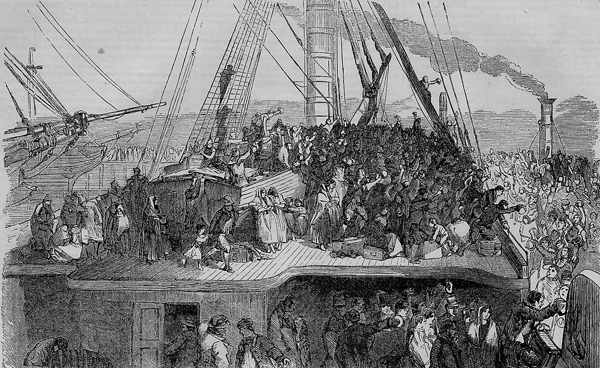
FIG. 16. Emigrants departing from Liverpool. An illustration of the beginning of an emigrant trip in Ballou’s Pictorial, published in Boston on 23.2.1856.
TABLE 25. Emigration to the United States from different areas, thousands of people, 1846–1875 (–1925).
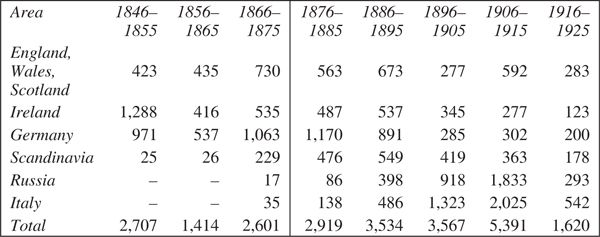
Source: Jones, 16–17. – The figures of the five decades after 1875 are given to show how the early trends evolved over time. The American Civil War and WW1 caused a drastic reduction in the number of emigrants.
By that time, technical developments had made it possible for steamships to carry more freight or passengers than earlier. Iron-built steamers with revolutionary screw propellers were more cost-effective in use than wooden paddle steamers. Later on, the compound engine would cause even more savings in coal consumption.397
The first steamship line to really take advantage of the screw steamers and start carrying steerage passengers was the Liverpool & Philadelphia Steamship Company, better known as the Inman Line, after the founder William Inman of Liverpool. The Inman Line started transatlantic traffic between Liverpool and Philadelphia in 1850. Having purchased an iron screw steamer, the City of Glasgow, in 1852, Inman converted her to an emigrant ship by preparing 400 temporary berths for westbound voyages and adapting them for cargo space eastbound. Apart from the fact that steamship voyages were notably faster than those of sailing ships – which was naturally convenient for passengers travelling uncomfortably in steerage – Inman’s concept included cheap ticket prices compared with mail steamers and cooked meals on board for the less wealthy passengers as well.398
The Inman Line soon added two similar but larger steamers to its fleet, but it did not take long before the service was interrupted. The City of Glasgow sailed from Liverpool in March 1854 with 480 people on board, and was never heard of again. In September of the same year, the City of Philadelphia was lost near Cape Race. These misadventures made the public suspicious of the seaworthiness of screw steamers for several years.399
The only Inman ship remaining after the losses of 1854, together with the two replacements, were chartered to the British and French governments as troop carriers in the Crimean war. This saved the company financially, and the public had time to forget the disasters. After the war, the market situation on the North Atlantic route changed with the collapse of the Collins Line. Inman changed its American port from Philadelphia to New York and the company’s name to the Liverpool, New York & Philadelphia Steam Ship Company. To replace the ceased Collins Line mail operations, the U.S. Postmaster General made individual trip contracts with steamship companies carrying mail to Liverpool and other European ports, offering compensation of sea postage only for the letters carried. The Inman Line thus started as a mail carrier between Liverpool and New York from early 1857, with a bi-monthly service.400
The Canadian Allan Line started a bi-monthly service on the Liverpool – Quebec route in 1856, sailing to Portland in the winter when navigation up the St. Lawrence was impossible. Cornelius Vanderbilt started his line between New York and Bremen via Southampton in 1857, the same year as the Inman Line changed to the New York route. Additionally, two important German lines started their steamship service on the North Atlantic route: Hamburg-Amerikanische Packetfahrt Aktien Gesellschaft, or Hamburg-Amerika Linie (the Hamburg-American Line), usually shortened to HAPAG, between Hamburg and New York in 1856 and Norddeutscher Lloyd (the North German Lloyd), between Bremen and New York in 1858. Both German lines soon added a call at Southampton to their service.401
Of all these new lines, the Inman Line, HAPAG and the Norddeutscher Lloyd not only operated in the emigrant business, but also carried mail on behalf of the U.S. Post Office. The Allan Line started as a mail carrier under a Canadian government contract, but also carried emigrants from the very beginning. All these lines started their operations with iron screw steamers that had steerage accommodation for 300 to 400 passengers.402
Between 1860 and 1875 the traffic on the North Atlantic route grew enormously. In the early 1860s there were about two weekly sailings to New York from England, or from the German states via England. The slight growth during the American Civil War was mainly due to the increase in German sailings, especially those of the Norddeutscher Lloyd which replaced the Vanderbilt Line. In the late 1860s, the German companies grew strongly and during some years even took a larger market share on the route than the Liverpool companies. The unexpected and fast growth of the German lines is depicted in Diagram 24.
After the Civil War had swept all American competitors from the North Atlantic route, the market was divided between the two British and two German companies. The emigrant transports were the main reason for the remarkable growth in the number of sailings from the mid-1860s. The peak year of this period was 1873, when the four companies had a total of 279 New York arrivals.403
In Diagram 25, the Cunard Line’s sailings to Boston and the Inman Line’s service to Halifax (1867–1871) are not included.
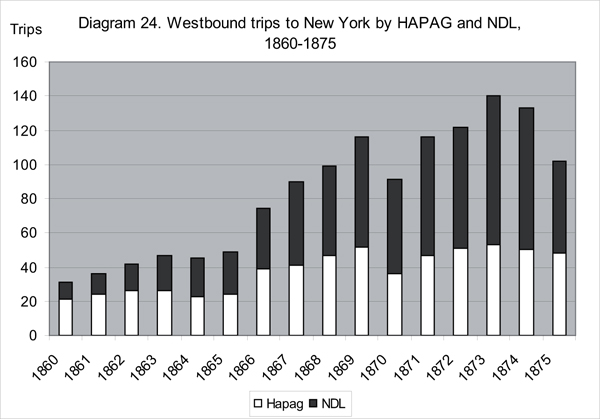
Source: Sailing lists of Hubbard & Winter, 174–194, 242–262. – The number of German emigrants almost doubled in the mid-1860s, which correlates strongly with the growth in the number of sailings. See the emigrant records in Table 25.
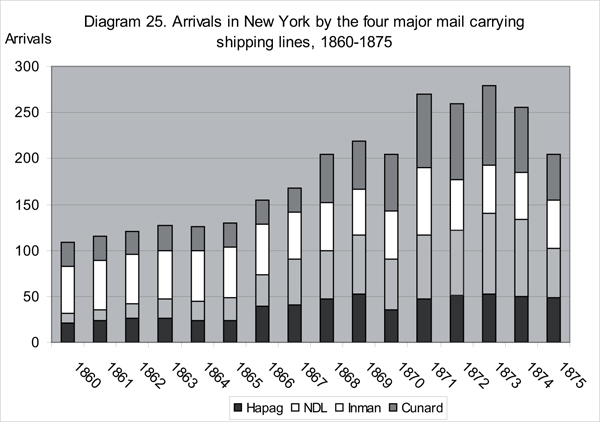
Source: Sailing lists of Hubbard & Winter, 44–80, 174–194, 200–224, 239–262.
Effects on business information transmission
In addition to the leading shipping companies, there was the Irish Galway Line, established in 1858, which carried mails from Galway via Halifax, or alternatively via St. John’s, to New York. After some changes in the company’s mail contracts and continuous problems in meeting its commitments,404 the line had to close down in early 1864. It has been stated that the decline of the company was due to the withdrawal of the government subsidy in 1861. Nevertheless, the abolition of the mail contract had a clear reason: the line’s poor performance. Their westbound sailings took over 15 days on average. Half of the trips were conducted in 16 days or more, while the company’s new Adriatic – purchased from the Collins Line – could make the same route in eight or nine days.405
During its short existence, the Galway Line introduced some new ideas to business information transmission. The company’s contract included a plan that the ships would carry telegrams to St. John’s, from where they could be transmitted to Canada or the United States, thus saving some time in information transmission. The transatlantic cable was not yet in regular operation, but telegraphic communications already existed from Newfoundland.406 Due to the ships’ slow voyages, this means of communications was not successful however; it was speedier to send the information by a mail steamer directly to New York.
An immediate effect of the Galway Line’s service from Ireland was that the Inman Line started to make a call at Queenstown on the way to or from New York in 1859, thus ensuring its part of the lucrative Irish emigrant business. The Cunard Line, seeing the effect on the mail traffic, started the same practice later in the same year.407
In a way, the Inman Line actually did the Liverpool merchants a disservice by starting calls at Queenstown. From then on, the incoming mails were offloaded while the mail steamer was anchored off Queenstown, taken to Cork by auxiliary steamer and loaded onto the train for Dublin. Then a mail steamer conveyed the mails from Kingstown – the port city of Dublin – to Holyhead, England, from where they proceeded by train directly to London. Movements of mails and passengers in this manner saved about twelve hours of transit time. Meanwhile, the mails for Liverpool and the northern parts of England continued by the transatlantic mail steamer and were dispatched in Liverpool on the following day.408 Thus, Liverpool businessmen lost the advantage of getting the American mails one day earlier than London. As the most important news could be transmitted by telegraph from the first port of arrival in any case, the difference was probably no longer considered crucial in the late 1850s.
Liverpool had already started to lose its control over the North Atlantic mail transmission earlier. Several American and German mail-carrying steamers – the Vanderbilt Line, the Havre Line, HAPAG, the Norddeutscher Lloyd – called at Southampton instead of Liverpool on their way to Havre or Bremen, as the competition in shipping was very hard on the Mersey. In the late 1840s, the American Chamber of Commerce in Liverpool wrote ‘to the Lords Commissioners of Her Majesty’s Treasury’ that ‘…whenever the (…) mails arrive late in the afternoon at Southampton, the letters for Liverpool are delayed twelve hours in London, always affording to the London Merchant decided advantage in all transactions – and moreover upon occasions when the arrival at Southampton happens to be late on a Saturday, the letters are not available in Liverpool until Tuesday morning as they do not arrive for delivery till after business hours on the previous Monday evening.’ Therefore, the merchants ‘humbly submitted’ that the mails would be directly distributed to the country.409
There may have been some relevance in the claims of the Liverpool merchants, as the plan to abolish the mail contracts with the shipping lines carrying mails to Southampton was ‘vigorously opposed’ by London merchants in the 1860s,410 even though they would have received their mails rapidly by train from Queenstown as well. It was not only important to get the news fast; it was also important to get it faster than the competitors.
Although all the mentioned shipping lines carried mails to and from England, it seems that British businessmen preferred ships with a reputation for being fast, and they also preferred short inland connections. The correspondence of Rathbone Bros & Co. lends some weight to this claim, even if it naturally represents only one company’s aims, and especially one that was located in Liverpool.
A sample of letters from Rathbone & Bros Co.’s correspondence in 1864411 shows that the company received mail from New York by almost every British mail steamer that arrived in Liverpool during the year. Of the 146 received letters, 77 had arrived by the Cunard Line and 64 by the Inman Line ships directly to Liverpool. Of the letters carried by the Cunard Line, 34 had arrived via Boston while 43 were sent directly from New York. Five letters had arrived by the German lines via Southampton.412
All the Liverpool ships sailed via Queenstown. According to Hubbard & Winter, the Cunard Line’s ships only stopped there for a short while, sometimes only for ten minutes, to dispatch the mail.413 Especially westbound, the Inman Line must have used much more time getting all the hundreds of Irish steerage passengers on board.
It seems that by far the fastest alternative to sending business information from New York to Liverpool in 1864 was by a direct Cunarder. Cunard’s ships sailed from New York to Queenstown in 10.5 days, while it took 11.1 days for the Boston vessels to arrive, even though the trip was about eight hours shorter. This was because, on the New York route, the Cunard Line had their newest and fastest vessels which sailed most of the voyages in nine or ten days. The Inman ships made the trip from New York to Queenstown in 11.7 days. About one day must be added to all these averages for the final trip to Liverpool. It was possible for a ship that had arrived at Queenstown early in the morning to reach Liverpool by the evening, but this did not happen very often. Even in these cases, it was too late to get the mails dispatched before the following morning.
Rathbone Bros & Co.’s agency in New York seemed to carefully follow the ship schedules. Most of the letters were written on the day before the ship’s departure (68 cases) or on the same day (also 68 cases), while in only ten cases was a letter written two or three days – once even four days – before departure. Since 1853 there had been a supplementary service in New York for businessmen under pressure who wanted to get the latest information on board a ship that was departing on the same day. The arrangement consisted of a clerk stationed on the steamer’s wharf after the official closing of the mails in the post office to receive the postage due and take care of the letters until ten minutes before the ship’s departure. This service was advertised in commercial newspapers when available.414 Several letters in the Rathbone correspondence of 1864 carry the handstamp ‘Supplementary Mail’.415 Although most of these letters were carried by the Cunard Line, the other lines were also included, which shows that the service did not depend on which flag the mail was carried under.
Due to the good business practices of the Rathbone agency, no unnecessary days were normally used in sending letters from New York. One extra day was normally needed for the inland transport of mails to Boston, however. Due to the Cunard Line’s sailing schedule – Wednesday sailings from New York and Boston – the ship also quite often arrived in Liverpool on a Sunday. This happened 20 times in 1864, and it caused one day’s extra delay for 35 Rathbone letters, as they were not dispatched before Monday. While the Inman Line sailed on Saturdays, this was not normally a problem for their ships, and it happened only twice during that year that the arrival occurred on a Sunday, causing an extra delay to three Rathbone letters.
All these details included, the duration of information transmission from the writer to the recipient was 12.2 days on average, if the letter was sent by a Cunarder directly from New York, and 13.6 days if it was sent via Boston. A letter sent by an Inman Line ship took 13.8 days on average – which made it a good alternative to Cunard’s Boston sailings, but not to those from New York.
The sample of letters sent by the German lines, the Norddeutscher Lloyd or HAPAG, was so small (only five letters) that no conclusions can be drawn. However, all these sailings were made in 11 or 13 days, giving an average of 11.8 days. The letters were in Liverpool 13.6 days from the date of the letter on average. Even if the performance of the German ships seems to have been equal to the Inman Line’s, they were only used in cases where the Inman Line ships that departed on the same day were only carrying mails to Ireland. Such arrangements were made by the Postmaster General for the Saturday sailings from New York; the U.S. mails were dispatched by more than one steamer each Saturday. Thus there could be two or even three mail ships leaving on the same day, one carrying the mails for Ireland, one for France and one for the rest of Europe.416
In light of the Rathbone correspondence, it seems that letters were not sent via Southampton and London if it could be avoided. In all the cases where a letter was sent by a German steamer, it arrived in Liverpool sooner than if it had been sent by the next Cunarder. The difference varied between three and five days. Three of the letters sent by the German steamers were forwarded by the supplementary service, indicating that something really important had to be communicated.
When comparing the services of the Cunard Line and the Inman Line, it was not exceptional that a Cunard ship that had departed from New York four days later than Inman Line’s, arrived at Queenstown on the very same day, and their mails were dispatched in Liverpool simultaneously on the following day. Incidents like this naturally strengthened the Cunard Line’s reputation as a reliable mail carrier, even if the Inman Line could also make fast voyages occasionally.
Sir Samuel Cunard – he had been knighted in 1859 – still insisted that the only safe means of mail transmission was by paddle-wheeler, and he kept this standard on the North Atlantic service until the 1860s.417 The Scotia, built in 1862, was the last paddle-wheeler of the Cunard fleet sailing up to 1876. Samuel Cunard died in 1865, a few years after the launching of the China, the company’s first iron screw steamer for the North Atlantic mail route, in 1862. This vessel adapted to the changed circumstances in many ways – in addition to 268 cabin passengers, she carried 771 in steerage. Until that date, Cunard had considered it inconsistent with the safety of the mails to carry emigrants, and therefore had refused to carry them. But times were changing.418
Open competition – the new deal on mail contracts
By the late 1850s, the Inman Line, HAPAG and the Norddeutscher Lloyd were already sailing with iron screw steamers, which used less coal and were able to carry hundreds of emigrants. Although the Cunard Line had started to operate emigrant ships in their Mediterranean service,419 they were still reluctant to use them on the North Atlantic service. As late as 1867, the company built the Russia, a fast iron screw mail steamer that carried 235 cabin passengers, but no steerage passengers. While the ship was under construction, the company learned that the British Post Office was not going to renegotiate their mail contract, which would expire at the end of 1867.420
The reason for this decision was clear. The British and American Post Offices were planning to reduce the existing postal rates by half, which would most probably increase the number of letters sent but decrease the postage revenues. Additionally, the British Post Office considered that the old kind of arrangement was not the most advantageous for its purposes. A reliable steamship service was now being conducted by several different companies. There would be a more frequent mail service to the United States if the steamship companies only had short, separate contracts. If the United States could make similar arrangements, communications between the two countries would be greatly improved.421
As the time for a new contract approached, the British Postmaster General advertised for offers to take the mails for the ocean postage alone – a practice that had already been in use in the United States for a long time. The Cunard Line refused to make any such offer and talked about retiring from the business. The Inman Line agreed to take the mails from New York to Queenstown and the German lines to Southampton at the rate of 1s. per ounce for letters and 3d. per pound for newspapers. In order to exclude the Cunard Line, Inman agreed to take the mails to Halifax as well as to New York.422
The Post Office had not expected the Cunard Line’s refusal to tender and was caught in a difficult situation. There were four regular mails each week between Britain and the United States: Tuesday outwards from Southampton by the Norddeutscher Lloyd or HAPAG alternately; Thursday outwards from Queenstown by the Inman Line, sailing from Liverpool on Wednesday; and Sunday outwards from Queenstown by the Cunard Line, sailing from Liverpool on Saturday. The homeward mails from New York were carried by the Cunard Line on Wednesdays, by the German ships on Tuesdays, and by the Inman Line on Saturdays. Additionally, there were the weekly Allan Line mails to and from Canada. It was obvious that if Cunard withdrew from this pattern of services, the balance of regular mail deliveries would be greatly disturbed. Representations were accordingly made to John Burns423 that the company should tender on the basis of a subvention rather than payment for sea postage.424
As always, the Cunard mail contract was also a political question. Before the new contracts with the Inman Line and the German companies had reached the Treasury, the Liberal government was replaced by a Conservative one. The new Postmaster General favoured acceptance of the Cunard Line’s belated offer to take the New York mails for £95,000, or £120,000 if Halifax calls were required, in addition to the contracts of the Inman Line and the German lines. The Conservatives related positively to the Cunard Line and upheld the policy of subsidizing steamship lines. They had granted an increase to the Cunard contract in 1846 and an extension in 1858. On this occasion the Government made a compromise with the Cunard Line, permitting them to take the mails for a year and paying £80,000 for it.425
New arrangements were needed almost immediately as the United States had agreed to a convention that reduced the ocean postage by half.426 The Postmaster General had to advertise for new bids. The National Line made the best offer, but was not given a contract due to its slowness – 14-day trips compared with less than ten by the fastest ones. By this time the Cunard Line had come to the conclusion that half a loaf was better than no bread and negotiated with Inman. The result was a private agreement whereby John Burns, speaking for both companies, confronted the Government with a request for £100,000 for the Cunard Line and £50,000 for the Inman Line. In a series of negotiations, these demands were reduced to £70,000 and £35,000 respectively, and the life of the contracts from ten to seven years. When these contracts expired, they were never renegotiated.427
From early 1869, the Cunard Line carried the British mails to New York, sailing from Liverpool each Saturday, and to Boston each Tuesday, via Queenstown. The Inman Line sailed to New York each Wednesday, also via Queenstown. Additionally, the German lines carried the Southampton mails for the postage only, as before.428
The postage rates for ocean letters were again reduced at the beginning of 1870. Instead of one shilling per letter in 1867 and six pence in 1868–1869, the postage rate for a transatlantic letter was only three pence in 1870. Simultaneously, the number of letters carried increased from 3.9 million in 1867 to 6.7 million in 1870. Despite the considerable growth in information transmission, the income for the Post Office declined markedly.429
After this, carrying mail was no longer a business for any steamship company. The British mail contracts with the Cunard Line and the Inman Line were far from the level the Cunard Line had started with. The United States held to its policy of paying only the sea postage. The steamship lines took the mails when convenient, on a weekly basis. In 1868 it twice happened that they did not bother to take the mails at all. When a further reduction in postage rates took place in 1870, the British lines refused to carry American mails and arrangements were made with the Guion Line and the Norddeutscher Lloyd.430
A couple of developments occurred on the North Atlantic route simultaneously – the traffic became more frequent and the sailings faster than ever. These two trends, combined with the drastic reduction in postage rates, increased the amounts of transmitted information markedly. Even if this must have been good for business on both sides of the Atlantic, it was not good for the shipping companies. Not only did the revenues from mails decline, but, due to the rapid increase in capacity, freight rates were also on the wane. Even the passenger rates were reduced due to the hard competition.431
In this business environment the transport of emigrants became an important part of shipping functions. The emigrant business was neither easy nor highly profitable,432 but it added a considerable amount of income to the shipping companies during the good years. For example, the Cunard Line received £70,000 in mail subsidies from the British Government for 104 voyages during a year and an additional £16,000 for American mail postage carried from New York.433 Leaving out the Boston route, it can be calculated that the income from the mails was £980 per round trip on average. If each emigrant paid the company £6 6s. for a trip from Liverpool to New York,434 the additional income for 500 emigrants added £3,250 to the company’s revenues on each round trip.
In 1870 the Inman Line carried 40,500 steerage passengers, the National Line 33,500 and the Guion Line 27,500. Although the Cunard Line carried fewer than 17,000 passengers in steerage, they carried an additional 7,500 cabin passengers, which was more than all the others together.435 The effects of the Cunard Line’s rethinking after the new deal on mail contracts can be seen in Diagram 26.
Until the end of 1868, the Cunard Line had 26 annual sailings to New York and as many to Boston. The new mail contracts required 52 sailings to both ports. But in the next few years, when emigrants were streaming over the Atlantic, the number of New York sailings was increased to 86. This meant heavy investments in new ships. The 2,500-ton Siberia and Samaria, with accommodation for 130 cabin passengers and 800 in steerage, were followed by a series of larger steamers in the late 1860s.436
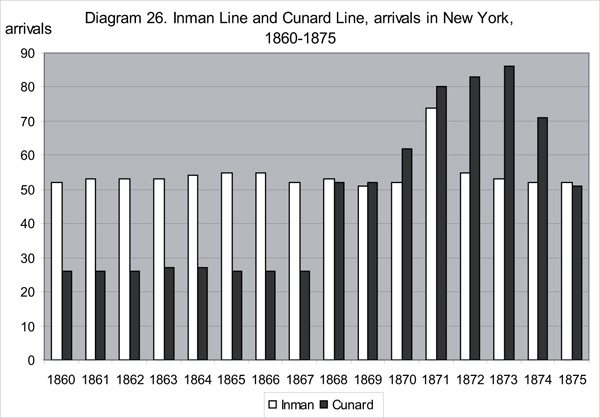
Source: Sailing lists of Hubbard & Winter, 44–80, 200–224. – The Cunard Line service to Boston and the Inman Line service to Halifax are excluded.
Based on the claims of William Inman in the Parliamentary hearings, it has been assumed by historians that the two shipping lines had become essentially identical in both speed and service by the late 1860s.437 However, in 1870 – even though the government subsidies were already being shared by these two companies – this was not yet true.438
As shown in Diagram 27, the Cunard Line made 21, or 34%, of its westbound trips in nine days or less, while the Inman Line made only five, or 10%. An average Cunard voyage took 10.2 days while an average Inman voyage took 10.6 days.
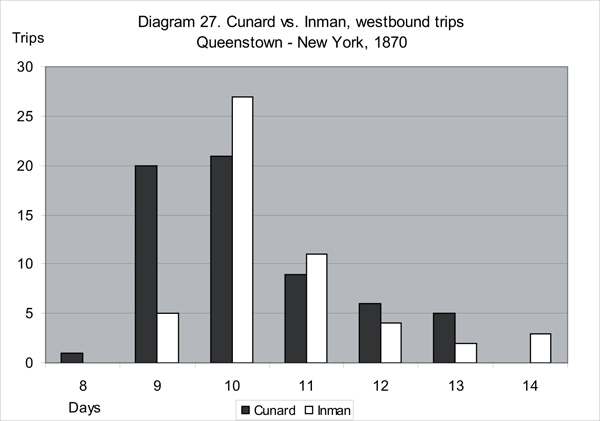
Source: Sailing lists of Hubbard & Winter, 61–64, 215–217. – The total number of Cunard and Inman voyages was 61 and 52 respectively.
Eastbound the difference was even greater. While the Cunard Line made 43, or 70%, of their eastbound voyages in nine days or less, the corresponding figure for the Inman Line was only 20 voyages, or 38%. Additionally, the company had bad luck and two voyages were lengthened to 17 and 27 days.439 An average Cunard voyage took 9.3 days while an average Inman voyage took 9.9 days.
The situation was quickly changing however. Instead of increasing the number of voyages like Cunard did, William Inman invested in larger and faster vessels. After launching two new 3,000-ton vessels, the City of Brooklyn and the City of Brussels, with accommodation for 200 cabin and 600 steerage passengers, in 1869 the company launched three 4,500-ton vessels, each one able to carry 120 to 200 cabin passengers and 1,200 to 1,300 in steerage. The City of Berlin, launched in 1875, was a 5,500-ton steamer that could carry 170 first class, 200 second class, and 1,500 steerage passengers. She made a record passage in both directions on the North Atlantic route, steaming from Queenstown to New York in seven days, 18 hours and two minutes, and back home in 2.5 hours less.440 The new ships were not only larger, but also faster than the Cunard Line’s.
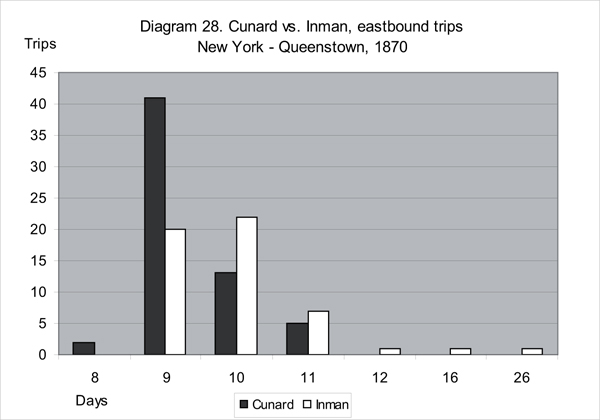
Source: Sailing lists of Hubbard & Winter, 61–64, 215–217. – The total number of Cunard and Inman voyages was 61 and 52 respectively.
At this point two new mail-carrying steamship companies still need to be presented, one British and one French.441 The transatlantic shipping boom of the early 1870s saw the establishment of a particularly important British mail-carrying steamship company: the Oceanic Steam Navigation Company Limited, better known as the White Star Line. The company name had been well known for conducting an emigrant service to Australia by sailing ships since the start of the gold rushes in the early 1850s. The line was not only remembered for carrying masses of emigrants to Melbourne but also because of the worst shipwreck to date, and the bankruptcy of the company in the late 1860s. The financial failure was caused not by unsuccessful trade, but by the collapse of the Royal Bank of Liverpool, where the company had heavy debts due to ship investments. When the vessels were sold, the company name remained and was purchased by a man called Thomas Henry Ismay.442 After restarting the Australian emigrant business, Ismay turned his attention to the North Atlantic service.
Within less than a year from March 1871, the White Star Line brought five new large steamships to the Liverpool – Queenstown – New York route. The Oceanic, Atlantic, Baltic, Republic and Adriatic were all about 3,700 tons and carried 166 cabin and 1,000 steerage passengers. Ismay not only copied the names of his ships from the famous Collins Line of the 1850s, but also copied the business idea. His ships would not only be the fastest on the North Atlantic run, but also the most comfortable for passengers, with several new innovations – which would naturally soon be copied by other companies.443
Another long-lived shipping line to be mentioned here was the Compagnie Générale Transatlantique, or the French Line, which started a contract mail service for the French government between Havre and New York in June 1864. It was the first French mail line since the unsuccessful Herout & de Handel Line of 1847.444 Contrary to the British government-subsidised mail system with different lines for the North Atlantic (the Cunard Line), the West Indies & South America (the Royal Mail Line), and the East India and Australasian routes (P&O), the French model was as follows: the North Atlantic and West Indies mails were taken care of by one shipping line (the French Line), while the South American and Asian routes were taken care of by another company, best known by the name Compagnie des Messageries Maritimes, or Messageries Impériales during the Imperial period.445
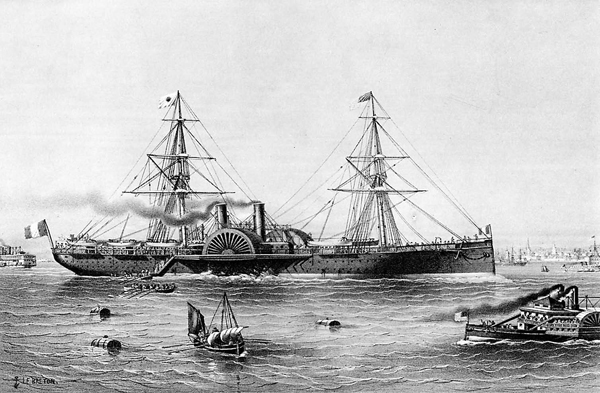
FIG. 17. The Lafayette of the French Line was one of the two vessels which started the French mail service after a 16 years pause on the North Atlantic route in 1864. (Barbance: Histoire de la Compagnie Générale Transatlantique, 1955).
The French Line started its North Atlantic mail service between Havre and New York in 1864. The company’s ships were built following the model of the fastest Cunarders, while the paddle-wheelers were already doomed to be outdated by other transatlantic shipping lines. The French Line did not carry steerage passengers either.446
In 1865,447 after a railway service had been established from Brest to Paris, the company’s ships started to make a call at Brest en route448 – a very similar arrangement to the Liverpool ships calling at Queenstown to pick up the latest mails from London. This probably gave some competitive advantage to the French Line against HAPAG, whose ships called at Havre on their way from Hamburg to New York. The sailings of the French Line were also transformed to a bi-monthly basis in 1866. HAPAG had changed Southampton to Havre as a port of call in 1869, but the arrangement saw several changes due to the Franco-Prussian war in 1870–1871. From 1872 the company had a weekly service from Havre on the way to and from New York.449
In January–June 1875 the average westbound voyage by a French Line ship from Havre to New York took 11.5 days, the same as the voyage by a HAPAG ship. For the whole year, the HAPAG average was 11.3 days.450
Thus the North Atlantic mail route to New York in the mid-1870s was dominated by three major British shipping lines, two German lines and one French line, in addition to a varying number of other major and minor shipping lines without a mail service. While the British and German companies’ ships of the 1870s always had a large steerage capacity, the French Line ships typically did not have that kind of accommodation.451 A comparison between the performance of different companies indicates that the number of people on board did not necessarily affect the speed after it had been accepted that emigrants could be carried in good new ships instead of those which no longer suited any better purpose. Bigger size and more effective machinery made it possible to keep the speed up – if preferred.
In search of glory – reputation and real life
The competition on the North Atlantic route was very hard during the whole period from the start of steamship traffic in 1838 to 1875, and did not decline after that. The public image of the shipping lines was largely based on the passenger comfort and record journeys, always highlighted by the press. They were also the most tangible advantages from the public’s point of view. Even if the individual decision on travelling might have been based on current prices, the reputation of the shipping company played an essential role in decision making.452
Even though speed was probably not the most important element for passengers in practice, it was critical for mails and freight. The speed of mail steamers on the North Atlantic route increased steadily throughout the whole steamship era. The Sirius made her first voyage in 18.5 days, with an average speed of only eight knots. In the 1870s the Germanic of the White Star Line doubled that speed to almost 16 knots. The speed record was improved 17 times from the Sirius’ first trip to the end of 1875. The figure includes cases where a vessel was able to improve her own speed record, as the Great Western did several times during 1838–1843.453
As Samuel Cunard stated in his letter to Viscount Canning, the General Postmaster, in 1853, the mails could have been carried across the Atlantic by safe and good vessels of 400 hp, but ‘effective and immediate measures [had to be taken] to meet our powerful opponents’.454 These measures repeatedly meant larger and faster vessels to beat the competitors, not only for the public image of the company, but also for the prestige of the whole country.
The Blue Riband was an entirely unofficial contest for the fastest sea crossing of the North Atlantic. No one ever organized it, and in fact a physical emblem or trophy did not even exist at that time.455 There were no official, written rules for the competition. The existing rules had been formulated over the decades, and maritime history has seen many kinds of interpretations of the records. As the contest for the Blue Riband was not organized by any authority, no official archive material has been left for historians. The information is mostly based on newspapers that enthusiastically followed the ship arrivals, as well as company records based on ships’ logbooks and other corresponding material.456
In later historical research, the following rules have been accepted as putting an end to the confusion regarding the speed records of each time: The vessel should be in regular line traffic, westbound from Europe to North America. The eastbound records were considered to be of ‘second class’. As the routes were different, only the average speed was calculated. The record sailing from coast to coast did not mean from port to port. In earlier times it was often measured between Daunt’s Rock off Queenstown and Sandy Hook lighthouse off New York.457
There was typically a correlation between the size of the vessel and its speed. From 1838 until the end of the century almost all Blue Riband holders were also the largest ships in the world, excluding the Great Eastern.458 She was never a Blue Riband holder but was definitely the largest passenger ship ever built until the 20th century.
Diagram 29 shows the development in size and speed of the fastest vessels on the North Atlantic mail route between 1840 and 1880. In the 1870s the size of vessels grew faster than the speed was improving, mainly due to the growing stream of emigrants. In the long run, these two elements – size and speed – would be tightly combined, as will be shown in the Epilogue.
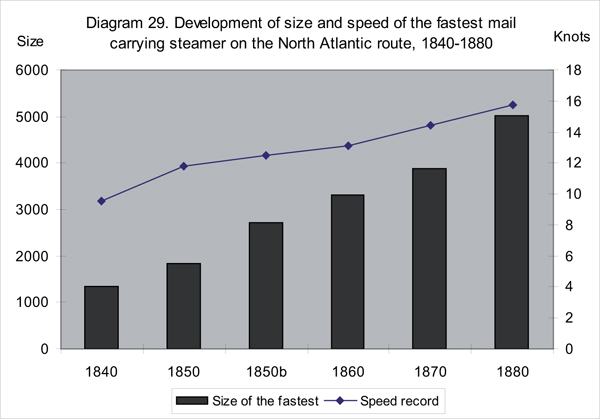
Source: Kludas, 36, 45, 49, 58, 60, 148. – The record ships were the following: Great Western (1840), the Europa of the Cunard Line (1850), the Pacific of the Collins Line (1850b), the Persia of the Cunard Line (1860), the Scotia of the Cunard Line (1870) and the Germanic, built in 1875, of the White Star Line (1880).
Maritime historians sometimes forget that one successful record crossing did not mean that all the North Atlantic traffic was conducted at the same speed. The newest, largest and fastest vessels were not at all representative compared with the rest of the Atlantic fleet. This dilemma characterized the transatlantic service during the whole steamship era, as can be seen in the following diagrams.459
In late 1850 (see Diagram 30), the fastest ship on the North Atlantic route was the Collins Line’s Pacific. She made her record westbound, crossing with an average speed of 12.46 knots. Being one of Collins’ four brand new liners, she represented an average vessel of that company but certainly not the rest of the North Atlantic shipping lines.460 The Pacific was more than 1,000 tons larger than an average Cunarder, and more than three times bigger than the smallest ships in this traffic. The average size of vessels in the North Atlantic mail service was 1,946 tons.461
In 1860, however, the fastest ship in the North Atlantic mail service was not the largest one. As can be seen in Diagram 31, the short-lived American North Atlantic Steamship Company, which tried to start a regular mail service with the former Collins liners Atlantic and Adriatic, was statistically strong when measured by average ship size in tons. The company’s Adriatic was clearly bigger than any other ship in traffic at the time, but she was never a Blue Riband holder.462
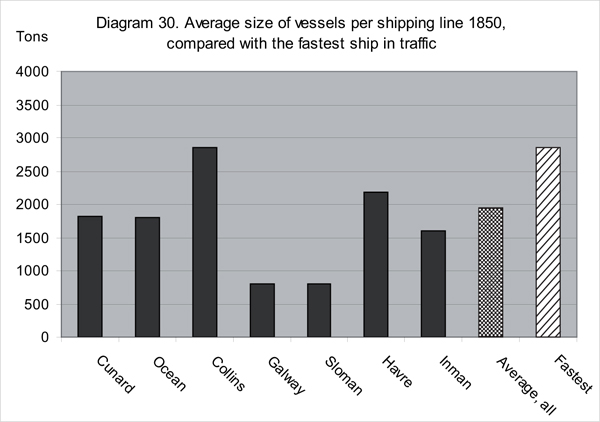
Sources: Staff, 129–132; Kludas, 45, 146.
The average size of all ships in the North Atlantic mail service in 1860 was 2,225 tons, while the size of the fastest ship, the Cunard Line’s Persia, was 3,300 tons. She was not a typical Cunarder of the time, but nearly 50% larger than the company’s fleet on average, which was 2,260 tons.
In 1870, the fastest ship on the North Atlantic route was clearly larger than any company’s average fleet. The Blue Riband holder was the Cunard Line’s famous s/s Scotia, the company’s last paddle-wheeler. Her size was 3,870 tons, while Cunard’s fleet was only 2,670 tons on average.
At the beginning of the following decade the fastest ship on the North Atlantic route differed even more visibly from her average competitors. The White Star Line’s 5,000-ton Germanic was 800 tons larger than the company’s fleet on average, and 1,900 tons larger than an average vessel in the mail service.
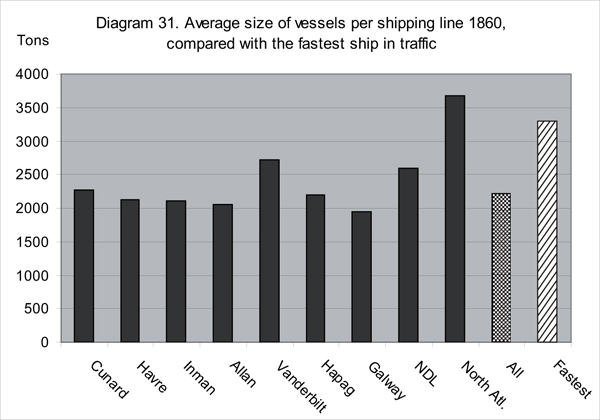
Sources: Staff, 129–137; Kludas, 49, 146.
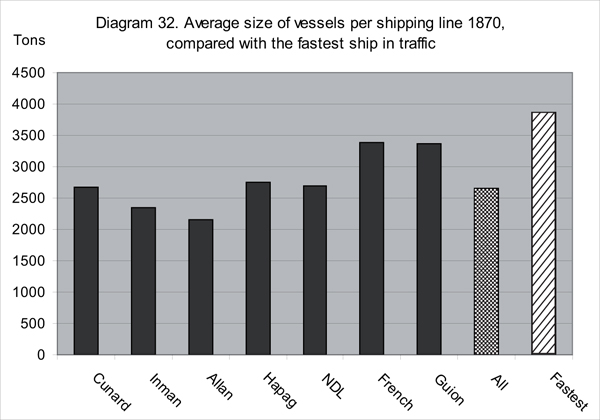
Sources: Staff, 129–139; Kludas, 49, 146.
Thus the Blue Riband holders were extraordinary, brand new and fast ships, not representing average vessels in the traffic. When talking about speed in this context, it should be remembered that there was a major difference between the record voyages and the bulk of the sailings. The reality was not the same as the best possible performance.
Different strategies led to varying performance between the major mail-carrying companies in 1875. The durations of westbound journeys between Queenstown and New York by the three major British mail-carrying companies are compared in Diagrams 33, 34 and 35.
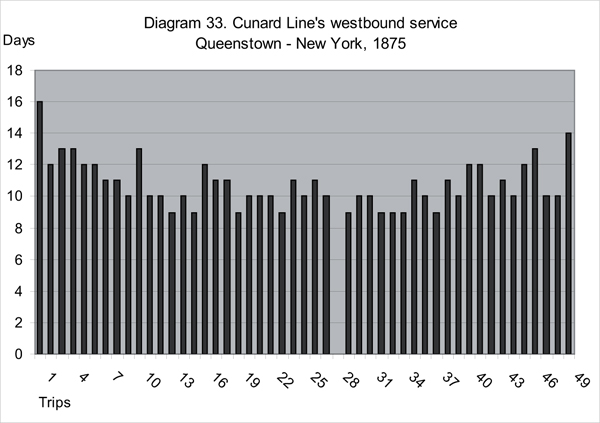
Source: Sailing lists of Hubbard & Winter, 78–80. – Sailings after 12 December are missing from the records. – The profile of the Cunard Line sailings in 1875 clearly shows that fast and regular mail sailings were no longer the company’s main priorities.
While investing in middle-size steamers for frequent emigrant sailings, the Cunard Line lost their former superiority on the North Atlantic mail run. In 1875, their journeys lasted from nine to 13 days, and two winter trips were even longer, taking 14 and 16 days. The average duration of the line’s voyages was 10.8 days. This was not very impressive, remembering that the company’s steamer Asia made an average westbound voyage on the one-day-longer route from Liverpool to New York in 11.4 days in 1850. In addition to the long average duration of the trips, the length of a single journey was quite unpredictable.463
As we have already seen, regularity was quite an inaccurate concept in the 19th century and the world was used to irregularities, especially regarding ship arrivals. The vessels were not expected to arrive punctually, as it was considered almost impossible. However, Diagrams 33 and 34 illustrate very clearly that both official British mail carriers had serious problems in meeting any expectations of regularity. After 35 years of steamship line service in the North Atlantic, forecasting the duration of the journey was still difficult.
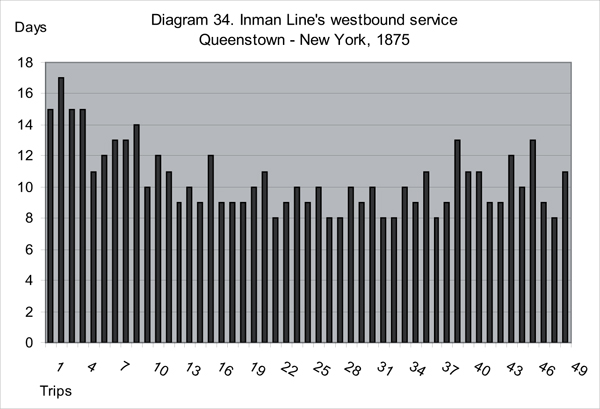
Source: Sailing lists of Hubbard & Winter, 223–224. – Sailings after 10 December are missing from the records. The sailing from Queenstown 2.1.1875 is not included in the diagram due to scale problems. The 23-day-long voyage has been included in the average sailing figure, however. – The profile of the Inman Line’s sailings in 1875 clearly shows the problem of having a mixture of different vessels on the same route. Some of the ships were really fast, but the company’s performance as a whole was not balanced.
Once again it was shown that a fleet with various kinds of vessels, old and new, large and small, was not ideal for a regular mail service. And history repeated itself – the performance of a newcomer with a fleet of similar, newly launched, effective vessels was superior. Diagram 35 shows the White Star Line’s performance on the same route.
After divesting their oldest vessel, the Oceanic, and getting the new Germanic into traffic instead of the chartered Belgic,464 the White Star Line had a fleet which could make the North Atlantic run in eight to ten days without a single exception during the whole year. Compared with Cunard and Inman, the difference was notable. The average duration of the Inman Line’s westbound voyages was 10.8 days – exactly the same as Cunard’s, even if some of their ships were clearly faster. The White Star Line had taken the leading role; their average westbound trips took only 9.3 days during the whole year.
Although the White Star Line’s regularity – only two days margin in arrivals – was very good compared with the competitors of the time, their sailings were still far from punctual. The Vanderbilt had already been able to operate with similar margins 18 years earlier.465
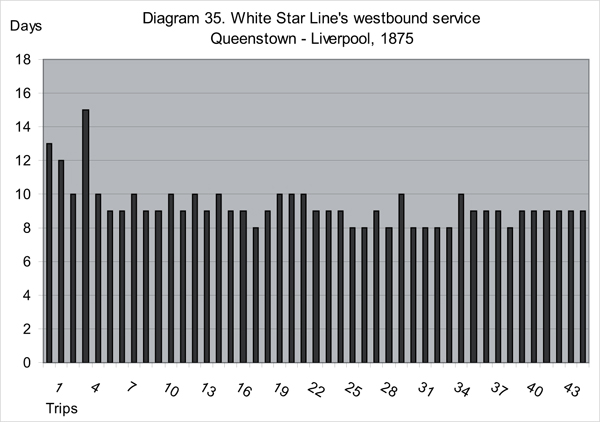
Source: Sailing lists of Hubbard & Winter, 331–333. – Departures after 3 December are missing from the records. – As can be noticed, the White Star Line’s performance clearly beat the competitors in speed and regularity of sailings.
A shipping line’s reputation did not consist of just passenger comfort, speed and regularity, but of safety as well. In view of the fact that safety was critical for the shipping business, one would have expected the shipping lines to pay more attention to the losses and different delays caused by continuous mishaps. But even if safety regulations were included in the rules of all steamship companies, only the Cunard Line really extracted routine obedience to these regulations.466
In fact, it was considered that a certain number of shipwrecks each year were natural and unavoidable. Even if disasters at sea caused unwanted negative publicity for the companies, the incidents were soon forgotten. For a historian of our time, it is somewhat difficult to understand how a shipping company could continue their business after losing nine steamships in mail service over eight years, with a total loss of 556 lives.467
During 1838–1875, more than 50 mail-carrying steamships were lost on the North Atlantic run, many of them with all mails and sometimes with considerable loss of human lives.468 In addition to these ill-fated voyages, a great number of trips were interrupted by mechanical problems, as well as damage caused by gales or collisions with other ships. The steamship machinery was not advanced enough to withstand heavy weather and hard driving: broken shafts, rudders, side-levers and cylinders, as well as lost screw blades, were among the troubles most often mentioned.469 All steamships were equipped with canvas until the 1880s, and, especially in the early years, the sails were often used to give additional speed or prevent rolling. Moreover, if a steamer lost its rudder or screw, or broke a shaft, she lost steerage and could only be saved by proceeding under sail.470
Hargest has collected a notable list of irregularities in the mail sailings, caused by different problems.471 Hubbard’s & Winter’s sailing lists, covering the years 1840–1875, are even more informative, although no records are complete in this regard. According to the notes of the latter source, not counting the trips where vessels were lost, more than 90 trips were interrupted due to machinery problems and 16 due to storm damage. Additionally, ships ran aground more than 20 times, needing repairs in half of the cases. Collisions caused damage in 12 cases – often to both parties involved in the incident. In a few cases the ship struck something – an iceberg, a whale or a reef. One ship caught fire.472
In addition to machinery troubles and problems caused by stranding or collisions, more than 50 voyages were lengthened due to the need for coal. Even though ships normally carried extra coal to manage delays caused by heavy weather, it sometimes happened that they had to call at Halifax – or the German and French ships in England – for coal before the end of the trip. Delays due to fog, ice and snowstorms were common on the North Atlantic route as well: Hubbard & Winter report about 80 cases.473
The management of all companies could have done much to prevent unnecessary delays, problems and loss of money, as well as loss of vessels and human lives. It was not by chance that some companies were continuously in trouble and had to cease their operations within a few years, or even less, due to general mismanagement. Typically, the shipping lines that had introduced the latest technology first, especially the screw steamers, had more engine troubles than the more conservative Cunard, which was accused by competitors of letting others do the expensive experiments and just collecting the benefits.474 The cautious attitude of the company can also been seen in the number of delays caused by fog or ice. Even though the Cunard Line’s vessels ran aground or collided, and even though they were not immune to mechanical trouble, almost half of their ships’ recorded delays were caused by cautious waiting in bad weather.475
On the whole it can be said that the speed of mail steamers improved notably during the period 1838–1875. The frequency of the mail service grew from a monthly or bi-monthly service to almost daily traffic from England and at least bi-weekly sailings from the German and French ports. The regularity of the departures did not really improve on the early days of contract mail sailings, as the departures were generally regular from 1840 onwards. Bad weather, mechanical problems and other misfortunes caused delays and heavy losses in the service throughout the period. The size of the ships was steadily growing, and so was the speed. Yet the record holders were lonely examples of the latest technology. The bulk of the mail steamers in everyday service consisted of smaller and slower vessels as the fleets were only gradually modernized in the most economic way.
What happened to the speed of business information transmission?
Although so many new speed records had been made and so many lives lost in an unnecessary speed contest during the two decades between the mid-1850s and mid-1870s, it is surprising to notice how little the efforts to improve the speed of ships actually affected business information transmission after a certain level of performance had been achieved. This level was achieved during the contest between the Cunard Line and the Collins Line in 1851, as can be noticed in Diagram 36.
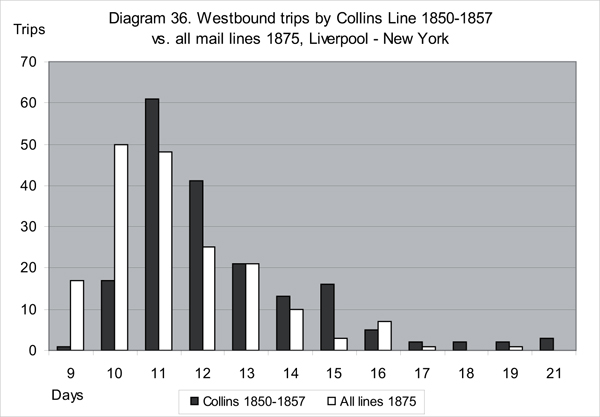
Source: Hubbard & Winter, 78–80, 98–108, 223–224, 315–316, 331–333. – ‘All mail lines’ include all the contract mail steamers on the Liverpool–New York run in 1875: the Cunard, Inman, White Star and Guion Lines. The number of Collins Line trips during 1850–1857 was 184, and the number of mail steamer voyages in 1875 was 183.
The diagram, even if somewhat artificial, shows that during the two decades, the duration of an average westbound crossing of mail steamers had only been reduced by one day.476 Simultaneously, the spread of the duration of all voyages was about the same. In 1875, the trip could still take anything between nine and 19 days, while about half of the journeys, or 53.6%, were conducted in ten to 11 days. In 1850–1857 the duration of Collins Line trips varied between nine and 21 days, and 55.4% were made in 11 to 12 days.
Table 26 shows the information circulation between Liverpool and New York enabled by the mail contract lines in 1875. The starting point is a letter sent from Liverpool on 1.1.1875.
As already noted, the westbound trips were shortened by approximately one day (0.9) on average between 1851 and 1875. The mail contract lines made 296 round trips on the North Atlantic run in 1875. Additionally, there were 49 eastbound trips by HAPAG, which did not call at the English ports westbound. Nevertheless, this large network could not enable more than 14 consecutive information circles within a year. The improvement was not impressive, compared with the 12 information circles made by the Cunard Line and Collins Line ships during 70 round trips in 1851. The duration of one information circle had been reduced somewhat more. While it had taken 27.3 days on average to get an answer to a letter from Liverpool to New York in 1851, the figure was 26.1 days in 1875.
The ships had been technologically improved since the early 1850s, which enabled more efficient use of the vessels in service. For example, the Cunard Line’s China made ten round trips in 1875 and her average westbound trip from Liverpool to New York took 10.9 days.477 The White Star Line’s new Adriatic made ten round trips in 1875 as well. Her average westbound trip from Liverpool to New York took ten days. Compared with the 1850s, the Cunard Line’s Asia made seven to nine annual round trips during her best years.478
Since there were almost 300 annual round trips conducted in 1875 by ships that were more efficient than ever before, why did the information circulation not reach the maximum, which would have been 17 consecutive circles per year instead of 14?479 The answer is that there was no need for it. Since the final introduction of the Atlantic cable in 1866, the mail steamers had lost their important role as the first news bringers, just like the American sailing packets in 1838. It was not considered necessary to organize ship departures in the most efficient way from the mail system’s point of view. The transmission of the bulk of the mails – even if still very important – was not so urgent any more. This was probably one of the ideas behind the radical changing of the mail contracts that occurred at the end of the 1860s, even though it has not been clearly pointed out by postal historians.
If the sailing dates, especially from New York, had been organized more evenly, there would have been a mail ship departure from that port almost every day of the year. Instead, four lines organized their departures on Saturdays, while there were no departures at all on several days of the week.480
TABLE 26. Consecutive information circles enabled by transatlantic mail steamers in 1875, an example.
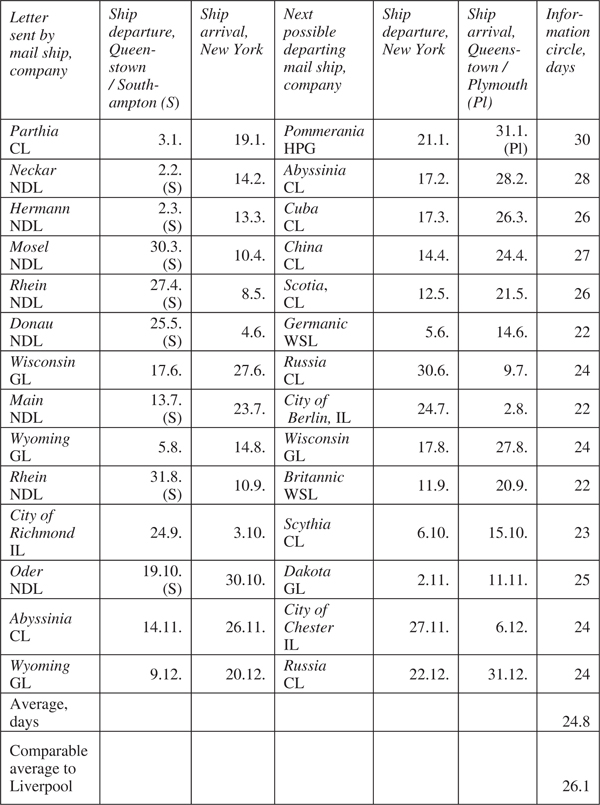
Sources: Sailing lists of Hubbard & Winter, 78–80, 193–194, 223–224, 260–262, 315–316, 331–333. CL = Cunard Line, GL = Guion Line, HPG = HAPAG, IL = Inman Line, NDL = Norddeutscher Lloyd, WSL = White Star Line. – Although the home port of most vessels was still Liverpool, Hubbard & Winter only give records as far as Queenstown for the year 1875. The average duration from Queenstown or Southampton to New York was 10.9 days, and if calculated from Liverpool, it was 11.4 days. The respective averages of eastbound voyages were 9.4 days and 10.3 days.
As can be seen in Table 26, there were sometimes four-day intervals between arrivals and departures, while there could also be a mail steamship departure on the very next day after a letter’s arrival.481
The date of arrivals at the destination was still unpredictable. A few examples of the variation in length of the Saturday sailings give an idea of the problem.
As shown in Tables 27a–c, the duration of information transmission by the Saturday sailings could last anything between ten and 15 days. One extra day has been added to the examples for the inland trips between New York and Boston, as well as from Queenstown or Southampton to Liverpool. In practice, a letter could sometimes reach the Boston departure, even if written in New York on the same day as the ship was sailing. The improved inland connections, especially railways, had streamlined the whole chain of communications, giving more equal opportunities to the cities outside New York.
TABLE 27 A–C. Duration of some Saturday mail sailings from New York, 1875.
| Ship, line |
Departure date from New York / Boston (B) |
Arrival date in Queenstown /Southampton (S) |
Duration of journey from New York to Liverpool, days |
| Mosel, NDL |
6.3.1875 |
17.3.1875 (S) |
12 (11 + 1) |
| China, CL |
6.3.1875 (B) |
15.3.1875 |
11 (1 + 9 + 1) |
| Celtic, WS |
6.3.1875 |
16.3.1875 |
11 (10 + 1) |
| City of New York, IL |
6.3.1875 |
20.3.1875 |
15 (14 + 1) |
| Ship, line |
Departure date from New York / Boston (B) |
Arrival date in Queenstown /Southampton (S) |
Duration of journey from New York to Liverpool, days |
| Oder, NDL |
3.4.1875 |
14.4.1875 (S) |
12 (11 + 1) |
| Atlas, CL |
3.4.1875 (B) |
13.4.1875 |
12 (1 + 10 + 1) |
| Adriatic, WS |
3.4.1875 |
12.4.1875 |
10 (9 + 1) |
| City of Brooklyn, IL |
3.4.1875 |
15.4.1875 |
13 (12 + 1) |
| Ship, line |
Departure date from New York / Boston (B) |
Arrival date in Queenstown /Southampton (S) |
Duration of journey from New York to Liverpool, days |
| Rhein, NDL |
15.5.1875 |
25.5.1875 (S) |
11 (10 + 1) |
| Algeria, CL |
15.5.1875 (B) |
24.5.1875 |
11 (1 + 9 + 1) |
| Celtic, WS |
15.5.1875 |
24.5.1875 |
10 (9 + 1) |
| City of Berlin, IL |
15.5.1875 |
24.5.1875 |
10 (9 + 1) |
Source: Sailing lists of Hubbard & Winter, 78, 223–224, 261, 332. CL = Cunard Line, IL = Inman Line, NDL = Norddeutscher Lloyd, WS = White Star Line.
Table 28 shows the main changes in business information transmission by sail and steam on the North Atlantic route 1815–1875, starting from the Falmouth packets and ending with the international steamship companies. In addition to giving some rough estimates of changes in speed and regularity, the table shows the number of round trips conducted by vessels with a mail contract and the number of consecutive information circles their services enabled each year in question. Additionally, there are a few comments on the reasons for improvement or stagnation of services.
TABLE 28. Business information transmission by sail and steam on the North Atlantic route, 1815–1875.
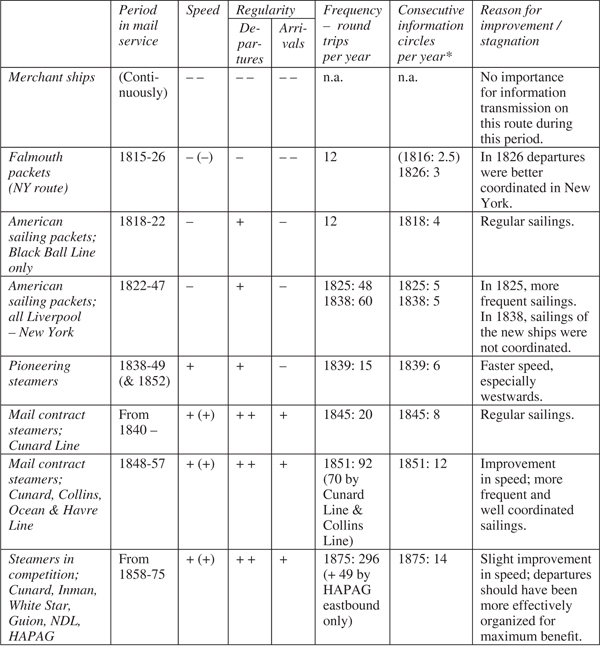
– – = very poor; – = poor; + = rather good; + + = good
n.a. = not applicable – this question has not been examined as merchant ships were not a primary or even a secondary means of information transmission on this route during the period.
* An information circle is the time between sending a letter and getting an answer to it. For example, in 1826 it was possible to send a letter and get an answer to it, send an answer to that letter and get an answer to it, etc. in three consecutive information circles per year by using the Falmouth packets. In 1875 fourteen such circles could be made per year by using the mail steamers.
Business Information and the Telegraph
It has generally been assumed that all overseas information transmission was slow and stable before the time of the telegraph, and that it was then suddenly catapulted into the modern age. As has already been shown in the earlier chapters of this study, the improvement in business communications by sea was continuous throughout the period from sail to steam, as was the development of the telegraph and its use in business information transmission. Instead of a fast jump from one era to another, the shift from information transmission by ship to telegraph took its time and included both progression and setbacks.
Throughout history there have been situations where it has been necessary to send messages faster than a man alone could move from one place to another. Messengers on horseback and carrier pigeons were used as early as Ancient Egyptian times. Early visual systems of communication, using smoke by day or the glow of fires by night to send signals from one hill to another, are well known in different parts of the world.482
The early methods of signaling messages from one place to another were generally used for military purposes, such as in the Roman Empire and by Napoleon during his many wars. The first really successful optical telegraph was developed by Claude Chappe, a French clergyman, during the years of the revolution. His invention was introduced in France in the 1790s and soon adapted in Sweden by Abraham Niclas Edelcrantz483 to be used for royal messages around Stockholm, and between Grisslehamn and Eckerö on the important mail route from Sweden to Finland. Contrary to Napoleon, who successfully used the optical telegraph during wartime, the Swedes neglected to maintain the system and it failed during the time of greatest need during the war between Sweden and Russia in 1808–1809. Finland was incorporated into Russia and the optical telegraph was forgotten for years. During the Crimean war, however, new optical lines were built by the Russians along the Finnish shores and successfully used for military purposes.484
Although the French optical telegraph system had aroused enthusiasm in the German states from the very beginning, it took 38 years before the invention was adapted by neighbours. The first line was erected in Prussia in 1832. The main reasons for the delay were related to decision making on the most practical system, as well as political problems between the states. The British developed their own system based on Chappe’s idea, and rather close to the one developed by Edelcrantz. Lord George Murray’s optical telegraph was used between London and Dover, Portsmouth and Great Yarmouth. Due to the usual fog and poor visibility at the coasts of England, the optical telegraph was never a great success on the Channel. The London – Portsmouth semaphore telegraph was in Admiralty use until 1847, however.485
Content removed from the open access version of this book
FIG. 18. Early pre-telegraph communications off Liverpool. The Bidston lighthouse was erected in 1771 as a navigational aid for vessels in the Rock Channel. Bidston Hill provided a fine point to spot vessels approaching the port and convey news of their arrival to their owners in town. The flag of the shipowner was raised when one of their vessels was identified. Additional signs informed how many ships were approaching, as well as whether they were snows, brigs or ships. A flag flying at half-mast indicated a vessel in distress. By 1825, there were some 50 flagpoles stretching both north and south of the lighthouse. © National Museums Liverpool (Merseyside Maritime Museum).
The optical telegraph was normally exclusively used by the authorities, especially for military purposes. In Sweden, exceptionally, it was suggested as far back as 1810 that the lines could be used for commercial purposes. The proposal seems to have been ahead of its time, as it did not arouse notable interest among either the administrative decision makers or the commercial associations. Nevertheless, private announcements and maritime intelligence were transmitted by the optical telegraph during later years, and from 1837 this service was subject to a fee.486
The noteworthy exception to all the other optical systems in the world was the telegraph, which was introduced between Liverpool and Holyhead off the west coast of Wales in 1827 (for an earlier system, see Fig. 18). Built by private capital and operated by the Trustees of the Liverpool Docks, the system was especially planned for commercial use.487 In these circumstances, it could indeed shorten the duration of important information transmission by several days.
The system was developed and partly owned by Barnard L. Watson, probably a former lieutenant of the Royal Navy. It included 11 stations at Liverpool, Bidston, Hilbre Island, above Prestatyn, near Rhyl, above Colwyn Bay, on the Great Orme, Puffin Island, above Point Lynas, on the west side of Anglesey, and on Holyhead Mountain. It was originally a one-mast system, overhauled and improved in 1841 as a two-mast system, and was replaced by the electric telegraph as late as 1861.488
The stations were located within 3.3 to 12.5 miles, or about five to 20 kilometres, distant from each other in places where there would be the fewest problems with visibility. Even if the duration of message transmission varied greatly depending on weather conditions, the system normally worked rather well and the signals were seldom stopped for a whole day. The message was generally transmitted through the whole chain of stations within a few minutes.489
The signal system was based on numbered codes covering the alphabet, compass signals, time signals, words and phrases, auxiliary verbs, merchant names, telegraph stations and gazetteers, ship names and signals between pilot boats. The words and phrases included e.g. lists of different kinds of hazards met at sea to be forwarded to the shipowner or Lloyds. There were also references to various cargoes – useful knowledge for the shipowners who could start selling the freight before it had physically arrived in port.490
The Liverpool–Holyhead telegraph was used in business information transmission from the very beginning. Its origins date back to the period, when the port of Liverpool had started to grow and was the most important destination for the American sailing packets. Once it was known that a vessel was approaching, arrangements could be made for the disposal of the cargo, and it was also possible to start planning the next voyage. They could also learn the state of the wind at Holyhead, and important political or commercial information from Ireland or America could be transmitted by the homeward bound vessels.491
In a report in 1836, Barnard L. Watson gave a brief summary which shows the scale of operations: ‘In the year 1828 there were about 847 vessels reported by name inward and outward bound; in 1831 there were 1712; in the present year, up to 30th Nov., there were upwards 2440, besides several hundred without numbers, upwards of 500 reports respecting Pilot boats, about 200 communications respecting wrecks, accidents and casualties, and the state of the wind and weather reported upwards of 700 different times. Telegraph Office, Liverpool, Dec 12, 1836.’492
On average, this meant that about eight ships were reported outwards or inwards each day, as well as one or two pilot boat movements. Additionally, there was news about problems at sea at least every second day. Weather conditions were reported twice every day. As there were naturally periods with less traffic at sea, especially in the winter, some days during the best sailing season must have been rather busy at the telegraph stations.
Thus, the semaphore telegraph was used in business communications in this particular area between merchants, their ships at sea, and Lloyd’s – and spread by these parties to other stakeholders when needed – from the 1820s.
In the 1830s, the electric telegraph was invented more or less simultaneously in several countries and developed into different forms. The needle telegraph, developed by the British W.F. Cooke and Charles Wheatstone from the original invention made by the Danish Hans Christian Oersted would be used especially on the railways. It appeared to be very important for safety reasons to have a warning system for approaching trains and the electric telegraph grew very fast especially in countries were the railway network was quickly built.493
In 1845, Cooke installed an electric telegraph between London and Portsmouth, soon rendering the semaphore obsolete. In the same year negotiations were begun with the government to lay a telegraph on the Chester to Holyhead railway line. The total length would be 300 miles linking London to Holyhead via Birmingham, Manchester and Liverpool, and thus giving Lloyd’s ‘every facility for shipping purposes’.494 It remains somewhat unclear what happened to this plan. The electric telegraph between Holyhead and Liverpool seems to have been completed just fifteen years later, in December 1860.495 Although much discussed, the Committee of the Liverpool Docks ‘did not see any need to change the system’.496
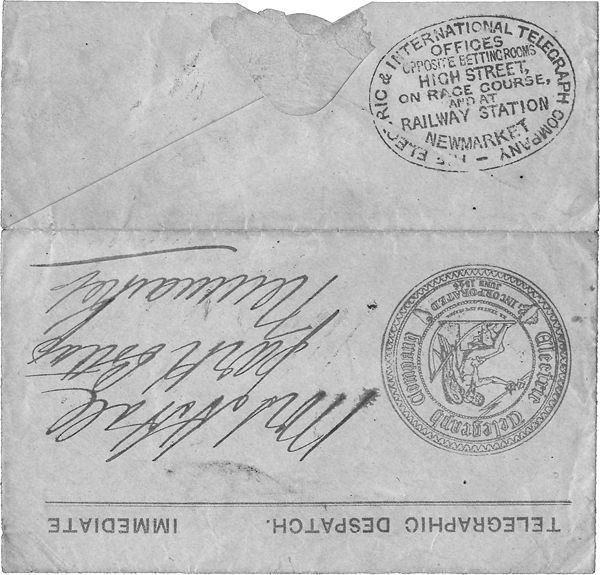
FIG. 19. One of the early commercial uses of the electric telegraph was to inform the results of race courses to the betting rooms in town. The Electric & International Telegraph Company had their office at the race course in Newmarket from 1860.
An experimental electric line was laid between Paris and Rouen in 1845, and, as it was a success, the French government decided in 1846 to replace all the optic lines with electric ones. Wheatstone & Cooke also built a telegraph between Brussels and Antwerp in 1846. The lines used to transmit marine news between Bremen and Bremerhaven in 1847, as well as between Hamburg and Cuxhaven in 1848, were similarly built by private entrepreneurs. In Sweden the optical telegraph stations were replaced by electrical stations one by one from 1853, and the line between Moscow and St. Petersburg was brought into use in 1858.497
The early electric telegraph was mainly of state interest, and not even meant for commercial use (see Fig. 19). The lines were opened for public use in the late 1840s or early 1850s, or even later depending on the country in question. One of the first such companies was the Electric Telegraph Company in Britain in 1848. The costs of sending messages were very high at the beginning, but they reduced notably in the coming years. Connections between different countries were opened in the late 1840s.498
The number of messages sent by telegraphs increased fast during the first 15 years in public use. The following comparison illustrates the progress made on the European continent, in Britain, France, Belgium and Austria.
TABLE 29. Number of electric telegraph messages sent, 1851–1866.
| Country |
1851 |
1856 |
1861 |
1866 |
| Austria |
45,000 |
252,000 |
846,500 |
2,507,500 |
| Belgium |
14,000 |
99,000 |
269,000 |
1,128,000 |
| France |
9,000 |
360,000 |
920,000 |
2,842,500 |
| Britain* |
99,000 |
812,000 |
1,201,500 |
3,150,000 |
Sources: BPP, Transport and Communications, Posts and Telegraphs 3. Reports from Select Committees on the Electric Telegraphs Bill with the Proceedings, etc. 1867–1868, Appendix 1, 17–18; Kieve, 68.
Due to differences in sources, the British figures cover only the messages sent by the Electric & International Telegraph Company, which held approximately 60% of the market share in Britain in 1868. The main competitor, the British & Irish Magnetic Telegraph Company was about half the size of its main rival, measured by miles of lines or sent messages, whether they were inland or including the Atlantic and continental cables. Together the ‘Electric’ and the ‘Magnetic’, as they were popularly called among the public, transferred 96% of the overseas telegrams to and from Britain in 1868.499
While the Europeans were building their technologically different electric telegraphs, the Americans chose a further option. Samuel F.B. Morse, originally an American artist, invented an electro-magnetic telegraph, which was based on experiments by the German professor Georg Simon Ohm and the American engineer Joseph Henry. Morse introduced his system publicly in 1837 and after a few years of improvements it was brought into public use in the United States in 1845.500
As the U.S. Government refused Samuel Morse’s offer to sell his invention for the sum of $100,000, private capital was collected to establish the Magnetic Telegraph Company. In early November 1845 its first line was opened between Philadelphia and Norristown, Pa. As if to point out the basic difference between the European and the American systems, the office in Philadelphia opened on the second floor of the Merchants’ Exchange.501 It would become typical that the European telegraph companies were mainly state-owned, while the Americans were private. Between the late 1840s and the 1860s, the American continent saw tremendous growth of telegraph networks operated by local companies under the Morse patent, and cooperating with the railroad.502
The spread of the new technology met difficulties in most places. Several problems had to be solved – both technical and practical. None of the early lines could boast about their transmitting capacity, and therefore much business had to be done at night. There were also continuous breaks in the lines. During the first five months in public business, the Magnetic Telegraph Company’s lines were down for 36 entire days. The direct telegraph line between Philadelphia and New York was delayed for years due to the latter city’s geographical location; the gutta-percha that was needed for submarine cables had not been introduced yet, and the messages had to be sent to New York by ferry over the Hudson from Newark, where the telegraph line from Philadelphia ended. In the New Orleans and Ohio Company in 1854, the problems were manifold. Yellow fever swept through the south and almost every operator fell ill. The line was kept going with great difficulty and business almost stopped. When the winter set in, a storm ruined miles of the line, and business was again suspended for a long period. Creditors became alarmed. In fact, many of the local companies had to be merged or leased during the first decade of the telegraph.503
Interestingly, New York was not very eager to get in touch with its neighbours by telegraph. The metropolitan city had its own interests and was mainly focused on overseas communications. Therefore the original line to that city was actually drawn from Springfield, Mass., to Buffalo, N.Y., via Albany and Utica. Springfield was designed to be the connecting point with the New York and Boston Company, the absurdity of which soon became apparent and the eastern terminus was changed to the city of New York. The first pole of this line was planted on the corner of Wall Street and Broadway in August 1845. The office of Poughkeepsie was opened in October 1846, almost a year later than the first line was opened in Philadelphia, while Hudson was opened at the end of the same month.504
The telegraph line between Boston and New York was completed somewhat earlier, in late June 1846. However, the line had been cheaply and carelessly constructed. As a storm was setting in, the wires broke in numerous places. In one of these, 170 breaks were reported in a section of 30 miles. The breaks occurred so often that during the first year of the company’s existence, the line did not work for half the time. Even if the wires did work, delays were the rule. Not even the passing trains could be reported perfectly.505 J. S. Brown and Paul Duguid hit the nail on the head when they claimed that the myth that the telegraph was the start of the information age (‘People travelled at the speed of the train. Information began to travel at the speed of light.’) was built on a merely technological approach. Instead of celebrating just the speed and separation, more attention should be paid to the way information and society was intertwined.506
The first to fully recognize the value of the telegraph for news purposes were the newspapermen in New York. In 1847–1848, the newly established New York Associated Press ran a steamer between Digby, N.S., and Portland, Me., to carry the news received by transatlantic steamers at Halifax. The European news was sent overland by express riders to Digby, 149 miles, to be dispatched from there by steamer to Portland and telegraphed to New York in advance of the arrival of the Cunard steamer at Boston. When the telegraph line was continued to St. John, N.B., the steamer took the shortest route from Digby to St. John, from where the news was telegraphed via Boston to New York.507
In 1851, it was possible to send messages by telegraph from Halifax to Portland, where they were re-telegraphed to New York. According to the Canadian postal historian J.C. Arnell, the system continued even after the Cunard steamers did not officially call at Halifax on their way to New York after 1850. They often heaved-to off Halifax to drop dispatches and mail to a waiting boat, so that the telegraphic news service could continue to operate. Thus, the Cunard steamers’ call at Halifax, combined with the gradual introduction of telegraphic communications between different areas in North America, enabled messages to reach Boston and New York considerably before the arrival of the steamers at their destination.508
In this way, the combination of mail steamers and telegraph could at least temporarily be used for speeding up the most important news on both sides of the Atlantic for more than 15 years – the semaphore telegraph between Holyhead and Liverpool even longer – before the Atlantic cable was in permanent use. Thus the telegraph was not born out of nothing, but was already a part of overseas communications. However, the steamships were still the most important part of the information chain, and the existing options of speeding up news transmission at the end of the journey by telegraph were quite marginal.
During the first ten years that the electric telegraph was in common use, the network of inland telegraph lines had been extended throughout the European continent and the British Isles, as far as the Western coasts of Ireland. On the other side of the Atlantic, telegraph lines had been extended throughout the Eastern states and provinces, and across Newfoundland, although there was a gap between the coasts of Newfoundland and the mainland. It was natural that dreams should arise of linking the Old and New Worlds by an Atlantic cable.
The first attempts to lay submarine cables in the 1840s failed due to problems in the insulation of the conducting wire. The first cable which was laid successfully in the English Channel in 1850 was cut by a fisherman’s anchor, and anchors were indeed a problem for submarine cables also in the following years, around the Merseyside in England as well as in the Mediterranean.509 However, permanent cables were established linking England with Ireland in 1853 and with the Continent, between Dover and Ostend, in the same year. Anglo-Dutch and Anglo-German cables were laid, and by 1857 there were electric communications with Holland, Germany, Austria and St. Petersburg. In the Mediterranean, several cables were laid for the French and Italian governments. Not all attempts were successful, however. Several costly failures were encountered in laying a cable in the deep waters between Sardinia and the coast of North Africa, as well as between Malta and Alexandria.510
The history of the Atlantic cable had its roots in the building of the electric telegraph in Newfoundland, a difficult task because the line traversed more than 400 miles of wild and desolate country. As the available capital became exhausted before the work was complete, the English engineer F.N. Gisborne who was mainly responsible for the project, traveled to New York for support. He was fortunate in meeting Cyrus W. Field, a wealthy merchant who had recently retired from commerce in his early thirties. Field soon took an active interest in the project, but was of the opinion from the outset in 1854 that the Newfoundland project was just a link to a larger one, the Atlantic cable. During the next twelve years, Field would be the soul of the Atlantic project, a man of tireless energy and courage who never lost his faith in the undertaking. Samuel F.B. Morse was also originally involved in the project on the American side. But a great deal of the science, mechanical skills and capital came from Britain.511
The Atlantic cable was a huge project and included several risks. The problems were partly technical and practical, and partly financial. The depth of the Atlantic Ocean was unknown and a survey of the route had to be made by deep-sea soundings. No single ship was large enough to carry and lay the cable, which would be more than 2,500 nautical miles long and weigh 107 lb. per mile. The elementary theory of electrical transmission was still in a very primitive state, causing costly mistakes. And the estimated capital needed was £350,000, of which about two thirds was for the production of the cable.512
The first attempt to lay the Atlantic cable in 1857 became a failure. The cable, laid by two vessels, the H.M.S. Agamemnon, lent by the British Government, and the frigate Niagara of the U.S. Navy, was technically ill-suited to the deep waters of the Atlantic. The first expedition was not able to lay the cable at its whole length, as it was broken in heavy seas and several hundreds of miles of it was lost in the depth of the ocean. The ships had to return to Plymouth, and the rest of the cable was discharged and coiled on the wharf, where the gutta percha insulation then deteriorated in the sun while waiting for the following attempt. The next expedition in 1858 ended with equally poor results.513
In August of the same year, the third effort was successful, and congratulatory messages were exchanged between Queen Victoria and James Buchanan, the President of the United States, across the Atlantic by the new means of communications. Unfortunately, the cable – technically poor already from the beginning – was not in good condition after all the handling in difficult circumstances. Messages could be transmitted only at a very slow rate and with much unreliability and repetition. Within a few weeks, the signals became unintelligible and in October, the cable was completely dead. The failure of the cable was never fully explained. According to Garratt, there were so many contributory causes that the wonder is not that it failed, but that it ever worked at all.514
During its short existence, the first Atlantic cable had showed its usefulness. Although only a few hundred messages were sent through it, many were extremely important. For example, the British government saved an estimated £60,000 while being able to halt the mobilization of two British regiments in Canada, as an urgent message could be sent by telegraph that the Sepoy Mutiny in India had been put down.515
The failure of the cable – and the consequent loss of some £500,000 by the shareholders who had subscribed for it – discouraged any further attempt to lay an Atlantic telegraph connection for some years. The undertaking was further discouraged in 1859 by the failure of the Red Sea Cable, in which some £800,000 had been invested.516
A great part of the capital had come from British merchants in London, Liverpool, Manchester and Glasgow. In the first meeting to raise money for the Atlantic cable, held in Liverpool in November 1856, Cyrus W. Field had put an outstanding argument to the investors: the information about changes in market prices, especially cotton, could be dispatched immediately by the electric telegraph. While it now took 40 days to send a letter and get an answer from New Orleans, a telegram would be in America – due to the time difference – before they had even sent it. In addition to the capital from American and British investors, national governments also took part in the project.517
When the project failed, the disappointment was intense. The need for a new cable was widely expressed, but investors were now more careful. The American Chamber of Commerce in Liverpool wrote a memorial to the Earl of Derby, the First Lord of Her Majesty’s Treasury:
‘…having witnessed and also to a certain extent experienced the great national as well as individual importance of the temporary success of electric communications between this country and the continent of America, your memorialists have learned with deep regret that the communication by the present Atlantic cable has become inoperative and that considerable further capital will be required to restore it and lay such additional wires as may be requisite to render the communication certain; the impossibility of which is no longer doubted…
…that your memorialists are informed that the funds subscribed by the originators of this great undertaking have already been exhausted and they believe that it will be impossible to obtain the necessary capital for completing this great work without the aid of such guarantee as would secure a moderate return upon the investment to those subscribing…
… that your memorialists would submit that looking at the magnitude of the work, its vast national importance, consolidating as it will when the chain is properly completed the various colonies and dependencies of this country into one vast Empire; that considering the entire capital and labour already expended without any return, and that without extraneous aid the work can never be accomplished, as it would tend much to the national welfare, if Her Majesty’s government were to extend their aid in such form and manner as they may feel justified by precedent and would enable the Atlantic Telegraph Company to obtain the requisite capital to complete their vast and noble undertaking.’518
A few years passed before the capital was again raised for a new attempt. Meanwhile, technical progress and new arrangements in cable production improved the prospects of success. In the maritime historical context, the first enthusiastic attempts to lay an Atlantic cable in the late 1850s were contemporary with the collapse of the Collins Line and the entrance of several new steamship lines – the Vanderbilt Line, the Inman Line and the German lines – with only sea postage mail contracts. Even though the telegraph is seldom mentioned in this connection, the expectations of fast Atlantic communications in the near future must have affected the decisions to cut the American mail subsidies.
Nevertheless, the British government continued the Cunard contract for ten years in the summer of 1858, just a few weeks before the brief success and the failure of the first cable. The renewal of the contract was strongly opposed by competitors, especially the Inman Line, but even the British Post Office was in opposition. The Admiralty which still had the mail contracts under their control thought that the service had national importance and preferred the continuation.519
While the U.S. Congress had been suspicious about supporting a telegraph line which would start and end on British territories on both sides of the Atlantic, the American Civil War stimulated attempts to raise new capital to continue the project.520
In 1865, when the Civil War was finally close to its end, President Abraham Lincoln was assassinated in Washington. The news of the President’s death on 15 April was rushed across the ocean by the steamship Nova Scotian, reaching a telegraph station in Londonderry on 26 April. The despatch arrived in London two hours later and appeared in the British newspapers on the following day, 12 days after the assassination. Julius Reuter, first with the news, was later accused of having personally profited on the stock market through holding back his early knowledge. The shock value of the report was somewhat muted as so much time had passed since the event, but the value of Reuter’s coup gives some perspective to the proposed costs of Atlantic telegrams.521
The case is a good example of coordination between ships and telegraph. The Allan Line ship Nova Scotian was on her winter route between Portland and Liverpool, which included a call at Londonderry in North Ireland instead of Queenstown used by other companies, due to her northern route. The Allan Line’s vessels did not usually make a call at Halifax or Newfoundland, but the captain of the Nova Scotian may have heard about the assassination, which took place already on 14 April, by telegraph in Portland before the ship departed, and thus heaved to at Halifax for the freshest news.
The Nova Scotian, leaving from Portland on 15 April, was ahead of her competitors, the Etna of the Inman Line and the Teutonia of HAPAG, which both departed from New York on 15 April, certainly carrying the same news. The importance of the news was well understood on board all the vessels. The Etna made an exception and did not call at Queenstown at all, but rushed directly to Liverpool, while the Teutonia headed to Southampton. They both arrived on 28 April – too late as the news had already been published in the newspapers on the day before.522
By the time of the next Atlantic cable expedition in July–August 1865, several improvements had been made both in the production arrangements and the technical qualities of the cable. The newly established telegraph construction and maintenance company also subscribed the remaining capital required. During the time that had passed, a suitable ship had also been constructed. The gigantic Great Eastern, built by the famous Isambard Brunel for passenger service on the Eastern route, had become an economic failure and was lacking employment. In her absence, it would have been necessary to employ three ships to lay the cable, and the hazards caused by the participation of even two ships in the laying operation had been amply demonstrated in the late 1850s.523
After one more failed attempt, a working Atlantic cable was finally laid in late July 1866. A few weeks later, the lost end of the earlier cable was found in the mid-Atlantic and the second cable was safely landed at Trinity Bay, Newfoundland in September.524 The Old and the New World were now finally connected with electric telegraph, which had been in common use on both sides of the Atlantic already for two decades.
The commercial use of the Atlantic cable started immediately, although not without problems. Sheila Marriner describes Rathbone Bros & Co.’s experiences of the early Atlantic telegraph: ‘There were two serious disadvantages… the possibility of costly errors arising through genuine mistakes, since orders by cable could be fulfilled and shipped before they were confirmed by letter. The danger of loss arising from this was minimized by limiting the amount of orders entrusted to any one cable to £40,000. The other serious difficulty was that of deliberate fraud. This could be overcome by the use of cipher which would prevent ‘enterprising people connected with the telegraph all through this country’ from selling ‘the contents of your messages to your neighbours’.’525 The telegraph company refused at first to take messages in code because of the great advantages to be gained by being able to read any important message. Finally the company agreed to the use of cipher, but when it did, this became accepted practice.526
A year after the opening of the Atlantic cable, Rathbone Bros & Co.’s agent in New York concluded desperately: ‘It seems almost impossible to get the cable honestly managed.’ The following month, the agent wished that the cable had never been laid. There was ‘not the slightest doubt’ that the news about corn prices was falsified in the interest of speculators who had combined to keep up the price of the article.527 Despite practical problems, the Rathbones were in almost daily telegraphic communication with New York, sending orders and keeping the agency advised on sales, of the market and of the reasons for anticipated price rises and falls.528
Graeme J. Milne has also examined the usual complaints by British merchants concerning the electric telegraph: only the briefest of messages could be sent and there was a great deal of suspicion about the reliability of foreign lines and the honesty of their operators. Technical problems were common. Even the greatest asset of the telegraph – speed – could not always be relied upon due to backlogs of messages piled up in the chain of telegraph offices. Larger documents, samples and the like had to go by sea in any case. Traders therefore needed reliable mail and telegraph services, which doubled the cost.529
The contents of the telegrams had to be very short, not only for security but due to the very high price of the transmission. The original rate was £20 for the 20 first words plus £1 for each additional word. By 1872, the price had been drastically reduced to four shillings per word, and in 1888 further to one shilling.530
In fact, transatlantic communications became a mixture of steamship letters and telegraphs which complemented each other. Short orders were sent by the telegraph, but the explanations were written and documents sent in letters carried by the mail steamers.531 Rathbone’s New York agents Busk & Jevons wrote to Liverpool 6.1.1869 in a letter sent by the Cunard steamer Russia: ‘Dear Sirs, on 31st Dec. we telegraphed you ‘write’ Schwinds Leed worth ten quarter encourage ‘shipment’, this you no doubt forwarded by Messrs Lamport & Holt’s steamer of 2nd Jan. The shipment of 2610 bags coffee p. Catharine Leed referred to above as being worth 10 ¼ *costs 9 ¼* & consequently promises a fair profit. Thinking of the tone of Messrs Schwind, McKinnel & Co.’s letter that they are likely to be somewhat backward in shipping & facing ourselves a very good opinion of operations in coffee this year, we added our message ‘encourage shipment’ which will we hope induce them to act more boldly…’532
As the quote describes, the tones of ordinary letters could also express feelings which could not be caught in a short telegraph message. And important documents should naturally be sent only by mail: ‘Dear Sirs, we have balanced the books & closed our accounts for the year but we have not time to dissect them for this mail. As we know you are anxious to receive them at the earliest moment possible we send you now the only essential documents, viz. Balance Sheet and Agency Assets… By next mail we will hand you our customary statements of the year’s business…’533
The growing use of the telegraph and speedier carriage of cargoes by steamship had fundamental effects on the organization of the produce markets in Britain. It reduced the need for carrying stocks, since fresh supplies in producing centres could be quickly conveyed to the markets and the level of prices in the markets could be made known in the producing areas so that it was no longer necessary to try to forecast conditions months ahead on inadequate information. Fluctuations in prices tended to narrow as up-to-date information about current business conditions and markets in all parts of the world became more readily available. Consequently, operations in produce markets became subject to international rather than to local and national influences. The spread of the telegraph killed the consignment business in cotton and in grain, but instead inspired the futures market.534
From the 1840s, there was a growing tendency for people to buy and sell goods ‘to arrive’. The essence of the ‘arrivals’ business was that the news should travel faster than the goods, and with the development of fast mail steamers this became possible. The establishment of telegraphic communications from New York to Nova Scotia and Newfoundland further increased the disparity between the speed of news and cargoes. This led to the development of the arrivals business in the cotton trade. During the American Civil War, a good deal of speculative activity took place in cotton and in buying and selling ‘to arrive’. According to Nigel Hall, in this kind of forward market it was a common practice for specific lots of a commodity to be contracted for before they were available for delivery. The Liverpool cotton market was the first in Europe to develop further to a futures market, in which contracts were highly standardized and did not refer to a particular cargo. The quality and quantity of the product set was fixed, and the only negotiable part of the contract was the price. Arrival and future delivery markets were separated in the early 1870s, following the opening of the Atlantic cable.535
The development of the telegraph from the Napoleonic wars to the Atlantic cable is depicted in Table 30.
TABLE 30. Development of business information transmission by telegraph.