VI The West Indies and South America
Wind vs. Wind
Choosing between private and public mail services, a micro case – Merchant ship communications between Britain and Guiana in 1840, a general view – The West Indian and South American mail services as parts of the whole Falmouth packet system – The South American route – The Mexico route – The last years of the Falmouth packet service, a conclusion.
While business information transmission in the North Atlantic was mainly taken care of by fast and regular sailing packets owned by commercial shipping lines from the early 1820s, the communications on two other important trade routes – the West Indies and South America – were dominated by merchant vessels. Additionally, the Falmouth packets were an important means of communications on both these routes.
The West Indian mail route followed the old sugar route between Britain and the colonies in the Caribbean including ports on the northern coast of South America. Over the years, other than British colonies were also included, and auxiliary ship services were started between several colonies and the British packet stations.536 In addition to the Caribbean islands, the Falmouth packets normally sailed to British Guiana and Mexico. The South American route consisted of sailings from Falmouth to Rio de Janeiro, and down to Buenos Aires and Montevideo either by the same packet or by an auxiliary ship.
Choosing between private and public mail services – a micro case
In view of the importance of the West Indian trade route in the early 19th century, surprisingly small numbers of merchant letters can be found in public collections, compared with the amount of correspondence kept in archives from other regions. One of the explanations given is that the descendants of merchants involved in the West Indian businesses did not preserve these documents because they wanted to forget the period of slave trade.
A handful of letters from Demerara and Berbice, British Guiana, to the Liverpool merchant houses Sandbach, Tinne & Co. and Thomas and William Earle & Co. in 1825–1841, discovered in the Merseyside Maritime Museum Archive’s collections, give a very homogeneous picture of information transmission. These 15 letters were carried by merchant vessels. The average time between writing and receiving them was 51 days.537
In addition to these general letters, a more variable case can be found in the correspondence between Thomas and William Earle & Co. and their sugar plantation at Berbice in 1840.538 This interesting sample consists of ten letters from 1840, each of them carrying a monthly return of the plantation’s business activities. Written by the same person to the same recipient and sent by different means of communication by various routes from a minor colonial county across the Atlantic in the age of sail makes the sample extraordinary in postal historical research .539
The letters portray the practical options and choices made by an individual, giving a picture of how efficiently the different means of information transmission served the merchants conducting regular business with the colonies. Comparing the micro case with shipping records gives an idea of the effectiveness of merchant ships as mail carriers, as well as the effectiveness of the government mail service between Britain and Guiana in 1840.540
At that time the government service included a variety of British, Danish, Dutch, French and Spanish colonies – a difficult service as the ports of call were so widely spread and not easy to navigate. By 1810, six local West Indian mail boats had supplemented the sailing packets that crossed the Atlantic, and by 1840 there were a dozen. The communications from England were twice a month.541
Thomas and William Earle, a father and son who were merchants and shipowners of Liverpool, were former slave traders who well knew the opportunities of the Caribbean area and were familiar with the organization of commerce there.542 In the 1830s, the company had acquired a plantation in Berbice, Guiana as a part of a bad debt.543 The Plantation Hanover, with ‘Sugar, Rum, Molasses, Cane, Livestock and Negro Labour’,544 was run by a manager, J.M. Houston, whose preserved correspondence with Liverpool includes the ten monthly returns of Plantation Hanover in 1840, two reports apparently being missing.
This specific year was crucial from the owners’ point of view, due to the recent abolition of slavery, which after a few years’ transition period had given full freedom to the plantation workers in 1838. British Guiana, together with Jamaica and Trinidad, was one of the colonies that suffered most from the changes. Many estates, earlier prosperous and productive, were now cultivated at a considerable loss, and several were abandoned.545
J.M. Houston, the manager, calculated the return of the plantation’s activities at the end of each month and sent the report by ship to the Earles of Liverpool. The letters, carrying the sender’s remarks on the means of transport as well as postal handstamps, enable us to follow the process of business information transmission in practice. What happened to the letters between writing and receiving them? Who took care of them, and how long did it take in each case to deliver the information?
The January report of Plantation Hanover was sent by the merchant ship Goshawk, which departed from Berbice on 13 February and arrived in Liverpool on 11 April.546 The report was dispatched to Thomas and William Earle & Co.’s office in Liverpool on the arrival day. The letter was carried fully privately, having no post office markings. The Earles learned about their plantation’s economic progress 71 days after the month in question had ended.
The February and March reports were sent by the British government’s packets, with postal markings by the Berbice Post Office respectively. The February report was sent from Berbice on 18 March and received by the Earles on 13 May. The report was carried either by the Ranger packet, which arrived at Falmouth on 10 May, or by the Penguin packet, which arrived on 8 May.547 As the letter was delivered in Liverpool on the 13th, the most probable arrival date at Falmouth was the 10th.548
The West Indian packets usually sailed directly from Falmouth to Barbados, from where the local mail boats (at this period mostly steamers) delivered the mails to the islands. On the way back home, the packet sailed via several of the islands collecting the mailbags for Britain. The system was slow and complicated, and the schedules often changed due to weather conditions or other reasons.
As the sources are not clear in this matter,549 we cannot know for certain to which island the mails from Berbice were forwarded in the spring of 1840. Table 31 shows the dates on which the two alternative packets stopped at the islands during their home voyage. As the monthly return of the plantation was sent from Berbice as late as 18 March, Barbados could not have been the place where the mails from Guiana were collected at the time. Tobago550 was out of the question for the same reason. The local mail boat could have carried the letter to Trinidad, were it would have been taken to the Ranger, but the Penguin had already passed the island.
The Guiana mails could also have been sent by a separate local mail ship to the rather distant St. Thomas, which was the other main interchange point of mail, together with Barbados. Why this would have been done, when the Falmouth packets also sailed via Trinidad, Grenada etc. on their home voyage,551 remains unclear. None of the monthly returns bear transit markings from the West Indian Islands, but this was rather typical.552 Independent of whether the Guiana mails were carried to St. Thomas by a mail steamer or by the Falmouth packet, they had to be sent from Berbice and Demerara more than ten days before the packet would proceed from St. Thomas to Puerto Rico, Haiti and England. To use a fixed reference, it is assumed here that, at the latest, St. Thomas was the island where the Guiana mails were collected.
The table clearly depicts the problem of carrying the West Indian mails, and makes the complaints of merchants understandable. The Ranger packet had sailed from Falmouth on 5 February and arrived at Barbados on 13 March – on the very same day as the Penguin packet, which had left from Falmouth on 17 February.553 The packets delivered the mails and proceeded to Tobago, the Ranger on the 14th and the Penguin one day later. There was a longer stay at Trinidad or Grenada before continuing the journey. Both ships departed from Grenada on the same day, as well as from several other islands, visiting different ports at Haiti, however. The ships’ inter-island journeys between Barbados and Cape Henry, or Cape Haitien alternatively, had taken three weeks before they turned back to England, and the crossing of the Atlantic an additional five weeks.
TABLE 31. Departure dates of the Ranger and Penguin packets, of Falmouth, from the West Indian islands and arrival in England, February–May 1840.
| Port |
Ranger packet |
Penguin packet |
| Falmouth |
5.2. |
17.2. |
| Barbados |
13.3. / 14.3. |
13.3. / 15.3. |
| Tobago |
15.3. |
16.3. |
| Trinidad |
21.3. |
17.3. |
| Grenada |
23.3. |
23.3. |
| St. Kitts |
29.3. |
29.3. |
| Tortola |
31.3. |
31.3. |
| St. Thomas |
1.4. |
1.4. |
| Puerto Rico |
2.4. |
1.4. |
| Cape Henry |
|
5.4. |
| Cape Haitien |
5.4. |
|
| Falmouth |
10.5. |
8.5. |
| Duration of the round trip |
95 days |
81 days |
Source: Lloyd’s List 11.5.1840, 12.5.1840.
The Ranger, carrying the February report, made the journey back home from St. Thomas two days slower than the Penguin, in 40 days. The report arrived in Liverpool on 12 May,554 and was received by Thomas and William Earle & Co. on the 13th, 74 days after the end of the financial reporting period.
The March report was sent on 9 April – rather soon after the end of the financial reporting month. It was carried by the Hope packet, which sailed from Falmouth on 4 March, arriving at Barbados on 4 April, and proceeding on the same day to Tobago and from there on 6 April to Trinidad, where she stayed for several days, then continuing as depicted in the note below.555 The trip from Barbados to Falmouth with all the stops at the islands took 52 days. The packet arrived on 26 May carrying a remarkable freight of 150,000 dollars.556 The March report was delivered to the plantation owners in Liverpool a few days later, approximately 58 days after the end of the reporting period.557
The April report was sent privately by the merchant ship Ann & Jane. The ship had arrived in Berbice on 30 March from Liverpool, but after some unexplained delays she departed on 20 May, having stayed 51 days at port. The report arrived in Liverpool by the Ann & Jane in 32 days, being dispatched to William and Thomas Earle & Co. on the next day after the ship’s arrival, 22 June.558 Despite the fast sea journey, it took the report 53 days to reach the owners.
Another alternative for J.M. Houston would have been to send the report by the Lapwing packet, which sailed from St. Thomas on 6 June and arrived at Falmouth on 15 July. The letter would have been dispatched in Liverpool around 17 July – 25 days later than by the private vessel.
The May report was sent from Berbice by the merchant ship Laidmans, of Liverpool. No date of sending the letter is available, as J.M. Houston did not date these documents, and the letter is missing departure markings of any post office. According to Lloyd’s List, the Laidmans arrived ‘off Salcombe’ on 12 August and entered Gravesend, London, on 16 August from Demerara.559
As the ship was not sailing for Liverpool, the captain dispatched the mailbag to a local boat off Salcombe, while the ship proceeded to London. The letter was posted from Kingsbridge, a small village in the inland, and marked by the post office handstamp used for private ship letters.560 It also bears the arrival handstamp of the Liverpool Post Office of 14 August, and the recipient’s note on 15 August. The postal markings, together with the information published by Lloyd’s List, prove clearly that the letter was carried by the Laidmans. As the vessel’s exact departure date from Demerara is unknown, it is not possible to calculate precisely the duration of the sea journey. However, the letter arrived in Liverpool two days before the ship entered London, and was received by Thomas and William Earle & Co. 76 days after the end of the financial reporting period.
The use of the official mail service would have shortened the delay markedly. Even if J.M. Houston had not finalized his calculations quickly enough to get them on board the Star packet, which stopped at St. Thomas on 18 June and arrived at Falmouth as early as on 18 July, he could have had them ready for the Reindeer packet, which called at the island on 24 June and arrived in Falmouth on 7 August.561 The first alternative would have shortened the waiting time by more than three weeks, and the latter by about one week.
The June report was sent by the merchant ship John Horrocks, of Liverpool. The new 294 tons vessel had arrived in Berbice on 12 April, probably on her first voyage as she was built in the same year.562 She departed for Liverpool on 30 July, carrying J.M. Houston’s calculations of the plantation’s financial results for June. When the ship left the port, more than four weeks had passed since the end of the financial period.
The vessel arrived in Liverpool on 10 September, and the letter was delivered to Thomas and William Earle & Co.’s office on the same day. The sea voyage took 42 days, and the letter was in the owners’ hands 72 days after the end of the financial month in question. No postage fees were paid for this direct, private service. If the official mail service had been used, the Mutine packet would have picked up the June report from St. Thomas on 22 July and brought the letter to Falmouth on 21 August. By this means, the letter would have arrived at the Earles’ office about 18 days earlier than it did,563 taking into account the couple of days needed for the trip from Falmouth to Liverpool.
The July report was sent by government mail, and it bears the Berbice Post Office handstamp of 21 August. The mails were picked up by the Hope packet at the port of St. Thomas on 4 September, and the ship arrived in Falmouth on 23 October.564 The trip across the Atlantic alone took 44 days – the longest eastbound West Indian packet journey of the year. The July report was 86 days old when received by the plantation owners in Liverpool on 25 October.
What if J.M. Houston had sent the July report by a merchant ship instead of the government packet? There were several regular traders leaving from Demerara for Britain during the month of August: the Isabella (of Glasgow) for London on 13 August, arriving at Gravesend on 2 October, the Marquis of Chandos (of London), departing on the same day and arriving at Gravesend on 17 October, the Sandbach (of Liverpool), also departing on the same day and arriving at Liverpool on 22 September, as well as the Thistle (of Glasgow), departing on 23 August and arriving at Clyde on 22 September.565 All these vessels would have carried the July report to the owners much faster than the mail packet. By the Sandbach, the report would have been in Liverpool 33 days earlier than it was.
Common to the sailings above was that they all departed from Demerara. The only sailing566 from Berbice was that of the Richmond Hill on 1 August,567 too early for the July report to be finalized by the plantation manager.
It would have been curious if no contacts had existed between Demerara and Berbice for private mail sending, although sailing between those two ports was rather difficult due to the prevailing winds and currents of the river.568 An overland route existed and the Post Office planned to use it, according to a statement given in that specific year.569 How long and in what condition the route was, is not known. As the manager’s reports generally consisted of formal remarks about the work at the plantation only, no evidence about such communications problems has been preserved.570
The August Report was sent by the merchant ship Guiana, of Liverpool. The ship had arrived at Berbice from Glasgow on 10 July,571 and was loading for London. There is no information about the departure date of the Guiana from Berbice, but she arrived at Deal on 9 November. The letter bears the private ship letter handstamp of London572 and a date handstamp of 10 November. The report arrived in Liverpool on the 11th, being dispatched on the same day.573 It took the report 72 days after the end of the reporting period to reach the hands of the owners.
If not sent by the Guiana, the letter could have been picked up by the Pandora packet from St. Thomas on 18 September, arriving at Falmouth on 27 October – about two weeks earlier than by the Berbice–Liverpool merchantman.
The September report arrived in Liverpool on 1 December by the merchant ship Ann & Jane, the same vessel that carried the April Report. Ann & Jane was one of the regular traders between Liverpool and Berbice, making 2.5 round trips during 1840. She had arrived at Berbice on 8 September, and departed for Liverpool on 25 October. Her home trip took 37 days, and the report entered Thomas and William Earle & Co.’s office on the date of the ship’s arrival, 62 days after the end of the reporting period. The letter bears no postal markings.
Even if this was a relatively fast delivery, the Peterel packet would have brought the report from St. Thomas, departing from there on 18 October, to Falmouth on 26 November. The report would have been in Liverpool a few days earlier than it was by the private ship.
Finally, the November report – the October and December reports are missing – was sent from Berbice by the merchant ship Camerons, of London. According to Lloyd’s List,574 the ship sailed for London on 13 November and arrived at Deal on 5 March and the letter, posted from Deal on the following day,575 arrived in Liverpool on 8 March, 1841 – 98 days after the end of the financial reporting period. It is clear that the ship did not sail on the date mentioned, with the November report on board. The departure must have been several weeks delayed. The Camerons arrived at Deal on the same day as the Euterpe, which had sailed from Berbice on 6 January, 1841.
Why the manager did not choose another alternative, remains unclear. There were several vessels sailing directly from Berbice for Liverpool and Glasgow before the departure of the ships for London. The best choice would have been the Favorite for Glasgow on 7 December, arriving on 19 January, 45 days before the November report was finally at Deal.576
Two Falmouth packets sailed home before the Camerons, both arriving on 12 February, 1841. The Swift and Ranger packets had left St. Thomas on 30 December and 1 January respectively, sailing again together, each of them carrying high-value freight, the Swift 100,000 dollars and the Ranger 80,000 dollars.577 The packets would have taken the November report to England more than three weeks earlier than it actually arrived.
J.M. Houston used private merchantmen in seven cases out of ten to send his monthly returns to Liverpool. In six cases out of the seven, the government mail would have been a faster alternative. Eight of the ten reports would have been quicker in Liverpool if sent by a Falmouth packet instead of a merchant ship. In two cases, a private vessel was faster than the official mail.
The figures in Table 32 give a 72 days’ average duration of information transmission between the end of the financial reporting period and the arrival of the results in Liverpool. The shortest time between the end of the reporting period and the arrival of the monthly return in Liverpool was 53 days, when sent by a merchantman, and the longest time 98 days. By government packets, the figures were 58 days and 86 days respectively.
Not all the time was spent at sea. By cutting the transmission of each letter into slices, it has been shown here that even several weeks could pass after the end of the reporting period before the merchantman chosen by the manager de facto departed with the letter on board. This waiting time varied from a couple of weeks to over a month, in some cases probably more, even though it cannot always be completely reconstructed.
The small sample of letters gives a clear and versatile picture of the communication conditions between the plantation and its owners on the two sides of the Atlantic. Compared with the on-line financial reporting and management systems and strict information obligations of today’s business life, the ownership and management of distant plantations in the early 19th century was not very systematic. The communications were not only slow, but entirely unpredictable.
In many cases, the letters from Berbice would have been in England much faster by a government packet than by a merchant ship, but sometimes it was vice versa – making it difficult for J.M. Houston to decide on the means of communications. He could have sent duplicates to ensure that at least one of them was carried by the fastest possible transport but none of the letters bear any markings indicating that.578
TABLE 32. Monthly returns of Plantation Hanover, Berbice, in 1840. Duration before the information was available to the owners in Liverpool after the end of each financial period.
| Monthly Return |
Days elapsed before information was available to owners after financial reporting period |
Ship type: Merchant vessel (M) Falmouth Packet (F) |
| January |
71 |
M |
| February |
74 |
F |
| March |
58 |
F * |
| April |
53 |
M * |
| May |
76 |
M |
| June |
72 |
M |
| July |
86 |
F |
| August |
72 |
M |
| September |
62 |
M |
| November |
98 |
M |
The alternative options (private / government mail) were checked in each case. The best possible choice at the date has been marked in the table with an asterisk (*).
By sending duplicates, the average time between the end of each reporting period and the fastest arrival of the information in Liverpool would have decreased from 72 days to 56 days without any changes in the transports. This would naturally have increased costs and the manager may have thought that the reports were not important enough for the extra expense. The owners may have thought that they were important, however, as most of the reports have been preserved among the company papers until this day.
When comparing the alternatives in sending the report each month, one can also ask whether J.M. Houston really did his best to finalize the figures as quickly as possible to get them shipped by the earliest possible means. The rhythm of life and business was not very busy at that time, and the overall economic situation in Guiana was hardly motivating either. Perhaps there were good reasons to delay sending bad news to the owners.
Complaints of slow communications were usual everywhere in the world, but as long as the transport was dependent on winds, not very much could be done to ensure a fast voyage. If the owners had comments or instructions regarding the financials or management of their overseas businesses, it would take another two to three months before the manager would have them in hand. Typically, the owners had to rely on their managers’ abilities to make decisions without specific advice, and he had to have authority, when needed. If things went wrong, the manager could be changed, of course.579
In the case of Plantation Hanover, the owners were clearly anxious about the plantation’s financial condition. The Earle correspondence includes several letters from John Ross, Attorney, written to the company management in Liverpool. According to him, Hanover had a reputation for being one of the most unproductive estates in the colony. He discussed the possible selling price and the balance of accounts. A couple of weeks later, in another letter, he points out errors in the accounts.580
Furthermore, the owners were not at all happy with the plantation’s management in Berbice. In addition to mentioning the problems that arose from the emancipation of the slaves and the subsequent discontent regarding notes to pay, John Ross also criticized the agent for running high expenses. In October he called it mismanagement and suggested some names of new possible managers for Hanover.581 And indeed, a few months later the manager had been changed to another person.582
In conclusion it can be noted that instead of the government mail service, the plantation manager preferred to send his financial reports to Liverpool by familiar merchant vessels. If possible, he chose a ship with Liverpool as the home port. He did not bother to send mail by vessels sailing from Demerara but preferred to wait until a ship was leaving from Berbice, even though it would take more time. He did not want to ensure the fastest possible transmission of the monthly returns, as he did not send duplicates.
The manager should have sent the mails by official mail as such a service existed, but this regulation was widely ignored. On arrival, letters were forwarded to the post office if inland transport was needed. A private ship letter arriving in Liverpool was dispatched directly to Thomas and William Earle & Co.’s office, not a single time to the Liverpool Post Office.583
Merchant ship communications between Britain and Guiana in 1840, a general view
As has been noted above, there were two different means of business information transmission in use between Britain and Guiana in 1840. Several questions remain open: How lively was the commercial traffic between the mother country and the colony at that time? Which British ports had the most traffic to Guiana? Was there a great difference in the number of sailings for Demerara and Berbice? How long did it normally take for a merchantman to sail from Guiana to Britain? How long did the ships stay at port? How well did the British government’s West Indian mail service work as a whole? This chapter will focus on the merchant shipping on the Guiana route.
The statistics of British Parliamentary Papers concerning the trade and commerce of the West Indies do not include a return of ships sailing to or from the West Indian ports in 1840. However, the existing figures for the years 1822–1830 show a great variety in annual sailings. The number of importing British merchant ships arriving at the port of Demerara varied between 128 in 1824 and 184 in 1829, while the number of exporting ships varied between 145 in 1826 and 212 in 1829. Respectively, the number of importing merchant ships arriving at the port of Berbice varied between 25 in 1822 and 1826, and 33 in 1827, while the number of exporting ships varied between 20 in 1826 and 31 in 1822, 1824 and 1827.
Thus, during the ‘good old times’ before the abolition of slavery, an average of 162 importing British merchant ships arrived annually at the port of Demerara, while 180 sailed to Britain with exports. Another 28 ships arrived in Berbice, and 27 exported from that port. A large number of other vessels also used these ports, but despite their number, the average size was small, usually less than 100 tons, indicating mainly transports between nearby colonial islands. The average size of British ships for Demerara was over 280 tons, while that for Berbice was somewhat less than 240 tons.584
To find answers to the questions outside the statistics, the number and duration of commercial sailings between Britain and Guiana in 1840 were calculated using the maritime intelligence published by Lloyd’s List during that year. Irish ports and Channel Islands were left out, for work economic reasons. The number of these sailings was not remarkable. In practice, there were three British ports which dominated the Guiana trade: London, Liverpool and Glasgow.585
The calculation of merchant ship traffic between Britain and Guiana in 1840 gave somewhat confusing figures. Some 245 ships were reported by Lloyd’s List to have arrived at or departed from a port in either end of the route.586 The total includes all ships that sailed in at least one direction during the calendar year. Even though some of the vessels made two or three round trips during the year, only 184 sailings were reported by the ports of London, Liverpool and Glasgow for Demerara or Berbice, while these ports reported 177 arrivals from the British ports. Only 104 sailings from Guiana for London, Liverpool and Glasgow were reported, and 130 arrivals from Guiana at these ports.
Part of this phenomenon can be explained by the fact that not all ships made direct journeys between Britain and Guiana. Many vessels were tramp ships, proceeding from the West Indies to somewhere else, loading or unloading part of the cargo en route. In this case the ship could have been reported to sail for or from Barbados, Jamaica etc. – or not reported at all, as sometimes happened – instead of mentioning a British port. At the arrival port in Britain, however, the ship was reported as having arrived ‘from Demerara’, leaving it open when she actually sailed, and from where. Sometimes a ship could also arrive e.g. in Ireland and suddenly appear to be loading in London. However, the total figures for 1840 were close to the annual average of 1822–1830, and the shipping to and from Berbice had even increased.
Another and probably more interesting aspect from the business information transmission point of view is the remarkable difference between the numbers of reported sailings, regarding the home voyage vs. trips in the other direction. Only some 60% of the ships reported to have arrived in Demerara or Berbice (177) were reported to have ever sailed back for Britain (104). Even though the production volumes were low in Guiana that year, the ships must have sailed back home, or somewhere else, during the year.
An explanation for the missing intelligence might be that the sailing lists were published in Lloyd’s List basically to inform the underwriters, shipowners and other stakeholders about the safe arrival or departure of vessels at foreign ports. The long distance communications were so slow that the ship in question had often arrived in Britain before the news about her departure from Guiana had been published by Lloyd’s List in London. The maritime intelligence gives several examples of this kind of delay.587
Publishing out-dated news was in no-one’s interest. Stakeholders did not need the information about the ship’s departure from Guiana, if the vessel was already at the home port. Most probably Lloyd’s List normally just left out this information, which explains at least partly the difference mentioned above. This observation depicts an overall problem of business information from the colonies in the era of sailing ships: the information received could be totally out-dated when it finally arrived.
TABLE 33. Number of ships reported by Lloyd’s List to have sailed between the British ports London, Liverpool and Glasgow, and the Guianian ports Berbice and Demerara, 1840.
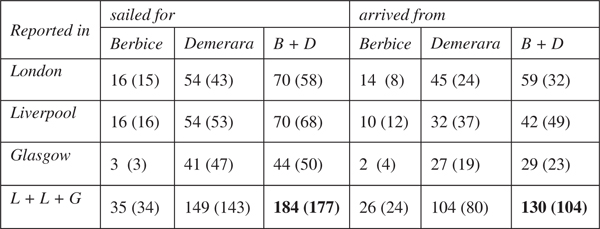
In brackets are the corresponding figures from the other side of the Atlantic. E.g. Lloyd’s List reported that 54 ships had sailed from London for Demerara during the year, and that 43 ships had arrived in Demerara from London.
Of the 595 records included in Table 33 a great part is overlapping as the figures include both ends of a single trip. As the dates of arrivals or departures are missing from many journeys, it has only been possible to calculate the duration of 148 sea voyages.
London and Liverpool were the main British ports for the Guiana trade. Glasgow was the third important one, while the others played a minor role. About 20% of the sailings were for Berbice, while the majority was for Demerara. Glasgow’s trade was almost entirely focused on Demerara. Only three ships sailed from the Clyde for Berbice during the year.
Despite the well known difficulties in Guiana, it seems that a few more British merchant ships were sailing to or from its ports in 1840 than a decade earlier. This meant that, despite decreasing trade figures, the opportunities for information transmission had actually increased since the 1820s.
An average sailing from Britain to Guiana took some 43 days, and an average home voyage 51 days. The duration of sailings varied a lot, 30 to 49 days being the most usual on the way to Guiana, and 40 to 59 days on the home voyage. The shortest sailing was from Glasgow to Demerara, 26 days, and the longest from Demerara to London, 77 days.588
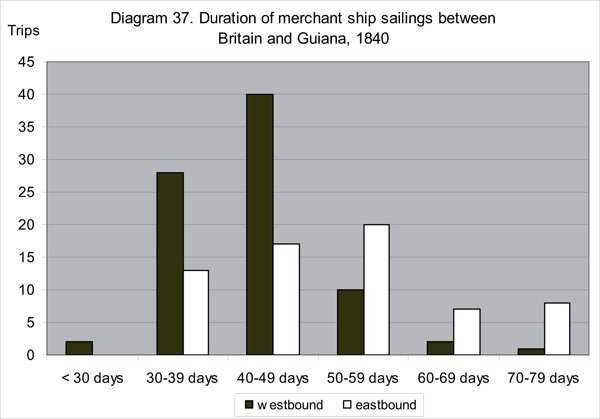
Source: Lloyd’s List, 1840. – The total number of westbound sailings included in the records was 83 and the number of eastbound sailings 65.
The rather big difference in duration of westbound and eastbound sailings may have been caused by the imbalance of trade between Britain and Guiana. The estimated value of imports from the mother country to Demerara was about £480,000 on average in 1822–1830, while the value of exports from Demerara to Britain was about £1.4 million on average. The figures of Berbice were about £70,000 and £200,000 respectively.589 The imported British industrial products were typically of higher value than the exported colonial bulk products, thus causing even more difference in the weight of cargo inwards and outwards.
The port stays varied between 12 and 120 days, without any reasons given. The stays of more than two months may have included major ship repairs, or even a non-reported trip somewhere else in between. The large British ports worked more efficiently than the colonial ports, even though their functions were also still very labour intensive, as Sarah Palmer has shown in her studies of the economics of the 19th century port of London.590 In Liverpool, a dramatic dock planning and building process took place with the advent of steam in the 1840s and 1850s, but had not yet started by 1840.591
Regular Guiana traders normally spent roughly four weeks unloading and loading in London or Glasgow, and more than five weeks in Liverpool, on average. The port stays in Demerara and Berbice were longer, from six to seven weeks on average. It is not mentioned in the documents whether labour shortages in Guiana were just as problematic at the ports as they were at the plantations. However, the delays in production at the plantations alone must have also caused extra waiting time for the exporting ships at ports.592
Of the 245 merchant ships sailing between the ports in question during 1840, about ten percent could be called regular traders. They made at least two round trips during the year, one of the ships being fast enough to make three. Of these vessels, 13 were on the London–Demerara route, five on the Liverpool–Demerara route and four on the Glasgow–Demerara route. One ship from Liverpool and London sailed regularly to Berbice. Unlike tramp ships, regular traders normally sailed directly between the two ports, being somewhat more reliable mail carriers.
Due to the slow and crowded passage up the River Thames, the merchant ships normally delivered their mailbags at Deal one or two days before their arrival in London. The Gravesend Post Office was also commonly used, as well as places off the southern coast, e.g. Salcombe in the micro case of this study. The law required the incoming ship’s captain to forward the letters to the nearest post office at the first port of call in Britain. In many cases the first port of call depended on the weather, the need for water or stores, etc., and could be wherever it was most convenient to put in.593
While many of the other merchantmen on the Guiana route were rather small vessels – not much over 200 tons and some even below that – the regular traders were mostly bigger, near 400 tons or even above. However, the fastest vessel on the route was the 214 tons Thistle of Glasgow, making three full round trips despite suffering a heavy gale ‘with loss of boat, bulwarks, spars &c.’ during one of the journeys in January 1840.594 The Thistle was obviously a fast-sailing ship but, due to her smaller size, her loading and unloading were also faster than some larger vessels. Especially her port stays in Glasgow were rapid: 14, 19 and 27 days.
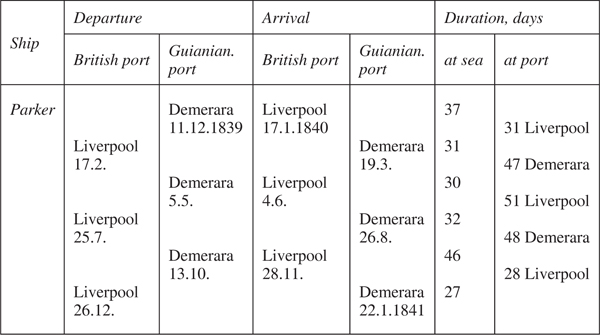
Not many round trips can be fully reconstructed due to missing dates. One good example of a regular trader with almost three round trips is the Parker, with sailings and port stays as follows:
TABLE 34. Duration of sailings and port stays of the regular trader Parker on the Liverpool–Demerara route, 1840.
Source: Lloyd’s List, 1840.
The example shows the great differences in the time spent at sea – or at port – even by the same vessel. It was rather impossible to forecast the duration of a voyage. On average, the Parker spent 34 days at sea and 32 days at port during the period. In other words, the first round trip from Liverpool included 61 days at sea and 47 days at port in Demerara, i.e. 44% of the time spent at port. The second voyage included 78 days at sea and 48 days at port in Demerara, i.e. 38% of the time spent at port. The exceptional efficiency of the Parker becomes evident when comparing these figures with the general average of time spent at port during the period. It was usually 53–55%.595
The records, even if not so representative as one would hope, give an impression that the merchant ships between Liverpool and Demerara were the best options to send private mail from the colony to the mother country. There were four to five ships leaving for Liverpool from Demerara each month, on average, but only one or two from Berbice.
Due to the nature of the business, i.e. trading colonial plant products, more than 40% of the recorded ship departures from Guiana fell in November–January. In addition, many ship captains most probably have wanted to avoid the hurricane season, which lasted from June to November, being worst from August to October.596 Thus, there were months when no ships departed for London or Glasgow, and only one or two for Liverpool. Even if there were ships loading at the port, the mail sender could never be certain of their schedules.
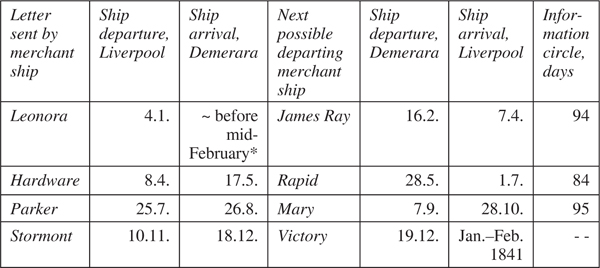
Due to the many missing dates in Lloyd’s List’s maritime intelligence, a perfect information circulation by using merchant ships as mail carriers on the Guiana route cannot easily be reconstructed. Table 35 depicts one example of how to send letters to and from Demerara, starting from Liverpool at the beginning of the year 1840.
TABLE 35. Consecutive information circles enabled by merchant ships between Liverpool and Demerara in 1840, an example.
Sources: Lloyd’s List 1840.
* The exact arrival date has not been reported. In this table, 42 days are allowed for the trip, compared to 39, 32 and 38 of the other westbound trips. – The duration of the last round trip has not been calculated as it continues for a great part to the following year.
As can be noted from table 35, less than four consecutive information circles could be implemented on the West Indian route within a year, if only merchant ships were used as mail carriers. Guiana is naturally an example of a distant colony, compared to e.g. Jamaica, but the information transmission between the plantations and their owners in the mother country was of course equally as important for these owners as for any others having businesses in the colonies.
In two cases (7.4.1840 and 18.12.1840) the table gives a very tight schedule for answers to the letters. It could have been implemented only if the locals had frequent contacts with the Coffee House, or the Post Office service was quick enough with the dispatches. Good luck was sometimes needed for the most rapid information flows.
The West Indian and South American mail services as parts of the whole Falmouth packet system
Apart from the merchant ships, there was the official channel for sending business letters to Britain, or via Britain, to be forwarded to other places in Europe: the Falmouth packets. As already depicted in the micro case of Plantation Hanover, the government’s mail system was rather slow and complicated. However, it would still have been a better option for the plantation manager in most cases, compared with the private ship dispatches.
The mail packets sailed from Falmouth for the West Indies on the 3rd and 17th of each month.597 Although delays of one or two days due to heavy gales were not exceptional, most departures from England were made on time. The round trips of the packets consisted of three parts: the westbound Atlantic crossing, the inter-islands journey, and the eastbound crossing on the way back home. Each of these parts depended on the earlier one, and the duration of them all was rather unforeseeable.
In 1840,598 the packets’ westbound crossing of the Atlantic varied between 20 and 45 days, nine of the journeys being made in less than 30 days.599 The average westbound trip from Falmouth to Barbados took 31 days.
MAP 3. Falmouth packet routes during the first half of the 19th century.
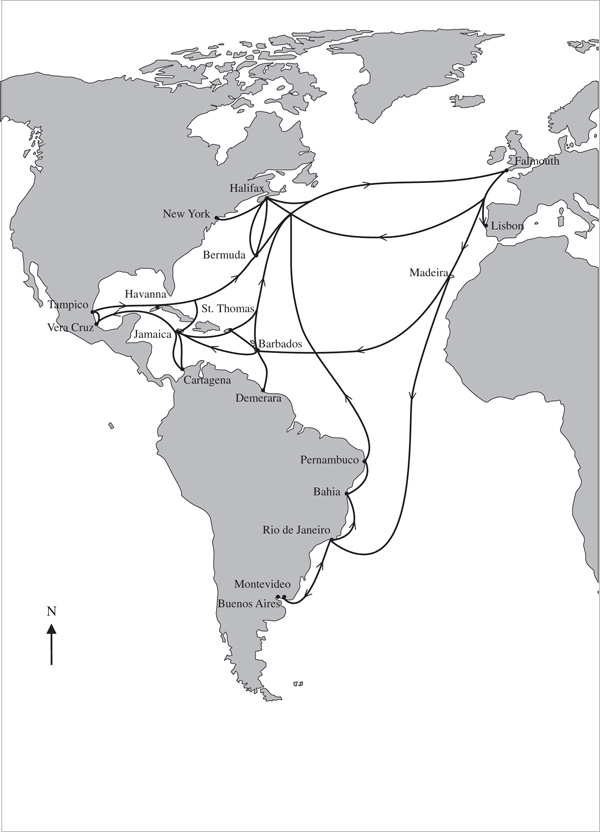
The duration of the inter-islands journey between Barbados and Cape Henry or Cape Haitien at Haiti varied between 20 and 30 days, being 23 days on average. The inter-islands journey started within 24 hours of the packet’s arrival at Barbados. If one packet was delayed, arriving simultaneously with the following one, which had departed two weeks later from Falmouth, the two ships sailed together for virtually the rest of the voyage.
The eastbound trip from Haiti to Falmouth took 33 days on average. The shortest sailing took only 25 days, and the longest 44 days. The average eastbound sailing was thus considerably faster than an average merchant ship sailing. The packet ships were approximately the same size as the merchant ships, near 300 tons on average,600 and they sailed with no cargo. Without the time-consuming cruising among the islands, the mail packets could have constituted a really competitive means of communications.
Yet the duration of the West Indian mail packet sailings had not changed much since the pioneering times of Edmund Dummer. His packets sailed from Channel ports, mainly Falmouth or Plymouth, to Barbados during 1702–1711 in 32.7 days on average, being only two days slower than the Falmouth packets of 1840.601 At the same time, however, it looks like the merchant ships would have sailed from British ports to Guiana clearly faster in 1840 than to Barbados in 1698–1700. According to Ian K. Steele, an average merchantman of the earlier period sailed from the Channel ports to Barbados in 62.9 days (20 cases) and from the west coast of England in 80.2 days (26 cases).602
We should probably not assume that merchant shipping developed so much faster than mail sailings. It seems that the customs-to-customs calculation method used by Steele may have added a number of extra days to the duration of voyages. The ships did not always leave on the same day as they were cleared from the customs, due to bad weather conditions or other reasons.
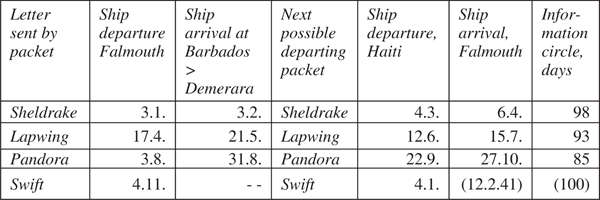
Despite generally faster sailings, the West Indian mail transmission – even if conducted bi-monthly – was organized in a way that gave no advantage to the government mail service compared with the merchant ships in terms of business information circulation. Table 36 gives an example of the best options, starting from Liverpool at the beginning of the year 1840.
TABLE 36. Consecutive information circles enabled by Falmouth packets for correspondence between Liverpool and Demerara in 1840, an example.
Source: Lloyd’s List 1840.
As can be seen in table 36, the information circulation enabled by the Falmouth packets on the West Indian mail route was not at all faster than what could be achieved by merchant ships (see table 35). The only good thing in the service was the regularity in sailing times from England. The arrivals at Barbados varied considerably, and there seems to have been no fixed departure dates from Haiti. From a Liverpool merchant’s perspective, at least four extra days had to be added for the inland connections to and from Falmouth. The mails were made in London two days before the departure of the packet, and they arrived via the London Post Office.
When looking at the West Indian route only, it seems strange that the Falmouth packets did not adopt the practice that had already been used by the American sailing packets in the North Atlantic for 20 years. The American packets made three round trips each year, not more or less, independent of contrary winds and other mishaps. Thus they could generally sail on the published date from both sides of the Atlantic. As already discussed, this punctuality made the North Atlantic business communications the best existing at the time.
The Falmouth packets made the West Indian round trip in 87 days on average. The longest round trip took 107 days and the shortest only 73 days. Within these limits, it would have been rather easy to organize a better working system, similar to the North Atlantic line traffic model. As there was a packet leaving from England regularly bi-monthly, there could have been one leaving from the other end correspondingly. Now there was a packet leaving regularly from Falmouth, but the time between two packet departures from Haiti at the other end of the voyage could vary between two and 34 days, not to mention the two ships that departed on the same day in April 1840.
Unfortunately, the system was too complicated to allow simple solutions. The same packets that carried the Guiana mails to Barbados and the answers ome to England also carried mails for Halifax and Bermuda until mid-1840, when the Cunard Line took over the North Atlantic route by its new steamers.603 In addition, they sailed the long mail routes to Vera Cruz and Tampico as well as to Bahia, Pernambuco and Rio de Janeiro. The last mentioned route was so long and therefore unpopular among packet captains that the ships were not normally sent there twice in succession. The stormy Halifax route with its raw winter winds was a similar case. As the mail routes were not equally long, scheduled mixed round trips were not easy to organize.
Although the South American packet route was the longest, it was not actually very much longer than the route to Mexico. The average duration of the round trip to Rio de Janeiro was 133 days and to Vera Cruz 126 days in 1840.604
The South American route
The South American route had existed since 1808 as part of the good relationship between Britain and the Portuguese Royal family living in exile in Brazil during the war time. The sailings were originally only to Rio de Janeiro, with a call at Madeira and Tenerife on the way outwards, but as the trade developed between Britain and Brazil, demand arose for an additional port of call in South America. In April 1817, the ‘merchants of Liverpool and London’ represented to the Postmaster General that Pernambuco as well as Bahia should be included as ports of call ‘as it would be a great convenience to the Trade’. A committee of captains at Falmouth considered that the voyage out and home to Rio would not be lengthened by touching Pernambuco by more than a week to ten days.605
The service on that route was certainly not easy, and the customers were not happy either. The coast of Pernambuco was reported by packet captains to be dangerous in the extreme, having neither lighthouses to direct vessels by night nor a port in which a packet could take shelter by day, and not the smallest assistance could be rendered from the shore. Strong gales were not the only problems during the early packet voyages. Captures by privateers and pirates caused several serious losses, and sometimes the ships had such a lack of crew that they were not able to sail on schedule. Heavy loss of life was not only due to action on board during the wartime captures, but at least 99 men were killed by yellow fever between 1780 and 1828 on board the packets.606
The merchants trading between Pernambuco and Britain complained a year or so after the arrangement had been made that the packets did not stay long enough to enable them to reply to the letters brought from Britain. In a number of instances, the packet had only remained a day or less. It was essential for the merchants to have sufficient time to receive their mail, absorb the contents and write replies to their trading contacts in Britain. As a result of the representation made, instructions were issued by the Secretary of the Post Office that packets should stay at Pernambuco for 48 hours, as they did at Bahia, unless it was detrimental to their safety.607
The sailing lists of Howat do not enable the calculation of all voyage lengths during the first years of packet service, as the arrival dates in Rio are not recorded. A comparison between the length of the home trips from Rio to Falmouth gives us the following results:
TABLE 37. Average duration of packet sailings from Rio de Janeiro to Falmouth, 1820–1850.
|
1820 |
1830 |
1840 |
1850 |
| Days on average |
62.2 |
60.1 |
58.7 |
51.9 |
Source: Sailing lists of Howat, 13, 77, 81, 86. – The packets called at Bahia and Pernambuco on six homeward voyages out of 12 each year.
It is interesting to note that the average sailings shortened by about ten days from the 1820s to the 1850s even if the route arrangements remained the same and all these trips were conducted by government sailing packets.608 Here the difference was clearly in the technical improvements of the vessels.
As already described in connection with the Falmouth packet sailings to Halifax (see Chapter V.2.) the Admiralty took over the Post Office administration of the mail packets in 1823 as part of the post-war arrangements. The ships which the Admiralty introduced in packet service were slow ten-gun brigs and sloops, later packet brigs. The first category packets were small men-of-war, mainly 230–240 tons, and built for general naval purposes in the 1820s. The ships were modified and re-equipped for mail service, mostly including the reduction of the armament to six guns, but they were never really suitable for this duty. The later packet brigs were built in the 1830s especially for the mail service. They were larger, about 360 tons, and more seaworthy than the older ones. Before these rearrangements took place, nine of the 25 naval packets of the first category were lost at sea between 1827 and 1840. Several of them just disappeared.609
In table 37, the year 1840 happens to be in the middle of the shift period, when the Admiralty had already replaced part of the old men-of-wars with new-model packet brigs. Five of the monthly trips from Rio were conducted by the newer, purpose-built vessels. Their average sailing time was 51 days, while the trip by the old vessels took 64 days on average. In 1850, only newer ones were left in service, and the average sailings had reduced to less than 52 days.610
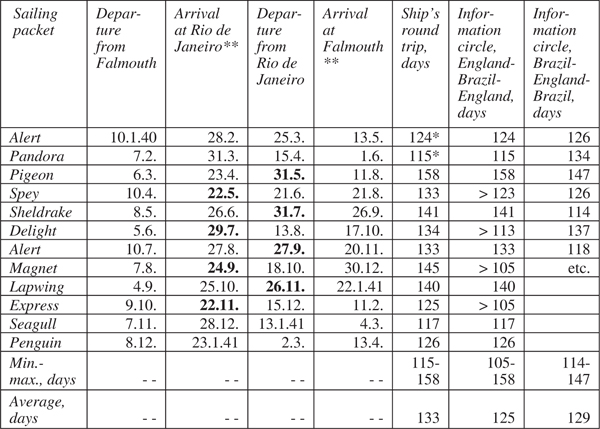
As mentioned, an average packet round trip between Falmouth and Rio de Janeiro took approximately 133 days. This was not the same as the information circle, however. By 1840, the packet system had been organized in a way which in four cases out of 12 made it possible to send an answer to a letter by the packet which was leaving from Rio earlier than the one which had carried the mails from England. Even this small arrangement reduced the length of an average information circle by eight days, from 133 to 125 days, without any changes in the duration of sailings. Table 38 shows how this worked. For an example of the alternative Rio de Janeiro–Falmouth–Rio de Janeiro, see Fig. 20.
Despite the varying length of sailings, the information circulation could have been clearly faster during the period of Post Office sailing packets, if the arrivals and departures had been better coordinated. Only four times out of 12 were the merchants in Rio de Janeiro able to reply to their letters immediately, while in the rest of the cases, the earlier packet had already left the port when the next one arrived with the latest news. In these four cases, the information circulation enabled by the combined service of two packets was several weeks shorter than the single vessel’s round trip.
Calculating from the beginning of 1840, the Falmouth packet service could offer fewer than three consecutive information circles between England and Rio de Janeiro that year. The first circle started by the departure of the Alert on 10 January 1840, the second by the Delight on 5 June and the third by the Express on 9 October. As can be noticed in Table 38, two of the circles clearly benefited from the possibility to send the answer from Rio de Janeiro by an earlier packet.611
Even if the information circulation to Rio de Janeiro can be considered rather fast compared with e.g. the much nearer located Demerara, the situation was worse if the letters proceeded to Argentina or Uruguay. The mail sailings to Buenos Aires started in 1824, and as long as the Post Office packets served on the route, they continued from Rio to Montevideo and Buenos Aires on their trip from Falmouth. The long sailing seemed to be too much for the Navy officers, as the system was changed when the Admiralty gradually replaced the private contract packets. Starting from late 1832, there was a branch packet service between Rio and the southern ports.
In 1830, the Post Office packets made the round trip from Falmouth via Rio and Montevideo to Buenos Aires and back again in 170 days on average. In two cases it was possible to send the answers from Buenos Aires by an earlier packet. This reduced the length of one information circle by ten and another by 23 days. The average duration of one information circle was thus 168 days.612 The system enabled two full information circles with Buenos Aires during that year, starting from Falmouth on 23 January and ending at the same port on 11 December 1830. The third circle started from Falmouth on 24 December; this packet arrived at Rio on 18 February, 1831. At least two days at both ends need to be added for inland transmission to and from Liverpool.
TABLE 38. Falmouth packet round trips and the length of information circles, Falmouth–Rio de Janeiro, 1840.
Source: Calculated from the sailing lists of Howat, 81.
– The options to send replies to the letters with an earlier packet are marked in bold. – An average sailing from Falmouth to Rio de Janeiro took 48 days, varying between 42 and 54 days. The sailing to the other direction took 57 days on average, varying between 42 and 73 days.
* February had 29 days in 1840.
** Six trips of the year were conducted via Pernambuco and Bahia.
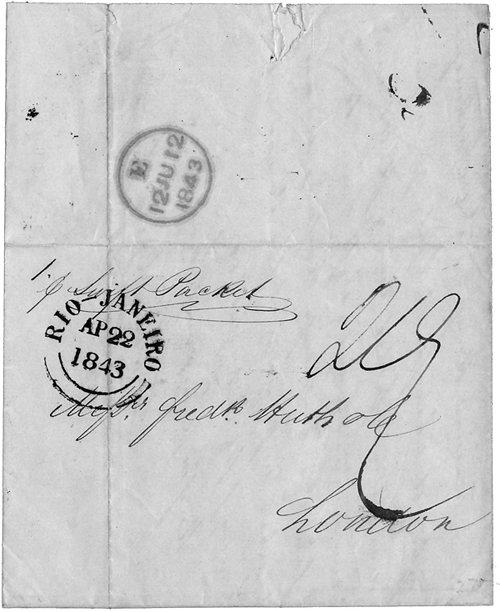
FIG. 20. The letter dated in Rio de Janeiro on 10.4.1843, was carried to England by the Swift packet, which departed from Rio on 23.4. and arrived in Falmouth on 10.6. The recipient, Frederick Huth Co. in London, has noted on the reverse that the letter was answered to on 4.7. Thus the answer must have been carried by the Penguin packet, which departed from Falmouth on 7.7. and arrived in Rio on 17.8. A concrete case, where we know that the letter from Rio received an answer in 129 days of the writing, or in 116 days after the mail-carrying packet had left the port of Rio.
The Admiralty system for Bueros Aires was more complicated. Table 39 (in the end of the book, p. 428) depicts how it worked in 1840. The route consisted actually of several parts. Firstly, the outward sailing from Falmouth to Rio de Janeiro took 48.5 days on average, varying between 42 and 54 days. The branch packet was ready to sail for Buenos Aires within three to five days after the Falmouth packet had arrived. The sailing took about 12 days. The average waiting time in Buenos Aires was ten days, varying between seven and 22 days. The trip back to Rio was typically more difficult than the voyage down; it took 20 days on average. The next Falmouth packet took the mails and left within ten days on average. The delay varied between two and 19 days, however. The homeward trip from Rio to Falmouth took 57.3 days on average, nine days more than in the other direction.
As can be noted in Table 39, the departures of the Falmouth packets from Rio de Janeiro were organized so that the mails from Buenos Aires could always proceed by the next packet after the one which had brought the mails from Europe. This was a major improvement compared with other Admiralty ruled routes where the next ship had often just left when the auxiliary service arrived with the mails, but the system itself was rather slow with changes of ships and waiting at ports. Even if some vessels were apparently better than ten years earlier, the length of an average information circle did not reduce very much within a decade, only from 168 to 162 days.613
The Falmouth packets stayed at Rio for approximately 27 days on average, while it took almost 43 days on average for the branch service to make the round trip to Montevideo and Buenos Aires. With respect to the mail service between England and Brazil, it was obviously wise to organize the sailings to Argentina and Uruguay as a separate branch service and thus speed up the information transmission to and from Rio de Janeiro. One could say, however, that some more efficiency at the ports could easily have reduced the length of the information circles by at least one week. Now, two weeks were used on average for taking the European mails to the branch packet at Rio, and the branch packet mails to the leaving Falmouth packet at the same port on the way back home.
The Mexico route
The packet route to Mexico was established in 1826, and taken over by the Royal Mail Steam Packet Company together with the West Indian route in 1842.614 As far as the writer of this study has been able to find out, no postal historical research has been published about the Falmouth packet sailings on the Mexico route during the period. From Britnor we learn the following about the sailings on this route in 1832: The departure from Falmouth was on the third Wednesday of each month, and the packet proceeded via Jacquemel (Haiti), Jamaica, Belize (Honduras), Vera Cruz and Tampico (both in Mexico), back to Vera Cruz, Havana (Cuba) and home to Falmouth. On the arrival of the Mexico packet at Jamaica, a branch packet was dispatched to Cartagena (Colombia) and that vessel also brought the replies to Jamaica in time for the homeward bound Jamaica packet. A colonial boat conveyed the mails from Jamaica to Nassau (Bahamas), and took the replies to Crooked Island (Bahamas) to be picked up by the homeward bound Jamaica packet.615
As can be noticed from the list above, the Mexico route was actually a combined service for the North and West Caribbean islands, Central America and Mexico. In 1837, the Mexico packets, which had been calling at Belize, were ordered to sail directly from Havana to Vera Cruz and the Honduras mail had to be taken by a branch vessel from Jamaica.616
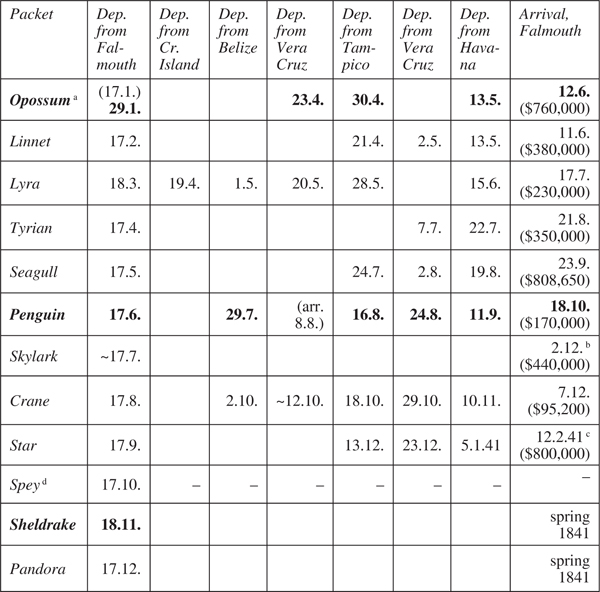
Several interesting details can be picked up from the Lloyd’s List maritime intelligence on the Falmouth packet sailings for Mexico in 1840 (see Table 40). Probably the first thing to notice is that huge sums of bullion were carried by each of the packets from Mexico. During 1840, over $5 million arrived at Falmouth in the Mexico packets.617 Vera Cruz and Tampico seem to have been the places where the Bank of England’s bullion mainly came from, even if considerable amounts of money freight were also constantly arriving from the West Indies and other areas.618
Perhaps due to the importance of the Mexico route, the departures from Falmouth were strictly punctual throughout the year. That was where the punctuality ended, however. It is hard to find any logic in the departure dates at the other end of the trip.619 Due to the delay of the Opossum in January, the February packet Linnet was in Tampico before the January mails arrived, departed on the very same day from Havana as the Opossum and arrived at Falmouth one day earlier. These two ships shared a freight of $1.14 million and there may have been good reasons to sail together, but from the information transmission point of view this was naturally not an ideal arrangement.
TABLE 40. Falmouth packet sailings for Mexico and consecutive information circles enabled by them, 1840.
Source: Lloyd’s List, 1840–1841.
a The Opossum departed from Falmouth already on 17.1. but put back on 28.1.
b The Skylark arrived at Cork already 28.11.1840. Her exact departure date from Falmouth in July is missing.
c On the same day as the Star arrived from Mexico with a considerable freight of $800,000, two other Falmouth packets arrived from the West Indies, the Swift with $100,000 and the Ranger with $80,000. Thus the mail coach from Falmouth to London was responsible for the safe transport of almost one million dollars on a single day. (Lloyd’s List 13.2. and 16.2.1841)
d Wrecked at the Bahamas Channel 24.11.1840; crew, passengers, mails and stores saved (Lloyd’s List 16.1.1841). The vessel was abandoned but later brought to Nassau by HMS Thunder. (Lloyd’s List 16.2.1841)
The system gave the Vera Cruz merchants about two weeks time to answer their mails. During that time the English packet sailed for Tampico and returned. The departure from Havana to Falmouth was most often on a Wednesday, Thursday or Friday at around mid-month, although the date varied between the 5th and the 27th. The home trip was made in 32.6 days on average.620 As can be noted from table 40, only two full information circles were possible between the trade partners in Britain and Mexico in that year. The next packet for Mexico departed on 18 November and would be back in Falmouth sometime in April 1841.
The Admiralty seems to have preferred to send the Mexico packets from Falmouth exactly on schedule instead of enabling the British merchants to answer their arriving letters. The Skylark departed on 17 July, the same day as the Lyra arrived from Mexico, and the answers had to wait for the next vessel for a whole month. The Crane departed from Falmouth for Vera Cruz four days before the Tyrian arrived with the mails from Mexico, the Star departed six days before, and the Spey just one day before the mails arrived.
Even if it was naturally important to keep the timetables, it might have been useful to reconsider them as it frequently happened that the duration of the Mexico sailings – the length of an average round trip was 126 days – was such that the mails from Vera Cruz arrived just after the monthly packet departure had taken place. If the service had been bi-monthly, this problem would not have existed – something to keep in mind when comparing the American sailing packets’ weekly service in the North Atlantic with anything the Admiralty was able to do on any route.
The last years of the Falmouth packet service, a conclusion
In conclusion, it can be noted that the varying length and the complexity of the Falmouth packet routes as well as their auxiliary services made the organizing of the mail system a challenging task. The Admiralty had 24 packet vessels for four different routes and monthly services, except the West Indies, which was bi-monthly. Of the packets, 13 were small (about 230 tons) and rather unsuitable for the service, two were middle-size (280 and 320 tons) and only nine were purpose-built, around 360 tons vessels. Additionally, there were several branch services: between Halifax and Bermuda; widely at the Caribbean and the northern parts of South America; and between Rio de Janeiro and the southern ports. This puzzle was supposed to function perfectly during the age of sail, when prevailing winds and storms could ruin any plans, and often did.
Diagram 38 illustrates the sailings of the Falmouth packets on different mail routes in 1840. It starts from 1 January and shows on which routes and for how long each ship was sailing during the year. The service for Halifax ended in the summer of 1840, when the Cunard Line’s mail steamers started their operations. For this reason, three ships were left unemployed in the middle of the year. Additionally, the Spey packet struck on a coral reef in the Bahamas Channel and was lost in November 1840.621
Each of the packets could sail on any route, and no difference was made on the basis of their slowness or other disadvantages.622 Basically, as was noticed when examining the South American route, a great part of the differences in duration of voyages were due to the varying quality of the packet vessels. As already discussed in Chapter V, it caused a dilemma, even on the North Atlantic route, if the shipping companies used very different steamers, while it was a great advantage if the fleet consisted of similar types of vessels. Although the problem was obviously well known by the Admiralty, nothing was done about it – in addition to economic reasons, it was probably thought that the vessels would soon be replaced by steamers anyway.
The general popularity of the American sailing packets was based on the idea of regular departures from both ends. Their schedules were built so that the targets could usually be met without problems and even if the duration of sailings varied a lot, the departures were on fixed dates from both Europe and New York. This was rather easy to manage due to the frequency of sailings. The longest waiting time between a ship’s arrival and the next one’s departure was one week only and generally just a few days. The number of vessels in service enabled sufficient time for loading and unloading at ports at both ends of the voyage.
The regularity of the Falmouth packets was limited to the departures from England only, and the rules varied between the routes. In 1840, the West Indian packets departed quite regularly on the 3rd and 17th of each month; the Mexico packets very accurately on the 17th (with the exceptions caused by Sundays); the South American packets on a Friday nearest to the 10th of each month with a couple of exceptions; and the Halifax mails on the first or second Saturday of each month.623 As a whole, the departure dates from England can be called regular within their own logic.
The philosophy used for the departures from the other side of the ocean was different. The schedules were calculated from each arrival of the Falmouth packet from England – regardless of whether the trip had taken three or six weeks. Strict orders regulated how many days or hours after the ship had arrived at Barbados the auxiliary ships should depart for the colonial islands, and by which date the mails should be collected to Havana, Cape Haitien or some other place selected for the purpose during the years. The advantages of this system were that the mails were carried home as fast as possible, and the vessels were back in England as soon as they could be.
Unfortunately the advantage of knowing in advance when the next mail ship would leave from Falmouth was in several cases cancelled out by the fact that the packet from abroad arrived shortly after another one for the same place had left the port. Even at the risk of slowing down the arrival of letters from the colonies, it might have been useful from the information circulation point of view to adjust the sailing dates to avoid such incidences. This would have been a difficult task in the long run, however, in view of the requirement for regularity of sailings. There would also have been the risk that the expected ship might never arrive.
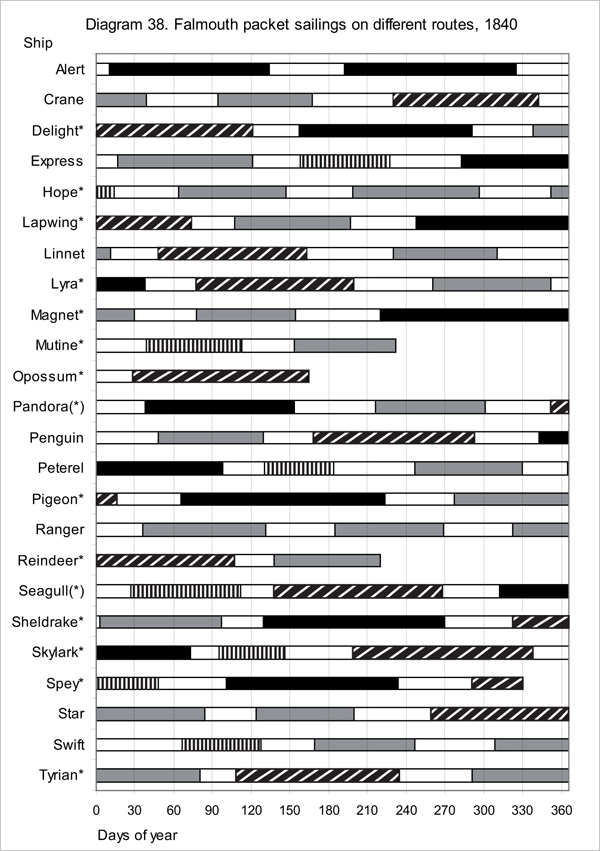
Source: Lloyd’s List 1840. – The small-size ships are marked with an asterisk*, and the medium-size ships with (*). The black parts of the pillars depict a trip to South America, and the grey parts a trip to the West Indies. The vertically striped parts of the pillars depict a trip to Halifax, and the diagonally striped parts a trip to Mexico. The white parts of the pillars depict the time each ship stayed at the home port between sailings.
The era of the Falmouth sailing packets ended on the Halifax route in mid-1840, when the Cunard Line started the steamship service from Liverpool via Halifax to Boston; and on the West Indian and Mexico routes in early 1842 when the Royal Mail Steam Packet Company took over these routes with its new purpose-built steamers. Six sailing packets continued on the long South American run until the end of 1850, when the Seagull took home the last mails from Rio de Janeiro, arriving in Falmouth on 30 April 1851.624
Overnight Change from Sail to Steam
By Royal Mail to sixty ports – The long way to South America
By Royal Mail to sixty ports
While there was a ten-year-long shift period in the North Atlantic when mails were being sent by all possible means – American sailing packets, pioneering private steamers and government contract steamers – the complicated Falmouth packet system on the West Indian route was changed overnight to an even more complicated Royal Mail Line (Royal Mail Steam Packet Company, or RMSP) system. Even if the government subsidy was as huge as £240,000 (compared to the Cunard Line’s much discussed £81,000), no competitors were struggling for the contract. In fact, the government did not even ask for bids but just accepted the proposal made by a man called James MacQueen.625
MacQueen was a Scotsman who had spent years in the West Indies, working as a sugar plantation manager in Grenada, and travelling a great deal around the Caribbean area and the Spanish Main. He returned to Glasgow at the age of 35 and earned his living as a newspaperman and merchant, also showing much interest in topography and African geography. He was the first person to plot the exit of the Niger into the Bay of Benin. In identifying the Niger’s course he was helped by his slaves on Grenada, some of whom were Mandingos, who had once lived on the river banks.626
This background gave him the ability to plan a network of steamship communications, which would serve the merchants in Britain as well as the West Indies, and several other places. His ‘General Plan for a Mail Communication between Great Britain and the Western and Eastern parts of the world; also Canton and Sydney westward of the Pacific’ included operations around the world: from Falmouth to Halifax; North America, the West Indies and Brazil; to Canton in China and Sydney in New South Wales (Australia) via Panama; the Mediterranean and East India by the Red Sea; and the eastern world by the Cape of Good Hope.627 The distances from port to port and the days of departures and arrivals were all carefully calculated. As MacQueen believed that a canal through the Central American isthmus (he preferred the Nicaraguan route instead of Panama) would be opened ‘at no distant date’ he boldly planned some of his routes to take advantage of direct access to the Pacific by such a canal, being thus some eighty years ahead of his time. Also his proposals for rapid bunkering of the steamers would have been considered advanced even in later decades.628
Content removed from the open access version of this book
FIG. 21. The Royal Mail Line paddle steamer Dee was one of the 14 original vessels built for the West Indies service in 1841. They were all produced to the same basic design and were named after British rivers. The Dee remained in service until 1860. (Painting by William Clark, 1841.) © National Museums Liverpool (Merseyside Maritime Museum).
The plan was obviously too much to be implemented by one company. Vernon Gibbs states in his book about British passenger liners that both the Cunard Line and P&O actually owed their birth to MacQueen’s representations. His proposals to the British Government in June 1837, strongly supported by the West India Committee, led to the establishment of the Royal Mail Company in September 1839, and to the Caribbean mail contract in March 1840.629 The huge amount of capital needed – £1.5 million – was collected with the help of bankers involved in West Indian affairs, including the well known Barings Bros in London. The first Chairman was John Irving, MP and merchant, who was also the Chairman of the Colonial Bank.630
MacQueen himself took on the role of an expert in Caribbean circumstances, which he undoubtedly was. His plan for the West Indian mail system was indeed very ambitious. While fourteen new steamers and three schooners were being built for the purpose, MacQueen set up a final tour to prepare the service. Over a period of eight months and covering a distance of over 18,000 miles, he studied the best options for the mail services, including ports, routes and schedules. His final plans consisted of the transatlantic service and ten branch lines covering the area between Halifax in the north and Demerara in the south, Barbados in the east and Tampico in the west. The routes covered some sixty ports and required the steamers to travel over 547,000 miles a year.631 The routes are well covered in earlier studies and do not need to be repeated here in detail.632 The transatlantic passage started and ended at Southampton, which had just been connected with London by railway. The Admiralty, which was still responsible for mail transport at sea, insisted that the Royal Mail ships had to carry the mails via Falmouth even though the inland mail was much slower than it would have been from Southampton. The mails were made up in London and the ships left from Southampton on the 1st and 16th of each month, while the departure from Falmouth was on the 3rd and 18th. Falmouth was finally left out from the service in September 1843.633 This was naturally a great disappointment to the port, which had been Britain’s main packet station for over 150 years.
The local routes between the Caribbean islands and Central America formed a complicated network where everything depended on something else. There were separate routes from Barbados to Guiana; from Grenada to Curacao; from Barbados to Turks’ Islands, by Antigua; from Turks’ Islands to the Jamaica district, to the Cartagena and Santa Martha district, and to the Havana and Honduras district; from Havana to the Mexico district, and to the North American stations; and to the Madeira district.634
The new traffic started on 1 January 1842, thus changing the West Indian mail system from sail to steam in a single night. By that date eight Royal Mail steamers had already sailed for the West Indies to take up stations. The first vessels to leave from England were the sister ships Lee and Larne, which left from Southampton on 3 December 1841. These small vessels of 250 and 300 tons would be used for the inter-island services. The first large Royal Mail vessel to cross the Atlantic was the Forth, 1,939 tons, which departed from Southampton on 17 December to be ready at St. Thomas for the mails carried by the Thames, which sailed from Falmouth on 3 January directly to Demerara, and the Tay, which left on the same day with the first regular mails for Barbados.635
The first sailings were fast compared with the earlier standards. The Thames arrived in Demerara from Falmouth in 20 days and the Tay at Barbados in 18 days. In 1840, the average westbound trip from Falmouth to Barbados by a sailing packet had taken 31 days, varying between 20 and 45 days.636 During the first nine months of 1842, the average trip between Falmouth and Barbados by a Royal Mail steamer took 19.2 days, varying between 17 and 24 days. More than 70% of the trips were made within 18 to 20 days. Not only were the steamers faster, but their arrivals were much more predictable. They also sailed punctually from Falmouth without exception.
There were problems, however. The service was not only to Barbados and back home. Cooperation between the network of different routes proved difficult, and this added too many days to the time required for mail transmission.
Thus, even if the mails were carried from England to Barbados in fewer than 20 days on average, the sailing back via St. Vincent, Grenada, St. Croix, St. Thomas, Turks’ Islands, Nassau, Bermuda and Fayal to Falmouth took about 38 days on average, varying between 33 and 45 days.637 And even worse than that, the ships arriving in Barbados from Falmouth often continued their journey on the same day, leaving no time for answers. The next packet would leave some two weeks later.
In practice the circulation of information to and from Demerara was as fast as to and from Barbados, even though the latter was several days closer to England, because the system served all the colonies during one West Indian round trip. The merchants at Barbados received their news from Europe earlier than those in Demerara, and their letters arrived somewhat faster in England than those from Guiana, but the information circulation was equally long from the British merchant’s point of view.
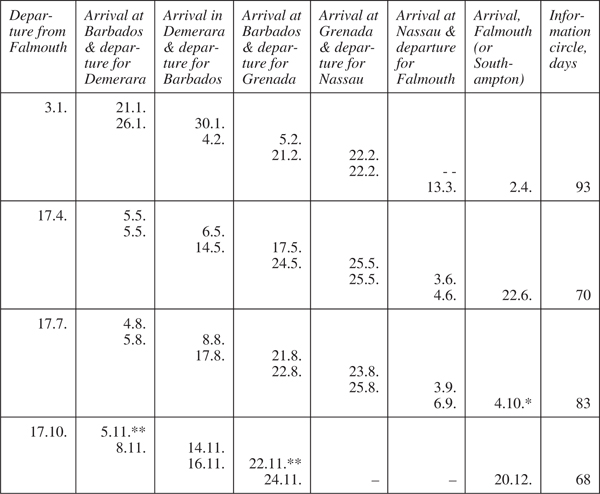
The duration of the homeward transport of mails was normally almost twice the length of the voyage westbound. The consecutive information circles enabled by the service between Liverpool and Demerara in 1842 are illustrated in table 41.
TABLE 41. Consecutive information circles between Liverpool and Demerara enabled by the Royal Mail Line service in 1842.
Source: Sailing lists of Kenton & Parsons, 10–14, 26–28.
* The ship was about ten days late. She called at Corunna on 1.10. due to strong easterly gales.
** The station was changed to St. Thomas. Barbados was visited on the way to and from Demerara.
As can be noticed, the system enabled only four information circles within a calendar year – not very impressive compared with the 3.5 information circles carried out by the Admiralty’s old sailing packets two years earlier. One of the Royal Mail steamers’ circles was even longer than the average Falmouth packet circle, which was 92 days.
The Royal Mail route system soon proved to be impractical and was changed for the first time in October 1842, after only nine months’ experience. As can be noticed from the table, the fourth circle was conducted via St. Thomas instead of Barbados. The trip homewards now included only calls at Bermuda and Fayal. This arrangement shortened the trip notably and the length of the information circle reduced from an average of 82 days during the three first trips to only 68 days on the fourth voyage.
The average trip from Falmouth to St. Thomas in 1842 took 22.7 days, compared to 19.2 days to Barbados. Additionally, the merchants of Barbados had to wait three to four days before the mails arrived from St. Thomas at their island. For these merchants, the route change was clearly a disadvantage, in terms of arriving news from England. However, they now had approximately six days time to answer their letters while the inter-island ship made her trip to Demerara. This was much better than answering on the same day or waiting two weeks for the next steamship – clearly an improvement.
While the businessmen in Demerara certainly felt that the new arrangement was an improvement in their communications, those in Berbice had an extremely busy schedule if they wanted to answer immediately to the letters received. The Royal Mail steamers usually went only as far as Demerara, while Berbice, Surinam and Paramaribo were served by local vessels or the mail was taken overland.638 Sometimes the ships stayed at Demerara only for one or two days, which made it rather impossible for the Berbice businessmen to write immediate answers to the arriving letters.639
A concrete example from early 1842 shows how the mail system worked via Barbados. A letter by William Earle from Liverpool to William Carter, Attorney, who was visiting Berbice at the time, was sent on 15 February by the Royal Mail steamer Teviot. She departed from Falmouth on 17 February and arrived at Barbados on 8 March. The letter proceeded by the City of Glasgow, which arrived in Demerara on 11 March, and was finally received by the Attorney in Berbice on 13 March, according to the handwritten marking. He wrote an answer on the same day and it was carried by the same steamer from Demerara on 15 March. The letter arrived at Barbados – the steamer had been damaged at Tobago but was able to continue – on 18 March. The Medway took then the letter from Barbados, departing on 4 April. She arrived at Nassau on 16 April. The Clyde sailed with the mails for Europe on 17 April, arriving at Falmouth on 8 May. The mails arrived in London on 10 May, and the letter was received by William Earle in Liverpool on the same day.640 The duration of this concrete information circle was 84 days.
The first letters from Liverpool to Berbice in January and February 1842 arrived surprisingly quickly, in 24 and 26 days. A delay with the next mail caused immediate alarm. Carter wrote to Earle: ‘I waited in Berbice for the steamer from Barbados with the 1 March mail from England until the 28th, but nothing was heard of her. I determined to go down to Demerara, where I arrived in a small schooner with several other passengers to England… There I heard that the mail had not reached Barbados on the 26th, that the steamer I had been looking for was disabled! I immediately made inquiries for a vessel going to Barbados… From Barbados I shall go to St. Thomas where I hope to receive letters…’
Carter sent his letter on 7 April from Barbados by the merchant ship St. Vincent. The letter was received by William Earle in Liverpool on 21 May in 44 days. Carter also sent a duplicate on the following day, on 8 April by official mail. The letter carries the handstamp of Barbados Post Office 18 April, and it arrived in England by the Royal Mail steamer Solway on 28 May.641 The steamship letter was on the way 50 days – almost a week longer than the letter by the traditional merchant ship.
William Carter sent one more letter from Barbados before the Royal Mail steamer departed. The merchant ship Alice took the letter, dated on 22 April, to Liverpool in 35 days.642
The huge difference between the West Indian and North Atlantic mail routes was concretely demonstrated in Carter’s following letters from his trip to the north. He continued from Barbados to St. Thomas, from where he sent a letter to William Earle on 28 April. It arrived in England by the same Royal Mail steamer than the duplicate sent from Barbados 20 days earlier. A letter from New York on 14 May was sent by the Cunard steamer Caledonia, which departed from Boston on 16 May and arrived in Liverpool on 29 May643 – on the same day as Earle received all the Royal Mail letters from the West Indies, the oldest of which had been sent 36 days before the letter from New York!
The shipping management of the Royal Mail Line – including routes, schedules, coaling, and repairs – was obviously much more challenging than the back and forth sailing between Liverpool and New York across the North Atlantic. The original routing via Barbados, which was reminiscent of the old system used by the Falmouth sailing packets, was changed in October 1842. St. Thomas in the Danish West Indies became the hub of all mail routes. The main reason for the change was that the route via Turks’ Islands was too dangerous and one of the Royal Mail steamers, the Medina, had already been lost there in May 1842.644 Figure 22 gives an example of how the new system worked.
FIG. 22. Royal Mail Line’s steamers at St. Thomas 23.11.1842.
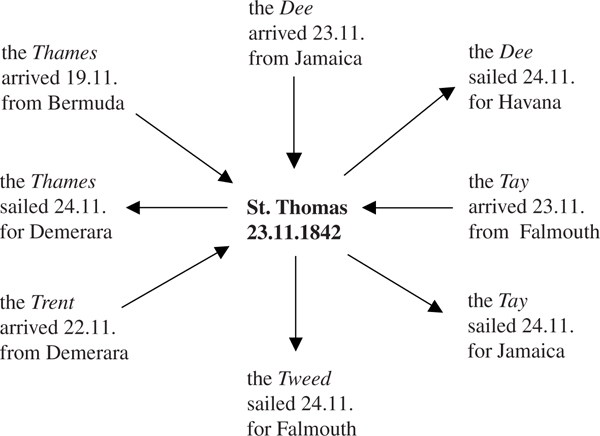
On 23 November, there were five large Royal Mail Line’s steamers simultaneously at the port of Charlotte Amalie, St. Thomas. The steamer Tay arrived with the European mails from Falmouth on 23 November. On the same day, the Dee arrived with the Jamaica mails, while the Thames was already there, having arrived from Havana, Nassau and Bermuda a few days earlier, and so was the Trent, which had arrived from Demerara on the 22nd. All the mails were quickly sorted and on the following day the Tay sailed for Jamaica, the Dee for Havana and the Thames for Demerara. The Tweed took all the mails which had been collected from the islands and proceeded for Falmouth, via Bermuda, on the same day.645
MAP 4. Royal Mail Line routes to the West Indies, January 1842.
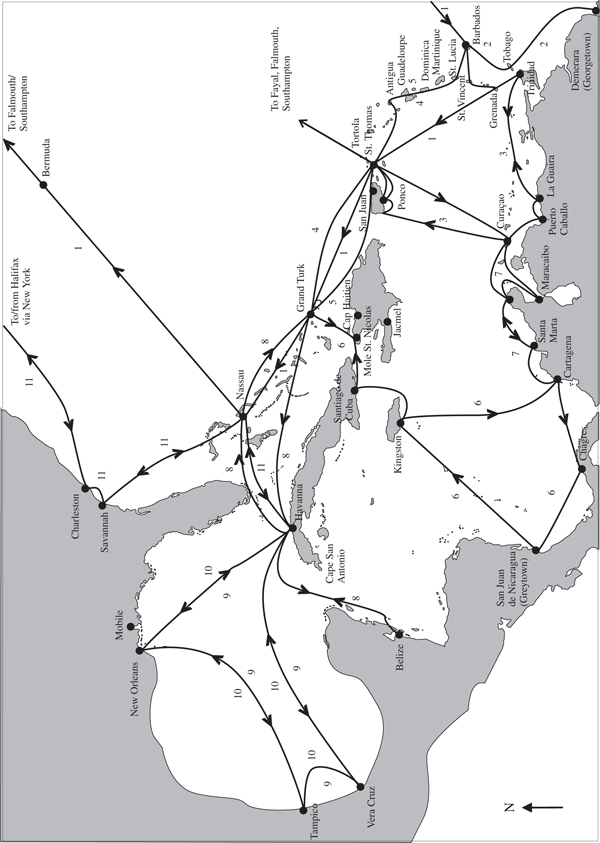
It is easy to imagine that everything did not always work that punctually. A few notes from Lloyd’s List as well as the sailing lists of Kenton & Parsons give some idea of the difficulties: The Tay grounded at Havana in February, but without major harm. The Medina was in quarantine in Nassau for ten days in March 1842. She was totally lost on a reef at Turks’ Island in May. Crew, passengers and mails were saved, however. The City of Glasgow was damaged in March. The Clyde struck a reef near Nevis and had to return to St. Thomas in July. There was a fire on board the Teviot in July. The Thames was damaged while striking a reef at Nevis (between St. Thomas and Antigua) in August, and had to proceed to London for repairs. The Solway lost sails and gib boom in a hurricane in September. In April of the following year she ran onto a reef off Corunna, Spain, and was lost. The Isis was damaged on a reef near Puerto Rico in September, and totally lost near Bermuda in October of the same year. All passengers and crew, except for a boy, were saved.646
In addition to the disasters at sea, many kinds of minor incidents followed each other. One of the often mentioned problems was coaling. The steamers required some two thousand tons of coal per week, and the whole supply had to be shipped to the depots in sailing vessels charted for the purpose. Bad weather in the Atlantic inevitably caused delays to the colliers and there were occasions when the local services had to be curtailed in consequence. In March 1842, the Medway and Tweed were reported to be delayed due to a shortage of coal. A report on the City of Glasgow noted further: ‘Negroes were on strike in Demerara which made coaling difficult – took 24 hours to ship 52 tons, which was all that was available. Chief Engineer and a coal trimmer suspended for ‘misbehaviour’.’ Also the Thames reported shortage of coal in April.647
The crews of the steamers were not always of the best quality. Another report on the City of Glasgow writes: ‘March 1842. The surgeon was sent home because he was insane. Ship’s crew described by Captain Boxer was ‘absolutely very little short of savages’. The third engineer was imprisoned at Barbados for attacking the saloon cook – ‘he is a notorious character having been flogged and dismissed from Her Majesty’s service’.’ The Havana authorities complained about the Clyde’s crew’s ’rowdyism’; they wanted a stone wall built around the depot to keep them in. On the other hand, also the circumstances on the islands were primitive, and sometimes violent.648
For obvious reasons the mails did not always arrive ‘just in time’. The captains had to improvise, as a report on the Thames describes: ‘23 April. Captain Hast will attempt to complete Table 3 on schedule but doubts it will be possible – if it becomes evident the ship is falling behind, they will return via Trinidad, coal at Grenada and thus be ready to receive the mails for the western area. If City of Glasgow is still disabled he will take the mails for Guiana.’649
All shipping companies with Admiralty contract also had to carry on board their vessels a Naval Agent who had complete jurisdiction over the mails ‘with full authority in all cases to require a due and strict execution of the contract… and to determine every question whenever raising relative to putting to sea, or putting into harbour, or to necessity of stopping to assist any vessel in distress, or to save human life…’ This officer was ‘to be provided with a first-class cabin and suitable accommodation for his servant and a properly equipped boat for his use.’ As Gisburn notes, this was not a bad appointment for an ex-Naval officer who (as frequently was the case) had been of decidedly second-rate calibre during his active service days.650
With two masters on board a vessel, the system led to inevitable friction. In March 1842, when the Forth and Tay of the Royal Mail Line were simultaneously at the port of Nassau, the two Naval Agents failed to agree on which of the two vessels should carry the homeward mails and which one would continue on the inter-island routes in the West Indies. They compromised by sharing the mailbags and both sailing home to England. The Forth won this unbelievable race, arriving at Falmouth on 20 April with six passengers and a few bags of mail. The company was already embarrassed by the non-delivery of two ships which were under construction at Bristol, and such occurrences just added to their difficulties.651
The sailing lists of 1842–1843 report at least 14 cases where the ships had arrived somewhere without the mails they should have had with them. Additionally, it frequently happened that the vessels did not call at all ports, which naturally ended with the same result. In several cases, the Navy vessels took care of the mails which had been left after.652
The reports published in England regarding the Royal Mail service were not encouraging. For example, at the end of April 1842 it was reported that no mails had arrived from Jamaica for two months. They were later brought by HMS Spitfire, a Navy vessel. In August, it was reported that while the Forth was on her way homewards, the ‘mails from Bermuda were forgotten and put ashore at Fayal’. In November, it was reported that the Trent proceeded to St. Thomas without Barbadian mails. They were forwarded by a hired sailing vessel. In May 1843, when the Thames arrived at Barbados with no English mails, a Barbadian newspaper wrote that this was the fourth time that had happened recently.653
When examining the improvement in speed of communications between Europe and the Caribbean or Central American area, it must be noted that many advances were due to mail route adjustments rather than changes in the speed of vessels – even though technological improvements also took place during those years.
Between January 1842 and January 1875, the Royal Mail Line’s West Indian contract was changed four times and the routes 11 times. The scale of operations was continuously declining. The original 11 routes were decreased to five or six by the end of the 1840s. The original system included six different communications hubs: Barbados, St. Thomas, Curaçao, Turks’ Islands, Havana, and Nassau. All these ports were places where two to four different mail routes met. Already in October 1842, several routes and ports of call were omitted and the number of hubs was decreased to four or five. After the loss of the Medina at Turks’ Islands, the area was avoided and these routes were redirected via St. Thomas.654
The lessons from the practical experiences in the Caribbean and Central American area, as well as the inevitable financial problems meant continuous streamlining of the Royal Mail Line services. Systems were also changed back and forth. For example, Barbados was originally the station for incoming mails from Europe, while Nassau was the station on the way out. In October 1842, it was changed so that all mails came in via St. Thomas and out via the same island, or alternatively via Havana–Nassau. In July 1843 the mails came in via Barbados and out via St. Thomas or Havana–Nassau. From 1850, St. Thomas was the main station both on the way in and out – until it was changed in 1872 so that St. Thomas and Barbados were the stations for both the incoming and outgoing mails alternatively.655
It is not possible here to go through the development of the speed of information transmission on all the different routes. Keeping the Guiana route still as an example, one can follow the improvement in mail transport by steamship up to the 1870s. As already noted from Table 41, the start of the steamship service in 1842 did not bring major changes to the information circulation compared to the sailing packet period. Ten years later, the number of consecutive information circles between Liverpool and Demerara within a calendar year had increased from four to six. This happened at the same time as the Cunard Line and the Collins Line were competing on the North Atlantic route and the number of consecutive information circles there had increased to twelve, compared with six at the time of the pioneering steamers.
MAP 5. Royal Mail Line routes to the West Indies, June 1852.
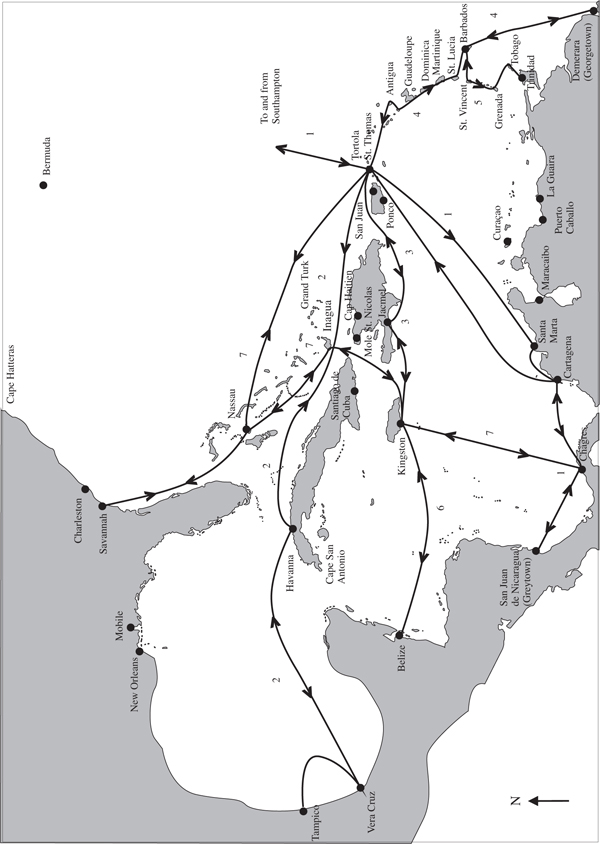
Between 1842 and 1852, the duration of an information circle between Liverpool and Demerara was reduced by some three weeks on average, from more than 70 to approximately 50 days. Apart from the confusion caused by the tragic loss of the Amazon in January 1852, a reliable information circle within two months could be counted on. The mails were made in London on the 1st and 16th of each month, and the Royal Mail steamers sailed from Southampton on the following day.
An average journey from Southampton to St. Thomas took 17.5 days and the trip homewards 16.9 days. The average round trip between St. Thomas and Demerara, via Barbados, took 11.4 days. A few days were lost in waiting at ports, but most arrangements worked fluently: the ships were ready to depart even on the same day once the mails had arrived. The problem was clearly in Guiana. The inter-island steamer – which normally was one of the large transatlantic vessels but not the same one which had just arrived from Europe – left from Demerara on the same or next day after arrival. The merchants in Berbice had to wait about two weeks for the next steamer to send answers to their letters. If they were in a hurry, they could of course take a trip to Demerara in wait for the arriving mails, as William Carter did in the earlier example in 1842. This was not very practical, however, as it was not known beforehand which day the steamer would arrive.
TABLE 42. Consecutive information circles between Liverpool and Demerara enabled by the Royal Mail Line service in 1852.
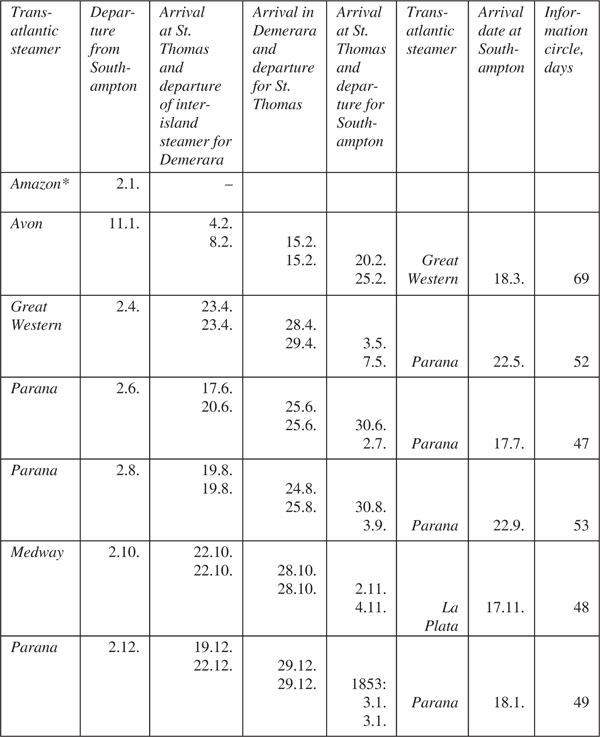
Source: Sailing lists of Kenton & Parsons, 131, 136. – The figures in ‘Information circle, days’’ include one extra day at both ends for the Liverpool – Southampton – Liverpool inland route.
* The Amazon caught fire at sea in the Bay of Biscay on her maiden voyage. She was lost with 115 lives and all mails. Until this disaster, the Admiralty had not approved iron steamers in the mail service, but preferred wood as it was thought it would be better in war service. Now the attitudes changed under the pressure of public opinion, and all mail steamers could be built of iron. See Bushell, 63–71; Nicol, vol.1, 45.
While the peak of the development in mail transmission by steamship was almost reached in the North Atlantic in the 1850s and only minor improvements would take place within the next two decades, there was still much to be done in the West Indian service. A decade later, information circulated between Liverpool and Demerara like this:
TABLE 43. Consecutive information circles between Liverpool and Demerara, enabled by the Royal Mail Line service in 1862.
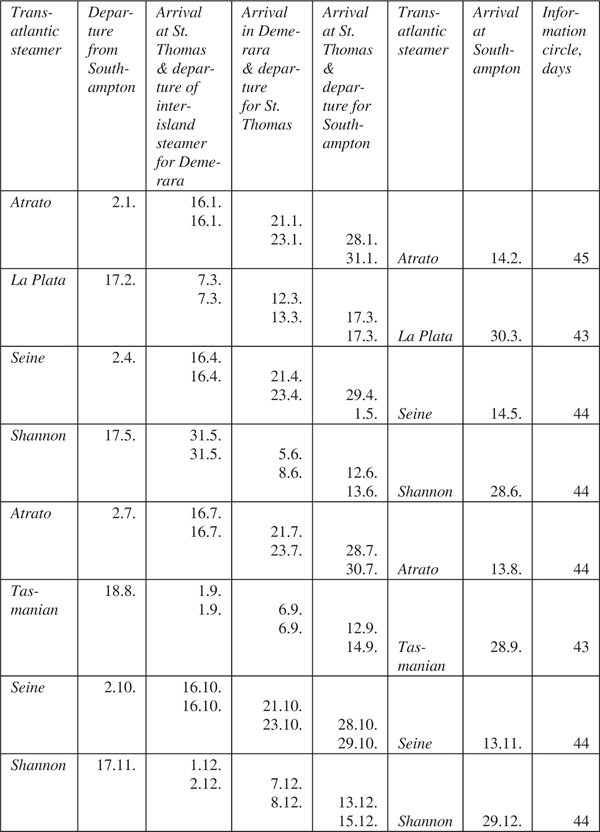
Source: Sailing lists of Kenton & Parsons, 209, 212. – The figures in ‘Information circle, days’ include one extra day at both ends for the Liverpool–Southampton–Liverpool inland route.
MAP 6. Royal Mail Line routes to the West Indies, March 1860.
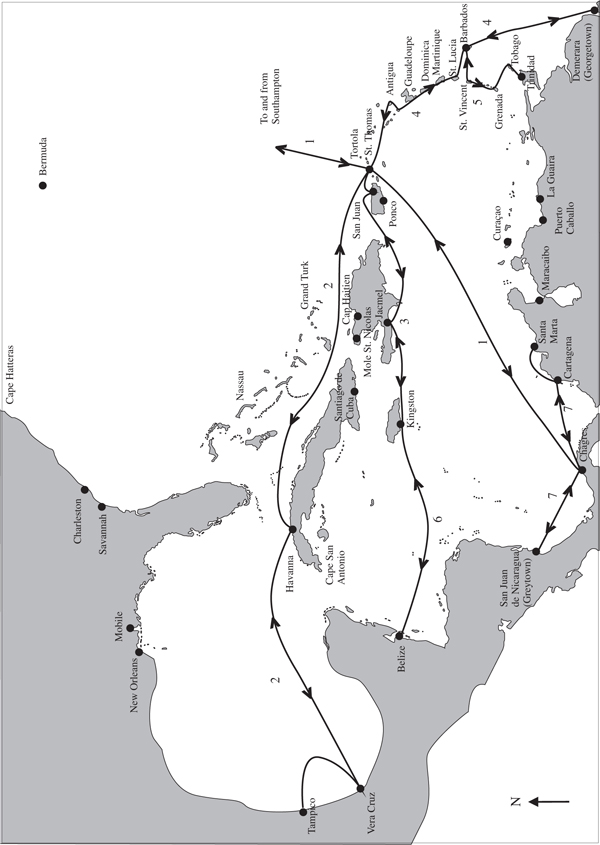
Eight, rather than six, consecutive information circles could now be conducted within a year. The average duration of an information circle was 42 days. The ships departed punctually from Southampton and rather regularly from St. Thomas, depending on the mail arrivals from the different inter-island routes. The arrivals in Southampton were regular within one or two days margin only, and there was at least three days to reply to the letters – a tight schedule, but not impossible.
Merchants could keep contact with their trading partners in the West Indies within 1.5 months rather than two months. The schedules of the Royal Mail Line were nicely organized: the same vessel which took the mails from Southampton sailed back with the answers. While she stayed at St. Thomas, the inter-island vessels collected the mails from the other colonies. Those from Barbados and Demerara could be sent to England by the same vessel, while those from more distant places were sent by later arriving steamers.
The length of an average trip between Southampton and St. Thomas had been shortened by three days to 14.5 days. The duration of the voyage was approximately the same in the other direction. The inter-island trip was about as long as it had been a decade earlier, but the ship now stayed in Demerara for one to three nights, which was a clear improvement.
It can be said that this was the peak of the improvement in information transmission by steamship between Liverpool and Demerara, if measured by information circles. But as in the North Atlantic, some progress could perhaps still be seen in the early 1870s. The number of consecutive information circles did not increase, and in 1872 one sailing was missed in Southampton due to the late arrival of the ship from St. Thomas.656
An interesting change from the shipping management point of view took place in April 1872, when the Royal Mail decided to organize the sailings to and from the West Indies via St. Thomas and Barbados alternately. At that time there was no major difference in the length of sailings to these places, the trip outwards took 13.5 days and homewards less than 13 days on average. For those who lived on the islands, there was naturally a difference whether they received their mails directly or indirectly, which might have been a reason for this arrangement.657
For the business partners in Demerara and Berbice, the arrangement was good news. As can be seen in table 44, there was now finally enough time to answer their letters. The inter-island trip was lengthened by the arrangement but as the steamers were somewhat faster than a decade earlier, the duration of the information circle was approximately one day shorter than in 1862.
TABLE 44. Consecutive information circles between Liverpool and Demerara enabled by the Royal Mail Line service in 1872.
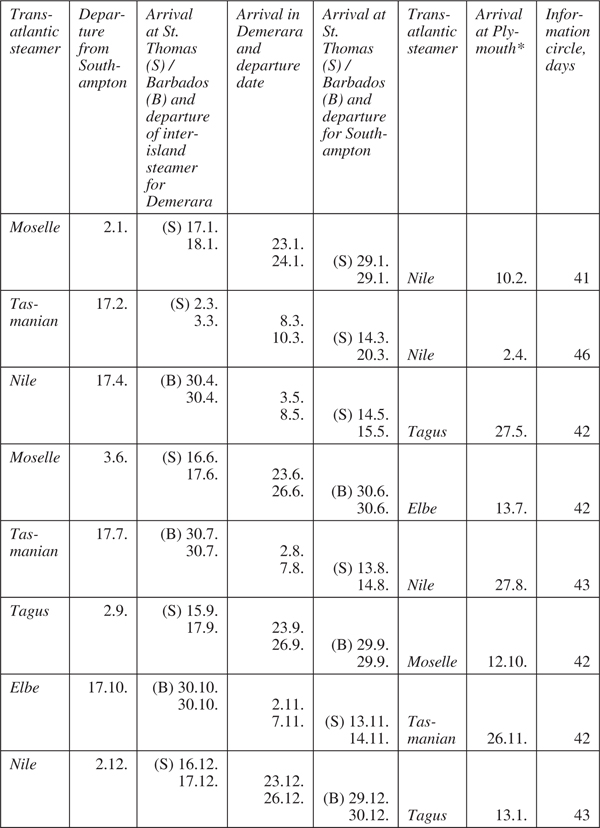
Source: Sailing lists of Kenton & Parsons, 288–289, 295. – The figures in ‘Information circle, days’ include one extra day at both ends for the Liverpool–Southampton –Liverpool inland route.
* Plymouth became the arrival port of the mails in England from October 1867. (Kenton & Parsons, 247)
A brief look at the merchant correspondence of Sandbach, Tinne & Co. and Thomas & William Earle & Co. in 1875–1876 tells that the Demerara letters were normally in Liverpool within 23 days on average, while those from Berbice took a few days longer. Of this small sample of 18 letters, all covers are missing. Not much more information than the dates of writing and the recipient’s markings are available. Most letters are from Demerara, and only two from Berbice. A few interesting details can be picked up, however.658
Firstly, it seems that the letters were not always written while the mail steamer was already waiting at port. Two of the letters were written three days before the steamer arrived, and one letter one day before. Most typical was that the letters were written on the same or the following day after the ship’s arrival, after incoming letters had been received. This happened in 11 cases. The rest of the letters were written just before the steamer departed. In one case the steamer did not stay at port overnight but the incoming letters had to be read and answered during the same day, which was done. And in three cases, the letter had been started on one day and continued on the following one or two days while waiting for the ship’s departure.
At that time, the inter-island service worked rather regularly. The senders in Demerara could know quite exactly when the next mail steamer would depart. The ship to St. Thomas normally departed on the 5th or 6th of each month, and the one for Barbados on the 25th or 26th. The arrivals were more varying. The ships from St. Thomas arrived between the 2nd and 6th, and the ones from Barbados between the 22nd and 26th of the month in question. This factor – as well as the length of each month – may at least partly explain the slight difference between the theoretical and practical information circles.
An interesting thing is that not all the letters arrived by the Royal Mail steamers. At least one of the letters was sent by a merchant steamship (‘per Annan’)659. The letter was written in Demerara on 2 February 1876, just three days before the Royal Mail inter-island steamer Corsica arrived, and departed on the following day. The letter was received by Sandbach, Tinne & Co. in Liverpool on 28 February and answered on the 29th – the same day as the Royal Mail transatlantic steamer Nile arrived at Plymouth. As the cover of the letter is not preserved, no information about the Annan’s arrival port is available but one could expect that she sailed directly to Liverpool or some other nearby port on the west coast of Britain.
There are three more cases where two almost simultaneously sent letters probably have been transmitted by different means. In one of them, the writer states: ‘We enclose copies of our letter yesterday by direct steamer…’660 As there is no sender’s note about a ship’s name and the covers with postal markings are missing, these cases remain unsure. At least one can state that the British government mail was not the only means of communications from Guiana even in the mid-1870s.
One could assume that, as late as in the 1870s when the ships were so much faster than earlier, it would have been possible to organize the schedules to allow enough time to answer the letters at least in Britain. However, there are two cases in the sample of 1875–1876 where the letter arrived in Liverpool on the same day as the next ship departed for the West Indies from Southampton. Additionally, there was one case where the letter had not been answered at all, probably due to the tight schedule.
The phenomenon is familiar from the North Atlantic route. Carrying mail in the 1870s was not as important for the shipping companies as it had been when no other means of communications existed.
As a conclusive example of the development of business information transmission on the West Indian route, one can state that the number of information circles between Liverpool and Demerara, conducted mainly by the British mail services, grew as follows:
TABLE 45. Development of business information transmission by sail and steam between Liverpool and Demerara, 1840–1862.
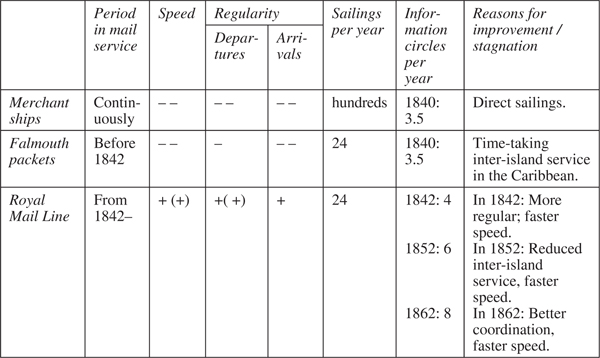
– – = very poor – = poor + = rather good + + = good
The international mail services in the Caribbean region, which started in the early 1860s, will be presented in Chapter VI.3.
The long way to South America
Even if the Royal Mail Line had been ready to take care of the South American mail service in addition to the West Indian mail route right from the beginning, the Admiralty had been wise enough not to give everything to the company simultaneously. A new steamship route to Rio de Janeiro, Montevideo and Buenos Aires was finally included in the company’s mail contract in July 1850. Of the £270,000 government subsidy, £30,000 was related to the Brazil and River Plate route starting from the beginning of 1851. This was the final end of the Falmouth sailing packet service – a decade later than regular steamship service replaced the packets on the North Atlantic and the Caribbean routes.661
The Royal Mail Line had learnt a lot from its earlier experiences, and the technology had improved enough for new challenges. Most of the problems met in the Caribbean could be avoided, timetables could be kept and it frequently happened that the ships arrived at port several days before schedule. This was naturally due to the fact that the company had learnt how to plan the schedules so that the result was positive performance instead of bad reputation. The mail contract also included penalties for delays, which may explain the need for rather loose timetables. And even though the South American route was very long, the system of branch services was simple and easy to manage compared with the West Indian routes.
A Royal Mail steamer left from Southampton for South America on the 9th of each month, or the 10th if the 9th fell on a Sunday. According to schedule, the ship arrived in Lisbon on the 14th or 15th, Madeira on the 18th, Tenerife on the 19th, St. Vincent at Cape Verde between the 23rd and 25th, Pernambuco on the 2nd or 3rd of the following month, Bahia on the 4th or the 5th, and Rio de Janiero on the 8th. She stayed at Rio for approximately four days, departing for the home voyage on the 12th, and was back in Southampton on the 12th of the following month.662 In real life, there were naturally differences in the performance.
TABLE 46. Royal Mail steamship round trips and the length of information circles, Southampton–Rio de Janeiro 1851.
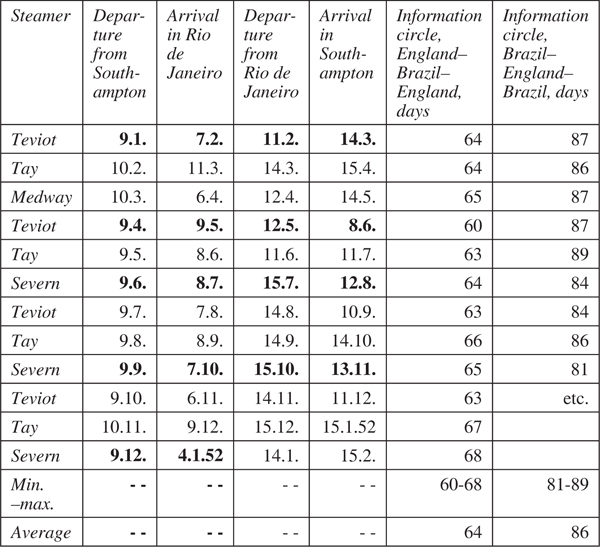
Source: Sailing lists of Howat, 129. – The consecutive information circles enabled by the Royal Mail sailings in 1851 are market in bold. An average outward trip took 29 days, varying between 26 and 30 days, while the homeward trip took 30 days on average, varying between 27 and 32 days.
The improvement in the speed and regularity of the information transmission on the commercially important South America route was notable. While the average voyage from Rio de Janeiro to Southampton by a Falmouth packet had taken 52 days in 1850, the Royal Mail steamers made the same trip in 30 days on average in 1851.663 This was probably one of the most notable improvements in the speed of one-way information transmission during the shift period from sail to steam.
Instead of only three information circles enabled by the Admiralty packets in 1850, the Royal Mail steamers could facilitate 4.5 consecutive information circles between England and Rio de Janeiro in 1851. But this performance was still far from ideal. Even if the sailings were now organized so that the merchants in Rio de Janeiro could reply immediately to their letters, the system did not work in the same way at the other end. As can be seen in Table 46, the steamer to South America had usually just departed a few days before another steamer arrived from there. For this reason, the information circles were three weeks longer from the Brazilian perspective than from the English.
Content removed from the open access version of this book
FIG. 23. The paddle steamer Magdalena was one of the five new vessels built by the Royal Mail Line, when they extended their contract to South America. They were then the largest wooden vessels afloat. After the dramatic fire which destroyed the Magdalena’s sister ship Amazon in 1852 with heavy loss of life, the Admiralty finally admitted that iron hulls might be a safer option. © National Museums Liverpool (Merseyside Maritime Museum).
The duration of the voyage from Buenos Aires to Southampton was shortened by more than a month from 76 days in 1850 to 44 days in 1851. The whole round trip between Falmouth and Buenos Aires had taken 150 days by a Falmouth packet, while the average round trip between Southampton and Buenos Aires by the Royal Mail steamers took 95 days.664 A letter sent from England in the early January got now an answer from Argentina in mid-April instead of late May.
Why was the difference between the round trips by sail and by steam not more than 55 days, even though the duration of the homeward voyage alone had shortened by 32 days? Firstly, the prevailing winds and currents made the sailing homewards from Buenos Aires longer than in the other direction. By sailing ship the difference was nine days on average, as it had been in 1840, but it was only two days by a steamer. Thus the benefit of using steam instead of canvas was greater on the way homewards than in the other direction. Even if the difference was not as notable as on the North Atlantic route, it definitely was relevant.
The mails remained two or three days in Rio de Janeiro before the departure of the branch steamer to Buenos Aires. The ship stayed there one or two weeks to give the merchants time to receive the letters and answer them.665 Back in Rio, there was an approximately four days’ wait before the transatlantic steamer departed with the mails for Europe.666 There were thus three major port stays in South America on the round trip to Buenos Aires (in Rio, in Buenos Aires and again in Rio) while there was only one on the round trip to Rio. The fewer port stays there were, the more efficiency could be achieved by using steam power. The benefits of steam could best be seen on the round trips to Rio de Janeiro. While an average Falmouth packet made a round voyage to Rio in 122 days, the same voyage took an average Royal Mail steamer only 64 days.667
The new route was an immediate success with steadily climbing passenger and freight figures already from the first year. The value of specie carried outwards between June and November 1851 reflected the trend: £35,000, £47,090, £88,000, £73,000, £115,000, and £232,000. In today’s terms, the figures were enormous. The November figure, for example, was four times greater than the value of the steamship carrying it. The valuable freights were mostly investment infusions supporting economic development in South America, in which British business was heavily involved. Nearly £200,000 from the November figure was gold contributed by British business houses towards the foundation of a commercial bank in Rio de Janeiro.668
Although coal still took most of the space, general cargo was also carried from England, mainly in the form of manufactured goods. Homewards, the ships carried gold and silver in minor quantities, diamonds (often to the value of £20,000 to £30,000) as well as coffee and tropical fruits. The number of passengers was normally between 30 and 70 southwards, but rose steadily. In 1855, the totals approached 200, which was close to the limits of the vessels. Already from the start, the homeward lists were better, about one hundred passengers or more. Many of them disembarked at Lisbon, all classes from ambassadors to deported slave-traders.669
In addition to the lack of comfort, the South American ports suffered from political unrest between Brazil, Uruguay and Argentina. In the early 1860s, England and Brazil were close to war, and the port of Rio was blockaded for some time. But the economy of the South American countries grew with the help of foreign capital, mainly British and American, and also French to some extent. Both the ports and the railways were built by foreign funds.670
Some statistics exist on the number of letters carried during the first years. In April 1852, one mail outwards included 3,414 letters to the Brazilian ports (Rio de Janeiro, Pernambuco and Bahia); 1,020 letters to Buenos Aires; 996 letters to Montevideo; 925 letters to the ports on the European side of the Atlantic (Madeira, Cape Verde, Teneriffe, St. Vincent and Lisbon); and 833 to the British Admiral in Rio. Homewards, there were 5,668 letters from the Brazilian ports; 1,794 from Buenos Aires; 1,136 from Montevideo; and 918 from the other ports. In total, the mail steamer carried 7,188 letters on the way to South America and 9,516 letters on the way back home. As this was the only existing mail service to the eastern parts of South America, other countries than the British also used it constantly. In fact, 44.7% of the letters outwards were of foreign origin, and 56.9% of the letters on the home voyage were addressed to other countries than Britain.671
In 1856, the Royal Mail steamers carried 66,252 letters outwards and 80,076 letters homewards on the South American route, as well as 123,408 newspapers outwards and 60,084 homewards. The total number of letters carried via Britain was 146,328 in 1856, and it increased to 242,000 in 1863.672
The Royal Mail steamship service was a great improvement in the communications between Europe and South America. How did the business connections work in practice then? In contrast to the mostly disappeared West Indian correspondence of the British merchant houses, several archives preserve business letters from South America. Eliminating those with no postal markings left, a sample of 253 transatlantic letters from Brazil, Uruguay and Argentina were examined for this purpose.
The letters come from three merchant houses of Liverpool. Daniel Williams was involved in shipping animal products such as salted hides, horsehair and meat from South America to Liverpool, as well as shipping outward cargoes of salt, coal and ironmongery. The letters from six different places in South America have been sent to the company’s office in Liverpool, or to the Artigas villa in Ormskirk, Lancashire, some 15 kilometres outside Liverpool. Most letters of the sample, 211 in total, are from this correspondence between 1854 and 1872.673
Of the other letters, 23 come from the Rathbone Bros & Co.’s correspondence already referred to in the North Atlantic connection. Even if most of the Rathbones’ businesses were connected with trade between Liverpool and New York, they were also involved in the coffee trade from South America to Europe and the United States, and tea shipments to Brazil. The letters are from Rio de Janeiro, Montevideo and Buenos Aires between 1854 and 1872. The third merchant correspondence comes from Henry Eld Symons, of Kirkdale, who was concerned in general trading principally with South America and Australia. The sample includes 19 letters from Rio de Janeiro and Buenos Aires to Liverpool in 1857–1858. Henry Eld Symons died in March 1858, and the correspondence ends in the summer of that year.674
Due to some significant changes in the postal services on the South American route in the late 1850s and 1860, the material has been divided into two: 1854–1859 and 1860–1872. The following table shows the origins of the letters and the time period.
TABLE 47. Origins of the merchant correspondence from South America 1854–1872.
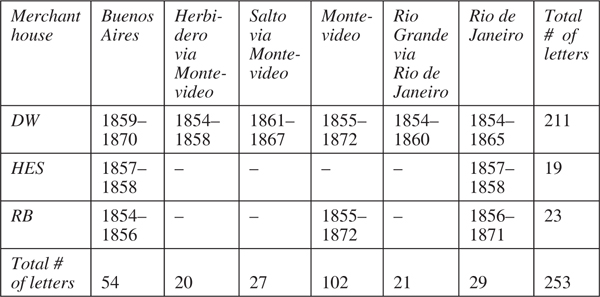
The total numbers of letters from different ports Buenos Aires 54, Montevideo 149 and Rio de Janeiro.50. DW= Daniel Williams, HES = Henry Eld Symons, RB = Rathbone Bros & Co.
Of the 93 letters from 1854–1859 in the sample, 13 were sent from Buenos Aires, 20 from Herbidero via Montevideo, 25 from Montevideo, 21 from Rio Grande via Rio de Janeiro and 14 from Rio de Janeiro. 89 of them were sent by Royal Mail steamers and four by merchant ships.
This sample raises an interesting problem, not widely touched on by historical research. Instead of just concluding that communications was slow at that time, it should be noticed that it was much slower from some places than from others. Daniel Williams could receive several letters in the same day’s mail from South America: for example, one from Herbidero, Uruguay; one from Rio Grande, Brazil; one from Buenos Aires, Argentina; and perhaps one from Rio de Janeiro, Brazil. All these letters had arrived by the same transatlantic steamer from Rio de Janeiro, but it had taken the letter from Herbidero 35 days to arrive in Rio via Montevideo by land and branch steamer, while it had taken the letter from Rio Grande 18 days to arrive in Rio by land, and the letter from Buenos Aires 13 days to arrive in Rio by branch steamer. The letter from Rio de Janeiro had been posted on the same day or the day before the transatlantic steamer departed and it was thus bringing the freshest news.675
In other words, the letters arriving by the same mail steamer could vary very much in age: the letter from Herbidero was more than two months old (in one case in 1855 it was 3.5 months old), the letters from Rio Grande and Buenos Aires were both about 1.5 months old, but the latter was at least a few days fresher; while the letter from Rio de Janeiro was received about one month after it had been written. And this was not the worst aspect of the issue. The letters which had travelled the longest times were answers to letters which had been on the way in the other direction equally long times. Thus, Daniel Williams would have received on 13 April 1856 from Rio de Janeiro an answer to a letter he had written on 10 February, but from Herbidero an answer to a letter he had written on 8 November of the year before.676
It must have been rather confusing to deal with different business partners with different time lags. One can also imagine that some merchants would have been in a clearly better position if they had carried on business with New York, for example, where they could have expected to get answers to their letters in about 25 days at that time. By speedier communications, also capital moved faster in the North Atlantic region than in the South American trade. No doubt, this made the contribution of agents in such places as Rio de Janeiro and Montevideo particularly valuable. They could deal with the inland producers and organize shipping while the letters were on their way to and from Europe.
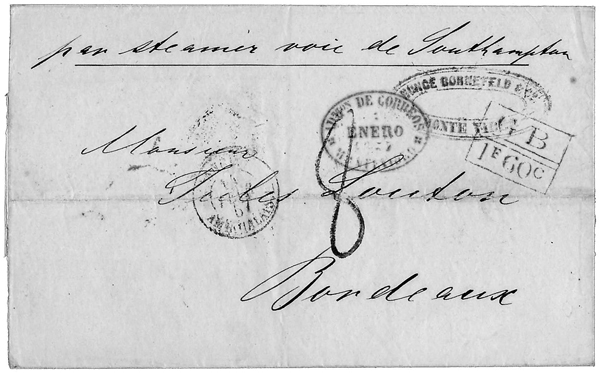
FIG. 24. The letter from Montevideo, Uruguay, dated on 4.1.1857, departed on 5.1. by the Royal Mail Line branch steamer Prince to Rio de Janeiro, and from there on 14.1. by their transatlantic steamer Avon, which arrived in Southampton on 13.2. The letter then continued via Calais and Paris to Bordeaux, arriving there on 16.2.1857 (two of the French handstamps on the reverse). – The rate ‘GB 1F 60C’ was based on the British-French convention which came into force on 1.1.1857.
Even if there was such an improvement in the speed of communications between Europe and South America in the early 1850s, the users of the postal services were not happy. The merchants and bankers from London and Merseyside wrote several memorials to the Post Office about the Royal Mail Line’s schedules. The problem was that, while the incoming letters arrived before mid-month, answers from Britain could be sent no sooner than the 9th of the following month.677 This delayed the information flow by about three weeks. In fact, an information circle from Rio de Janeiro to London and back to Rio took three weeks more time than the circle from London to Rio and back to London despite the fact that the letters were carried by exactly the same vessels.678
The entrepreneurial Liverpool merchants soon made proposals to start a monthly packet service to South America directly from Liverpool. As the Post Office was already paying a subsidy for one such service, it was not eager to make new mail contracts. However, the South American & General Steam Navigation Co. began its operations by four new iron screw steamers between Liverpool and the South American ports in August 1853. These vessels did not carry packet letters, but undoubtedly ship letters to Rio de Janeiro, Montevideo and Buenos Aires. One of the Rathbone letters of the sample of Liverpool correspondence was carried by a ‘Liverpool steamer’ in late 1854, but the service does not seem to have taken any greater role in the mail transport.679
In the following summer, the Post Office finally made a contract with the South American & General Steam Navigation Co. for monthly mail sailings, which would depart from Liverpool on the 24th of each month to avoid conflict with the Royal Mail Line’s sailings. Only four round trips – and those with machine problems and other delays – were made under the mail contract before the company’s ships were chartered to the Crimean war for troop transports, and the service ended without ever starting again. In total, the company undertook only 12 sailings to South America. But as Bonsor puts it: ‘Perhaps this was just as well, however, as no fewer than eight other concerns established lines of iron screw steamers to Brazil between 1854 and 1859 and not one of them remained in operation for more than a year or two.’680
By 1858, perhaps partly due to the pressure of potential competition, the Royal Mail Line could finally offer an accelerated service to the West Indies and South America in a new mail contract. The company agreed to introduce a faster service to Brazil from 9 May 1858 and to the West Indies no later than from 14 September 1859. It also agreed to provide four new iron paddle steamers, three to the West Indian and one to the South American route.681
The faster journeys to South America were achieved by leaving out the stops at Madeira and Tenerife, which were already being served by contract packets on their way from Plymouth to the west coast of Africa, and by increasing the average speed of the steamers to 9.5 mph on the transatlantic route, and to 9.0 mph on the branch route. The ships were now coaling in every port on the route except for Pernambuco and Buenos Aires, instead of carrying heavy loads of coal at the beginning of the journey, and they were thus able to proceed faster.682
One of the main reasons for accelerating the service to Brazil by seven days was to ensure that the correspondence from South America reached Britain in time for a reply to be sent by the Southampton steamer on the 9th of the same month. This improvement in the mail communications was effective for all dispatches for the following 137 months, except for only two occasions when the homeward steamer suffered an accident.683
Table 48 shows the effects on the information circulation in the early 1860s, when the system had been taken fully into use. The duration of the one-way voyages was reduced by only four to five days from the early 1850s, but the number of consecutive information circles increased from four to six per year. The letters could now be replied to within a few days after arrival at both ends of the journey.
TABLE 48. Royal Mail Line steamship round trips and length of information circles, Southampton–Rio de Janeiro, 1862.
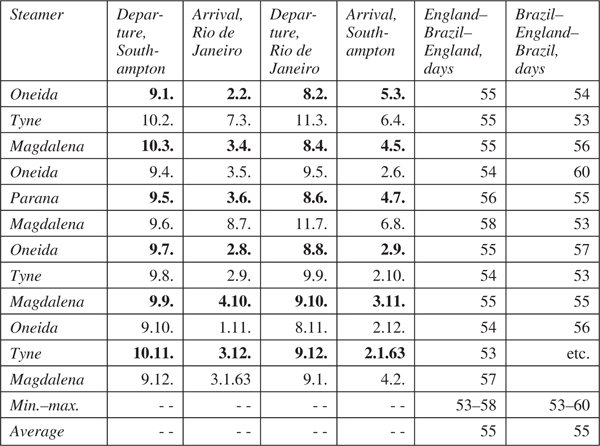
Source: Sailing lists of Howat, 134. – Royal Mail steamers sailed from Southampton on the 10th, if the 9th was a Sunday. An average outward trip took now 25 days, varying between 23 and 29 days, while the homeward trip took 25 days on average, varying between 23 and 26 days.
Table 49 shows a conclusion of the development on the South America route, combining the information of Tables 38, 46 and 48.
One of the interesting details is that the change from sail to steam in 1851 cut the duration of an average information circle by 61 days when looked at from England, but by only 43 days when looked at from Rio de Janeiro. In other words, the length of an average information circle by the very same Royal Mail steamers on the very same voyages was 64 days from England to Brazil and back to England, but more than three weeks longer from Brazil to England and back to Brazil. The problem was caused by poorly matching schedules in England.
By the early 1860s, the length of one information circle could finally be reduced to 55 days on average from the earlier 64 or 86 days. This was possible as the Royal Mail Line steamers could now make their round trips to South America in less than two months. This improvement enabled a system where the next ship for Brazil was still waiting in the port, when the one from there arrived.
This clear change is an extraordinary example of how information transmission could be speeded up without new technological innovations or increasing the frequency of sailings. The new arrangement of the existing schedules increased the number of consecutive information circles per year by no less than one-third.684
TABLE 49. Development of the speed of information transmission between England and Brazil, 1840–1862.
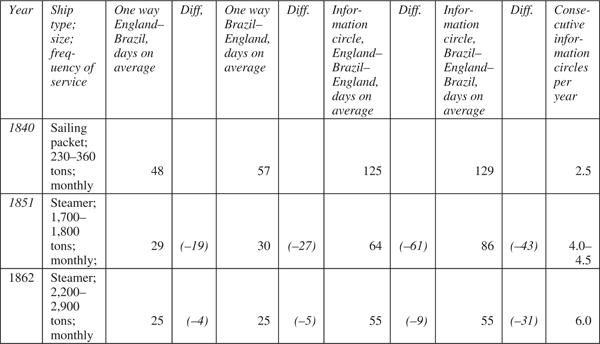
Diff. = Difference in days.
The change can also easily be noticed in the Liverpool merchant correspondence. Instead of the average 31 days before May 1858, letters from Rio de Janeiro were arriving three or four days faster after that date. And the letters from Rio Grande, which had earlier been transmitted in 50 days on average, were delivered in 40 days. Most probably, the inland connections between Rio Grande and Rio de Janeiro had also been improved at that time.685
International Competition and the Influence of the Telegraph
The French postal services, the West Indies and the Spanish Main – The French postal services, South America – The Panama route – International competition and the introduction of the telegraph in the West Indies – International competition and the introduction of the telegraph in South America
The French postal services, the West Indies and the Spanish Main
As was noted in the context of the North Atlantic mail services, the French model of a government-subsidised mail system was based on different geographical thinking from the British. Instead of one shipping line operating on the North Atlantic route (the Cunard Line), one on the West Indian & South American routes (the Royal Mail Line), and one on the East Indian and Australasian routes (P&O), the French model was the following: the North Atlantic and West Indian mails were taken care of by one and the same company, Compagnie Générale Transatlantique, or the French Line, and the South American and Far Eastern routes were taken care of by another, Compagnie des Services Maritimes des Messageries Impériales. Later, other companies also joined the system.
The French Line started their contract mail service for Vera Cruz in the early 1860s urged by the government during a military expedition to Mexico.686 The first French mail steamship service of 1862–1865 operated between St-Nazaire, close to Nantes on the western coast of France, Fort-de-France at Martinique, Santiago de Cuba, and Vera Cruz. The service was carried out once a month by a fleet of four iron screw steamers of 1,700 to 1,900 tons. Two of them, the Tampico and the Vera Cruz, were purchased from the former South American & General Steam Navigation Co. of Liverpool.687
Even though the French started their mail operations by steamship in the Caribbean 20 years later than the Royal Mail Line, they could not at once build a well working schedule for information transmission. A pick-up from the sailing lists of Salles gives us the following results for the first whole year of operations on the new route:
TABLE 50. Round trips and consecutive information circles on the St-Nazaire–Martinique–Vera Cruz–St-Nazaire route enabled by the French Line service, 1863.
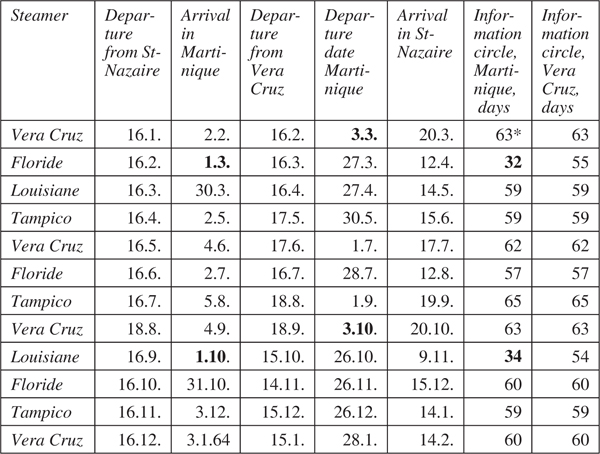
Source: Sailing lists of Salles, Tome IV, 25. – In most cases, the ship homewards had already departed from Martinique when the mail steamer from St-Nazaire arrived.
* The Louisiane had departed from Martinique on 28.1.1863 and the answers for the letters which arrived on 2.2. had to wait until 3.3. – if not sent by e.g. the Royal Mail Line from some other island.
For military operations it was probably enough that a regular service was conducted by fixed monthly departure dates from both terminal ports. In fact, an average trip from Vera Cruz to St-Nazaire by the French Line – 29.4 days – took just about two days longer than the trip from the same port to Southampton by the Royal Mail Line.688 As the average round trip to Vera Cruz by the French Line took almost exactly 60 days, the risk of missing the opportunity to send an answer from France by the following steamer was great. In several cases the ship had already departed when the letters from Mexico arrived. The Royal Mail Line made the round trip to Vera Cruz in 57.5 days on average, which allowed the merchants two to five days time to send their answers by the next steamer – a rather tight schedule, but obviously possible to manage during the time of the railways.689
Even though the difference in speed was not remarkable between the two shipping companies, the Royal Mail Line could afford six annual information circles to Vera Cruz, while the French Line enabled only five.
The merchants at Martinique – and those in France who traded with that colony – were in an underprivileged position. Even if the sailings to Martinique were made in 16.5 days on average in both directions, the answers had to wait for three to four weeks at the island and more than two weeks on average in France due to the schedules. The unpredictability of the service must have been even more irritating from the businessmen’s point of view. At Martinique, the average waiting time was 26.6 days. In two cases the earlier ship was delayed and the answers to France could be sent within two days of the mail’s arrival. In St-Nazaire, the time available for answers could be anything between one and 32 days – and it was.690
The information circles between Martinique and the mother country depended on the sailings from Vera Cruz, and most often the information circulation was equally slow to both places. The average length of an information circle to Vera Cruz was 59.7 days, and to Martinique 56.1 days, thanks to excessively delayed ship departures. The Royal Mail Line did not have sailings to Martinique at that time but the nearby Barbados could be reached almost as quickly, in 17.3. days on average. Due to the bi-monthly service and matching schedules, the Royal Mail Line could afford eight annual information circles to Barbados compared with the French Line’s five to Martinique. Even if the Royal Mail Line had had a monthly service only, it would have enabled six information circles between Britain and Barbados.691
What did the merchants on Martinique do in this situation? They sent their letters by the Royal Mail Line steamers, as they had done earlier. A letter in the writer’s collection was sent from St. Pierre, Martinique, on 10 September 1863 to Agen, France by the Royal Mail steamer Tasmanian, which departed from St. Thomas on 13 September and arrived in Southampton on the 28th. It was carried by train from Paris to Bordeaux and from there to Toulouse on the 29th, and it arrived in Agen on 30 September – three days before the French mail ship would even have departed from Martinique.692
It did not take long, however, before the French rearranged their mail service. In August 1865, the system was thoroughly changed and the main problems solved. This was a similar overnight change to the Royal Mail Line’s a few years earlier. One can only wonder why the system was not better organized from the very beginning. According to Salles, the mail route was improvised in a hurry to serve the military operations in Mexico.693 The new system included several mail routes. There were two monthly sailings from St-Nazaire: one for Vera Cruz and the other for Colon–Aspinwall. Additionally, there were several branch routes. At least the sailings to the terminal ports were now organized comme il faut.694
The new arrangements on the Mexico route included the transformation of the French mail centre from Martinique to St. Thomas, which was located further westwards and thus closer to Vera Cruz. All the three steamers were changed to new and larger ones. The Impératrice Éugenie and the Panama were iron paddle steamers of 3,400 tons each, and the France was an iron screw steamer of 3,200 tons.695 These changes shortened the sailing time in each direction by a couple of days and enabled earlier departures from Vera Cruz. The length of the round trip was thus reduced from 59.7 to 54.4 days. The extra five days gave the French merchants time to answer their letters immediately and by this means increased the number of consecutive information circles between France and Vera Cruz from five to six per year. By these changes, the French mail service achieved the same efficiency and speed on the route as the British.
TABLE 51. Round trips and consecutive information circles on the St-Nazaire–Vera Cruz–St. Thomas–St-Nazaire route enabled by the French Line service, 1866.
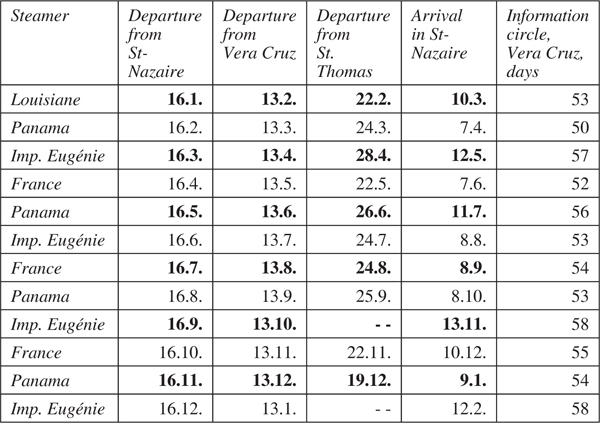
Source: Sailing lists of Salles, Tome IV, 105. – The bold figures show an example of how the six consecutive information circles could be achieved during the calendar year.
As the sailing date of the Royal Mail Line was on the 2nd of each month and the French Line’s on the 16th, the frequency of business communications with Mexico actually doubled. There were now 24 annual mail sailings in total from Britain and France. This did not increase the number of matching information circles, however. The voyage was so long, and the stays at port in Europe as well as Mexico so short, that the other shipping company could never offer a faster alternative to send a letter. An example: a Royal Mail steamer departed from Southampton on 2 April 1866, arriving at St. Thomas on the 16th. The branch steamer for Mexico left on the next day and arrived in Vera Cruz on 28 April. She departed with answers to the letters on the 30th. The fact that also a French Line steamer visited Vera Cruz in the mid-month and would be there again in mid-April did not affect the British communications in any way. The same was evident in the French communications respectively.696
Thus there were two simultaneous information circulation processes which never met each other. However, the positive effect of more frequent service was undoubtedly greater than the harm caused by the slow sailings. The concrete advantages of such a double system on a long mail route will be presented in connection with the introduction of the French services on the South Atlantic run, where a similar arrangement had taken place a few years earlier with good results.
The French branch services suffered from mismatching internal schedules just like the British services had done years ago. Martinique is a good example. The island was now served as part of the other long mail route from St-Nazaire to Colon–Aspinwall.697 Since the railway between Colon and Panama had been opened in 1855, several shipping companies had been willing to take their part of the business. The Panama mail route will be examined more closely later in this chapter. In this connection, it is probably enough to state that the round trip between St-Nazaire and Colon via Martinique took 50 days on average, which was an appropriate time to enable six consecutive information circles per year. The ships called at Fort-de-France en route in both directions. And more than that, there was a branch steamer operating between St. Thomas and Fort-de-France to facilitate a bi-monthly service to Martinique. When the transatlantic steamer for Vera Cruz arrived from St-Nazaire to St. Thomas, the mails were taken to Martinique and Guadeloupe by an auxiliary ship, and the answers were carried to St. Thomas two or three days before the main steamer’s return.698
The transatlantic steamers departed from St-Nazaire on the 8th and 16th of each month.699 According to the new schedule, Martinique received the mails from St-Nazaire on the 3rd as well as the 22nd or 23rd of each month, and the mail steamers left towards St-Nazaire from the island between the 7th and 9th, as well as on the 18th of each month.700 This was somewhat impractical as there were now two incoming mails after each other without any outgoing, and vice versa. Table 52 shows the problem clearly.
Even if a bi-monthly service now existed for Martinique, it was only a partial improvement from the business information transmission point of view. The earlier 56 days long information circles were now reduced to 46 days on average. But the length of the circles varied between 37 and 57 days, and even the average lengths of them varied from 41 to 50 days depending on the original departure date – the 8th or 16th. The letters sent from St-Nazaire on the 16th by the French Line steamer to Vera Cruz could be answered rather quickly at Martinique by sending the letters to France by the steamer which was on its return voyage from Colon. This did not work vice versa, however. The company made the needed changes in the schedules as late as 1872, thus finally enabling eight consecutive information circles by the French service between St-Nazaire and Martinique.701
The French mail services mainly overlapped with those of the British instead of complementing them. Yet the departure from St. Thomas for St-Nazaire on about the 24th of each month was appropriately between two Royal Mail Line departures (which took place at about the middle and end of the month) thus speeding up the correspondence from St. Thomas to Europe by a few days.702
In 1872, the French Line changed its departure dates from St-Nazaire to Colon from the 16th to the 20th of each month. This also caused a change at the other end: the ships started to leave from St. Thomas later in the month, almost simultaneously with the Royal Mail Line.703 As a result, the French Post Office probably lost many of their British customers as the service was of no use for them any more. This was the price paid for getting the mail system to work better at Martinique. It was a never-ending problem in the Caribbean to keep everybody satisfied on the different islands.
TABLE 52. Round trips and information circles enabled by the French Line service to Fort-de-France, Martinique, 1866.
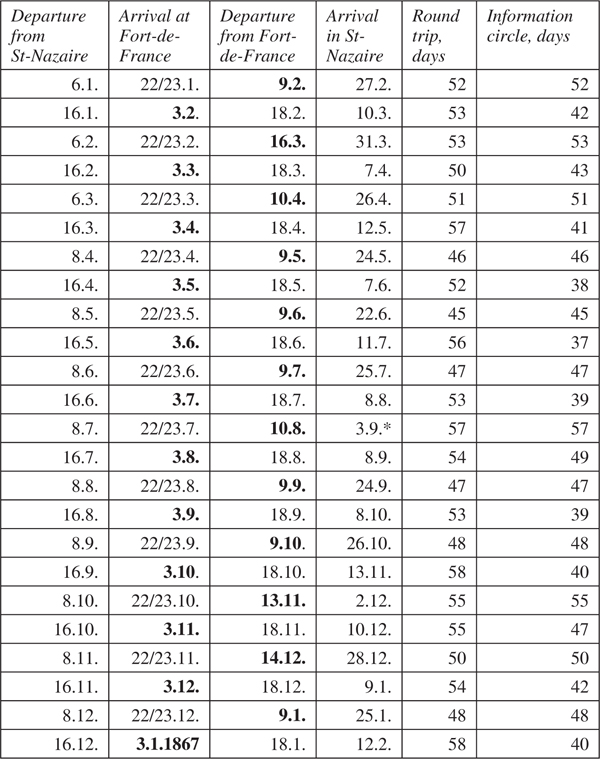
Source: Sailing lists of Salles, Tome IV, 79, 105, 168. – All the arrival dates at Fort-de-France (the 22nd /23rd & 3rd) as well as the departure dates of the 18th from the same port are scheduled dates published by Salles, not the implemented sailing dates. This has no relevance in the issue, however. The arrivals and departures printed in bold are those where a faster departure could have been of benefit: the letters which arrived on the 3rd could have been answered already on the 9th of that month by the other route’s service homewards.
* The delayed arrival was due to the Louisiane being quarantined in Corunna during the home voyage. (Salles, Tome IV, 79)
The French postal services, South America
On the South American route, the French Post Office’s invasion started already in 1860 – in reverse order compared with the British mail services which had started on the West Indian route a decade earlier than they entered South America. The contract was given to the well known French shipping company, Messageries Impériales, which already operated from Marseilles on the Mediterranean mail routes with no less than 57 ships. The new route to Rio de Janeiro, with a branch service to Montevideo and Buenos Aires, used Bordeaux as the terminal port instead of Marseilles, however. For this service, the company received an annual subsidy of 4,700,000 francs.704
The service started in May 1860 with no major problems. The first four steamers employed on the transatlantic route were all purpose-built and new: The Béarn, Estramadura, Guienne and Navarre were all 1,900 to 2,400 tons iron paddle steamers, later converted to screw. The branch steamer Saintonge carried the mails from Rio to Montevideo and Buenos Aires. The system was copied from the British, without unnecessarily repeating their mistakes, as the French Line had done in the Caribbean. From the first year, Messageries Impériales operated in a very proper way, departing from both Bordeaux and Rio on the 25th of each month, and arriving at the other port on about the 20th of the following month. The departures were punctual, and the arrivals at Bordeaux were more often early than late.705
A comparison between the Royal Mail Line (see Table 48) and Messageries Impériales services to Rio de Janeiro, with the year 1862 taken as a random example, shows that there was no major difference in their operations.
It can easily be noticed that, by the early 1860s, technological development and the ability to set up effective logistic networks had reached a point where regular, relatively fast and reliable communications were the norm. Both companies made their round trips in 55 days on average, which was in line with their contracts.706
This did not mean that all uncertainties had been washed away. The arrival dates were not always as scheduled, but varied to some extent in both directions. For example, in 1862, the duration of the journey from Rio de Janeiro to the European terminal ports varied between 24 and 27 days if made by Messageries Impériales, and 23 and 26 days if made by the Royal Mail Line.
TABLE 53. Round trips and consecutive information circles enabled by Messageries Impériales service to Rio de Janeiro, 1862.
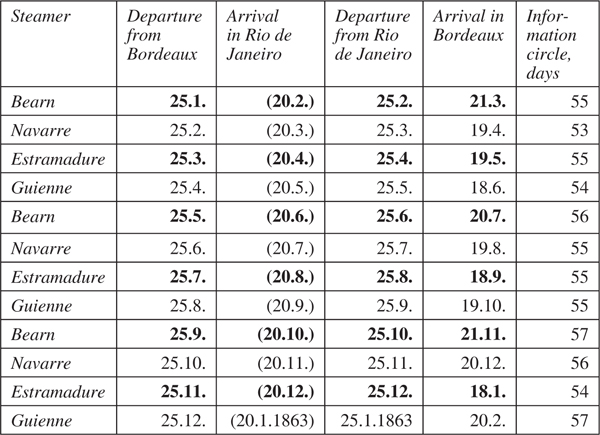
Source: Sailing lists of Salles, Tome III, 24–25. The arrival dates in Rio de Janeiro are scheduled, not necessarily applied arrivals. The normal variance can be seen when comparing these dates with the arrivals in Bordeaux.
Whereas many trips were made faster than scheduled, real delays were scarce. However, due to the long sea route across the stormy Atlantic and the fact that the average travel speed of the small vessels was still only nine or ten knots, variations obviously occurred.
Inland trips did not cause major delays to information transmission in Britain or Central Europe at that time, even if they certainly did in Uruguay or Brazil. The railways took the mails from Southampton to London or Liverpool on the same day, and from Bordeaux within two days. If the mail ship arrived in the evening, the dispatch of the letters took place on the following day.
Messageries Impériales organized their schedules from the beginning in the way that maximized the benefits of the doubled service from the users’ point of view. As the Royal Mail Line steamers departed from both ends of the voyage on the 9th, there was a good two weeks’ difference between the French and the British services. For business communications it was sensible to use both of them, and the French mail steamers soon carried a good proportion of mails also to Britain.
The Liverpool merchant correspondence gives concrete evidence for this. Of the 160 letters sent from South America between 1860 and 1872, 84 were carried by the Royal Mail Line and 68 by Messageries Impériales. In addition, eight letters were transmitted by two later established British mail contract lines.707
TABLE 54. Merchant correspondence from South America by period and mail-carrying shipping company, 1854–1872.
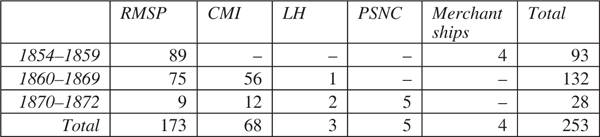
Source: Correspondence of Daniel Williams, DB/175. (MMM); and Rathbone Bros & Co., RT XXIV.2.36. (SJ); Accounts and papers of Henry Eld Symons, 380 MD. (PRO).
RMSP = Royal Mail Steam Packet Co., or Royal Mail Line; CMI = Compagnie Messageries Impériales; LH = Liverpool, Brazil and River Plate Steam Navigation Co (better known as Lamport & Holt); PSNC = Pacific Steam Navigation Co.
It seems that, although the business contacts of the British used the French services in all the South American ports, it was especially the mails from Montevideo that were often carried by the steamers of Messageries Impériales. The Uruguayan business partners of Daniel Williams used the French mail service for letters sent not only from Montevideo, but also frequently from Salto, a city located up the River Uruguay, about one week from Montevideo. Additionally, the Rathbone Bros Co. received letters from Montevideo by French steamers.
TABLE 55. Merchant correspondence from South America by port of departure and mail-carrying shipping company, 1854–1872.
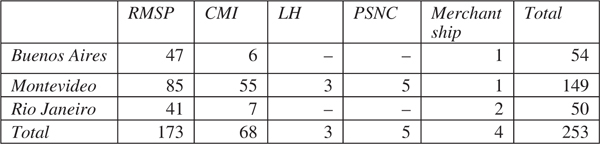
Source: Correspondence of Daniel Williams, DB/175. (MMM); and Rathbone Bros & Co., RT XXIV.2.36. (SJ); Accounts and papers of Henry Eld Symons, 380 MD. (PRO).
RMSP = Royal Mail Steam Packet Co., or Royal Mail Line; CMI = Compagnie Messageries Impériales; LH = Liverpool, Brazil and River Plate Steam Navigation Co. (better known as Lamport & Holt); PSNC = Pacific Steam Navigation Co.
Due to the length of the journey, the double service did not improve the number of consecutive information circles within a calendar year. As on the Mexico route after 1865, the two mail services – even if working well separately and complementing each other in the best possible way – could not do more than they did.
During the years of the American Civil War, coastal services between South America and the United States were restricted and uncertain. The best way to send letters between e.g. Buenos Aires and New York was twice across the Atlantic.708 The writer’s collection includes two letters which have been sent by this means. A letter from Buenos Aires on 1 March 1862 to New York was late for the same day’s Royal Mail sailing to Southampton, and was carried by the Saintonge of Messageries Impériales, departing on 14 March to Rio de Janeiro, and from there on 25 March by the same company’s Navarre, which arrived at Bordeaux on 19 March. The letter was taken via London to Queenstown and on 24 April by the Inman Line’s Edinburgh to New York, where it arrived on 6 May 1862.709
Another letter from Buenos Aires on 14 August 1862 to New York was carried by the Saintonge to Rio de Janeiro and from there on 25 August by the same company’s Estramadure, which arrived at Bordeaux on 18 September. The letter was carried from Queenstown on 21 September by the Cunard Line’s Europa to Boston and by railway to New York, where it arrived on the same day, 2 October 1862.710
The Panama route
The Panama route was a specific case from the very beginning. The interest in developing communications with the Pacific coast had arisen simultaneously with the recently achieved independence of the South American countries in the early 1820s. A six-month return of 1823 shows that 31 British and 33 American ships visited the port of Valparaiso, Chile, during the period. Additionally, several other ships calling at the port were British owned and manned, even if operating under the Chilean flag. Of the British ships, no less than 18 came from or sailed to Liverpool, and only one was bound to London. This trend continued in the following years. All the ships sailed to Britain via Cape Horn. The home voyage took four months on average.711
Doublet records several options for mail routes in the 1820s or early 1830s between the west coast of South America and Europe. Undoubtedly, all these routes were slow and the communications were unreliable. Letters from Chile in particular could be sent by the following ways:
- northwards by sea, usually by private ship, to Panama, taken over the isthmus to Chagres to connect with the West Indian service of the Falmouth packets
- southwards by private ship via Cape Horn to Buenos Aires and then by ship to Rio de Janeiro to connect with the South American service of the Falmouth packets
- by private ship all the way. If the ship was from the United States, the letters were usually transferred at an American port to a ship bound for Britain
- by British warships of the Pacific squadron returning to or coming from Britain. French and American naval vessels were used similarly by their own nationals.
- overland via Mendoza to Buenos Aires and then by private ship or packet to England.712
The connection with the Falmouth packets at the West Indies has not been examined by historians and very little is known about it. Pawlyn mentions that the Jamaica service was extended to include Cartagena ‘near Panama’ in 1825, and Britnor notes that in 1838 H.M.B. Hornet was employed as a branch packet boat between Jamaica and Chagres.713 Whether there was any other service between Cartagena and Chagres than private ships before 1838 is not known.
The route via Panama was apparently not much used by the countries south of Callao (near Lima in Peru) due to the very long voyage and the strong Humboldt stream. The passage from Falmouth to Chagres took 45 days. No less than 23 days were counted for unloading the goods, procuring mules for the land journey to Panama, and the reloading and detention of vessels due to the dilatoriness of the Custom House officers and people. The voyage from Panama to Callao took 35 days and to Valparaiso against the monsoon 22 more days – in total 125 days .714
The Panama overland route, although much shorter than its eastern counterpart between Alexandria and Suez, presented far greater difficulties. Instead of the flat country of a river delta, the Isthmus of Panama consisted of a rugged central mountain range with outlying hills, densely covered with tropical forest, gradually descending to sea level. Rivers were shallow and there were no roads. The ravines and luxuriant undergrowth were breeding grounds for fever-carrying mosquitoes. Mails, goods and travellers used dugout canoes on the waterways, and mules where the water courses were not available. The less than fifty miles passage over the isthmus took an average of four days from Chagres to Panama and two days in the reverse direction, but in the rainy season the journey could take much longer.715
The other existing connection with the official mail service was not much easier. The Falmouth packet branch route from Rio de Janeiro to Buenos Aires included a leg over the Andes to Chile and Peru from 1824, when Buenos Aires and Montevideo were included in the South American service. The route across the Andes would take 14 to 18 days from Buenos Aires to Santiago depending on the season. In early 1829, the service was totally closed following ‘clashes between conflicting parties and predatory Indians’. The route was not re-opened before 1832, and it was still reported to be ‘very irregular’ in 1837.716
In addition to these arrangements and the use of men-of-war, merchant ships were continuously used as mail carriers. As Doublet puts it, ‘merchants, private or persons in official positions used any available ship to convey mail to Europe’.717
In these circumstances the Pacific Steam Navigation Company started its operations between Panama and the young states on the west coast of South America. The aim was to arrange monthly communications between Panama and Valparaiso by two steamers, calling at the somewhat exotic intermediate ports of Coquimbo, Huasco, Copiapo, Arica, Islay, Pisco, Callao, Huanchaco, Lambayique, Payta, Guayaquil and Buenaventura. The company, established in London in 1838 and granted a Royal Charter in 1840, was given a mail contract by the British Post Office for five years in 1845, with a fixed annual subsidy of £20,000.718
This was the only mail contract in the history of the British Post Office for vessels which actually had nothing to do with Britain – they did not touch any British or imperial colonial port. The value of the postage was so small that it covered only a fifth of the subsidy. A Committee Report inspecting contract packets stated in 1853: ‘The extension of British influence and British commerce appears to have been the chief inducement for supporting this communication between the republics of New Grenada, Bolivia, Peru and Chile...’719
The mail service of the Pacific Steam Navigation Company was closely connected with the Royal Mail Line’s service to Chagres, which started in 1842 along with the other new West Indian routes. Cartagena, Chagres and San Juan de Nicaragua were served by the same branch steamer from Kingston, Jamaica. Cartagena was also a part of another branch line from Curaçao, which was served by a triangle line from Barbados–Grenada as well as St. Thomas. The mails for Chagres could thus arrive at Cartagena by two different routes, but as they all arrived from Europe by one and the same ship, this was no particular benefit. In October 1842, this overlapping service was deleted from the company’s route map.720
The published sailing lists do not enable any deeper examination of the early schedules of the Royal Mail Line’s service to the isthmus. One round voyage of early 1843 can be picked up as an example:
TABLE 56. Royal Mail Line, round trip Falmouth–Chagres, January–April 1843, an example.
| Port |
Arrival |
Departure |
Comments |
| Falmouth |
|
4.1. |
Falmouth–St. Thomas (main route out) |
| St. Thomas |
27.1. |
27.1. |
St. Thomas–Kingston (route 6) |
| Kingston, Jamaica |
30.1. |
1.2. |
Kingston–Chagres–Kingston (route 10) |
| Chagres |
12.2. |
16.2. |
|
| Kingston, Jamaica |
28.2. |
2.3. |
Kingston–Havana–Bermuda (routes 6 & 6b) |
| Havana, Cuba |
6.3. |
9.3. |
|
| Bermuda |
15.3. |
18.3. |
Bermuda–Falmouth (main route return) |
| Falmouth |
2.4. |
|
|
Source: Sailing lists of Kenton & Parsons, 25–27, 31–33.
The trip from Falmouth to Chagres by the Royal Mail steamers, using a combination of four different mail routes, took 39 days – six days less than by the Falmouth sailing packets. The journey from Chagres to England was even longer, taking 45 days. In addition to the transit ports named in the table there were several others where the ships called at briefly on the way. The following ports were called at during the round trip: (Southampton –) Falmouth – Madeira – St. Thomas – Jamaica – Santa Martha – Cartagena – Chagres – Cartagena – Jamaica – Cape San Antonio – Havana – Bermuda – Fayal – Falmouth ( – Southampton). The mails waited at different ports for ten days in total, in addition to the four days stay at Chagres waiting for the mails from the Pacific. Thus, of the 88-day-long round trip on the Atlantic side of the voyage, 14 days were spent at port and 70 at sea.721
There is no published maritime intelligence on the Pacific Steam Navigation Company’s early sailings. A record from 1846 notes that the new Ecuador sailed from Panama on 25 May and arrived at Callao on 6 June, proceeding on 18 June and arriving at Valparaiso on 24 June. Thus the sailing down to Chile took no more than a month with the stops included.722 The Postmaster General’s announcement of the PSNC contract in 1846 informed the public that mails for the ports at New Grenada, Ecuador, Peru, Bolivia and Chile would be made in London on the 17th of each month, and that the steamship from Panama would be ready to leave with the mails on the Pacific side approximately on the 23rd of the following month.723
At that time, it took the Royal Mail steamers 33 to 35 days to arrive at Chagres from Southampton. The Ecuador’s sailing matches well with the Postmaster General’s announcement. The Atlantic mails arrived at Chagres on 20 May and it seems that they were taken across the isthmus in five days – quite an improvement compared with the description of earlier times. Probably the explanation is that mails and passengers were easier to take across the isthmus than any normal cargo. Loading and unloading did not take much time and the customs officials had less to say. It was also easier to organize the inland trip on a regular basis.
To conclude, it seems that the steamships operating jointly on the Atlantic and Pacific mail routes managed to reduce the duration of information transmission from England from the earlier four months (or more) to 50 days for Callao and 68 days for Valparaiso. Instead of the fewer than 1.5 consecutive information circles that were possible earlier, two full circles could now be conducted each year with rather good regularity.
There was a growing interest in the isthmian route also in the United States. The west coast of North America had been part of the United States from the mid-1840s after the Oregon boundary dispute with Canada and the war against Mexico, and the gold rush to California started in 1849. As the transcontinental railway was not yet built, the easiest way to reach San Francisco was along the two water routes on both sides of the isthmus.724
The traffic across the isthmus increased rapidly, so much that in 1850 a group of New York investors began the construction of a railway from Chagres to Panama City. According to Bushell, the Royal Mail Line also contributed with a remarkable sum. The railway was completed in 1855. Chagres was replaced by a more modern port slightly to the east, named Aspinwall by the company which built it, but later known as Colon.725
The American coastal services by steamship consisted of four principal routes: the Panama route to California from New York and New Orleans via Cuba or direct to the isthmus; the New Orleans and Vera Cruz route; the Charleston and Havana route; and the New York and Brazil route which was inaugurated as late as 1865.726
The service between New York and Chagres was started in December 1848 by a U.S. Postmaster General mail contract. The purpose-built steamers entered the service in September 1849 and January 1850. The United States Mail Steamship Company mail contract was for ten years and was extended for one year in 1858. At the conclusion of its contract, the company withdrew from the Panama route and it was taken over by the Pacific Mail Steamship Company and the Panama railroad, which formed the North Atlantic Steamship Company to operate a line between New York and Colon.727
The Pacific Mail Steamship Company – not to be confused with the British Pacific Steam Navigation Company which operated from Panama southwards – operated between Panama City and San Francisco, with various calls at Acapulco, Manzanillo, San Blas, and Mazatlan in Mexico and San Diego and Monterey in California. The service started in February 1849. After 1851, usually only one stop was made at either Acapulco or Manzanillo. This speeded up the voyage.728
An interesting comparison can be made from the report of the U.S. Postmaster General in 1853. The different mail routes between New York and Colon, a distance of 2,000 miles with twice-a-month service, received a total annual subsidy of $290,000. The service between Panama City and San Francisco, a distance of 4,200 miles with a twice-a-month service in each direction, received $348,250. And the Panama railroad, even if not yet fully completed, received an annual subsidy of $95,335. Thus the whole service between New York and San Francisco cost the U.S. government $733,585 in total. This payment covered a twice-a-month (24 round trips) mail service along a route of no less than 6,200 miles by steamship plus the railway costs. In the same year, the Collins Line received $858,000 on the North Atlantic route for 26 round trips between New York and Liverpool, a distance of 3,100 miles.729 The extra cost for showing national pride on the North Atlantic route was high indeed.
How did the American mail service work between New York and San Francisco in the early 1850s? Table 57 shows the consecutive information circles enabled by the combined service in 1851.
TABLE 57. Consecutive information circles enabled by the American mail service from New York to San Francisco via Panama, 1851.
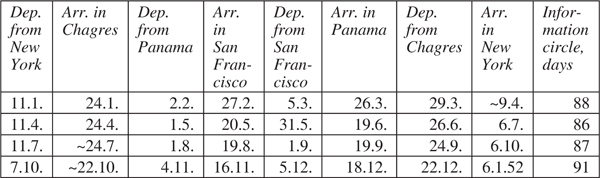
Source: Sailing lists of Wierenga, 321–322, 341–342. ~ marked are estimates.
The mail service between New York and San Francisco via Panama was quite efficiently organized in 1851, when taking into account that it was a combination of two different steamship services and a non-completed railway. It took 88 days on average to receive an answer from San Francisco to a letter written in New York. The schedule seems tight at the New York end, but it probably worked as the system was not changed.
Within a few years, business information transmission by this route improved in a most admirable way:
TABLE 58. Consecutive information circles enabled by the American mail service from New York to San Francisco via Panama, 1856.
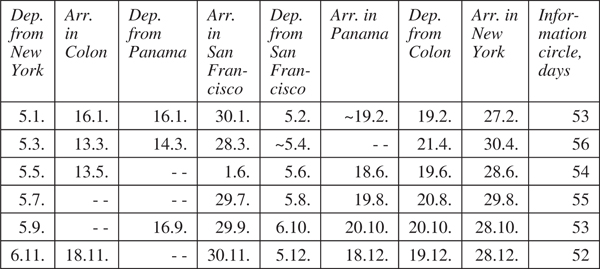
Source: Sailing lists of Wierenga, 325–326, 352–354. ~ marked are estimates.
Instead of 88 days in 1851, an information circle could now be accomplished in 53.5 days on average. The service enabled no less than six information circles per year instead of only four a few years later.
The length of the sailings had been shortened by reducing the number of the ports of call and by replacing old steamers with new ones. The completion of the Panama railway in 1855 was an important part of the achievement. The New York Herald noted on 17 April 1855 under the headline ‘Efficiency of the Panama Railroad’ that the captain of the steamer John L. Stephens, off San Francisco on 16 March, had sent the following message for Messrs. Forbes and Babcock, Agents Panama Mail Steamship Company, San Francisco: ‘I left Panama with my command at 7 30 P.M. of the 20th inst. With 266 (256?) mailbags, 421 passengers, 620 packages of freight, and three horses, all of which were on board and the ship under weigh in ten hours from Aspinwall. R.H. Pearson.’730
European letters to California could be sent by a Royal Mail steamer from Southampton via St. Thomas to Colon, across the isthmus and by the American mail service to San Francisco. Another option was to send the letters across the North Atlantic by a Cunarder or by some other mail service, and then by the American coastal services via Panama.
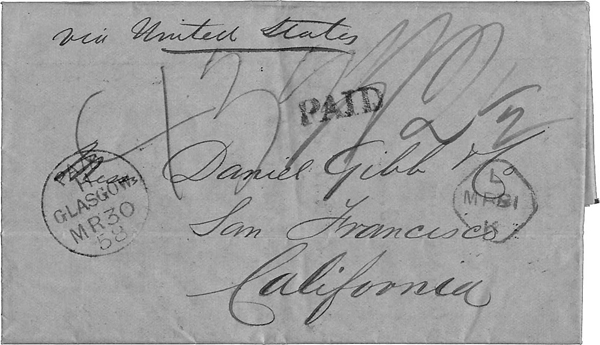
Fig. 25. The letter sent from Glasgow, Scotland, on 30.3.1858 to San Francisco, was carried via Liverpool and New York by three different mail steamers and across the Panama Isthmus by the newly established railway, from sender to recipient in 46 days. (See the text.)
Also the second alternative seems to have been in use. The writer’s collection includes a letter from Glasgow on 30 March 1858 to San Francisco (see Fig. 25). It was carried across the Atlantic by the Inman Line’s City of Washington, which sailed from Liverpool on 31 March. The letter arrived in New York on 13 April and proceeded for Colon on the 20th by the United States Mail Steamship Company’s Star of the West. It continued over the isthmus by railway and was carried from Panama by the John L. Stephens of the Pacific Mail Steamship Company, arriving in San Francisco on 15 May in 46 days.731
The letter could have been carried by the Royal Mail steamer Parana, which left Southampton on 2 April and arrived at St. Thomas on the 22nd. The steamer Trent departed on the next day and arrived at Colon on 28 April.732 From Colon the letter would probably have been sent to San Francisco by the same ship as it was sent by, anyway. The British-American connection did not work in the best possible way. If a letter was sent via the North Atlantic route, it had to wait in New York almost a week, and if it was sent via the West Indies, it waited in Colon. It was obviously not in the British interests to change their schedules according to American needs, and vice versa.
The British services via Panama to the west coast of South America also naturally benefited from the Panama railway. Although there are no sailing lists available from the west coast traffic in the 1860s, a letter in the writer’s collection gives evidence of the improvement. The letter, sent on 15 January 1866 from Havre was carried by four different steamships: first by a branch steamer across the English Channel to Southampton and from there on 17 January by the Royal Mail steamer La Plata to St. Thomas, where she arrived on 2 February. The same company’s Tyne took the letter on the same day and sailed via Haiti and Jamaica to Colon, arriving on 8 February. From there the letter was taken by train across the isthmus to Panama on 9 February and by a Pacific Steam Navigation Company’s steamer to Callao, where it arrived on 17 February.733 The whole trip from Havre via England, the West Indies and Panama to Peru took only about a month – 33 days.
Simultaneously with the rapidly developing steamship services and railways, large sailing ships reached the peak of their development in both size and speed. The California and South American routes, as well as the tea trade from China to England, saw the expansion of the most beautiful clippers – fine, sharp and fast vessels designed to carry very heavy cargoes – built in American or British shipyards for companies still preferring sail to steam on the longest sea routes.734 The clipper boom started in the late 1840s and continued until the depression of 1857, declining rapidly just before the American Civil War.
Even if very much admired for their speed, the clippers did not carry major amounts of mail to California or South America. The trip from New York via Cape Horn to San Francisco by the fastest clippers took at least three months, and an average sailing took 130 days.735 However, the rapidly growing number of clippers on the long routes must have stimulated a need for fast mail services to carry out the trade. While the clippers were sailing around Cape Horn from New York to California, the mails were sent by fast mail steamers via Panama.
During the peak year 1853, at least 150 clippers sailed from the east coast of North America via Cape Horn to California. The sailings took place rather evenly throughout the year without seasonal variations. In practice, at least two ships left for San Francisco each week, and sometimes even four or five.736 But the mail service by steamships via Panama was so much faster that there was no sense in sending letters by the clippers, even if the next steamer departure date was two weeks later.
The Panama route was not the only alternative for connecting the steamship traffic of the two oceans. In the early 1850s, there were strong opinions in the United States that the overland route should be drawn more north across Nicaragua, thus shortening it by some 400 miles from New York, or 500 miles from New Orleans. The crossing itself was much longer at Nicaragua, some 170 miles, but most of it could be made by water along the San Juan River and Lake Nicaragua. The journey across the Isthmus of Panama was about 55 miles.737
So important was the position of the new route that Britain and the United States came close to war over Nicaragua at the beginning of the gold rush, when plans for digging a canal through the isthmus were drafted for the first time, and each of the two nations was eager to take control of it. A crisis was averted by a treaty specifically binding Britain and the United States to the joint control of any canal at Nicaragua or elsewhere in Central America.738
These lucrative overland routes to California also caused exciting and ruinous competition between the shipping companies. The chief element in the contest was the opening of a route over Nicaragua to rival that of Panama. The Nicaragua route was vigorously promoted by Cornelius Vanderbilt, the ‘Commodore’ who would later establish the Vanderbilt European Line for the North Atlantic service.739 As the government had subsidised the mail routes between New York and Colon, and as Panama and San Francisco had already been occupied, Vanderbilt started an ‘independent’ line via Nicaragua, stating that his ships were faster and the rates cheaper than those of the ‘monopolies’. While the Commodore and his associates were dominating the scene, several other competitors appeared, and the New York and San Francisco newspapers were often filled with lively descriptions and speculations concerning these businesses.740
Disregarding the financial ups and downs of the companies, caused by numerous rate wars and fluctuations in stock prices, which all led to uncertainties in operations, the competition had its positive sides as well. Low passenger rates attracted people to use the steamers when travelling to California, and, during the peak years, extra vessels were sent from New York so often that there actually was a weekly service to San Francisco.741 The mail ship service was bi-monthly, but most probably other steamships were also used to carry letters privately. This may have speeded up the information circulation during those years, but the services were rather unpredictable. Several cases were reported where, for example, the passengers were left on their own at Panama without a ship to take them to San Francisco even if they had tickets for the whole journey.742
The competition between the ‘humbug steamship companies’ was reflected in the popular ballads of the day. One of them began like this:
‘The greatest imposition that the public ever saw,
Are the Californian steamships that run to Panama.
They have opposition on the route, with cabins very nice,
And advertise to take you for half the usual price:
They get thousands from the mountains, and then deny their bills,
So you have to pay their prices, or go back into the hills.’743
The Vanderbilt Independent Line was closed in 1856 after being mixed with the Nicaraguan revolutionary war.744 The struggle between the different companies, also still involving Vanderbilt, continued on the Panama route until the late 1860s. When the mail contracts ended in 1859, new and different deals were made that resulted in the United States Mail Steamship Company, which had dominated the mail route between New York and Colon, discontinuing its operations. The company had never achieved the popularity of Pacific Mail and there were few regrets when it ceased its operations. The company was said to be in the hands of a ‘number of heartless banking speculators, knowing little about maritime affairs, and less anxious about the multitudes who entrust their lives to their keeping, than of the semi-annual dividends’. Nevertheless, during its eleven years of operation the company suffered only one serious disaster, the loss of the Central America with 423 lives in a hurricane in September 1857.745
As this was the time when the American mail contracts on the North Atlantic route were transformed to cover only sea postage, the U.S. Postmaster General decided to invite bids for a new contract also on the Panama route. Both Vanderbilt and Pacific Mail bid on the contract, but it was awarded to a Daniel H. Johnson, who promised to carry out the service with $216,000 instead of the earlier $741,200 per year. It appeared later that he was totally unable to fulfil the contract and only acted as a ‘broker’ while the whole business finally ended in Vanderbilt’s hands. The new ‘mail line’ Atlantic and Pacific Steamship Company started their operations in late 1859. The list of backers of the company showed that most of the old United States Mail organization had gone over to Vanderbilt as well.746
Thus the Vanderbilt steamers became the ‘mail steamers’ and the ships which carried the mails for more than a decade passed into the position of ‘the opposition’. The Pacific Mail had carried the mails promptly and safely for a decade without losing a single mail. The new agreement again led to rate wars and hardly improved mail transmission – the sailing lists from the 1860s are not published anywhere. The Civil War caused additional safety problems regarding specie – the treasure shipments consisted mainly of gold from California – and there were times when the mail ships were protected by Navy vessels. During 1848–1869, over 400,000 people travelled from New York to San Francisco and more than 230,000 people in the other direction via Panama. The corresponding figures via Nicaragua were over 70,000 and more than 60,000 respectively. The shipments of specie via Panama were worth more than 710 million dollars and those via Nicaragua some 46 million dollars – huge sums of money in those days. For instance the whole fleet of Pacific Mail in 1859, consisting of seven ocean-going steamers, was offered two million dollars by Vanderbilt during one of the negotiations.747
Pacific Mail continued on the route, however, and was still operating at Panama in the 1870s, while the transcontinental railway had taken the mails and specie, as well as most passengers, to the inland route. Foreseeing the coming competition with the railway, Pacific Mail spread their operations to the Japan and China routes in the mid-1860s.748
The transcontinental overland mail route had already existed since the late 1850s. The letters were taken from the eastern coast of the United States to St. Louis in Missouri by railway, and then by mail coach via Fort Smith and El Paso to California. The latter service operated every second week under a very non-profitable mail contract from the government’s point of view: the annual subsidy was $600,000 while the annual return was only a little more than $27,000. In the midst of the Civil War, the service was renegotiated and the ‘Central Overland Route’ for the northern territories was organized as follows: the first leg ran from St. Joseph, Missouri to Salt Lake City by the Central Overland Company; the second from Salt Lake City to Virginia City, Nevada by the Butterfield Company; the third to Sacramento was sub-let to the Pioneer Stage Company; and the final journey to San Francisco was completed by a river steamer service.749
The contract time was 35 days, but for example during the winter of 1861–1862 snowfalls were so heavy that only a light mail could be carried, and in the spring coaches sank up to their axles in mud. Summer conditions brought the unwelcome attention of the Indians. The conflicts continued through the 1860s. The road between Omaha and Denver was one of the worst affected. The contractor complained that between April and mid-August 1867, the Indians had robbed him of 350 head of stage stock, burned twelve of his stage stations, destroyed three coaches, severely wounding several passengers and killed 13 of his most reliable employees. The Indians also fought to prevent the railway from invading their land, and therefore attacked trains and destroyed railway property. During one attack in 1867, they derailed a train and scalped the people.750
Despite safety problems, the Panama route was rapidly superseded by the transcontinental railway after its opening in 1869. The difference in duration of information transmission was great, but not as huge as has been commonly supposed. Instead of comparing the several months trip around Cape Horn with the speedy railway, the right comparison would naturally be the three week journey via Panama by steamer and the one week journey by train. A few years later, an express train could make the trip from New York to San Francisco in less than four days.751
MAP 7. Development of mail routes from New York to San Francisco in the mid-19th century.
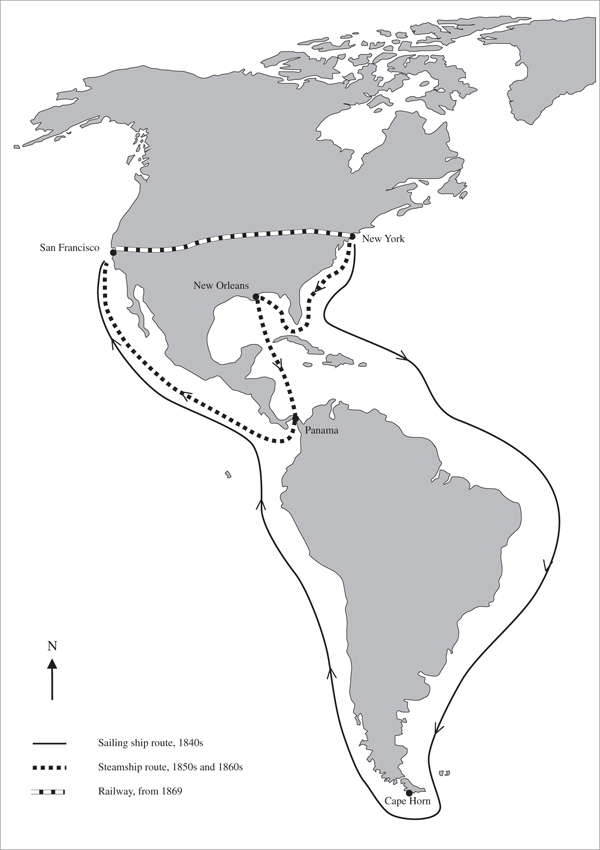
While the transcontinental stage coaches had been less efficient in news transmission than the Panama steamers, the Pony Express (between St. Joseph, Missouri, and San Francisco in 1860–1861), together with the partially built telegraph, carried news between the coasts faster than the ships. From 1861, the telegraph alone made the mail steamers carriers of documents and confirmatory details instead of bearers of the first news of great events. When the mails were taken to the rails, the great time of the Panama steamers was over. Being a cheaper alternative, the Panama route was still popular among the less wealthy. Service was slower than in the old days, as the ships now made frequent calls at Central American and Mexican ports. The Pacific Mail Company was putting its best efforts into the transpacific service, and the Panama steamers suffered as a result. They were described as ‘cheap and nasty’, their awnings full of holes, the furniture shabby and the food bad.752 Losing the mails and specie typically meant the loss of general interest. When the Panama Canal was finally opened on the same day as WW1 began in 1914, the benefits were in cargo shipping but not in information transmission.
TABLE 59. Duration of information transmission by different means of communication between New York and San Francisco, ca 1850–1870.
| Means of communication |
Time period |
New York – San Francisco |
| Sailing ship (clippers) |
1850s |
~ 4 months |
| Steamer via Panama, no railway |
– 1855 |
~ 6 weeks |
| Steamer via Panama, railway |
1855– |
~ 3.5 weeks |
| The Pony Express (152 westb. and 146 easb. trips in total, 11,500 / 23,500 letters in total) |
1860–1861 |
~ 2–3 weeks (incl. 4 days for New York–St. Joseph)* |
| Transcontinental railway |
1870s |
~ 1 week |
* Source: Richard C. Frajola, George J. Kramer and Steven C. Walske, The Pony Express. A Postal History (New York, 2005), 84-100.
The duration of information transmission has been estimated on the basis of the sailing lists of Wierenga and Cutler (1960) and they are just for a rough comparison. The sailing times of the clippers varied a lot and there is no intelligence on their sailings back to New York – many of them probably sailed on to China across the Pacific. As the clippers were not actual mail carriers on this route, they are included in Table 59 just as examples of the best possible performance by sailing ships. For exact figures, the steamship traffic on the Panama route should also be compared with the Nicaragua route and all the different companies, which would not give much that is new from the research point of view. Railway schedules are not easily found, and the difference would be in days only.
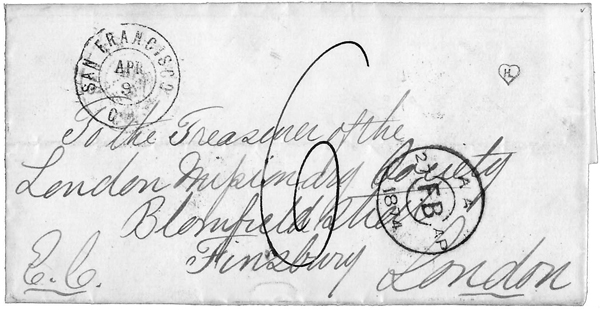
FIG. 26. The letter sent from Rarotonga, Cook Islands, on 17.1.1874, to London was carried by a by-passing merchant ship to San Francisco, where it arrived on 9 April. The marking ‘E.b.’ down to the left indicates that the letter should be sent eastbound, i.e. via the United States and not via Australia and Suez. It took 82 days from the writing of the letter before it was in San Francisco, but only a week to bring it to New York by the newly opened transcontinental railway. The HAPAG’s mail steamer Holsatia took the letter to Plymouth in ten days and it was received in London on 27.4. in 100 days. – Cook Islands, in the mid-Pacific, were a seldom visited place, where the only Europeans were missionaries and occasional ship crews.
As a conclusion, it can be stated that information transmission between the east and west coast of North America included a paradox: the journey by sailing ship, which was the slowest means of communication, was also the longest in terms of miles. The combination of two steamship lines and an overland crossing at Panama or Nicaragua caused a double effect: the length of the journey was shortened markedly, while the speed was also greatly improved due to the change from sail to steam. The railway across the Panama isthmus made that part of the trip shorter and easier to manage, thus again speeding it up. And finally, when the shortest possible route and fastest possible vehicles were brought into use, the duration of the journey was reduced to less than a week compared with the original four monthsor more. This process was one of the most remarkable improvements in the duration of information transmission anywhere by traditional means of communication, even the telegraph included.753
International competition and the introduction of the telegraph in the West Indies
The German Hamburg-Amerika Linie (HAPAG) started steamship operations between Hamburg and the West Indies, including inter-island services, in 1871. The German Imperial Post Office authorized HAPAG to organize the mail transportation on these routes similarly to the Royal Mail Line, and these two companies became ‘friendly competitors’, often visiting the same ports of call. Both companies also published postage stamps of their own for local use on the inter-island voyages. The Royal Mail Line used them only for a short while during 1875, but HAPAG’s stamps were in use until the various countries wherein they provided mail services became members of the Universal Postal Union.754
Additionally, there were local steamship companies which took care of some branch routes. The most important was the company of Captain Robert Todd, who had an agreement with the Venezuelan government in the 1860s to carry out a mail service between La Guaira, Puerto Cabello and St. Thomas. This route was originally operated by the Royal Mail Line.755
The Royal Mail Line also lost several other mail routes to competitors, like the northern route to the Bahamas to the Cunard Line in 1859.756 In early 1865, the West India and Pacific Steam Ship Company of Liverpool started a monthly service for Haiti, Jamaica and Mexico; and another route for Jamaica and Belize. The contract with the government remained short-lived, however, due to several alterations in sailing dates and occasions where no vessel was available. In April 1866, the contract was terminated and the letters carried by the company were treated by the Post Office as normal ship letters. The company was given another chance in 1868 with routes to Mexico and the northern coast of South America, but the contract was for one year only and the compensation was limited to the weight of the mail carried.757
In January 1875, the new mail contracts of the Royal Mail Line came into force. The annual subsidy was reduced by about £120,000. However, the company had already made the necessary improvements and modifications to meet this change in its fortunes. For the West Indian service the annual subsidy was now £86,750 and for the South American service payment was according to the weight of the mails carried. Several of the ports served in the West Indies were in fact non-contract ports. While other companies took parts of the Royal Mail Line’s earlier routes, the opposite was also true. After Plymouth became the first port of call in England from October 1867, the West Indian ships started to call at Cherbourg on the French side before proceeding to Southampton from May 1869. In June 1873, a monthly service was inaugurated from Southampton to the West Indies calling at Bremen and Hamburg on the way home.758
Very little is known about the schedules conducted by the different mail lines during the 1870s, as no details have been published of them. It would be especially interesting to examine the ‘friendly competition’ between the Royal Mail Line and HAPAG on the West Indian route. That will remain for further examination by somebody else, however. From the business information transmission point of view, a detailed study of this time period is not crucial. The telegraph had already reached the Caribbean and the steamers were not urgent news carriers any more.
After a decade of negotiations, with several companies and governments being involved and numerous technical problems being solved, the first submarine telegraph was laid between Florida and Cuba in 1867 by the American International Ocean Telegraph Company. One of the difficult questions in developing the network was once again whether or not any country should have exclusive rights for communications via Panama, which would combine the Atlantic and the Pacific coasts by telegraph. As can be expected from the historical background, the British government was very adamant on this question. Although several countries and colonies were ready for grants and subsidies for the new telegraph network, International Ocean found it soon necessary to raise new capital under the name of a new company.759
West India and Panama Telegraph Company Ltd. was founded in London in 1869 and manned by directors mostly from Liverpool, which showed where the main interest in the area laid. By the early 1870s, a telegraph line had been opened between Santiago de Cuba and Kingston, Jamaica, while the one between Kingston and Panama was postponed due to technical difficulties. St. Thomas was combined with St. Kitts and onwards to Antigua, Guadeloupe, Dominica, Martinique, St. Lucia, St. Vincent, Granada and Trinidad. In early 1872, the line was continued to Barbados, and via Trinidad to Demerara.760
Instead of one cable telegraph company, there were in fact four of them involved in the Caribbean area. Two were British, (the West India and Panama Telegraph Company and the Cuba Submarine Company) and two were American (the International Ocean Telegraph Company and the Central and South American Telegraph Company). Three of them formed an alliance and operated in competition with the Central and South American Telegraph Company, whose activities, as the name implies, were mainly in Central and South America. It did not operate in the West Indies and did not pose a threat to the monopoly of the Associated Companies.761
The companies soon found that things did not go according to their plans. The laying of cables and the initial establishment of services were much more arduous and expensive than had been calculated. As the original idea of extending activities to South America – the most lucrative part of the plan – did not come about, there was considerable unused capacity in the cable network. Another surprise was that demand for the telegraph remained much lower than had been estimated. The continuing depression in the sugar trade brought serious economic difficulties in most colonies, and the economic significance of the Caribbean area in world trade was on the decline. The social structure of the area was not favourable for the telegraph, as the large majority of the population was illiterate. The telegraph served members of the commercial community, manufacturers, plantation owners and various government officials, but beyond this it found little use. As the Caribbean islands belonged to different European powers, it was not surprising that the demand for traffic between the islands was not great.762
For the business in British Guiana, the telegraph seems to have been a useful tool, however. The Sandbach, Tinne & Co.’s correspondence gives several examples of how the combination of steamship letters and telegraph worked in practice:
- ‘We enclose copies of our letter yesterday by direct steamer… and have to acknowledge your telegram in answer to ours about the ‘Malvina Shutte’ for timber… We enclose a letter from Robert Smith about Ruimveld. It is of course what you would have anticipated when you did not send us a power of attr. Meanwhile we await your instructions – we do not wire ‘Rotterdam’ because it might mean so much we did not wish to say. The King Arthur is loading for London. Sugar is alongside @ 1s/9d…’
- ‘In your additions of 3 March you had the word ‘avaria’ – We substitute ‘average’ for the second ‘avaria’.’
- ‘Dear Sirs. We have to acknowledge your P16 per mail with enclosures & your telegram 4/94… Harrisons. The reasons we telegraphed was… Glencorn. We will telegraph later on. We have heard from the owners.’
- ‘Dear John, the mail being late, we have ‘nowt’ to acknowledge, and little to say on our own account.’
- ‘Dear Sirs. We have your P38, 39, 40. Mexicans. Your telegram 4/119 duly received but the Government Secretary has not replied yet to us… Enclosures: letter for Crosby, letter for Olivieira, 3 telegrams, P/copies last mail.’763
The mixture of business information received by telegrams and steamship letters made communications between the sugar plantation in Demerara and the owner company in Liverpool rather complicated. For an outsider, it is almost impossible to understand what it was all about. Cross-references were necessary to keep the partner on the other side of the ocean informed about the status of knowledge of the writer at the time when he was sending the letter. Numbered letters and telegraph codes illustrate fairly standardized business communications. And more than that, the degree of independence at the plantation had been notably reduced. The owners, thousands of miles away, now controlled the distant plantation much more strictly than a few decades earlier.
International competition and the introduction of the telegraph in South America
In the late 1860s, the business environment of the old players like the Royal Mail Line and Messagerie Impériales changed markedly on the South American route. The introduction of the compound engine made it possible to carry more freight and passengers than earlier, instead of filling the ship holds with coal. This was particularly important on the long sea routes. While the royal mail services of Britain and France had enjoyed notable subsidies for their operations, new competitors could now start on the same routes without government support. The increasing space for cargo and passengers made the voyages profitable anyway, and in fact steamers now finally overtook sailing ships as long distance carriers. It did not take long before the government policy changed on the South American route as it did everywhere else, and the shipping companies were paid only according to the weight of the mails carried.764
The Liverpool-based company generally known as Lamport & Holt started their steamship service for South America in 1863 under the name Liverpool, Brazil and River Plate Steam Navigation Company. They sent two ships to South America in the first year, eight in 1864, 24 in 1865, and 41 in 1866. These vessels occasionally carried private ship letters for the Liverpool merchant houses.765 In 1868, the company started as an official mail carrier under government contract on the route Liverpool–Lisbon–Bahia–Rio de Janeiro–Montevideo–Buenos Aires. A short-lived contract was also made with the London-based Tait & Company (London, Belgium, Brazil and River Plate Royal Mail Steam Ship Company).766
An interesting phenomenon on the route was the entrance of the Pacific Steam Navigation Company on the east coast of South America. This was the same company that had been carrying mails under a British contract along the west coast from the mid-1840s. They now established a direct route from Liverpool via Bordeaux, Lisbon, Cape Verde, Rio de Janeiro, Montevideo and Punta Arenas to Valparaiso. Instead of sailing down to Cape Horn the steamers took the shorter route via the Straits of Magellan.767
In 1870, there were five regular mail steamship lines operating between the main West European ports and South America. The mails for Buenos Aires were sent to the departure ports from London on the 2nd, 9th, 19th and 23rd or 24th of each month, with Sundays sometimes changing the date by one day. The departure dates from Buenos Aires were on the 9th, 12th, 17th, and 27th of each month. The Pacific Steam Navigation Company, leaving on the 12th of each month from Liverpool, sailed via Montevideo to Valparaiso and Callao without going to Buenos Aires. Their ships departed homewards from Montevideo on the 26th.768
For natural commercial reasons, not all these companies operated on exactly the same routes. The Royal Mail Line, Lamport & Holt and Tait & Co. sailed to Buenos Aires from different British ports and Messageries Maritimes sailed to the same place from Bordeaux. The Pacific Steam Navigation Company sailed from Liverpool to Montevideo as mentioned above. The vessels also called at somewhat different ports during the voyage. As all shipping lines called at Rio de Janeiro and Montevideo, these ports actually kept more options for business communications than Buenos Aires. Communications with Uruguay benefited notably when Tait & Co. ceased its operations to Buenos Aires in 1870 and the Pacific Steam Navigation Company doubled its service to Montevideo and Valparaiso from July in the same year.769
TABLE 60. Consecutive information circles between Liverpool and Montevideo in 1870, an example.
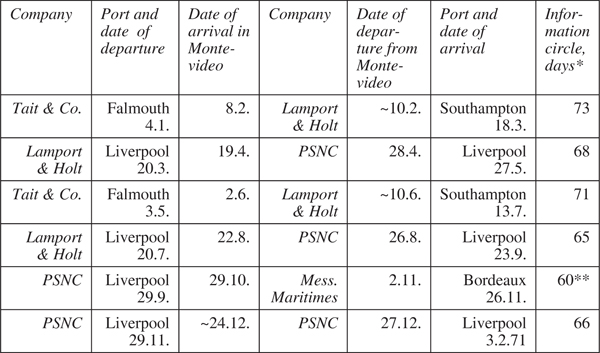
Sources: Sailing lists of Howat, 137, 171, 183, 211; Salles, Tome III, 89, 91.
* = information circles are calculated from the date of departure from the homeport to the date of arrival at the homeport, using the fastest possible change in Montevideo (not including those departures which took place on the same day when the mail from Europe arrived, however)
** = two days have been added for the trip between Bordeaux and Liverpool. From the other ports, the mails were principally sent on the same day by railway.
As the distance between Montevideo and Buenos Aires was just one sailing day, we do not know whether the difference was very remarkable in real life, however. There may have been local steamboat services which took the mails to Buenos Aires, although it should be remembered that there was a national border between the two cities. Table 60 shows the flow of consecutive information circles between Liverpool (or any other major English port with inland rail connections) and Montevideo in 1870. For Buenos Aires, one or two days should be added to the duration of the voyage.
By chance, the information circles starting from early January 1870 lead to a presentation without any Royal Mail sailings. Almost six consecutive information circles could be conducted on that route by using almost exclusively the newcomers, with one Messageries Maritimes sailing as an exception. An average information circle enabled by the service of the four companies took 67 days. As there were ships leaving rather often, the number of possible consecutive information circles rose to 5.5 per year. If the Royal Mail Line had sailed on the route alone, the length of an average information circle would have been almost the same, 68 days, but the monthly schedule would have enabled only four consecutive information circles within the calendar year.
The services of the different shipping lines were not identical. Interestingly, the old mail lines – Royal Mail, Messageries Maritimes and Pacific Steam Navigation Company – made constantly faster journeys than the newcomers – Tait & Company and Lamport & Holt. The Royal Mail Line had also finally abandoned the old branch service system between Rio de Janeiro and Buenos Aires, and the direct service shortened the duration of the voyage by a few days.770 A fair comparison between all companies is difficult due to the different routes and the fact that not all the real dates are given in the sailing lists, but sometimes only the administrative schedules. Additionally, the sources sometimes disagree about the dates.771 With these reservations, the average performance of the shipping lines was as follows:
TABLE 61. Average duration of journeys between English/French ports and Montevideo, 1870.
| Shipping company |
Average duration of the trip, home port – Montevideo |
Average duration of the trip, Montevideo – home port |
| Lamport & Holt |
30 days |
35 days |
| Messageries Maritimes |
30 days |
26–27 days |
| Pacific Steam Navigation Co. |
28 days |
32 days |
| Royal Mail Line |
28 days |
30 days |
| Tait & Co. |
33 days |
35 days |
Sources: Sailing lists of Howat, 137, 171, 183, 211; and Salles Tome III, 89, 91.
Naturally, the British Post Office closely examined the duration of mail sailings. When Tait & Company was not able to improve its performance but instead asked for the possibility to lengthen the voyage to 42 days in a new mail contract, the Post Office turned to Pacific Steam Navigation Company for a better offer. Thus the latter company took over the contract in July 1870 while Tait & Company disappeared from the scene. Table 61 shows clearly the reason why Lamport & Holt was not asked to take the contract.772
In 1874, the Royal Mail Line started a bi-monthly service, thus following the example of Messageries Maritimes which had started a new commercial line in addition to their government mail service in 1872. The ‘rapid’ new line of Messageries Maritimes did not touch Bahia or Pernambuco, while the other line did. By 1875, the South American mail services by steamship had reached their peak in frequency and speed. In addition to the three mail-carrying lines from England and one from Bordeaux, there was the German Hamburg-Süd operating from Hamburg, the French Société Générale de Transports Maritimes (SGTM) operating from Marseilles, and the Italian Lavarello Line, operating from Genoa.773
Contemporary statistics by the Argentina Director-General of Posts and Telegraphs give interesting information on the numbers of letters carried by the shipping lines from Buenos Aires to Europe in 1876. Messageries Maritimes was the market leader with 100,000 letters (31%), while the Royal Mail Line carried 88,000 letters (28%). The Mediterranean companies had taken a considerable share of the transports within a few years of starting the service: SGTM carried 46,000 letters (15%) and Lavarello 45,000 letters (14%). Lamport & Holt carried 10,000 letters (3%); and ‘various ships of the Pacific Steam Navigation Company and sundry German ships’ carried 29,000 letters (9%). The total number of letters from Buenos Aires to Europe was 318,000.774 In addition, the ships carried the mails from Montevideo and the Brazilian ports.
TABLE 62. Consecutive information circles between Liverpool and Montevideo in 1875, an example.
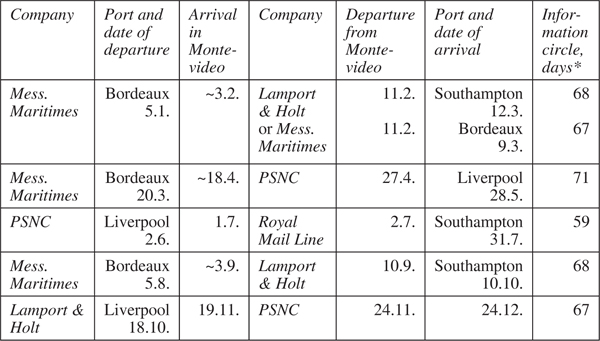
Sources: Sailing lists of Howat, 140, 174, 217; Salles, Tome III, 94. ~marked are estimates. – Two days have been added for the trip between Bordeaux and Liverpool. From the other ports, the mails could be sent on the same day by railway.
Table 62 gives an example of information circulation between the Atlantic mail ports and Montevideo, using Liverpool as the European terminal to be consistent – it could naturally be any major English port with railway connections.
There were no less than 86 mail sailings to and from Brazil and the River Plate ports in 1875, compared with 61 in 1870. However, the result from the business information circulation point of view was now poorer than earlier. Instead of 5.5, only five consecutive information circles could be carried out within the calendar year. The same result could have been achieved by using the Royal Mail Line’s bi-monthly service alone.
The main reason for this outcome was that sailings could not be really coordinated due to the different contracts of the shipping lines. While Messageries Maritimes and the Royal Mail Line sailed bi-monthly, and Lamport & Holt monthly always on the same days (except for Sundays for the British lines), the Pacific Steam Navigation Company sailed every second Wednesday, thus altering the dates continuously.
The departures from the European ports were not evenly split but varied greatly. Even if there were seven to eight departures each month, the system did not work well from the business information transmission point of view. While there were sometimes four departures within a week’s time, ten days could then pass without a single sailing.
The arrivals and departures were sometimes mismatched within the same shipping line, so that the next ship departed on the same day as, or one or two days before the arrival of the company’s vessel from the other direction.775 The Liverpool-based companies competed by sailing out on the same days as the old mail contract companies, or very close to them.776
For example in February 1875, Messageries Maritimes first sailed on the same day as their own vessel arrived at Bordeaux, so that no one could answer the arriving letters in Paris, to say nothing of England. The Pacific Steam Navigation Company then sailed out one day after the Royal Mail Line, which was not very useful for anyone. Lamport & Holt sailed a day after Messageries Maritimes had departed from Bordeaux, which meant that the mails for the sailings had to be sent from England almost simultaneously. And finally the Pacific Steam Navigation Company again sailed out on the same day as the Royal Mail Line. Instead of spreading the seven departures evenly on every fourth day, for example, three of the departures took place within six days between the 5th and 10th February, and four of them within five days between the 20th and 24th February. During the rest of the month, there were no sailings outwards at all.777
Additionally, answers to letters that arrived on a Pacific Steam Navigation Company ship on the same day as another of the company’s vessels departed normally had to wait up to ten days for the following departure, while letters by the Royal Mail Line had to wait five days. After 1.5 weeks without sailings, there were again two on the same day.778 Even if the sailings were somewhat faster in 1875 than five years earlier, the duration of specific voyages varied notably.
The Royal Mail Line’s homeward sailings from Montevideo took 29.5 days (30.2 in 1870) on average, varying between 28 and 32 days. Lamport & Holt’s sailings took 31.1 days (35) during the whole year, and 30.3 days under the new contract which began in April 1875. The duration of sailings varied between 26 and 37 days. Pacific Steam Navigation Company’s sailings took 30.7 days (31.8) on average. The length of the sailings varied between 29 and 33 days. The express mail line of Messageries Maritimes made the home voyage in 25.1 days (25.6) on average, varying between 24 and 27 days, while the commercial line which visited several more ports used 30.3 days for the home voyage, varying between 26 and 35 days.779
As in the concurrent North Atlantic service, the speed and frequency of sailings was not utilized in the most efficient way. When the companies competed by sailing on the same day or very close to each others’ sailing dates, the overlapping meant lost opportunities at least from the business information transmission point of view. When the transport of mails ceased to be the main purpose of the sailings and the needs of freight shipments and passenger traffic were preferred, information transmission was the loser.
From the mid-1870s, the British Post Office looked for economies in the overseas contract mail services. This led to a reduction in the sums paid to the companies per ounce of letters carried. The Post Office also wanted to economise by restricting the obligation to transport letters only to the outward mails from Britain. Overseas countries would then become responsible for making their own contracts with shipping companies for carrying the mails to Europe. Under these circumstances, Lamport & Holt’s mail contract was cancelled in 1876, while the contracts with the two other British companies on the South American route, the Royal Mail Line and the Pacific Steam Navigation Company, were accordingly curtailed.780
The British Postal Agency in Buenos Aires, established in 1824, was also suppressed in June 1873 by an Argentina government decree, together with the French Agency. For decades, the British and French communities had enjoyed the privilege of being able to take their letters for their home countries and intermediate ports to their Consulate Packet Office for direct transmission without incurring the handling of the letters by the local Buenos Aires postal authorities or paying their charges. The letters would now be sent by the Argentine Post Office and be pre-paid by Argentine postage stamps. The mailbags would be delivered to the mail agents on board the English and French steamers ‘on the day and hour fixed by the agents of those lines’.781
All the former privileges, subsidies and special arrangements were now removed from the information transmission services and no one coordinated the networks. This was undoubtedly cheaper for the governments and corresponded better with the principles of free competition, but it was definitely a step back from the business information transmission point of view. Even if the fastest messages could be sent by telegraph, the important bulk mails with documents, explanations to the telegrams and tone of voices in the letters were transported more slowly than earlier. Continuous improvement had been replaced by overlapping services, unhealthy competition which ruined tens of shipping lines, and the still rather unpredictable duration of information transmission.
The changes in the South American communications environment were also related to the introduction of the telegraph. But long and difficult distances, as well as the commercial and political interests of several countries involved in Europe, South America and the West Indies made the negotiations about laying the cables an extensive process. Several companies were established and capital collected, agreements were signed between governments and several thousand miles of gutta percha cables were manufactured for the purpose. Jorma Ahvenainen gives a detailed description of the early planning period in his excellent study of the European cable companies in South America.782
The first working cable was laid between Uruguay and Argentine in late 1866. The River Plate Telegraph Company had been set up by two British men: John Proudfoot, a Liverpool merchant, and Matthew Gray, a Glasgow engineer, who was the Managing Director of the India Rubber, Gutta Percha and Telegraph Company. Proudfoot was primarily interested in trade between Britain and South America, while Gray’s interest lay in the work these concessions would create for his company. The subscribers of the shares were mainly from Scotland and North West England, especially from Liverpool and Manchester.783
From the very beginning, the company proved to be a sound enterprise. When the line was connected with the land line between Argentine and Chile, established by the Transandine Telegraph Company in 1872, the River Plate Telegraph Company took the initiative by presenting itself as a quick carrier of messages between the western coast of South America and Europe. That was not exactly correct, but it is true that the telegraph shortened the duration of information transmission by several days at both ends of the journey. An urgent message could be sent from England or France to Lisbon by telegraph, and taken from there by a steamer to Montevideo, to be forwarded to Valparaiso or Santiago de Chile again by telegraph.784 This was a similar system to the one used on the North Atlantic route in the earlier years, when the Atlantic cable did not yet work but there were telegraph lines from New York to Newfoundland and from Holyhead to Liverpool.785
The company advertised that 12 days could be saved in the duration of information transmission between Europe and Valparaiso by using its connections instead of the normal steamship service. In fact the effect of the combined services by mail steamers and telegraph was even greater. While the Pacific Steam Navigation Company sailed from Liverpool to Valparaiso in 42 days and in the other direction four days longer, the trip by their mail steamer between Lisbon and Montevideo took only 23 to 25 days. Thus the combined services shortened the duration of urgent information transmission by 19 to 21 days – even without the help of the Atlantic submarine telegraph cable, which was established between Portugal and Brazil by the Brazilian Submarine Telegraph Company in 1874.786
The early South American telegrams were expensive, however, and could certainly be used for urgent information only. The rate between Montevideo and Buenos Aires for ten words was Frs. 15.75 at a time when the Anglo-American company between Britain and the United States charged Frs. 50 for ten words. The tariff between Montevideo and Valparaiso was Frs. 21 for the first ten words and Frs. 13.10 for each further ten words. And the rate of a submarine telegram between Lisbon and Montevideo was Frs. 18,125 – per word.787
Researchers who are fascinated by the technical development expressed by the telegraph often overestimate its importance in overall information transmission. For example, Ahvenainen writes about the opening of the public cable between Europe and Buenos Aires in July 1875: ‘Before this date a message sent as surface mail from Europe had taken one month to reach Rio de Janeiro, and a few days longer to reach Buenos Aires. Now, with the opening of the telegraph line, it took less than a day. This was a very great change in the speed of global communication.’788
It was of course a huge change, if the news could be received on the same or following day after being sent, and the value of the telegraph in transmitting news can certainly not be overestimated. Also in particular businesses it was important to receive the news in brief, or to send a ‘buy’ or ‘sell’ order as quickly as possible.
Yet the difference in information transmission to South America before and after the direct submarine telegraph line was opened was not as much as one month, but only about two and a half weeks. The duration of information transmission between the British ports and Rio de Janeiro had reduced constantly from 60–70 days by the Falmouth packets in the 1820s to 22 days by steamship from port to port in the 1870s.789 If the already existing telegraph line between Britain and Portugal was used for part of the trip, the duration of information transmission between London and Rio de Janeiro was no more than 18 days.
As time is always measured in days and hours, one cannot actually talk about the speed increase in relative terms. Even if the use of telegraph undoubtedly was 20 times faster than the steamship service, it could seldom be utilized to such a degree in business communications. It naturally depended on the size of the business, but most companies probably did not have daily use for such new and expensive information systems. The decision on the acceptability of information costs depended each time on the issue at hand. In many cases, it was good enough to send the information by ordinary mail as usual. As bulk mail and telegraph were often used to complement each other, it is difficult if not impossible to calculate precise consecutive information circles after the intercontinental telegraph had been introduced.
Table 63 shows the reasons for the most remarkable changes in information transmission between Britain and Brazil between the 1820s and the 1870s. The first notable reduction in the length of sailings took place in the 1830s, when the Admiralty changed part of the old men-of-wars to purpose-built packets in the Falmouth service. This change from one sailing ship type to another reduced the length of the voyage by ten days on average.
TABLE 63. Duration of information transmission by sail, steam and telegraph between Rio de Janeiro and Falmouth / Southampton, 1820–1875.
| Year |
Means of information transmission |
Durationin days, average per year |
Comments |
| 1820 |
Falmouth packet |
62.2 |
Original packets |
| 1850 |
Falmouth packet |
51.9 |
Part of the packets changed to new purpose-built vessels |
| 1851 |
Royal Mail steamer |
29.7 |
Change from sail to steam |
| 1859 |
Royal Mail steamer |
25.2 |
Streamlined route, new vessels |
| 1872 |
Royal Mail steamer |
22.0 |
Competition leading to a streamlined schedule |
| 1872 |
Telegraph from England to Lisbon, steamer to Rio |
~18 |
Combination of services was possible since the international telegraph lines were established in Europe in the 1850s and 1860s. |
| 1875 |
Telegraph |
~1 |
Information transmission depart from physical transport |
Sources: The average numbers of sailing days are calculated from the sailing lists of Howat, 12–13, 85–86, 129, 132–133, 137–139.
The most striking change took place from the beginning of 1851, when the Royal Mail steamers replaced the Falmouth packets on the South American route. While the average packet sailing from Rio de Janeiro to Falmouth had taken 52 days, the steamers made the trip in less than 30 days. Calculated in days, this was an even more important overnight change than the opening of the submarine cable line in 1875.
The development in steamship technology did not reduce the length of the voyage remarkably between the early 1850s and 1870s. The duration of the trip was shortened by one week during that time, but it was caused by the streamlining of the route as much as by technological improvements. The reason for the humble progress in this respect is obviously that the Royal Mail Line started on the South American route 13 years later than the first pioneering steamers crossed the Atlantic. Most of the early problems in technology had already been solved, and the South American route could be served comparatively well from the very beginning.
The difference between the combined telegraph and mail steamship services, which had been in use for several years already, and the direct submarine telegraph line between Europe and Brazil was only 2.5 weeks. Naturally the fast telegraph service enabled numerous information circles per year – in theory perhaps a hundred or more. Nevertheless, there were the time differences, and all kinds of technical delays could occur when sending the messages through different stations. The rates were high, and there was of course no need to send messages all the time. Although the telegraph did not perhaps revolutionise the South American trade, it was undoubtedly the fastest tool for those cases where delivery of urgent information was essential.