Communications with the Asian trade ports by the East India Company – The development after the abolition of the EIC monopoly – Private merchantmen as mail carriers, the forgotten period in postal history – Merchant ships as news carriers – Steaming via the Cape of Good Hope vs. the Overland route – Fighting against the time of changes
Before the monopoly of the honourable East India Company (EIC) was abolished in 1813, nearly all information transmission between Britain and East India, or other Asian regions in which the British had trade interests, was carried by the East Indiamen. For China, this was the practice until 1833.790
It is not possible to describe here the whole story of the EIC. The archives of the India Record Office in the British Library in London keep 14 shelf kilometres of documents concerning the Company’s history during three and a half centuries. A brief overview may still be necessary to understand the historical context.
The EIC was established in 1600 to take a share of the East Indian spice and textile trade then dominated by Portugal. In the mid-18th century the Company was purely a commercial enterprise which imported and exported goods from its factories, having trading posts in Calcutta, Madras and Bombay. By 1815, after a long period of wars, the Company ran the most powerful army in India, including the Bombay Marine, and ruled their three presidencies from Fort William (Calcutta), Fort St. George (Madras) and Bombay Castle (Bombay & Surat). The Company’s privileges in India included incomes from inland customs, tax on spirituous liquors, the salt and opium monopoly, administration of the Courts of Justice, police, etc. The EIC also had a trading post in Canton (Guangzhou), China, to trade tea for silver and later for Indian-grown opium. By the 1820s, when the British government had abolished the Company’s monopoly on the other routes, the opium-tea trade was the only lucrative part of the business.791
There were also East India Companies in the Netherlands, France, Denmark, Scotland, Spain, Austria and Sweden. None of them gained as much importance in the whole Indian Ocean region in the long run, however, and the last companies were dissolved by the end of the Napoleonic wars.792
Until the 19th century, there was no other means to send mails to India or other trading posts east of the Cape than by ships of the different East India companies, which held their national monopolies on the Asian routes. All companies most certainly carried mails, but not much is known about the numbers of letters or any postal details. As only the British East India Company survived after 1815, this study will focus on its mail services, as well as on the use of private merchantmen as mail carriers after the abolition of the monopoly, and on the start of a government subsidised steamship service (see Chapter VII.2).
Between 1761 and 1834, no fewer than 570 vessels sailed from London to East India or China on behalf of the British EIC. Some of them made only one ‘double voyage’, as the round trip was called on the East India route, while the long-lived ones in the early 19th century were able to make ten or 11 double voyages, the record being 14. Some 30 of them, mainly small 100–300-ton ships sailed as ‘packets’ for the company’s important mails. They were sent out only once or twice a year, and thus did not form any regular service. The total number of voyages during the last 73 years of the company’s commercial activities – the ‘packets’ excluded – was 2,451.793
The largest East Indiamen, built in the 1790s and early 19th century, were about 1,200 tons or even more. The vessels registered at 1,300 to 1,400 tons were mainly in service from 1817 until the disposal of the merchant fleet in 1834. The number of crew of the largest ships was standardized to 130. All the vessels were heavily armed, resembling men-of-war and, if necessary, took offensive as well as defensive action. Traditions were of the highest order, and the Marine Service was essentially a corps d’elite.794
Most ships sailed from London for the eastern waters during the spring, and returned within one or two years. The Company stated in a Parliamentary hearing in 1810 that the favourable season was considered to be mid-November to mid-March – no matter whether the voyage was from England or from India. As the homeward cargo was generally more valuable than the outward cargo, preference was given to sailing from India, rather than from England, in the favourable season.795 In practice this meant that the ships often stayed in India and especially in China for several months before starting their homeward voyages. As Jean Sutton points out in a recent study,796 the long stays in Canton were due not only to the monsoons, but also to the complicated and time-consuming trading system conducted by the Chinese authorities. There were consequent long delays in getting answers to mails sent from Europe.
The long passage normally started from England, with an East Indiaman being refitted and ‘coming afloat’ at her moorings in London. When the cargo was stowed, she was taken down to Gravesend, where ‘goods in private trade’, supplies, water, livestock and finally most of the passengers were taken on board. In peace time she then proceeded to the Downs off Deal, to meet with the rest of the division of East Indiamen with which she was to sail. Passengers who had travelled by road to Deal embarked, and the convoy sailed on the first favourable wind. In times of war, the ships usually sailed to Portsmouth, assembled in convoy there and proceeded under the protection and orders of an escorting man-of-war.797
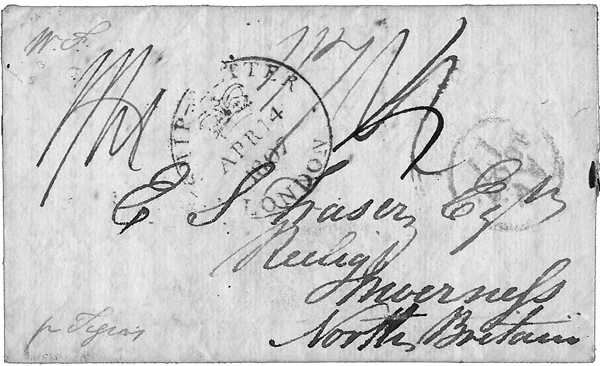
FIG. 28. The letter dated in Meerut, near Delhi in North India, on 22.4.1806 was handstamped (on the reverse) by the Bengal G. P. O. in Calcutta some five months later in September, to be carried to England by the Tigris, one of the East Indiamen. The Tigris was on her 2nd round trip (out of six) to India. After a rather normal five-to-six months sailing around Africa, the letter was received in London on 14.4.1807 – almost a year after being written.
Before the Post Office Act of 1815, there was no packet mail service by the Post Office to the East. Letters were ‘handed in’ to the EIC ships – sometimes in Navy vessels – in bags sent from the Post Office or Government Departments or the EIC Office mainly at Gravesend, or they were brought on board by the passengers. Many senders, particularly the merchant community, waited until the last opportunity and then dispatched their letters to Deal or Portsmouth to be put on board there. The mails were only subject to the normal ship letter charges levied by the Post Office, and the inland postage. The EIC did not receive compensation for the service. The free transit was a great benefit to the Post Office, as a normal packet mail service on such a long route would have been very expensive. On the other hand, the service was very slow (see Fig. 28). The East Indiamen were not designed to be fast mail carriers and their main interest was in trade.798
The departing convoy of East Indiamen normally took the course to Madeira and then with the N.E. winds towards the coast of Brazil, endeavouring to cross the equator at between 20o and 25o W. After slow progress in the Variables the next objective was to gain a latitude between 30o and 40o S. and take advantage of the strong westerly winds. The ships then steered to run down their easting in the ‘roaring forties’, eventually approaching the Cape of Good Hope from S. or even S.E. Most convoys called at the Cape for water and provisions, usually essential after two or three months at sea. Letters for St. Helena were normally landed at the Cape, to be picked up and forwarded by homeward sailing vessels.799
The ships bound directly for China continued on the forties until nearing the west coast of Australia. Then they continued on that latitude turning northward up the east coast of Australia, via New Guinea and the east coast of the Philippine Islands, then N.W. to Canton. Alternatively, they sailed northward at about longitude 100 E. for the Timor Sea, via ‘Pitt’s passage’ and the Moluccas, then east of the Philippines to Canton. The convoys for India left the Cape on one of several routes depending on the season and prevailing monsoon, using the ‘inner passage’ by the Mozambique Channel, watering at Comoro Islands, and then the ‘eight degree’ or ‘nine degree’ passage to Bombay, or using the ‘middle passage’ to the east of Madagascar, watering at Mauritius. Ships for Madras and Calcutta sailed more N. or N.E., often calling at Ceylon before proceeding up the Coromandel Coast.800
Although navigation in the Indian Ocean offered its own problems, the critical part of any outward voyage from Europe was in the Atlantic. A ship which failed to make Cape Recife (in Brazil) could easily lose a further four or six weeks in making a second attempt, and would then need to water on the Brazilian coast before continuing. It was nearly impossible to sail directly from Europe to the Cape of Good Hope. Decisions regarding the three main turning points all had to be taken in the open ocean by the best means available: navigation by latitude, lead and lookout, lunar observations and later the chronometer. The effects of currents were especially difficult to calculate.801 It sometimes happened that an East Indiaman or several of them parted the fleet and were never heard of again. Stranding on an unknown shore could be as fateful as a hurricane or an attack by the enemy. Due to the many uncertainties at sea, it was common to write duplicates and triplicates of letters to ensure that at least one of them arrived safely at the destination port.802
Before focusing on the time period after the Napoleonic wars, it may be useful to shortly examine the EIC’s performance as a mail carrier in 1812, the last year before the abandonment of the monopoly in India. Table 64 shows the departure dates and the destinations of the East Indiamen leaving from England in 1812.
TABLE 64. Departures and destinations of the East Indiamen, 1812.
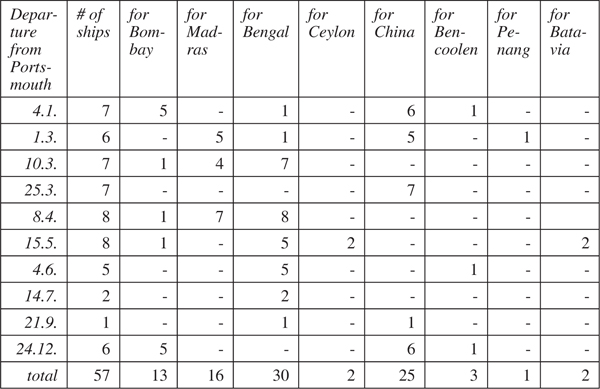
Source: Lloyd’s Register for Underwriters 1813. ‘Ships in the East India Company’s service &c.’ – Several ships intended to trade in more than one port, making the total of destination ports more than 57. Additionally, there were two ships sailing for Australia.
As can be noticed from the table, even if there were 57 ships sailing to the East that year, there were in fact only ten occasions to send mail to Asia as the ships sailed in convoys. Additionally, there were only a few occasions to send mail to each destination. In five of the ten convoys there were ships sailing for Bombay, 13 in total. The ships for Madras, 16 in total, sailed in three convoys in March–April. Almost every convoy included ships for Bengal (Calcutta), 30 in total. The 25 ships for China (Canton) sailed in five convoys.
Content removed from the open access version of this book
FIG. 29. The East Indiamen usually sailed in convoy to minimize safety risks. The heavily armed vessels looked like men-of-war and also acted like them, if needed. This impressive fleet of East Indiamen in the China Seas was painted by William John Huggins, ca 1820–1830. © National Maritime Museum London.
There were also three ships sailing for Bencoolen, Sumatra, one for Ceylon, one for Penang off the Malayan coast, and one for Batavia in Java during the year. If the mail-carrying ship was not sailing directly to China but via India, as usually was the case, the duration of the mails for China lengthened remarkably.
Four of the convoys to the East departed within six weeks in March–April 1812, while there was a five-month period from mid-July to the end of December, when only one ship sailed to Asia.
The duration of sailings varied depending on the weather and navigation, as well as the size and load of the ships, etc. An average ‘double voyage’, i.e. the round trip from London to the Asian ports and back home, took one year and five months.803 This included at least two to three months spent at ports in India, and even a longer time in China.
Only occasional trips were made to Southeast Asia. These journeys were for Batavia, Bencoolen, and Penang. At least two ships made a call at Malacca on their way to China.804
There were no EIC ‘packets’ sailing to India between 1809 and 1814, and only one sailed during the last-mentioned year.805 Thus, the East Indiamen were the only means of sending mail to Indian or other Asian ports in 1812, in addition to the men-of-war. All the EIC ships sailing for China were large, over 1,200-ton vessels, while the size of the ships exclusively for India varied between 500–950 tons. Of the 32 smaller ships, 14 were chartered by the EIC for one, four, six or eight voyages. Most of them departed together on 10 March or 8 April, 1812.806
As Lloyd’s agents in various Asian ports did not normally report the exact sailing dates, and only seldom the arrival dates, even if the arrival itself had been announced in Lloyd’s List, it is not possible to draw conclusions about the time spent at different ports, or the time between a mail arrival from London and the following ship departure. Thus, it is not possible to calculate information circles from the 1812 material. A couple of examples may clarify how business information transmission between Britain and the Asian trading posts worked at that time.
On 1 March, 1812, five large East Indiamen sailed from Portsmouth in convoy, protected by the Navy warship Pique Frigate. Of the East Indiamen the Cuffnells, the David Scott, the Royal George and the Winchelsea were on the way to China via Madras, at which port they arrived on 11 June, after a rather fast 102 days of sailing. The Surat Castle took a route for Penang and from there directly to China. According to maritime intelligence from Madras, the four ships ‘were to sail for China about 25th July’, but due to some unknown delays, they sailed on 16 September.
Further on, we only know about the movements of the David Scott and the Royal George. They were reported to have arrived together at Malacca on 25 October and in China, meaning Canton, on 13 January 1813. The ships were reported to be ‘off Portsmouth’ on 9 August of the same year, and they arrived at Gravesend on 13 August. The two other vessels Cuffnells and Winchelsea had arrived two months earlier, on 7 June, together with the fifth ship Surat Castle, probably having sailed together from China.807
The next vessels to sail for India departed from Portsmouth on 10 March, 1812. They sailed to Madeira in a huge convoy including about one hundred ships bound for the West Indies, South America, Africa, Madeira and East India, and were protected by the warship Loire Frigate. The ships Asia, Astell, Bengal, Earl St. Vincent and Prince Regent were bound for Madras and Bengal. The Chapman and Lady Carrington were on the way to Bombay and Bengal, while the Coldstream and Larkins were headed for St. Helena and Bengal. They were all chartered, medium size Indiamen between 550 and 950 tons.808
The Asia, together with the Earl St. Vincent and Prince Regent, probably also the Astell, arrived in Madras on 13 July, after 125 days of sailing. The Bengal had arrived four days earlier. They all sailed together for Bengal and arrived at St. Helena on their home voyage, being reported to have sailed on 26 November. They arrived at Gravesend on 16 May, 1813, with no reason for the delay given.809
The Coldstream and Larkins had arrived at St. Helena on 3 June and sailed from there for India on 7 July. They departed from Bengal on 27 December and arrived together at St. Helena on 16 March, 1813. Finally, the Larkins arrived at Gravesend together with a convoy including the Cuffnells, Surat Castle and Winchelsea, from China, on 7 June while the Coldstream was accompanied by the David Scott and Royal George, also arriving from China, on 13 August.810
Due to missing information and uncertainties in the newspaper intelligence as a whole, and especially at wartime, we cannot draw many conclusions from the details above. It seems clear that the sailings were conducted purely for trade purposes, including the administrative needs of the company in India, and that the mails arrived when they arrived. It is difficult to estimate whether the ships that sailed directly back to Britain from India without continuing to China could take with them answers to letters sent by earlier Indiamen. At least the ships Asia, Astell etc., which arrived at Gravesend on 16 May, 1813, must have carried answers to letters delivered by themselves on the outward journey as well as to letters delivered by the large Indiamen that had sailed earlier but continued to China. Even in this case the fastest answers were taken home by the same ships which took the letters in the other direction. An answer to a letter for India was thus received in somewhat over fourteen months, and the answer from China in somewhat over fifteen months.811
It was officially stated that it took 180 days on average to send a letter from Britain to India.812 This did not mean, however, that the duration of an average information circle would have been approximately one year. The departures from the destination ports were seasonally limited and even the announced departure dates could be postponed by months. The sailing routes and ports of call varied, and several problems could delay the ship’s voyage. When private traders entered the East Indian markets in growing numbers after emancipation, the slow and very unpredictable system of information transmission had to be reviewed. This took place between 1815 and 1819.
The development after the abolition of the EIC monopoly
The closing of the European ports by Napoleon and the long continuance of the war with France had led to a decline in British trade. For this and several other reasons, the Government made a decision to allow outside merchants admission to the Indian markets. After a hard struggle to postpone the evil day, the EIC finally lost the monopoly in India under the Charter Act of 1813.
Private traders, who had been allowed to ship goods only in the ‘privilege’ space of the EIC ships, were now able to use their own vessels, although they had to be at least 350 tons burthen. In addition, they had to obtain a licence for each voyage from the EIC upon payment of fee, and the ships could only use a few specific ports in India: Bombay, Madras and Calcutta, as well as the port of Penang. Private traders could not ship goods direct from India to the ports of continental Europe, and, to protect the West Indian sugar trade, an extra duty was charged on sugars imported from the East Indies over and above the duty levied on the West Indian sugars.813
Despite the restrictions, private trade proved to be more profitable and extensive than that of the EIC, and a consolidating Act of 1823 declared that this trade might be carried on by British vessels with all places within the limits of the EIC charter, except for China. Finally, the Charter Act of 1833 took away the exclusive privilege of trade with China, too, with effect from 22 April 1834, and by the end of that year the last of the East Indiamen had been sold to new owners.814
Although the war continued till 1815, the number of ships sailing for India more than doubled during the first years of free trade – from 57 in 1812 to 135 in 1815. In 1825, the number of ships sailing for India and other Asian destinations was 220 and in 1832, the last whole year of the EIC monopoly in China, the number of outgoing ships was 280. Additionally, there were an increasing number of ships sailing for Australia, frequently returning via Asian ports. Their number was six in 1815, 50 in 1825, and 114 in 1832.815
The opening up of the Indian market had several consequences and side effects. One was that imports from the mother country increased progressively. For example, whereas 30 British ships entered the port of Calcutta during the 1814–1815 sailing season, this increased to 91 in 1816–1817 and to 132 in 1817–1818. After the war, American traders also frequently visited Calcutta, but not usually the other Indian ports, which were further away. The lively traffic soon caused a glut in the market and the over-heated situation calmed down within a few years. Fluctuations would be typical in the future, too.816
From the business information transmission point of view, one of the main consequences of the changes in market conditions was that the need for communications with Asia quickly increased manifold, while at the same time the only mail carrier, the EIC, withdraw its interests from merchandise in India and concentrated on the China trade. Basically this meant that, although the Company continued to sail to India for its own purposes, sailings were less frequent than earlier and the Company had no interest in carrying mails under the rule of the Post Office.817
Now the Post Office was facing a new situation. The mail service to Asia needed to be organized without high expense, but as fast and reliably as possible. The Post Office never planned to have its own vessels for the Indian route, as it had in the North Atlantic, the West Indies and South America. The Indian Packet Letter Act of 1815 enabled the use of private merchant vessels as packets during periods when there were no EIC ships sailing for the East. These ships had to be carefully chosen from the departing vessels, taking into account Lloyd’s recommendations. Thus, between October 1815 and October 1816, 16 vessels carried official mail from Britain to India. Five of them were naval vessels, four were East Indiamen (with three of them sailing in a convoy together with one of the naval vessels) and seven were private merchantmen. Most of the mails (six out of seven) were carried by naval vessels from India to Britain.818
The system was not very successful. The naval vessels were warships and did not sail for business information transmission purposes. They did not call at all ports needed, but sailed directly from London or normally Portsmouth to Madras and Calcutta. There was also great difficulty in obtaining tenders from private ships for mail carrying, as they did not want any restrictions in their stay in India, the trade there being the main purpose of their voyages. For users, the postage fee for packet letters was considerably higher than for private ship letters. The Act of 1819 finally ended the confusion. All letters to and from India would be treated as ship letters, carried by any vessel, and the charge would be the same, 4d sea postage plus the inland letter rate for landing. Outgoing letters of less than 3 oz were charged sea postage of 2d.819
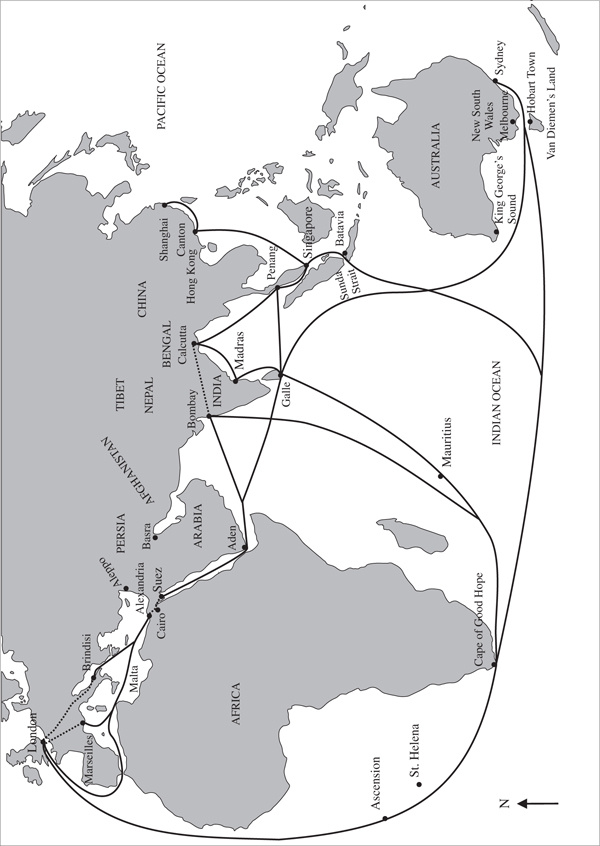
MAP 8. Mail routes to Australasia in the mid-19th century.
Private merchantmen as mail carriers – the forgotten period in postal history
The period from 1819 to the mid-1830s, when the overland route via Suez was gradually brought into use, has remained untouched in the history of communications. Those scholars who study the history of the EIC are generally not very interested in the late period, and postal historians have found it difficult to collect maritime intelligence on the hundreds or even thousands of private merchant vessels. Well known authorities in postal history have even claimed that ‘before 1837 the only means [for letter communication with India] lay round the Cape of Good Hope in ships belonging to the East India Company’.820
John K. Sidebottom briefly mentions private merchantmen as mail carriers in The Overland Mail: ‘…the mail sent via the Cape to India amounted to only 150 bags a year, but, of course, very many more letters went to India without passing through the Post Office. The Cape service – operated by private ships including ‘East Indiamen’ – was roughly a weekly one…’821 The present study is apparently the first attempt to find out how communications, especially from the business information transmission point of view, really functioned between British and Asian ports during that period.
The number of private vessels sailing for Indian ports grew steadily throughout the period between 1812, the last year of the EIC monopoly in India, and 1832, the last year of its monopoly in China. There were annual fluctuations, but the general trend was upwards. British ships dominated the Indian trade. After the Napoleonic wars, other nationalities also took a share of it, however. Vessels under American, French or Portuguese flags could be seen at the port of Calcutta although not often in the other Presidencies. In practice, most mails for Britain and other places in Europe were carried by British merchantmen, naval vessels here excluded.822
Table 65 shows how the number of departures from British ports for Asian destinations grew with the gradual abolition of the EIC privileges.
Although mail carrying was not a business for shipowners, the improved communications undoubtedly served trade, giving more frequent opportunities for information transmission. The more ships there were sailing on the route, the more even was the distribution of departures within a calendar year. While the former East Indiamen had carefully chosen the best winds for their sailings, growing competition forced shipowners to send their vessels out at any time of the year. This naturally meant that there were more ships arriving from and departing for India and other Asian ports throughout the year, and letters could be answered more often.
TABLE 65. The departures of vessels from British ports to India, China & other Asian destinations during some selected years between 1812 and 1832.
| 1812 | 1815 | 1825 | 1832 | |
| January | 7 | 11 | 15 | 11 |
| February | – | 10 | 18 | 19 |
| March | 20 | 2 | 11 | 22 |
| April | 8 | 26 | 13 | 16 |
| May | 8 | 26 | 27 | 28 |
| June | 5 | 8 | 26 | 36 |
| July | 2 | 5 | 22 | 35 |
| August | – | 4 | 6 | 24 |
| September | 1 | 10 | 18 | 21 |
| October | – | 4 | 15 | 27 |
| November | – | 3 | 12 | 15 |
| December | 6 | – | 2 | 3 |
| total | 57 | 109+26 =135 |
185+35 =220 |
257+29 =280 |
Source: Lloyd’s Register for Underwriters 1813, 1816, 1826, 1833; Lloyd’s List of the above-mentioned years, passim. The figures with a ‘+’ are departures, which were published without an exact sailing date. The ships to New South Wales and Van Diemen’s Land are not included in the figures. Their total number was 98 in 1832.
To get a clear picture of how communications worked, how long it took to carry mails from Britain to different Asian ports or to get answers to them, how frequent the traffic was on different routes and what the major problems were, one specific year has been examined in more detail. This year is 1832, the last ‘normal’ year when the large East Indiamen were still in the China service. At that time, merchant vessels offered the only means of sending letters to Asian ports, while steamers had not yet taken on their future role as mail carriers.
The ships sailing from Britain to India or other Asian trading posts, including Australia, in 1832 have been followed throughout their voyages for two and a half years until the end of June 1834, by which time most of them had returned home. Some vessels were still on their way at that time, and several would never return. Many vessels were fast enough to start – and in some cases even complete – a second voyage within the time period. Only the round trips which started in 1832 have been taken into account, however.
By 1832, the number of ship departures from Britain for the Asian and Australian ports – China still being the monopoly of the EIC – had increased to approximately 400 per year. Most of the ships were individually sailing private merchantmen and, as it was peace time, there was no need to sail in convoys. However, ship captains still preferred to sail in company with one or a few other vessels to avoid security risks.823
Due to insufficient data in some 20 cases, 378 of the approximately 400 merchant vessels have been included in this study. Of these ships, 128 sailed for Madras and Bengal and 76 for Bombay. In addition, 37 vessels, 20 of them being large East Indiamen on their last voyages under the flag of the EIC, sailed for China mainly via Indian ports but also directly via the Sunda Straits.824
The Indian trade ports were not the only places of interest east of the Cape of Good Hope. Equalisation of the duty on sugar from Mauritius in the mid-1820s had rapidly increased the export of sugar from that island.825 In 1832, no fewer than 47 ships were reported to have sailed from Britain for Mauritius as their main destination port. But even though the Liverpool merchants often referred to the growing Mauritius sugar trade as an example of the positive consequences of trade emancipation,826 only three of the 47 vessels were in fact from Liverpool. Seven vessels came from Bristol, Glasgow and Edinburgh, and the rest from London.
The Southeast Asian ports were growing rapidly as well. New business opportunities had opened up after the war. Since the EIC expedition to Ceylon in the early 19th century, Colombo had become a frequently used port of call on the way to Bengal. The former Dutch Batavia became an often visited port on the way to and from China and Australia, and the newly established colony of Singapore, ‘founded’ by Sir Stamford Raffles as late as in 1819 and belonging to the British crown from the early 1830s, was visited by no fewer than 62 British vessels in 1832. 17 vessels also sailed for Manila in the Philippines.827
There was fast development in the Australian colonies, New South Wales and Van Diemen’s Land, too, even though there was not much basis for any serious trade yet. After the United States gained independence in 1775, Britain had started to transport convicts to Australia. By the 1820s, the number of penal transports had increased significantly, and in the census of 1833, no fewer than 40,000 people out of the total Australian population of 60,000 were convicts. The rest consisted of free emigrants, 10,000 of them being children under 12 years old. Some British administrative and military groups need to be added.828
The Australian colonies did not offer attractive business opportunities compared with the Asian countries. The purchasing power of the population was very limited and there was little to export.829 The growing need for manufactured articles from Britain and the export of wool, together with the continuing emigrant and convict transports, nevertheless increased the traffic considerably.830
There were thus several types of business going on in the Indian Ocean in the early 1830s. In addition to the traditional East Indiamen sailing for India and China, there were private merchantmen on their way to India or some of the Southeast Asian ports. There was the Mauritius sugar trade and the various ships for Australia, many of which were carrying emigrants or convicts and arriving back home via different Asian ports.831
To differentiate these businesses, it may be useful to examine the sailings by the homeports of vessels. Before the emancipation, the trade with India and other related Asian ports was dominated by London, as the city was the domicile of the EIC. After 1815, Liverpool took a notable share of the Asian trade. Glasgow participated with a smaller share, while the other British port towns only sent a few vessels to Asia each year, if any.
By 1832 London had lost approximately a third of the Asian shipping business to its rival ports. One quarter of the sailings now departed from Liverpool. The other British ports together accounted for less than 10% of the sailings.
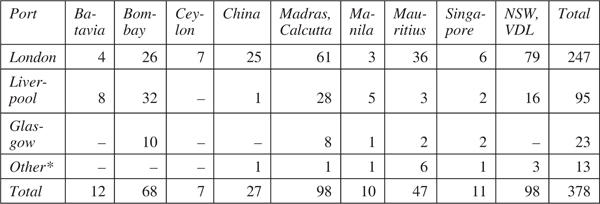
Table 66 shows that Calcutta was considered the most important destination by the London merchants. The Bengal area was still the cornerstone of the EIC, and would be for 25 more years. But the Liverpool merchants and shipowners were now equal with London in the Bombay trade, and they had taken a remarkable share of the business in Madras and Calcutta. No fewer than 60 vessels from Liverpool sailed for India in 1832 – more than one per week on average.832
TABLE 66. Asian and Australian trade in 1832, number of departing British ships by home port and destination.
Source: Lloyd’s Register for Underwriters 1833; Lloyd’s List, 1832–1834, passim.
* ‘Other’ includes three vessels from Edinburgh, four from Bristol, three from Greenock and one from Hambro. Two ships sailed from Plymouth and Portsmouth, originating probably from London.
London clearly dominated in terms of trade volumes, and even more in terms of values. The total tonnage of the vessels sailing from London to Madras and Calcutta in 1832 was 32,150 tons and to Bombay 12,740 tons. The corresponding figures of Liverpool were 9,350 tons and 12,740 tons respectively.833
The average vessels sailing from London to the different Australasian ports were nearly 400 tons on average, even if the large East Indiamen of over 1,200 tons are excluded. The average Liverpool vessels were approximately 330 tons, while the ships of other ports were even somewhat smaller. Typically, the ships for India were larger – over 400 tons on average – than those sent to Batavia or Manila, which were only 240–280 tons on average. The smallest ships of fewer than 200 tons were mainly for sailing to the Australian colonies or Mauritius, which probably showed that the trade carried on with these places was not at the same level of sophistication as that carried on with some more important areas.834
The difference in the value of imports was striking. On the India route, London dominated the trade in the very high valued silk and indigo – which had traditionally been part of the EIC monopoly, even after the gradual abolition in the 1820s – as well as most of the coffee, also importing two thirds of the saltpetre, three quarters of the sugar and 70% of the pepper. Liverpool thus had a minor share of these imports, and about half of the quantity of the low valued rice and cotton. London’s share of the official value of imports from India in 1830 was £2,681,730 and Liverpool’s £333,710. Additionally, all bullion was shipped to London, worth some £815,000. In total, the value of imports to London was more than ten times that to Liverpool.835
Although the value of the Liverpool shipping for India was clearly inferior to that of its wealthy London rivals, communications with India benefited considerably from the fact that there were 147 ships sailing for India during the year instead of just 87. In addition, the ships from London often stayed for a long while at port in Portsmouth or Plymouth before sailing out, thus extending the length of the voyage. At least 36 vessels called at these ports on their way to India and stayed there for more than ten days on average before starting the voyage. Even if there was an ‘express’ mail from London to Portsmouth and Plymouth, the letters which were sent while the ship was at Gravesend or Deal were already two weeks old when she left the coast of England. Liverpool ships sailed out directly.836
The hard competition had considerably shortened the duration of sailings compared to the days of the EIC monopoly. The fastest journeys between Britain and India were made in fewer than 100 days, the records in 1832 being 83 days from London to Madras, 98 days from London to Calcutta, and 93 days from Liverpool to Bombay. The fastest sailings homewards were about two weeks longer in each case.
An average sailing from Liverpool to Bombay took 125 days and the home voyage 128 days in 1832–1834. An average sailing from London took 134 days while the home voyage took 130 days.837 Even the slowest sailing, 174 days from Liverpool to Bombay, was shorter than the average sailing of 180 days two decades earlier. The figures include stops for watering and provisions.
The same improvement in speed could be seen in the round voyages. While the fastest East Indiamen had returned from India in about 14 months before the abolition of the monopoly, the fastest round trip was now made in somewhat over eight months, the record Liverpool–Bombay–Liverpool round trip taking 246 days.838
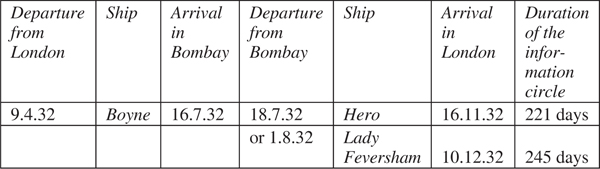
Due to the frequent traffic that had arisen between Britain and India, the information circle was easily shorter than the duration of a round trip by one specific vessel. In the best case, it could work in the following way:
TABLE 67. An example of fast information transmission by private merchantmen between London and Bombay, 1832.
Source: Lloyd’s List, 1832.
Thus the combination of faster sailings and more frequent departures at both ends of the journey enabled a major improvement in business information transmission. Although the record trip by the ship Boyne has been taken as an example on purpose, the homeward sailings were about average in length. A merchant who wrote letters to his business partners in Bombay in early April, now received answers in mid-November or early December – probably half a year earlier than before.
Due to missing dates, especially concerning the Bombay arrivals, it is not possible to calculate the average length of information circles. An average round trip – from home port to home port – was 309 days, i.e. some ten months, and remembering that all ships had to use about a month for unloading and reloading in Bombay, the average information circle must have been fewer than 300 days. Answers to letters left Bombay sooner than the ship in which they had been carried.
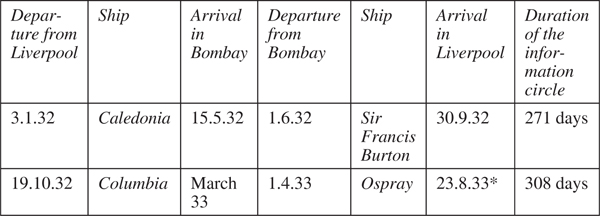
There was still plenty of variation in the duration of information transmission. Even if the system now enabled two information circles in 20 months or less, their length varied significantly, as can be seen in Table 68.
TABLE 68. Consecutive information circles enabled by private merchantmen between British ports and Bombay, 1832–1833.
Source: Lloyd’s List, 1832.
* Arrival in Glasgow.
Not only had sailings become faster but port stays had also shortened radically. The average stay in Bombay – in the cases where both the arrival and departure dates were reported – was 30 days, if two extra long 76-day stays for unknown reasons are excluded. The ships also sailed quickly from Britain, some vessels being on the way back to Asian waters before the end of 1832. Not only information but also freight and capital moved faster than ever earlier.839
An average voyage from Britain to Madras took 118 days and back home in 126 days, while an average voyage to Calcutta took 137 days and back home in 141 days.840 The differences were due to the varying lengths of sailing routes, and obviously the ships were also more heavily loaded on the way homewards.
While the ships often called at Madeira or the Cape on the way to the east, it was common practice to call at St. Helena on the home voyage. It was from there that most shipowners and merchants learnt that the vessel they were waiting for would soon be arriving. Even if the ships did not stay long at St. Helena – normally only a day or two – some of them sailed home faster and could tell news of the ships coming behind them. The last leg of the voyage from St. Helena to England took approximately two months on average – 59 days calculated from 124 voyages – but the variance was great, from 39 to 90 days.841
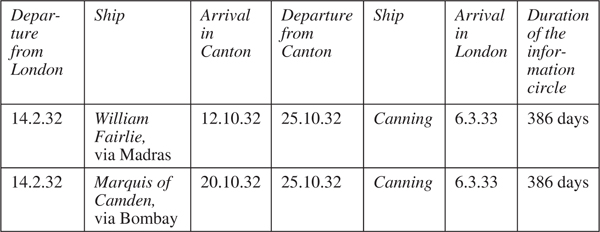
While information transmission with India had improved remarkably, the opportunities for communications with China still remained much the same as before. While the private merchantmen sailed to India in some four months on average, the record being less than three months, the trip to China via India took 7.5 months (224 days) on average.842 As can be seen from table 69, there was no difference in the duration of information circles depending on the route in India.
In real life, information transmission from London to Canton probably did not take the eight months indicated above. For example, the William Fairlie arrived in Madras on 1 June and there were certainly country ships departing for China before the large vessel from Europe was ready to proceed. The problem, however, was that there were no ships leaving from Canton to Europe with answers before the sailing of the Canning on 25 October.
TABLE 69. An example of information transmission by the East Indiamen between London and Canton, 1832–1833.
Source: Lloyd’s List, 1832–1833.
Starting from the late spring of 1832, the sailings of the large East Indiamen were rapid and direct, with no interruptions apart from the stop at St. Helena on the home voyage. The Company was in a hurry, and the duration of the round voyages of the last vessels sailing directly via the Sunda Straits to China was only a year on average, the record being 10.5 months only. The last four sailings from London to Canton took no more than 107 to 117 days. While the average home voyage directly from Canton to London took 125 days, the fastest sailing homewards took only 116 days.843
The main problems in business information transmission between Britain and China were the seasonal character of the sailings (most departures took place during the first half of the year), the complicated routes (most ships sailed via India, where they stayed at ports for weeks or even months) and the long passages.
The size of the vessel had surprisingly little to do with the duration of the voyage. The emancipation of the Asian trade had drastically increased the number of small ships on the Asian routes. Table 70 shows the change in ship sizes on the Asian trade routes from 1812 to 1832. As can be seen, almost all vessels on these routes were more than 500 tons in 1812, but 20 years later more than 70% were less than that. Simultaneously with this development, however, the average speed of information transmission increased remarkably, as has been shown above.
TABLE 70. Ship sizes on the Asian trade routes in 1812 and 1832, excl. Australia.
| Ship size, tons | % of vessels, 1812 (n=56) | % of vessels, 1832 (n=280) |
| 100–499 | 1.8 | 71.0 |
| 500–999 | 55.3 | 22.0 |
| 1000–1499 | 42.9 | 7.0 |
Source: Lloyd’s Register for Underwriters, 1813 and 1833.
Contrary to some earlier assumptions, the large East Indiamen of 1300 to 1400 tons were not slow, but sailed rapidly if there was a need for that. However, a small 294-ton merchant vessel from Liverpool could manage the route within approximately the same time, as can be seen from Table 71.
TABLE 71. The fastest sailings from Britain via Anjer (Sumatra) to China, 1832.
| Departure port | Departure date | Ship, size | Arrival date in China | Days at sea |
| London | 1.5.32 | Lord Lowther, 1332 tons | 16.8.32 | 107 |
| London | 25.5.32 | Earl of Balcarras, 1417 tons | 13.9.32 | 111 |
| London | 25.4.32 | Edinburgh, 1335 tons | 17.8.32 | 114 |
| London | 25.4.32 | Berwickshire, 1332 tons | 20.8.32 | 117 |
| Liverpool | 10.6.32 | Walter, 294 tons | 6.10.32 | 118 |
Calculated from Lloyd’s List, 1832–1833.
Yet small ship size was not generally a special advantage either, even if mail packets were normally small compared to the large merchantmen. In fact, the main benefits of small vessels in mail service were probably mainly financial. They sailed with a smaller crew and were fast to load and unload.
On the route to Australia, all ships weighed less than 550 tons, and more than 40% of them were less than 300 tons. Of the smallest vessels, only two were among the 12 fastest, while six of the 26 largest ships of 401 to 500 tons were among the fastest. An average outbound voyage took 138 days and an average homeward voyage 156 days, probably due to different routes and stays at port.844
TABLE 72. The size and speed of vessels on the Australian route, from Britain to New South Wales and Van Diemen’s Land 1832.
| Size, tons | Number of ships | Number of this size of shipsamong the 12 fastest |
| 150–300 | 38 | 2 |
| 301–400 | 28 | 4 |
| 401–550 | 26 | 6 |
| Total | 92 | 12 |
Calculated from Lloyd’s Register for Underwriters 1833 and Lloyd’s List 1832–1834. The total number of vessels was 98, but the size of six remained unknown.
A few further records show even more variety. On the Calcutta route, the fastest sailing from London took only 98 days by the 1,333-ton East Indiaman Macqueen. The 650-ton Duke of Northumberland sailed from Portsmouth to Calcutta in 105 days and back to London in 116 days. The 360-ton Samuel Brown of Liverpool sailed for Calcutta twice in 1832. Her first sailing outwards took 113 days and the second 115 days. The 282-ton Collingwood sailed from Liverpool to Calcutta in 111 days.845 The duration of the voyage seemed to depend less on the size of the vessel and more on factors such as the load, the skills of the captain and his men, and especially the weather.846
Merchant ships as news carriers
By 1832, Lloyd’s List was publishing maritime intelligence from distant Asian ports more often and more accurately than earlier, partly because of growing interest but also as a consequence of improved communications. The intelligence was now received in London faster and more frequently than earlier, enabling a better news service for readers.
To illustrate how the news from different Asian ports reached British interest groups, a few cases have been picked out from the maritime intelligence published by Lloyd’s List during the period in question.
The 666-ton James Sibbald, commanded by Captain Darby, had sailed from London for Calcutta on 14 June 1832, arriving at Bengal on 2 November. The news of the ship’s arrival was brought to England by the Duke of Lancaster, which sailed from Sand Heads (off Calcutta) on 1 December. She arrived in Liverpool on 25 March and those who waited for news about the James Sibbald found the needed information in Lloyd’s List on 29 March, together with news about several other ships which had arrived in Calcutta before 1 December. It took the Duke of Lancaster 114 days to sail to England and the news about the arrival of the James Sibbald was 147 days old when published.847
By the time the owners in Britain learnt the good news about the ship’s safe arrival in Calcutta, things had changed drastically in India. The following information about the James Sibbald arrived rather soon after, brought by an unknown vessel which had arrived at Bordeaux. The news, dated in Paris on 14 April, read shortly: ‘The James Sibbald, Darby, from Bengal to London, is lost on Point Gordewain, entrance of the Coringa Bay. Crew and Passengers saved.’848
What had happened? Was the ship really a total loss? Where were the crew and passengers? There was news arriving by different ships from India, but it took almost two more months to learn the whole story.
The next news about the ship came by the Lady Flora, which had sailed from Madras on 10 January. She landed the mails off Margate on 27 April and arrived at Gravesend three days later after 110 days of sailing. The short news report, dated on 9 January, read: ‘The James Sibbald, Darby, from Bengal to London, grounded on a Sand Bank off Coringa Point 29th ult. and there is but little hope of saving her either the ship or cargo. The Passengers had arrived at Masulipatam.’849 This information was 112 days old when published. After this, nothing more was told about the passengers. However, the fate of the ship and cargo was important, and the reporting continued.
The following news came by the Duke of Buccleugh, which had sailed from Calcutta on 14 January. Dated two days earlier at that port, the story read: ‘By last advices from the James Sibbald, which got on shore about 15 miles below Coringa 28th ult. she was being lightened, in the hope of getting her off.’850 The Duke of Buccleugh sailed from Bengal via the Cape of Good Hope and St. Helena in 113 days and the news was 115 days old when published. However, it showed that the agent in Calcutta did not know well enough what happened at Coringa Bay. Although the news was the most up-to-date at the time, it would turn out to be too optimistic.
The following piece of news gave a different view: ‘Madras, 3d Jan. The James Sibbald, from Bengal to London, on shore on the Coast, is full of water. About 1000 chest of indigo, with some other portions of cargo have been saved.’851 The London, which carried the news, had sailed from Madras nine days later than the agent had dated his report. She was a large East Indiaman of 1,332 tons, probably heavy loaded. She was reported off the Wight on 5 May, but the news was published as late as on the 10th, 128 days old. For the owners, this was good news, however. One thousand chests of indigo were worth some £45,000 while the value of the ship must have been considerably less.852
The fate of the vessel was clarified in Lloyd’s List 11 days later: ‘The hull of the James Sibbald, wrecked off Coringa, was to be sold 15th inst.’853 This news, dated on 21 January in Madras, arrived by the Coromandel, which was reported arriving off the Wight on 18 May. The ship had sailed from Madras on 24 January and arrived at Gravesend on 24 May.854 Despite the fact that Lloyd’s List was published only twice a week at the time, news was often published before the ship carrying it had de facto arrived at the homeport. In this case, the news seems to have been landed ‘off the Wight’.
And the final news about the wrecked vessel was reported in Lloyd’s List on 14 June, two months after the first news about her accident, and 5.5 months after it happened: ‘The cargo saved from the James Sibbald, wrecked off Coringa, has been reshipped per Charles Eaton, Fowle, arrived at Madras.’855 This news had been sent by the Wellington, which sailed from Madras on 24 February, and it was 110 days old when published.
The story is a good example of how news arrived, not only slowly but sometimes also in a confusing order. The mails bearing news of the disaster were carried by six different ships which sailed from India within 1.5 months. The first piece of news, arriving from Paris, was short but quite correct, and the rest was additional information. Lloyd’s List seems to have published everything they heard about the ship, even contradictory information. The paper never made a complete story about the disaster. There was no space or need to return to the matter. The readers could draw their own conclusions.
Another example tells about several British vessels which got into trouble in a severe storm at Bengal in May 1833. The interest groups – whether they were owners of the ships and their cargoes, underwriters, family members of the crew and the passengers, or anyone who had an interest in the ships’ fortunes – received the bad news by a Lloyd’s List report published on 1 October:
‘Calcutta, 24th May. A severe Gale commenced here on the evening of the 20th instant, and continued with great violence for 24 hours. The Duke of York, Locke, from London & Madras, is high on shore about half a mile to the southward of Hedgellee Creek. The Lord Amherst, Hicks, bound to London, is stranded abreast of Kedgeree Light House, and reported to have broken her back. The Eamont, Nash, bound to Penang, Malacca and Singapore, is on shore and bilged a little below the same place, and within a cable’s length of the General Gascoyne, Fisher, bound to Mauritius, which is said to be also bilg’d. The Robert, Blyth, bound to Liverpool, is high and dry above Kedgeree; and it is feared that they may all be considered as wrecks. – The Sultan, Mitchell, bound to Mauritius, it is hoped has got to sea, altho’ there are apprehensions entertained of her either having foundered or gone on the Sand, in which case all hands must have perished.’
The report continues in the same Lloyd’s List issue: ‘Calcutta, 25th May. There is a probability of the Robert being got off; but the hopes of saving the other ships are very faint. No doubt a large portion of their cargoes may prove uninjured. Two people have been washed on shore from the Sultan, who report that they were blown from her at the instant after her masts went, but nothing is known of her afterwards. All concur that this Gale was more violent than any other in recollection.’856
The news must have been brought by the Lord William Bentick, which arrived from Bengal on 29 September.857 She was a convict ship, which had sailed from Hobart Town via Batavia and Madras to Calcutta and was now on the way back home, having been out for 17 months. She sailed from Calcutta on 3 June, and was the first ship to enter Britain with the news about the storm damage. For information transmission, any vessel which was on the way homewards was good enough. The news was 130 days old when published, but the freshest available. A duplicate of the report might have been carried by the Bengal, which departed from Calcutta on 24 May, 1833, but the ship arrived in London as late as on 4 November.858
It took several weeks before any additional information about the disaster in Calcutta was received by arriving ships. On 8 November Lloyd’s List reported:
‘The Duke of York, Locke, from London; the Lord Amherst, Hicks, bound to London, and the Eamont, Nach, which were driven on shore near Calcutta in June, have been condemned. The Robert, Blyth, bound to Liverpool, and the General Gascoyne, Fisher, bound to Mauritius, which were driven on shore at the same time, would be got off.’
This news was carried by the Hooghley on her home voyage from a relatively efficient round trip to India. She had departed from London on 4 December, 1832 and arrived in Calcutta on 19 April 1833 from Madras. In June she departed homewards and on 6 November she was reported at Deal, where she also landed the mails.859
In November, more news arrived concerning the wrecked vessels: ‘Mauritius, 26th July. The Samuel Brown brings accounts that the Genl Gascoyene, bound here, which was on shore in the [river] Hooghley 2d June, was proceeding to Bengal to be docked and repaired.’860 ‘Liverpool, 17th November. The Robert, Blythe, bound to Liverpool, ran on shore in the Hooghley, was got off previous to 23d June.’ ‘Kedgeree, 17th June. The General Gascoyene, Fisher, bound to the Mauritius, floated at high water.’861 And ‘Calcutta, 24th June. The General Gascoyene, Fisher, bound to Mauritius, which was on shore in the Hooghley, has put back here.’862
It remains somewhat uncertain by which ship the news from Mauritius was brought to England. The tiny Clorinda, only 183 tons, arrived from a long voyage to Hobart Town, Sydney, Singapore and Mauritius on 18 November. She had left Mauritius on 28 July, two days after the letter to Lloyd’s List had been written, and probably landed the news on her way to Glasgow a few days earlier.863
Both the pieces of news published on 18 November were brought by the Janet, also on the way to Glasgow, on her way home from Manila, Singapore and Calcutta. The reports were received at Liverpool, maybe from Holyhead by the optical telegraph, and forwarded to London.864 The carrier of the news published on 22 November cannot be identified due to a lack of maritime intelligence.
The final results of the incident could be read in Lloyd’s List on 10 December, almost 2.5 months after the first distressing news about the incident had been published: ‘Bengal, 23d July. The Lord Amherst, Hicks, has not been got off, being broken, bilged, totally dismasted, and filling with the tide.’ And ‘The Eamont, hence to Singapore, has been sold, with the cargo, as she could not be got off.’
This news had been dispatched by the Patriot King, a regular trader from Liverpool, already on her second voyage to India within the examined period. She left Calcutta on 2 August and was reported arriving at Milford on 7 December. She arrived in Liverpool on 16 December.865
The examples clearly show the great diversity of the mail-carrying ships, but also how useful it was from the information transmission point of view that there were many vessels sailing home from Asian waters throughout the year. Even though the length and routes of the sailings varied, the ships carried complementary news. Any ship could be a news bringer, if not for a specific merchant, at least for the business community as a whole. As all these ships were considered mail carriers by the Post Office, we can assume that important business letters were also carried by the same means as the Lloyd’s agents’ reports for the newspaper.
To highlight the difference between information transmission on the frequently sailed India route and on the China route (still the monopoly of the EIC), one more example might be useful. On 9 April, 1833 Lloyd’s List published the following piece of news:
‘Singapore 8th Nov: The Moffat, Cromartie, [a smaller East Indiamen of 820 tons] from London to China and Halifax, put here 6th instant, with loss of main and mizzen masts, and having sustained damage during a Gale in the China seas, which commenced on the 22d and continued till 26th ult. (Mem. It was expected that the Moffat would be ready for sea about 28th Nov.)’
Four weeks later Lloyd’s List reported that the Moffat had arrived in China on 10 January. Two weeks later the paper published contradictory news: ‘The Moffat, Cromartie, from London, which put into Singapore and was stated in the List of 7th inst. to be arrived at China on the 10th January, had not arrived there on the 26th of that month.’866 This was alarming, as the sailing from Singapore to Canton normally took only eight to ten days.
All these news items were carried to England by East Indiamen on their way back home. After the Earl of Balcarras had left Canton on 26 January without any information about the damaged Moffat, no vessels sailed from China for a month. In fact, the Moffat had arrived in Canton only three days after the departure of the Earl of Balcarras but the news about the happy turn of events did not reach England before the arrival of the following East Indiaman, the Reliance, in mid-June.867
The last example shows that even if the sailings from China by the large East Indiamen were not necessarily longer than by the ships from India, the long periods between the sailings caused unnecessary delays in information transmission. This would gradually change when trade with China was opened up in the following year.
The total number of mails carried by private sailing ships via the Cape was remarkable. In 1833, the Post Office statistics recorded 3,725 bags of mail for India, carried by 427 ships from 17 British ports.868 Against these figures, it was not surprising that the pressure for faster communications with Asia would grow both in England and in the East
Steaming via the Cape of Good Hope vs. the Overland route
The first attempt to establish a steamship service between England and India took place in 1825, when the steamer Enterprise was taken from Southampton around the Cape of Good Hope to Bengal, sponsored by the wealthy merchant houses of London and Calcutta. The 479-ton ship was built especially for the venture. Her journey was made only six years after the first eastbound Atlantic crossing by the Savannah, with very similar results: although the trip was technically successful, the effort turned out to be a commercial failure. Instead of the planned 70 days, it took the vessel 113 days to reach Bengal. The ship ran out of coal and had to proceed under sail for more than half of the voyage.869
The Enterprise was never taken back to Europe again. She remained in the Indian Ocean, mainly at Bengal, but was evidently also used by the EIC as a contemporary mail carrier between Bombay and Suez from 1826 to 1833.870
By chance, the Enterprise was piloted up the River Hooghly by a Thomas Fletcher Waghorn, a former naval officer now working for the EIC. He was convinced that the future of communications with Europe lay in steam propulsion, but soon realised that a shorter and more profitable route should be found for the service. Between 1826 and 1830, Waghorn was actively advocating, first in India and later in England, the idea of establishing a fast steamship service from England to Egypt to link up with a similar service from Suez to India.871
The overland route was not a new innovation; it had been in limited use since the early 17th century. There were in fact two alternative routes: one connecting the Mediterranean and the Persian Gulf via Aleppo, Baghdad and Basra; and another one connecting the Mediterranean and the Red Sea via Alexandria and Suez. By the late 1650s, the EIC had developed a custom to send overland letters from India to London every summer, usually in August, to advise of the safe arrival of ships, of the expected state of the market, of the plans for the next outbound fleet and of the amounts of Indian commodities to be purchased before the rains. The route may also have been used for sending duplicates of letters carried homeward by ships around the Cape of Good Hope. The Overland route was used in both directions.872
The EIC sent their own dispatches via the Persian route, from London via Marseilles (or Leghorn), Aleppo and Basra (or Gombroon) to Surat in India. The transit took at least six months, but eight months was more usual and over ten months was not at all uncommon. It was often difficult to find a safe means of communication through the different war arenas in Europe, while the Middle Eastern deserts rife with plague, invasions and raids were dangerous as well. Although the Red Sea route had been considered a number of times in the 17th century, nothing had happened by the end of the 18th century due to the resistance of the EIC, which wanted to stick to its old traditions. The Red Sea route was probably faster, but it was not safer or more regular, and it was generally condemned as hot, mysterious and distinctly unhealthy.873
When Thomas Waghorn advocated direct steamship communications between England and India via Egypt, he unwittingly aroused strong feelings among the different parties. The EIC offered limited support but little financial backing, while the British Post Office rejected most of his proposals out of hand. The Anglo-Indian merchants had differing opinions. The Bombay Government and mercantile community had nothing against the idea, as the Overland route would have brought Bombay, on India’s west coast, 1,000 miles closer to England than either of the east coast ports of Calcutta and Madras. The merchant houses in London and Calcutta, then the hub of India’s political, economic and military life, were for a direct steamship service to Bengal, via Suez or around the Cape.874
Fighting against the time of changes
The EIC was naturally not very interested in supporting anything that would mean better business communications for its rivals who had actively fought against the Company’s privileges in India and elsewhere. The Government of Bombay, in close intimacy with the Bombay mercantile interests, pressed the EIC in the 1820s to open up a steamship route from Suez to the Red Sea and eastward across the Arabian Sea to Bombay. The Company finally agreed to supply the engine for a wooden steamer built in the Government shipyard at Bombay. The ship, tactfully named Hugh Lindsay after the Chairman of the Court of Directors of the EIC, was launched late in 1829. She made her maiden voyage in the following March from Bombay to Suez in 33 days. The costs of this and later voyages by the vessel were so high that the EIC forbade any further steam trips to the Red Sea.875
In fact, the Company was not interested in improving even its own information transmission. A deeper look at the EIC’s General Correspondence from Bengal, Madras and Bombay to London, sent in 1832–1833, presents a striking picture of the Company’s general attitude towards communications between East India and the mother country.
C.H. Philips has examined the communications process of the EIC in his general study of the Company in 1784–1834. According to him, Lord Ellenborough, President of the Company’s Board of Control from 1828, made several efforts to improve the speed of communications between India and London. Having been appointed President, Ellenborough was shocked to find that the home government was only dealing with events that had taken place in India over two years before. In his view, London had abandoned effective control over the Indian Governments, and he ‘determined to remedy the evil without delay’. As Philips puts it, ‘the first and obvious step was… to establish steam communication between India and England via the Red Sea… The ‘chairs’ adopted his suggestion and within ten years a monthly service by this new route was established.’876
Ellenborough also turned his attention to the system of preparing dispatches in reply to the letters of the Company’s Governments in India. Under the existing system the latter sent home all information in huge, general letters, which took a considerable time to prepare and included both trivial and important matters. No attempt was made in London to deal with the more important matters first. Instead, all subjects were replied to paragraph by paragraph in strict numerical order. The system was certainly slow and clumsy. Simultaneously, the number of folio volumes received from India grew every season, without any increase in the staff which would take care of preparing the drafts.877
Ellenborough estimated that one year would be time enough to send and receive an answer to a dispatch between London and India. He made four suggestions, namely that 1) both the Board and the India House should increase their staff, 2) the method of conveying information through huge general letters should be replaced by one in which each subject was to be dealt with in a separate letter, 3) an abstract of each letter should be written on the cover so that the home government could deal with the more important letters first; and 4) all consultations to be sent home should be lithographed, thus saving the time involved in copying them by hand at the India House. According to Philips, Ellenborough carried through his proposals despite strong opposition by the ‘chairs’, achieving a beneficial increase in efficiency and dispatch in the system of correspondence.878
A closer look at the Company’s General Correspondence of 1832–1833 in the India Record Office, British Library, gives a rather conflicting picture of the overall efficiency by which the improvements were carried through. A portion of 1,422 letters from Bengal, Bombay and Madras show clearly that there were major differences in the communications culture of the three presidencies. Calcutta was the most phlegmatic in its communications. Letters written in Fort William frequently waited for months at port before a ship to England took them on board. E.g. the ship Isabella dispatched 31 letters written in Calcutta between April and November 1832 when arriving in London in early April 1833. The Georgiana dispatched 29 letters written in Calcutta between July 1832 and March 1833 when arriving in London in early September, 1833.879 Even if these are extreme examples, it is hard to understand why the letters were not put on board earlier departing vessels.
As can be seen in Table 73 (in the end of the book, p. 429), most ships carried letters which had been written over a period of several months. On the other hand, it can be noted that letters written during one and the same month were carried by several ships; e.g. the letters written in Calcutta in December 1832 were taken to London by 12 different vessels. In reality, the number of letters was larger than can be observed from the table. The correspondence in the EIC records includes first copies, duplicates or triplicates of letters, depending on which one arrived first. In most cases, there is a handwritten note ‘Read in Court’ with a date close to the date when the letter was received, indicating that this was the first copy that arrived.880
The EIC preferred to send the letters by ships which were chartered by the Company, or which had formerly been in its service. Of the 24 ships in Table 73, no fewer than 18 were or had been chartered by the Company. Letter copies sent by several vessels proved to be a useful system, as two of the ships were wrecked during the home voyage. As can be seen, the vessels often sailed close to each other, due to safety reasons and old tradition. As a result, there were long periods when no letters arrived from Bengal with EIC correspondence: two months in the spring, another two months in the summer and several one month periods in the autumn.
The table shows that the letters (both originals and copies) were collected in ships which were loading at port, without any knowledge of their actual departure dates. Many vessels carried letters to London which had been written even before the ship had arrived in Calcutta. The ‘ranking’ of how the first, second and third copies were divided between the ships for England seems to have depended on the expected departure date, as well as the reputation of the ship, its Captain and its owners in the eyes of the EIC officials in Calcutta.
The latter principle meant that e.g. the Liverpool ships were excluded. Of the nearly 700 received letters in the EIC General Correspondence, sent from Bengal in 1832 and 1833, only one was carried by a Liverpool vessel. This was the Hindoo, owned by the prosperous Brocklebank family of Liverpool. The letter, an original dated on 25 June, 1833, must have been important as it was sent by the next possible vessel. The Hindoo sailed on 8 July.881
Even in the best case, there was usually at least one week’s lag between the date of the freshest letter and the ship departure from Bengal, probably due to the time-consuming trip in the river Hooghley from the Docks of Calcutta to Sand Heads at the Bay of Bengal, near Kedgeree, from where most ship departures we are reported.
There is an astonishing difference in the total speed of information transmission if we compare the EIC mails with the news sent by Lloyd’s agents from Bengal to England during the same period,882 partly by the same ships on the very same journeys. For example the Hooghley, which carried to Lloyd’s List the news that the ships Duke of York, Lord Amherst, and Eamont, driven on shore near Calcutta, had been condemned in June, arrived in early November after a rather slow trip of 146 days. But the age of the letters which the ship carried simultaneously for the EIC varied between 163 and 274 days. The fastest vessels which brought Lloyd’s news in the examples did not seem to carry EIC letters at all, even though some of them did on an earlier or a later voyage.
Despite Lord Ellenborough’s efforts to speed up the EIC communications between India and London, letters from Calcutta did not always follow his instructions. Instead of writing a separate letter on each issue – although this did often happen – the reports could just as well include two to four hundred carefully numbered paragraphs, all written by hand, extending up to 200 pages.883 A long memorial by Sir Charles Metcalfe to the Court of Directors in London, dated on 24 July, 1832, included answers to 38 earlier letters from 11 May to 10 August 1831, plus one from 4 November 1831. His topics covered Bombay, China, Company’s Servants, College, Miscellaneous, Marine, Navy, Post Office, Public Instructions, Pension, Profit & Loss, Prince of Wales Island, Singapore & Malacca, Telegraph, Vaccination and Law – in nearly alphabetical order. The letter was received in London by the ship Juliana on 23 December, 1833.884 Thus, the Court received answers to their questions sent two and a half years earlier.
The communications from London to Bengal were no faster than in the other direction. Although the draft books of the Company in the India Record Office do not include information about the ships by which the letters were sent and thus no indication of how long it took to receive them, the contents give some idea of the speed of the EIC communications as a whole.
With reference to the figures above, it is no wonder that the Company had no interest in investing in faster communications between London and Calcutta. Its own system of communications was so outdated that there was really no significant difference whether a letter was received one or two months earlier or later.
In Bombay, the culture was rather different. As can be noticed from Table 74 (in the end of the book, p. 430), most ships stayed in Bombay for a shorter period than in Calcutta, and letters were not kept waiting for so long. Even though the duration of the sailings from Bombay to London was approximately the same as from Calcutta, the letters from Bombay were never older than ten months on arrival. The usual time lag of the Bombay letters was six to eight months, while from Calcutta several letters were more than 12 months old when received in London. In the best cases, communications from Bombay worked really well: for example the letters written on 23 January, 1833 arrived in London by the Lady Raffles on 24 May, 1833, in 121 days.
TABLE 75. Time lag between writing letters and drafting the answers between London and Bengal, the East India Company, 1832.
| Date of writing the draft in London | Answer to a letter from Bengal | Date of the letter(s) now answered | Time lag between writing the original letter and writing the answer |
| 4.7.1832 | Territorial Finance Department | 20.6.1831 | 380 days |
| 4.7.1832 | Commercial Department | 28.9.1830 | 645 days |
| 4.7.1832 | Commercial Department | 6.7.1830 | 729 days |
| 11.7.1832 | Public Department | 1.11.1831 | 253 days |
| 25.7.1832 | General Department | 27.4.1830 22.9.1830 26.10.1830 8.3.1831 31.5.1831 |
820 days 672 days 638 days 505 days 421 days |
| 1.8.1832 | Law Department | 8.2.1831 | 540 days |
Source: The EIC, General Correspondence from London to Bengal, E/4/ 735 (BL: IRO).
Where did the difference derive from? Ever since the emancipation of the East Indian trade in 1813, Bombay had been more open to private merchandise, while Bengal had been more strictly under the old rule. No fewer than 22 of the 31 sailing vessels which brought EIC mails from Bombay, dated between January 1832 and June 1833, were private merchant vessels without any connection to the Company, and none of them sailed under a valid EIC charter.885
Of the 436 Bombay letters of that period, no fewer than 90 were carried by Liverpool vessels.886 These dispatches arrived in England by three vessels at the end of the period, in March–April 1833. The Cordelia brought no originals, but ten duplicates and six triplicates; the John Taylor carried five originals, two duplicates and 25 triplicates; and the Royal George eight originals and 35 duplicates. Most originals had evidently been sent by London vessels, and the Liverpool ships had been relied on as second and third carriers because nothing else was available. However, they arrived before the vessels which carried the originals, and therefore these letters have been kept in the Company’s records.
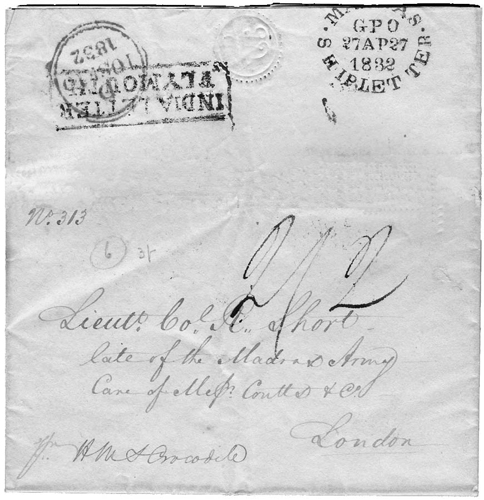
FIG. 30. The letter dated on 19.3.1832 in Madras, was carried by one of the three Navy vessels which took mails home to England that year. The letter was handstamped by the Madras G. P. O. on 27.4.1832 and carried by the HMS Crocodile, arriving in London on 10.9.1832, in 175 days from the writing and 136 days from Post Office to Post Office.
Even though there was a steamship connection by the Hugh Lindsay, only one letter from Bombay was carried by that vessel and further via the Overland route during January 1832 – June 1833. This small letter, consisting of two thin sheets and a normal sheet for cover, was written on 4 January, 1833, with instructions to be carried by steamer and further via Malta. The letter was from the Management of the Medical Retirement Fund in Bombay, claiming that they had not received any government aid for three and a half years, ‘which has nearly proved fatal to the institution’. The letter arrived in London on 9 April, 95 days after being written.887
The location of Madras made its communications different from both Calcutta and Bombay. Many ships put in on their way to Bengal or on the way homewards. However, it seems that the ships which took mails from Calcutta did not carry the mails from Madras even if they stopped there, and vice versa. Of 292 letters sent from Madras to London in 1832, less than a third were carried by ships which had a former or current connection with the EIC. A significant portion of the mails (69 out of 292, or 24%) were taken home by three Navy vessels, while no letters were sent by this means from Calcutta or Bombay (see Fig. 30). Liverpool ships were not used for carrying EIC mails from Madras. As the ships usually did not stay long at that port, the letters left sooner from there than from Calcutta. In addition, the durations of the sailings from Madras were clearly shorter than from Calcutta or Bombay due to the shorter sea voyage.888
Compared with the manner by which Lloyd’s agents used the existing network of private communications to send maritime intelligence to England, the EIC had definitely lost its touch – and obviously also its interest – in improving information transmission. The unbelievable inefficiency of the management, combined with general conservative attitudes must have been one of the main reasons for the Company’s final collapse. While it had been possible to ignore the changing times in the shelter of a monopoly, the EIC soon noticed that it could not keep its earlier position in the new environment, in which the competitors were entrepreneurs instead of government officials and accustomed to using all existing means of communication for their benefit.
In search of better communications – The Peninsular Company enters the scene – Via Marseilles – Mixed service – Royal Charter for the P&O – The EIC service to India – Mail sailings to China – The P&O mail monopoly begins – Geographical distance, a relative concept
In search of better communications
At home in England, Select Committees of the House of Commons resolved in 1832 and 1834 that steam communication with India via the Red Sea was practicable, that under proper arrangements the expenses could be greatly reduced, and that a regular service should be opened, the net costs of which should be defrayed equally by the British Government and the EIC.889
The Committee also supported an alternative route from Alexandretta, on the Syrian coast, overland to the Euphrates, and then down that river for 1,000 miles to the Persian Gulf, and on to India. This plan was originally placed before the Committee and warmly endorsed by the EIC, and it was supported by the British Government which wanted to counteract Russian interests in the Middle East. The mercantile houses looked at the Euphrates plan rather coldly, considering that it was yet another attempt by the EIC to defer any effective action. The efforts by the Company and the Government to operate steamers on the Euphrates in 1835–1837 were not successful, and one of the small vessels was in fact lost in a sudden storm with almost all hands.890
Additionally, the Select Committee of 1834 determined that the Admiralty’s Malta packets should be extended to Egypt and/or Syria as necessary. In addition to the old Falmouth sailing packet route to Vigo, Oporto and Lisbon, the Admiralty had conducted a naval steam packet service on the England – Gibraltar – Malta (– Corfu) route since 1830. The Mediterranean service was needed for British control over Malta and the Ionian Islands, conquered during the Napoleonic wars, as well as Gibraltar, which had belonged to Britain since 1713. In March 1835, this naval steamship mail service was extended to Alexandria.891
Now there was a steam-powered European leg for the East India service via Alexandria and Suez. In the Indian Ocean, the EIC finally added two large steamers to the Indian Navy for the Suez–Bombay run, to the delight of Bombay and the discomfiture of Calcutta. The Overland route between Alexandria and Suez was pioneered by Mr. Waghorn, whose efforts to carry mails through the desert proved to be so much more efficient than the official service that he was appointed by the EIC as Deputy Agent and Superintendent for the Indian mails in Egypt from June 1837.892
The Indian mails were made up at the General Post Office in London on the first of each month and the naval steam packet sailed from Falmouth on the 3rd or 4th, depending on the weekday. The average duration of the voyage by the Admiralty steam packets via Malta to Alexandria was 22.5 days, varying between 20 and 26 days, while the homebound voyage took a few days more.893
The Overland trip was made by donkeys and river boats from Cosseir or Alexandria to Cairo, and from there by camels to Suez. The crossing took several days. In Suez, the mails were taken on board the Hugh Lindsay which took them to Aden, from where they were taken to Bombay by one of the EIC’s two new steamers, the Atalanta or the Berenice. By these means, the mails were carried from England to India in 74 days and in the other direction within 64 days on average. These figures are calculated by Sidebottom from the dates of postmarks on some covers carried by the Waghorn service. The duration of the trip varied between 60 and 81 days eastwards and between 56 and 123 days westwards.894
From Bombay, the mails were sent to Calcutta by runners (dawks), which normally made the trip between the two ports in a fortnight.895 But the mail service by the EIC steamers did not function satisfactorily. It was more or less mismanaged, highly irregular, and at times quite unsafe. In June 1838, one batch of mail from Calcutta was delayed for so long at Bombay that it took 135 days to reach London; the next batch from Calcutta was again delayed at Bombay and finally dispatched via the Persian Gulf route, where Arabs captured part of it and scattered the letters over the desert. The Calcutta community’s frustration and disappointments reached a climax in the summer of 1839 when the EIC steamers left Bombay for Suez on two successive occasions without waiting for mails known to be on the way from Calcutta.896
Besides these postal arrangements, the London merchants had in 1836 formed a committee to set up a commercial enterprise, the East India Steam Navigation Company, in order to link Britain via the Suez–Overland route with all the Indian ports, China and Australia. The reaction to this plan in Calcutta was somewhat mixed. Although a better mail service was naturally welcomed, the Calcutta community disliked the idea that Bombay would be the company’s initial terminus. With little support from India and strong opposition from the EIC, the new company soon foundered. A revised plan, submitted by a chief London lobbyist for Calcutta interests, was accepted by the leading India houses in London in late 1838. In Calcutta, however, the opinions were again split due to a simultaneous local plan to start a mail service by at least one direct steamer on the Calcutta–Suez run.897
The Peninsular Company enters the scene
The steps which the British Government and the EIC now took separately, but not unconnectedly, to improve the steamship service between Britain and Egypt and between Suez and India, undermined all the plans and campaigning of the Anglo-India merchant houses during 1825–1840. When the EIC finally gave way, the Directors were not anxious to strengthen their longstanding opponents. Instead, taking advantage of the dissension and controversies which separated Bombay merchants from Calcutta merchants, and Calcutta merchants from London merchants, the EIC bypassed them all and awarded its coveted support and the contract to a complete newcomer to the eastern seas, later known as the P&O.898
Obviously there was also a practical reason for this decision. The Peninsula Steam Navigation Company (PSNCo), as the company was called at that time, had already gained a good reputation in conducting a mail service on the Falmouth–Vigo–Oporto–Lisbon–Cadiz–Gibraltar route from 1837, after having won the postal contract advertised by the Government for public competition. The company carried mails from England to the Iberian Peninsula once a week, using five steamers, for an annual payment of £29,600 and with fines for each delay of 12 hours or more.899
From September 1837, the Indian mails had been carried by the PSNCo steamers from Falmouth to Gibraltar, from there by the Admiralty packets via Malta to Alexandria, by different means along the Overland route to Suez, and finally by the EIC steamers from Suez to Bombay.900 The chain of the different services, here in the homeward direction due to lack of eastward dates, can be described by using an example:
The mails from Calcutta were sent by runners across India for Bombay on 11 September, 1837, and taken there on board the EIC steamer Atalanta, which sailed for Suez on 27 September. The sources available do not enable us to calculate the duration of the 1,700-mile sea voyage, but the mails – having meanwhile also been taken across the desert via Cairo by camels, riverboats and donkeys organized by Mr. Waghorn and his partners – left from Alexandria by HMS Volcano on 7 November. The ship arrived at Malta on 11 November and another naval steamer, HMS Firefly proceeded with the mails on 17 November, arriving at Gibraltar on the 23rd to forward the mails to the PSNCo’s Iberia, which sailed for England on the following day. The ship arrived at Falmouth on 2 December and the mails were forwarded by mail coach to London, where they arrived on 4 December.901 The trip took 84 days, which was not immensely better than what could be achieved by the fastest sailing vessels directly – and much more cheaply – from India.
In 1838, the Overland trip from Bombay to London took 64 days on average, the duration of the voyage varying between 50 and 100 days. To this, about a fortnight should be added for the dawk service between Calcutta and Bombay, and two days for the mail coach between Falmouth and London. Thus the Calcutta mails arrived in London in 80 days on average. The fastest mail arrived in 65 days while the slowest dispatch took 118 days.902
Via Marseilles
Mr. Waghorn’s private express service was still able to make faster voyages than the official mail by using alternative means of transport where available. To avoid transit delays, typical for the official mail, he opened agencies at Alexandria and Malta to forward dispatches by the quickest steamers to Marseilles, to proceed by railway, coach and steamer for England, where they arrived some ten days before the Post Office mails. The arrangement soon received official attention by the Lords of the Admiralty and the Postmaster General, and to stop this uncomfortable competition, new arrangements were soon made for sending mails to India via Marseilles, from where the Admiralty packets would take the dispatches to Malta, to be forwarded to Alexandria.903
In May 1839, the new overland route via Marseilles was taken as an official alternative to the Post Office mails. The single postage rate for a letter to India by British packets via Marseilles would be 2s. 8d. and by French packets, in case British were not available, 3s. 1d., while the postage rate 2s. 6d. for the all-sea route from Falmouth by the PSNCo would remain unaltered.904 Compared to the private ship letter rate via the Cape, which was 4d. plus the inland rate only, the costs of greater speed were still high.
The faster route via Marseilles was soon given preference by the Admiralty steamers. The all-sea mails via Gibraltar had to wait at Malta for several extra days, even ten or 12, for a packet while the mails for Marseilles left soon after the steamer had arrived from Alexandria.905 The mails from Alexandria arrived now via Malta at Marseilles in 11 or 12 days, while about five more days were calculated for the journey between Marseilles and Calais on the English Channel.906
Mixed service
In 1840, there was thus a mail steamship service from England to India, via the Red Sea, and mails could be sent from Bombay or Calcutta even further to the East, although not yet by steamer. There were several independent players taking part in the long transmission process, and delays here and there could not be avoided. The duration of business information transmission was still far from satisfactory.
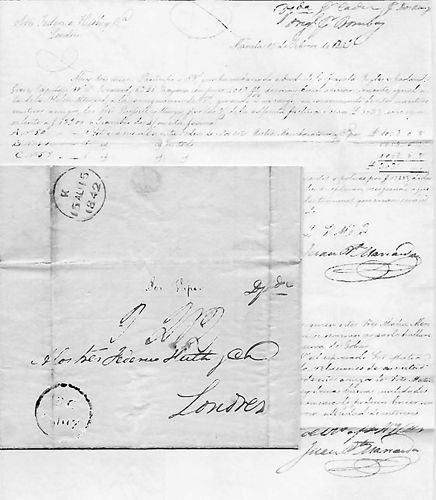
FIG. 31. The letter dated in Manila, the Philippines, on 10.2.1842 includes a bill of lading, informing the Fredrick Huth banking company in London about sending goods to their customer in England by two ships (one of which was the Garland Grove, an English frigate on her way homewards after having carried female convicts to Australia). The letter was written by a clerk but the owner of the company added with his own handwriting on the top right corner that the original letter should be sent via Bombay (the Overland route) while this letter should be sent by the Spanish merchant ship Dos Amigos on her way to Cadiz. In Cadiz, the letter was forwarded by the British Consulate (‘B. C. Cadiz’ handstamp on the cover) to the P&O’s Peninsula route steamer Royal Tar on her way from Gibraltar homewards. The ship arrived in Falmouth on 13.8. and the letter arrived in London on 15.8.1842, in 186 days.
As the sailing dates of the Eastern route are well covered by several postal historians, there is no need to go to the archives to find out when the different mail carriers departed or arrived at ports on their way to Australasia. Reg Kirk’s monumental studies on the P&O schedules have been published in several volumes, mainly in the late 1980s. Lee C. Scamp has found lots of interesting details especially concerning the China route, published in a large volume in 1997. And finally, Colin Tabeart has collected the Admiralty steam packet sailing dates of the Mediterranean service, published in 2002. Having all this data in hand, we can pick up an example to see how the system worked in practice (see Table 76).
TABLE 76. Duration of mail transmission between England, India and China, 1840, an example.
| Means of communications | Port 1 – Port 2 | Departure – arrival | Days | Delay at port, days |
| All-sea route:By mail coach | London–Falmouth | 18.1.–20.1. | 2 | |
| Royal Adelaide (P&O) | Falmouth–Gibraltar | 24.1.–1.2. | 8 | 4 |
| HMS Volcano (Adm.) | Gibraltar–Malta | 1.2.–6.2. | 5 | |
| Express route:By railway | London–Marseilles | 4.2.– ~9.2. | 5 | |
| HMS Alecto (Adm.) | Marseille–Malta | ~10.2.–13.2. | 3 | 1 |
| Both mails: continued by HMS Megaera (Adm.) | Malta–Alexandria | 14.2.–20.2. | 6 | 8 /1 |
| Overland Egypt, by camels etc. | Alexandria–Suez | between 20.2. and 27.2. | 7 (?) | incl. |
| Berenice(EIC) | Suez–Bombay | 27.2.–13.3. | 15 (?) | |
| Overland India, by runners | Bombay–Calcutta | between 13.3. and 27.3. | 14 | incl. |
| HMS Larne (Adm.) | Calcutta–Singapore | 27.3.– ~15.4. | ~19 | ~18 |
| Actif(private sailing vessel) | Singapore–Canton | 3.5.–30.5. | 27 | |
| Total, all-sea | London–Canton | 24.1.–30.5. | 127 | incl. |
| Total, express | London–Canton | 4.2.–30.5. | 116 | incl. |
Sources: Kirk (1987), 65; Tabeart (2002), 62, 191; and Scamp, 10. – February had 29 days in 1840.
The example enables a few observations. First of all, the bulk of mails from Falmouth were in this case delayed due to the late departure of the Royal Adelaide. With the Saturday mails from London, she should have sailed on Monday, 20 January but was reported to have left on the 24th. She arrived at Gibraltar via Lisbon and Cadiz on 1 February. The transfer of dispatches seems to have been conducted smoothly, as the Admiralty packet Volcano started her voyage from Gibraltar to Malta on the same day. However, the mails from Falmouth had to wait at Malta no fewer than eight days, until the Admiralty packet Alecto arrived from Marseilles with the express mails and all the dispatches could be taken on to Alexandria.907
The Overland voyage across Egypt and the time taken by the Berenice to steam from Suez to Bombay was 22 days in total. The mails arrived in Bombay on 13 March, the all-sea mail via Falmouth and Gibraltar in 55 days and the express dispatches via Marseilles in 38 days, a very good record compared with earlier information transmission by private sailing vessels in 125 days on average.908 The China mails were then probably carried to Calcutta by the dawk service, as they were taken from that port to Singapore by HMS Larne, reported to have departed on 27 March. As the trip to Singapore took no more than three weeks, she arrived there in mid-April. The following vessel for Canton, being the Actif, departed on 5 May and arrived, probably via some other port, at Canton on 30 May with the 4 February mails.909
The last part of the trip could not be called effective by any measurement. The ‘express’ mails arrived in China 78 days later than the Bombay merchants had received their part of the dispatches which had been sent on the same day from London. The 116-day express mail transmission from London by the Overland route to China actually took longer than the fastest direct sailings by the East Indiamen in 1832.910
Royal Charter for the P&O
In 1840, the second contract between the Post Office and the PSNCo stretched the company’s activities to the Mediterranean as the European link in the Indian service. This was an exclusive Royal Charter for a mail steamship service to the East, comparable with the Cunard Line’s in the North Atlantic and the Royal Mail Line’s in the West Indies.
The charter included an annual subsidy of £34,200 for the Alexandria service during the next five years, as well as the right of incorporation with limited liability – a lucrative deal as the shareholders of the rival companies would be unlimited. The geographical enlargement of operations caused a need to change the company’s name to the Peninsular and Oriental Steam Navigation Company. The capital of the new company was fixed at £1,000,000. In addition to the five steamers of the former PNSCo, two larger ones – the Great Liverpool of 1,400 tons, and the Oriental of 1,787 tons – were chartered from a company which had lost the transatlantic mail contract given to the Cunard Line.911
From September 1840, the all-sea mail service between Falmouth and Alexandria was taken care of by the P&O. The packets departed from Falmouth on the second of each month, called at Gibraltar and Malta only, and proceeded immediately after coaling. The ships were larger than the Admiralty steamers used earlier on that route, and one and the same vessel took the mails all the way from Falmouth to Alexandria, thus avoiding delays in transfer from one ship to another at the different ports. As a result, the duration of the all-sea trip from Southampton via Gibraltar reduced from an average of 28 days in 1839 to 16 in 1841.912
The P&O mail contract included a clause that the company would provide a service from Suez to India within two years. Which part of India, was not specified. While the attitudes among the disappointed Anglo-Indian merchant houses towards the P&O remained cool, their financial support for any route was limited.913
The EIC offered a rather modest bonus of £20,000 a year for five years if the P&O successfully inaugurated a service between Calcutta, Madras and Egypt – which left to the EIC the monopoly of the shortest and most direct route to Bombay, which they were then covering with their own naval steamers. And indeed, this arrangement by the EIC continued until the P&O took over the Bombay route in 1852.914
The British Government finally awarded the P&O a contract for the route Suez–Ceylon–Madras–Calcutta for an annual payment of £115,000.915 For this service, and to cover the whole route from England to India – and later to China and other places in the East – much preparation was needed.
The P&O organized overland route facilities of its own, including small tugs and barges to convey passengers along the Mahmoudieh Canal between Alexandria and Atfeh, and a larger Nile river steamer. As the goods had to be carried by camel, caravans of 3,000 to 4,000 animals were needed to transport a single shipload. Even the coal for vessels in the Red Sea area went across Egypt by camel-back. This was necessary as, due to the unfavourable monsoons, it could not be sent by sailing vessels as was the normal practice in sending fuel to the eastern stations. The P&O also opened a hotel in Cairo, reserving it almost exclusively for its own passengers.916
On 24 September 1842, the ‘large and powerful’ Hindostan of 2,018 tons departed from Southampton and arrived in Calcutta on Christmas Eve, in 91 days, having coaled at Gibraltar, Cape Verde, Ascension, St. Helena, Cape Town, Mauritius, and Galle in Ceylon. Two more purpose-built vessels arrived in 1843 and 1844.917 Now when there were enough steamers for the service, a new contract was made between the Government and the P&O for the Calcutta line, and another for a new China line from Galle via Singapore and Penang to Hong Kong. The latter was opened in August 1845.918
The EIC service to India
Until the P&O started their mail service to Bengal, both the Bombay and Calcutta merchants were served by EIC steamers from Suez to Bombay. This part of the trip, together with the overland crossing in Egypt, took 20 days in 1841, while the total voyage between London and Bombay took 36 days.919 Even if this was a radical improvement compared with the duration of information transmission only a few years earlier, a brief look at the information circles raises some questions.
As can be seen from Table 77 (in the end of the book, p. 431), the departures from England were punctual. Although there was not always a sailing from Bombay on the first day of each month that year, it happened nine times out of 12, however. Yet long delays – from 17 to 29 days – at both ends of the journey between the arrivals and departures were typical. If there had been a more frequent service, the duration of the voyage itself would have enabled 4.5 consecutive information circles per year, leaving a good four days margin at both ends.920
For the mails to and from Calcutta, the service was even poorer. At least one month had to be counted for the return trip between the ports of Bombay and Calcutta, and in real life this was hardly enough. As there was no direct steam ship service to Calcutta, the existing means of information transmission worked as follows:
TABLE 78. Consecutive information circles enabled by the express services between London and Calcutta, 1841.
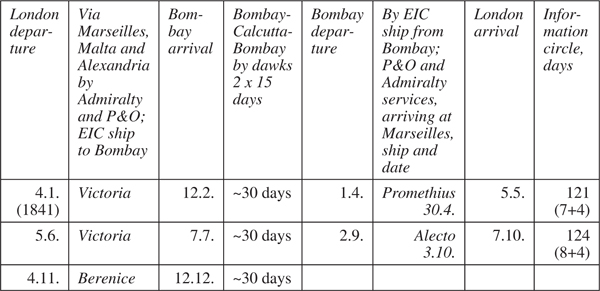
Source: Sailing lists of Scamp, 31–32, 37–38, 47; Tabeart (2002), 69–73, 191–192.
Compared to 3.5 information circles per year between London and Bombay, only 2.5 could be managed by the existing means of communication between London and Calcutta. In the example, the mails from Calcutta arrived in London on 5 May, and answers to them just missed the India mail, which left on the day before. This happened again, when the India mails arrived on 7 October, and the express dispatches had been sent three days earlier on the 4th.921 Letters from Calcutta always missed the next mail ship departure from Bombay due to the long and troublesome voyage between the two ports. In terms of information circles, there was no real use for the Marseilles express service, as answers to letters could not be sent sooner than they were, anyway. But if the message was urgent, the express service naturally saved a few days in the one-way voyage.
The P&O Calcutta Line from Suez to Madras and Calcutta started in early 1843, first with only one steamer, and finally from the beginning of 1845 with three vessels. From January 1845, the service was conducted monthly. The China Line started a monthly service in the summer of 1845.922 Until then, all business information transmission to the East was taken care of by a combination of the P&O, Admiralty, EIC and various private merchant vessels as described above.
A memorandum of covers received at Bombay by the EIC steamer Berenice in March 1845 gives an idea of the number of letters and newspapers carried from England to India and China at that time. The all-sea mail via Southampton included 24,400 letters, 30,000 newspapers and seventy-five boxes, while 6,000 letters, 8,000 newspapers and 38 boxes arrived by the express service via Marseilles. Additionally, the mails carried by the Berenice included 1,700 letters from foreign countries, as well as 5,000 newspapers and 28 boxes.923
TABLE 79. Consecutive information circles enabled by the co-operating services of the P&O Calcutta Line and the EIC Bombay Line between London and Calcutta, 1845.
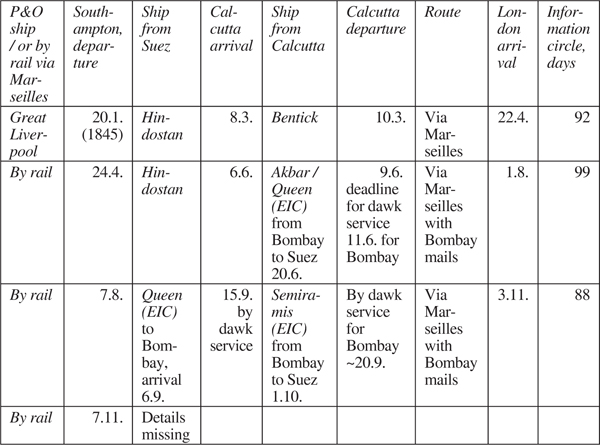
Sources: Scamp, 93–103, 108–117; Kirk, The P&O Lines…, 11, 23–24. – There are several differences in the sailing data between Kirk and Scamp. The latter has been used here in case of confusion, as it is newer and based on thorough examination of local newspapers as well as Kirk’s studies. – From 1843, the P&O mail departures and arrivals were directed via Southampton instead of Falmouth, which was sensible due to the newly opened railway connection. The arriving mails were normally postmarked in London on the same or the next day after the ship’s arrival. See Kirk (1987), 20–21.
The monthly P&O steamship service all the way from Europe via Suez to Calcutta was definitely an improvement, but it could not alone serve the Bengal merchants satisfactorily. It often happened that the steamer from Calcutta had just departed, or she departed on the same day as the mails from Europe arrived. In these cases, the EIC steamer from Bombay to Suez could still be reached by the dawk service across the Indian mainland. According to Scamp who refers to the Calcutta newspapers, the service was in general use, this route thus complementing the direct P&O all-sea mail service.924
Many of the local problems were classic examples, typical also in the early mail services in the Atlantic and the West Indies, as has been shown in the previous chapters. When the Hindostan arrived at Calcutta on 8 March, 1845, the Bentick departed on the same day, or two days later, depending on the sailing data used. The Hindostan met serious problems on her way to Calcutta in early June and arrived on the day after the mail ship for Suez had departed. But using the dawk service, answers to the letters could be sent via Bombay, from where the EIC mail steamer was leaving for Suez on the 20th. Thus there was, in fact, a bi-monthly mail service from Calcutta, even if it did not enable heavy bulk mail dispatches.925
Mail sailings to China
The real difficulty in Eastern communications was between India and China. The mails were carried by an ad hoc basis from Bombay or Calcutta, probably via Singapore, to Canton by varying merchant ships, which happened to sail for China. By comparing the sailing data published by Scamp with a ‘Chinese Repository’ list of port arrivals in Hong Kong between August 1841 and June 1843, we get some interesting background to the mail-carrying sailing vessels between India and China. Having dispatched the mails at Canton, many of the ships arrived within a few days in Hong Kong. Of the 17 mail carriers on the list, eight were loaded with opium, five reported general cargo or sundries, one carried cotton, one coals, and two arrived in ballast.926 It is clear that the main interest of these ships was not to carry mail as rapidly as possible, but to take care of their own businesses.
There were different mixtures of mail routes also in the Southeast Asian leg of the journey. An example: the EIC steamer Cleopatra took the European mails from Aden to Bombay, where she arrived on 5 August, 1841. At the port of Bombay, most of the mails were taken on board a private merchantman, the Parkfield, which sailed for China with a general cargo on the 10th. The EIC steamer Madagascar left Calcutta on 16 August, but without any of the dispatches that would probably arrive from Bombay on the 19th by the dawk service. Instead, the ship arrived at Canton on 12 September with fresh Singapore newspapers and a few London papers that she had picked up from HMS Larne in Singapore. The Larne arrived at Canton from Madras on 19 September with some Indian government dispatches and Madras letters, but with no business letters from Bombay. The Parkfield arrived at Canton with the London mails from July as late as 4 October, after ‘56 days out’ as the Repository noted .927
As the last irritant in the matter, those few dispatches brought by the Madagascar ‘though landed at the Hotel, could not be opened in consequence of a recent order of yours to the contrary, but were sent to Hong Kong and returned here four days afterwards’. This was due to an order by the British Superintendent of Trade that all mail arriving at Macau was to be sent to the new Post Office at Hong Kong for processing, even though most of the merchants still resided at Macau. In consequence, the merchants who received dispatches by the Madagascar were unable to reply to their letters by the City of Palaces, which soon left Macau for Calcutta.928
As long as there was no organized mail system in the Southeast Asian part of the route, the dispatches were carried as described above. It often happened that a minor part of the mails arrived before the bulk, but whether these were the mails for which senders had paid an extra fee in London cannot be verified without seeing the rate markings on letters which were carried by these different means. This could probably be discovered by postal historians collecting covers from Asian mail routes.
TABLE 80. Consecutive information circles enabled by the fastest mail services between London and Canton, 1841, an example.
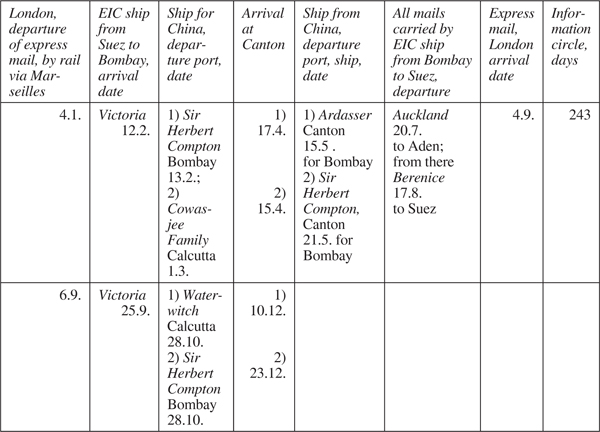
Source: Sailing lists of Scamp, 31–32, 37–38, 47.
The mails often arrived by nearly identical merchantmen from Bombay to China, but the duration of the journey varied greatly. For example, the major part of the mails was sent from Bombay by the merchant ship Westmoreland on 12 September, 1841. She arrived at Canton on 21 December while some the mails already arrived by the Monarch on 6 November. The latter had sailed from Bombay on 16 September. The same letters from London could be taken from Bombay to China in 51 or in 100 days, depending on which vessel the authorities in Bombay happened to put them on board at the port.929
The duration of the fastest possible information transmission via the Overland route from London to Canton varied between 79 and 126 days in 1840, between 65 and 119 days in 1841, and between 61 and 110 days in 1842.930 But most of the business letters did not arrive by these fastest communications, as has been shown by Scamp, who has examined a wide range of newspapers for more details.931
Canton Press calculated the following averages for the voyage between London and China: 104 days in 1840, 91 days in 1841 and 88 days for 1842. Yet these were not the averages for the normal mail, but the very first news arriving in Canton by different ships, often not the main mail carriers.932
It was normal that arriving vessels carried on board some latest newspapers from the port of departure, and therefore general news often reached the East Asian colonies faster than business letters, which formed one major shipment. Table 80 shows the information circulation enabled by the mixed service in 1841.
This mixed service, with the leg from India to China covered by private sailing vessels, enabled only 1.5 consecutive information circles per year between London and Canton, one circle taking some eight months. And yet it was fortuitous that the mails from India arrived in London on 4 September, just two days before the next departure date of the express mail. If the London mails had been sent off just before the Asian dispatches arrived, the next opportunity to reply to letters from Asia would have been several weeks later. In this case, the replies from England would have arrived in China on 23 January, 1842.933
The new trade port of Hong Kong was growing rapidly. The ‘Chinese Repository’ reported 147 arrivals in August–December 1841, and 371 arrivals in the whole calendar year 1842. Most vessels were on different inter-Asian routes, but 20 ships sailed directly from London or Portsmouth, and 14 from Liverpool. On arrival, these vessels had been out for 135 and 130 days, respectively, on average.934
The John O’Gaunt sailed from Liverpool in 108 days, arriving in China on 9 July, 1842. If she carried private ship letters, they must have been sent on 23 March at the latest. This was a week earlier than the bulk mail from England left for the Overland route, and about ten days earlier than the last dispatches of express mails could be sent via Marseilles. And in this month, the Overland mail reached Canton rather quickly, via Bombay by the Sir Herbert Compton and via Calcutta by the famous opium clipper, the Red Rover, both arriving on 22 June.935 The fastest mails arrived in 77 days, which was close to a record. The Overland route appeared to be a better choice, at least this time, but private ship letters were naturally more economical.936
Private merchant vessels continued to carry the official China mails from India until the first P&O steamer, the Lady Mary Wood, made her first voyage from Galle via Penang and Singapore to Hong Kong with the bulk mails of 20 June and express mails of 24 June from England, arriving on 13 August, 1845.937 This new arrangement took the London mails to Hong Kong in 50 days, thus halving the normal duration of information transmission in one night. This was one of the occasions in the history of world communications, where a mere logistical arrangement was able to revolutionize the duration of information transmission, without radical new inventions, but using what already existed.
When the P&O was allowed to expand its services to China, the government did not even ask for bids from any other company. It was considered that the company had already invested so much in the service that it would have been unjust not to give them the business. Additionally, the cost of the P&O services east of Suez averaged 17s 1d per mile only, while the estimated cost of the Admiralty packets was 42s 6d.938
While the P&O Calcutta Line service via Galle actually made no major difference in communications with Bengal compared with the shorter sailing to Bombay and the inland runners, the steamship service from Galle definitely improved the information circulation with China. Instead of sailing via India, the mails were forwarded from Galle directly by a mail steamer to Penang, Singapore and Hong Kong.
As can be noticed from Table 81, the new system enabled 2.5 consecutive information circles each year compared with only 1.5 in 1841 (see Table 80). The new service more than halved the time taken by the sailing vessels around the Cape, the mails now being carried in about two months in each direction.
This happened simultaneously with the beginning of the golden era of the American-built sailing clippers, which took over a great part of the tea trade between China and London in the late 1840s. Since the abolition of the monopoly of the East India Company in China in 1833, the nature of the British tea trade had thoroughly changed. In the days of the EIC monopoly, the term ‘new season’s tea’ did not really exist. Tea, as bought in London from a retailer, was never less than 18 to 24 months old. The East Indiamen always sailed from China during the favourable monsoon between November and March, and when the teas arrived in England some five or six months later, they were stored in bonded warehouses for about a year, since a large reserve was necessary in case the China fleet failed to arrive. When the business was opened for competition, the import of fresh tea became very lucrative. The merchants had no difficulty in selling the new crop as soon as it arrived at the docks, and the glamour attached to tea carried by a well-known ship could procure even higher prices – we still remember, for example, the famous Cutty Sark, one of the British tea clippers from the sunset of this period in the 1870s.939
TABLE 81. Consecutive information circles enabled by the new P&O China Line services, London–Hong Kong, 1846.
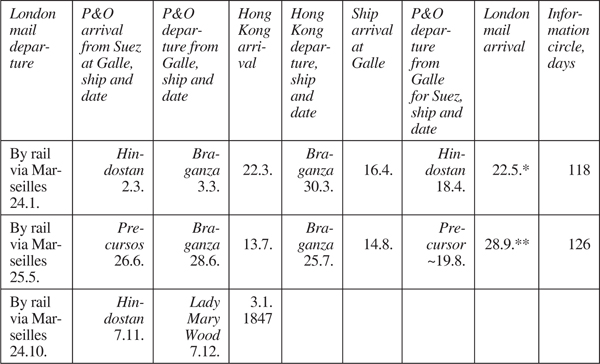
Source: Kirk, The P&O Lines…, 11, 23–24, Tabeart (2002), 197, Scamp, 131–134.
* The arrival date is an estimate (Marseilles arrival + four days).
** Due to the delay in the Indian Ocean, the express mails seem to have missed the Admiralty packet for Marseilles at Malta and were carried together with the bulk mail to Southampton by the P&O steamer Oriental. Thanks to the railway connection, the mails were in London on the same day when the ship arrived in Southampton. As can be noticed, these mails arrived too late to be answered in the September mail.
The fast American clippers, built for the California run in the late 1840s and 1850s, naturally took their share of the profitable tea trade. Instead of returning in ballast to New York after their arrival in San Francisco, they continued across the Pacific to China, loaded rapidly up with tea, and proceeded to London. This was now possible as Britain had abrogated the remaining provisions of the old Navigation Acts in 1848 and opened up commerce to ships of foreign origin on equal terms with British vessels. Up to the time of the American Civil War, at least 139 cargoes of tea were landed in Great Britain by American ships, most of them ‘Yankee clippers’.940
Even if greatly admired for their speed, the tea clippers were not often an alternative for the steamship mail service via the Overland route. As in the California run, the clippers sailed a much longer seaway than the steamers and could not make a shortcut across an isthmus, as the steamship companies did at Panama and Suez. The fastest journeys in the tea trade took less than 100 days from China to London941 but compared with the mail transmission of only two months by steamship, the option was not very attractive and was mainly used for consignee’s letters. But the new rapid form of tea trade benefited greatly from fast business information transmission, and would be one of the main reasons for further development of communications between Europe and China in the 1860s.
The P&O mail monopoly begins
During the 1850s, the P&O gradually gained a rather complete monopoly on the eastern routes. In addition to the Southampton–Alexandria route already taken care of by the company, the express service between Marseilles and Malta, earlier carried out by the Admiralty, was transferred to the P&O from January 1853 as a part of a new mail contract.
The mails were made up in London on the 8th and 24th of each month to leave at 8 p.m. that day. No more than 60 hours were allowed for the railway transit through France and the shipment in Marseilles. Thus the vessels from Southampton and Marseilles would arrive at Malta simultaneously. The Southampton mails departed on the 4th and 20th of each month respectively. According to the schedule, the trip took 14 days, including a stoppage at Gibraltar and another for coaling at Malta. 942
Additionally, the P&O voluntarily entered into increasing postal commitments. The Calcutta and China lines were served twice a month instead of monthly. The company also gradually took over the Bombay route, the mails being first carried by the Calcutta steamer and later directly from Suez via Aden to Bombay twice a month. In addition, the P&O started a mail service between Singapore and Australia, via Batavia, although it was interrupted three years later due to the need for steamers in the Crimean war.943 The Australian mails will be discussed later in this chapter.
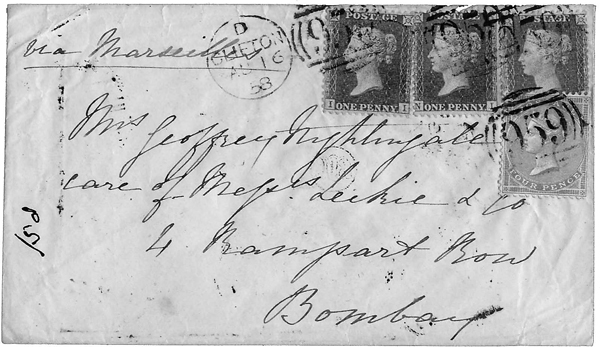
FIG. 32. The letter sent on 16.8.1858 from Clifton, England, to Bombay, was carried along the express route via Marseilles and Overland via Suez, arriving in Bombay by the P&O steamer Cadiz on 9.9.1858 in 23 days. (See the text.)
After the Crimean War in 1854–1856, the British faced further problems in the East – the Second Opium War with China in 1856–1858, and the Indian Mutiny in 1857–1858.944 In such circumstances, fast information transmission between England and Asia was crucial not only to the interests of the merchant houses, but also to the British crown. To cope with this problem, and apparently also to discourage French plans to dig a canal from Port Said to the Gulf of Suez, the Overland railway across the Egyptian desert was finalized and opened in 1859.945
The mail service to Bombay, which had taken over a month in each direction in the early 1840s even via Marseilles and the Overland route in Egypt, could be conducted in just 23 days in 1858. A letter from the writer’s collection illustrates a good example of this speed. The cover from Clifton, England, to Bombay on 16 August, 1858, was sent via London on the 17th, being addressed ‘via Marseilles’. It was taken by the P&O steamer Cadiz from Suez on 27 August to Bombay, where it arrived on 9 September and was handstamped in the Bombay Post Office on the same day (see Fig. 32).946 The one-way voyage from London to Bombay had been considerably shortened, but did the information circulation improve correspondingly?
TABLE 82. Consecutive information circles between London and Bombay via Southampton, March 1859–March 1860.
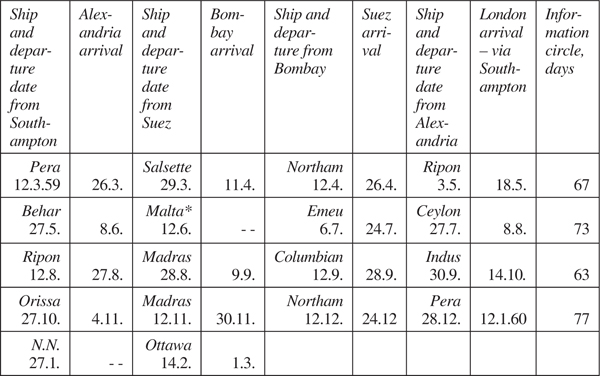
Sources: Kirk, The P&O Bombay…, 12, 47.
* The Malta was laid up at Aden due to a breakdown. The mails for Bombay were carried by the Concordia, no arrival date in Bombay given.
From March 1859, mail transmission to the East was taken care of by the P&O as a weekly service. The China and Calcutta mails were transmitted from Southampton in the 1st week, the Bombay mails in the 2nd, the China and Calcutta mails in the 3rd, and the Bombay & Australia mails in the 4th week of each month.947 By examining the consecutive information circles on the India and China routes, we will notice an interesting point.
In 1859–1860, the information circulation between England and Bombay ran as follows: The all-sea mails for Bombay via Southampton, Gibraltar and Malta to Alexandria, overland to Suez and further by another P&O vessel to Bombay were carried in approximately one month on average, i.e. 30 days eastwards and 32.5 days westwards. The number of consecutive information circles was 4.5.
The duration of eastward voyages varied between 28 and 34 days, while the westward voyages took 28 to 42 days. An average information circle between London and Bombay via Southampton took 71 days. The shortest time to get an answer to a letter from Bombay by this means was 59 days and the longest time was 82 days.948
As the departure dates from Southampton for the Bombay mails were the 12th and the 27th of each month, and one information circle normally took something between two and two and a half months, the system enabled rather fast answers to letters arriving from India. The system served quite well the Southampton bulk mail service. The express route via Marseilles gives us a slightly different view.
TABLE 83. Consecutive information circles between London and Bombay via Marseilles, March 1859 – March 1860.
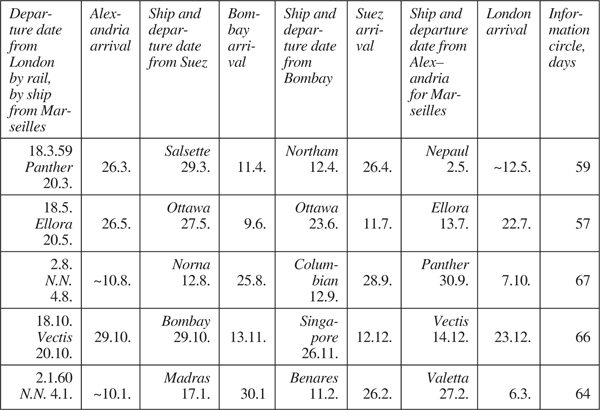
Sources: Kirk, The P&O Bombay…, 12, 47; Kirk 1989, 58–64; Proud, 23–51.949 – Two P&O vessels from Marseilles to Alexandria (‘N.N.’) remain unknown. This does not affect the schedules, however.
As can be noticed, the duration of a single trip varied between about three to four weeks. The shortest information circle took 57 days and the longest 67 days. Even if the one-way express service was usually several days faster than the bulk mail transport and thus shortened the duration of a single voyage notably, the benefit could not be fully transferred to those who paid for rapid communications. The express service enabled five consecutive information circles per year instead of four and a half by bulk mail – but no more.
In information circulation between England and China, the difference between the all-sea mail and the express service was even less significant, as can be noted from Tables 84 and 85.
TABLE 84. Consecutive information circles London–Hong Kong 1859, via Southampton.
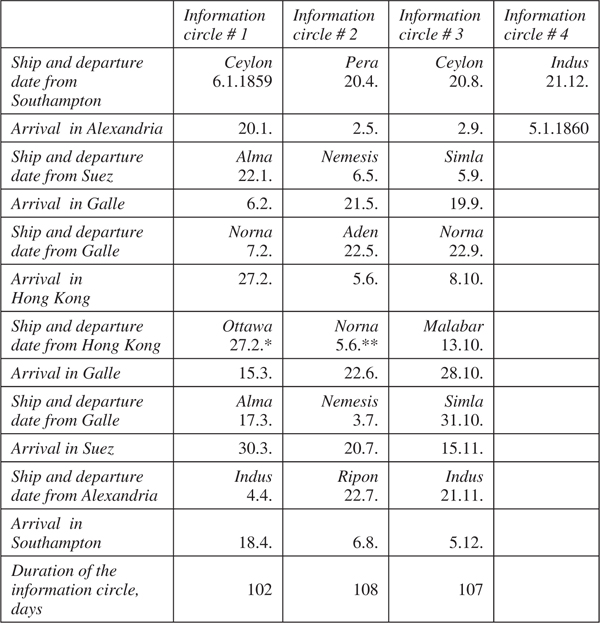
Sources: Kirk, The P&O Lines…, 45–47, Proud, 18–42.
* The Ottawa departed with the European mails on the same day as the Norna arrived. The chance that the recipients had an opportunity to answer their letters may be just theoretical. Probably some of the recipients could answer, while the others did not. The following mail steamer departed on 15.3.1859.
** The Norna departed with the European mails on the same day as the Aden arrived. The following mail steamer departed on 22.6.1859.
TABLE 85. Consecutive information circles London–Hong Kong 1859, express via Marseilles.
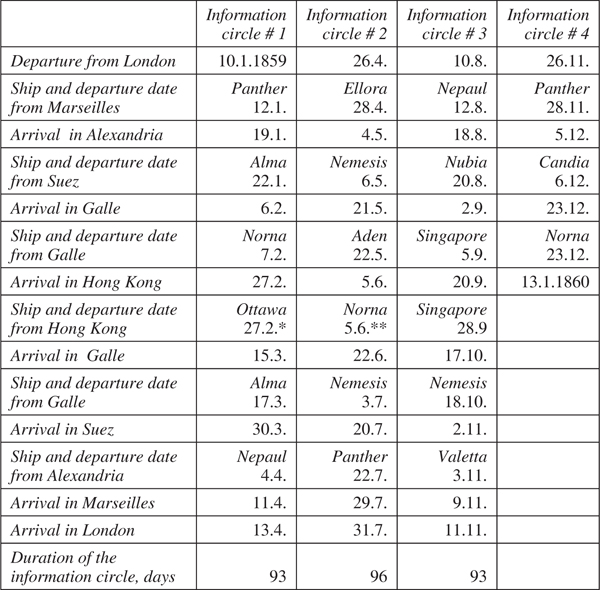
Sources: Kirk, The P&O Lines…, 45–47, Proud 18–42.
* The Ottawa departed with the European mails on the same day as the Norna arrived. The chance that the recipients had an opportunity to answer their letters may be just theoretical. Probably some of the recipients could answer, while the others did not. The following mail steamer departed on 15.3.1859.
** The Norna departed with the European mails on the same day as the Aden arrived. The following mail steamer departed on 22.6.1859.
The one-way trips between London and Hong Kong were typically six days shorter in each direction via Marseilles than via Southampton, as that was the time lag between the departures from those ports, while the trip east of Suez was made by the same vessels. The system had some apparent benefits, but it also included several elements which could have been improved.
The benefit of shortening the voyage by paying extra for the express service worked only in the European part of the trip. Even there the problem was that the arriving letters could often not be answered immediately, but had to wait for a couple of weeks for the next departure, regardless of whether the arrival was by express via Marseilles or by the all-sea mail via Southampton. Even if it was possible to answer quicker by sending the answers by the all-sea mail which departed sooner, they did not arrive at the other end faster, but by the same mail steamer.
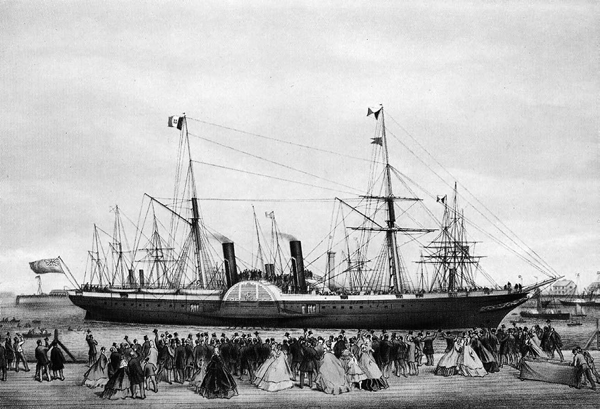
FIG. 33. The Ripon, built in 1846, served the P&O for 26 years, mainly between the UK – and Alexandria. (Cable: A Hundred Year History of the P&O, 1931).
There was no express service available in India or China that was similar to using the Marseilles express route in Europe. Instead, there were major disadvantages built into the system, especially at the port of Hong Kong. This can easily be noticed by picking out the arrival and departure dates of the mail steamers, as in Table 86.
In examining mail arrivals in Hong Kong in 1859, we can notice from Table 86 that the P&O mail steamer for Galle, from where the mails were forwarded to Aden, departed in five cases on the same day as the European mails arrived in Hong Kong. Even if the local post office had been efficient enough to dispatch the arriving mails – which naturally depended very much on the time of day the ship arrived – the merchants would not have had many hours to answer their letters. If the mail ship from Galle arrived in the evening, there was no time at all. The next opportunity to send letters to Europe was after some two weeks, varying between 11 and 17 days.
In a few cases the mail ship arrived one to four days after the mails for Europe had departed from Hong Kong, and there was not even a theoretical possibility to reply to the letters earlier than some two weeks later. There were several cases where there were two mail arrivals without any departing mails in between, and two departures without anything arriving in between.
TABLE 86. Mail arrivals and departures by the P&O steamers in Hong Kong, 1859.
| Mail arrival in Hong Kong,ship and date | The first possibility to send answers to the letters:Departure from Hong Kong, ship and date |
| Cadiz 15.1. | Singapore 15.1.Cadiz 30.1. |
| Pekin 27.1. | Cadiz 30.1. |
| Ottawa 11.2. | Pekin 15.2. |
| Norna 27.2. | Ottawa 27.2.Norna 15.3. |
| Malabar 19.3. | Singapore 31.3. |
| Singapore 26.3. | Singapore 31.3. |
| Cadiz 10.4. | Aden 13.4. |
| Pekin 24.4. | Cadiz 24.4.Pekin 5.5. |
| Ganges 9.5. | Ganges 22.5. |
| Norna 20.5. | Ganges 22.5. |
| Aden 5.6. | Norna 5.6.Malabar 22.6. |
| Singapore 22.6. | Malabar 22.6.Singapore 5.7. |
| Pekin 9.7. | Pekin 22.7. |
| Cadiz 23.7. | Cadiz 10.8. |
| Granada 5.8. | Cadiz 10.8. |
| Ganges 22.8. | Granada 24.8. |
| Malabar 7.9. | Ganges 12.9. |
| Singapore 20.9. | Singapore 28.9. |
| Norna 8.10. | Malabar 13.10. |
| Cadiz 23.10. | Norna 29.10.Cadiz 15.11. |
| Ottawa 16.11. | Ottawa 30.11. |
| Ganges 29.11. | Ottawa 30.11. |
| Pekin 14.12. | Ganges 15.12. |
| Malabar 27.12. | Pekin 30.12. |
Sources: Kirk, The P&O Lines…, 42–47, Proud 18–49.
In fact, Table 86 shows a list of lost opportunities, although half of the cases depict a nicely working system. Even if the mails departed punctually from England, there were more than enough opportunities for them to be delayed during a trip consisting of several different steamship journeys, as well as railway trips and reloading at ports between the sea voyages. The arrivals in Hong Kong varied by more than a week and so did the departures. The time that the mail steamers normally spent at port in Hong Kong varied between five days and three weeks, with some longer exceptions.
To speed up mail delivery in the arrival port, the Post Office authorized the shipping companies to arrange sorting of the mails on board during the long sea voyages. The idea was adopted from the French packets in the Mediterranean and first used on the Australian route by the British in 1858, when the European & Australian Royal Mail Company held the Charter for that mail route. There were two authorized clerks on board the ship to sort and handstamp each letter before they were landed upon arrival at the destination port. From 1859, the British packets in the Mediterranean also sorted their mails between Alexandria and Southampton.950 This arrangement probably saved money for the Post Office as the work could be done during a longer period at sea, instead of the normal rush at the local Post Office at the port of destination, with several clerks trying to sort a large amount of letters and newspapers as quickly as possible. The system was widely used by the railways, too. In addition to increased work efficiency, it naturally speeded up information transmission.
Geographical distance – a relative concept
As discussed in Chapter VII.1., the number of sailings for Australia grew constantly in the 1820s and 1830s. The mails between Europe and Australia were carried by private merchantmen, and especially the mails homeward were often badly delayed. There was no interest among shipowners to commit themselves to regular sailings, as homeward cargoes were difficult to obtain in Sydney.951 Many ships sailed from Australia to Chinese or Indian waters in hope of more valuable freight952 and there was no sense in sending European mails in that direction before the Overland route had been introduced.
Finally the British Government made an agreement with the brothers Henry and Calvert Toulmin for a monthly mail service by sailing vessels around the Cape of Good Hope to Australia. The service was in use from 1844 to 1848, but it never worked satisfactorily. The Postmaster General of New South Wales reported in 1846 that the average time taken by the post office packets on their trips to Sydney was 124 days, twelve days more than the average for the private merchantmen. The colonists in Melbourne and Van Diemen’s Land were even more dissatisfied with the Toulmin packets, as they sailed to Sydney only. The ships carried Melbourne mails to Sydney to be returned to Melbourne by boat or by the recently established overland mail. As the complainants put it: ‘our letters [are] taken past our doors and sent back to us after a delay of three to six weeks with a six-fold postage’. If the packets had stopped at Melbourne, the Sydney merchants would not have used the service. They definitely did not want to depend on shipments from Melbourne.953
This was not the only aspect similar to the long quarrel about the mail service in India. What might be called a ‘Battle of the Routes’ followed. One alternative for a steamship mail route was a transpacific route via Panama by the Royal Mail Lines. The problem was that the railway across the isthmus did not exist yet. The all-sea route around the Cape of Good Hope was seriously considered as it was used by the merchantmen, emigrant ships and the Toulmin packets. There was also the possibility to diverge from the P&O line at Galle or Singapore, and to come down the western coast of the Australian continent around Cape Leeuwin, or to sail via Torres Strait and straight down the east coast to Sydney. All these alternatives had their pros and cons and the discussion continued.954
In 1847, the P&O offered a monthly service from Singapore to Sydney, if they would also get the contract for the Aden–Bombay Line which was still held by the EIC. According to Robinson, the offer was rejected partly due to growing fears of a monopoly being built up by the P&O in the eastern seas and partly because the EIC was unwilling to surrender the Bombay Line.955 It was clear that the latter was not interested in giving up the service between Bombay and Aden, and it was equally clear that the EIC would not expand its mail service to Australia. So nothing happened.
By 1851, some decision had to be made. Until then, the trade between Britain and the distant Australian colonies had remained modest, but the gold rush changed it all. As Michael K. Stammers puts it: ‘As soon as the news of the discovery of the new goldfields was brought back to England, many people were tempted to sail out in the hope of digging up a fortune. Australia had a predominantly agricultural economy at the time of the gold finds. Consequently, the little manufacturing industry that existed could not cope with the needs of the great influx of new settlers and it was also deprived of labour because of the all-powerful attraction of gold. Gold exports enabled the Australians to import vast quantities of all kinds of manufactured goods from England to satisfy the wants of her new people, and also provided capital to invest in projects to extend the economy. The building of railways was one especially important example. All the materials – the rails, the locomotives, the coaches, the bridge components, the signals – were nearly all made in Great Britain and shipped out. Due to the rapidly increasing number of people and large quantity of British exports demanding shipment, the Black Ball Line [of Liverpool, not to be mixed with the American namesake in the North Atlantic] and its competitors enjoyed an unprecedented boom.’ 956
The statistics are impressive. The annual number of passengers for Australia rose from about 21,000 in 1851 to almost 88,000 in 1852, and continued on this level for several years. The number of inhabitants in New South Wales expanded from 119,000 in 1841 to 179,000 in 1851 and 249,000 in 1855 and the lately established Victoria (including Melbourne) grew from 12,000 in 1841 to 237,000 in 1851 and 409,000 in 1855.957
The passenger fares to Australia rose rapidly, and so did the freight rates. Cargo space was offered by the Black Ball Line, the main shipping line for Australia, in mid-1852 at £7 per ton, while premier express freight, like the new crop of teas from China, never went much above £ 4–5 per ton. It was easy to find a full crew in Liverpool as there were many who wanted to work their way out to Australia, but it was difficult to find crew from Melbourne back home, unless the most highly inflated wages were offered. Nevertheless, the Black Ball Line and several other quickly established – or already existing – shipping lines, including the famous White Star Line, conducted now frequent sailings to the distant colonies.958
The Australian sailings were organized as a bi-monthly line service, following the example of the American sailing packets in the Atlantic. Even the competition between the shipping lines followed the Atlantic example: speed was one of the main stepping stones to prestige. Using the latest scientific studies of winds, currents and the technique of ‘Great Circle Sailing’ by Lieutenant M. F. Maury of the U.S. Navy, and by ordering fast clipper ships from the best American shipyards, the average passages to Australia shortened markedly. It was reported that the average passage of Liverpool ships to Australia was reduced to 110.5 days from the earlier 120 in 1852, and further to 105.5 days in 1853, which compared favourably with the London averages for the same years of 123 and 126 days respectively.959
But this was not enough; a mail steamship line was also needed. In 1852, the British Government made a compromise, believing that a trial between two different routes at the same time would show which one was better. The mails would thus be taken by the newly established Australian Royal Mail Steam Navigation Company around the Cape of Good Hope every second month, alternating with the P&O service from Singapore to Sydney, a new leg of the company’s Asian services.960
The first steamer to reach Australia was the P&O’s Chusan, a small vessel of only 700 tons and 80 horsepower, which left from Southampton in mid-May 1852 and arrived at Melbourne at the end of July.961 The trip to Sydney took 84 days in all. Her arrival in Australia was celebrated as the beginning of a new era. But it would take several more years before the Australians really had a satisfactorily working mail service.
The Australian Mail Line service was a disappointment from the beginning. The Australian, although two times larger than the Chusan, and with engines four times as powerful, could not make the journey on the estimated schedule or even near that. On her first trip, she ran out of coal twice and finally arrived at Melbourne in 91 days, and Sydney four days later. Her return trip was even more disappointing, taking 113 days. The Australian’s second voyage was even worse than the first; she had to return to Plymouth twice with mails that were badly damaged by water. The mails for South Africa were finally sent by the General Screw Steam Shipping Company, which had had a mail contract for that route from 1850, and the Australian bags by the next P&O steamer.962
The Australian Mail Line steamers were almost uniformly behind schedule. Machinery breakdowns, insufficient arrangements for fuel and poor management in general were to blame. This was not unique, remembering the typical deficiencies of the time e.g. in the Atlantic, but as the trip was so much longer, the effects multiplied.963 Within less than a year, the Australian mail line gave up, and in October 1853 the mail service via the Cape was taken over by the General Screw Company. The company turned out to be much more efficient, and its flagship, the Great Britain of 3,200 tons, made her first trip to Australia in 65 days.964
But the difficulties were not over yet. In the following year, the Crimean War began and the Government needed all available steamers for troop and horse transports. In practice, all mail steamship companies had to reduce their mail sailings due to the war service, including both the P&O and the General Screw Company. In 1855, the mail service for Australia was again carried out by sailing ships, with monthly mail contracts hastily made between the Government and the Liverpool-based sailing ship companies, the Black Ball Line and the White Star Line.965
The bold sailing ship companies competed seriously with steam power. One of the Black Ball Line’s new American clippers, named the James Baines according to the owner, ran from Boston to the Rock Light off the British coast in 12 days, and from Liverpool to Hobson’s Bay in Australia in 64 days – ‘carrying 700 passengers including 80 first-class, 1400 tons of cargo and 350 sacks of mail containing over 180,000 letters’. The average outward voyage of the three fastest Black Ball Line clippers took 84 days, and the homeward voyage, run by Cape Horn, 93 days.966 In fact, there was no great difference whether the Australian mail service was conducted by sail or steam during the early 1850s. Journeys of some 90 days on average – all ships were not at all as speedy as the fastest clippers or steamers – enabled no more than two information circles per year, if even that.967
Content removed from the open access version of this book
FIG. 34. The Marco Polo was one of the best known clipper packets on the Australia route in the 1850s. She was owned by the Liverpool-based Black Ball Line, which together with the White Star Line shared the mail contracts to Australia during the Crimean War. On her maiden voyage to Melbourne in 1852, the Marco Polo created a world record by sailing out in 68 days and home in 76 days, less than six months out, the first time this had been achieved. (Tabeart 2004, 139) © National Museums Liverpool (Merseyside Maritime Museum).
After the war, the British authorities invited tenders for mail contracts via Egypt to Australia. The P&O offered to carry the mails between Suez and Australia for £140,000 per year, while a newcomer, the European & Australian Royal Mail Company, offered a service for £185,000, without including the Malta–Marseilles branch in the tender. It was a heavy blow to the P&O prestige when the contract was awarded to the European & Australian Line. The latter company was quite unprepared to start the service, having neither ships nor facilities for repair and coaling east of Suez. Beginning with chartered ships, the service started in January 1857.968
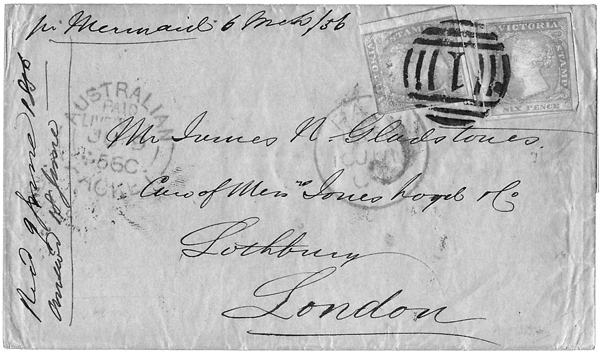
FIG. 35. The letter dated on 6.3.1856 and sent from Melbourne on 8.3., was carried by the White Star Line clipper packet Mermaid, which sailed on 13.3. with 99 passengers, 37,020 ounces of gold, 50,000 sovereigns, wool, etc. and arrived in Liverpool on 9.6.1856. (Tabeart 2004, 153) The letter was on the way for 95 days from the writer to Liverpool and was received latest on the next day in London. The sea journey took 88 days.
The European & Australian Line service ended in bankruptcy after 24 round trips. Kirk goes through all the voyages in his study of the Australian mails, depicting the reasons that led to the failure of the company. A few quotes from Kirk tell quite a lot:
‘Oneida was not available to take the 11.3.57 voyage from Suez – not having arrived at that port. Her next mail voyage was from Galle 31.11.58 when she again broke down, in this case, before reaching Aden. The mails and passengers at Suez on 11.3.57, had to wait for Simla on the 28th. The European & Australian Company lost the whole of the subsidy for this mail transit from Sydney to Southampton – it was swallowed up by penalties for late mail.’ – ‘Despite her [the Emeu’s] quick passage, she arrived too late to take the August mails from Sydney. What happened to any mails from the French postal service is not known.’ – ‘European with engine trouble, lost time between Galle and Sydney. Her arrival time at Sydney [18.10.57] was 8 days 19 hours later than specified by contract – for which penalty was £1,800. At first it was advertised that she would leave with the November mails but […] she was unable to leave before 11.12.57. On 19.10.57 the Sydney Post Office advertised that the Aberdeen barque Oliver Cromwell would leave with the mails on the 25th, and proceed via the Cape of Good Hope to London…’ – ‘Naturally she [the Emeu] was not available to take the 27.10.57 departure from Suez. As always, the European & Australian Line were handicapped by not having a replacement steamer, or charter steamer, available at the time. Officially: ‘No mails from Suez to Sydney, in consequence of the accident to Emeu. By an alternation in the terms of the contract, the penalty will be deducted from the next quarterly payment.’ By nepotism, most of the penalties were eventually remitted.’969
The owners of the European & Australian Line lost over £700,000 within the two years of service,970 despite the fact that they had a mail contract, showing once again clearly that a government mail subsidy did not make a shipping company prosperous if it could not manage its business. To keep the service going, the Royal Mail Line – the well-known contractor for West Indian mails – took over the management of the European & Australian Line service for half a year until a new contract was made with the P&O for the Australian mail service from Suez via Mauritius to Australia, starting in early 1859.971
From the viewpoint of information transmission, the following is how information circulation would have functioned if the sailings had been carried out as planned in the European & Australian Line mail contract, starting from 1857.
TABLE 87. Consecutive information circles, London–Sydney, as planned in the mail contract, 1857.
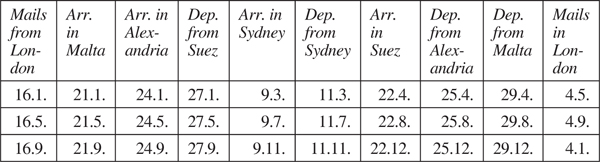
Source: Kirk (1989), 8.
TABLE 88. Consecutive information circles between London and Sydney enabled by the European & Australian Line service, 1857.
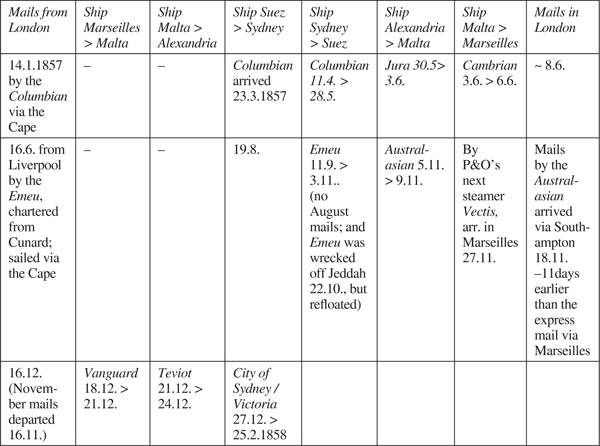
Source: Sailing lists published by Kirk (1989), 8–22, 32–36.
The service of the European & Australian Line was nicely planned, enabling three annual information circles between England and Australia. There was enough time between arrivals and departures in Britain, also affording a smooth service for the bulk mails via Southampton, arriving on the 6th and leaving on the 12th. The dispatches would be more hurried in Sydney, but the letters could still have been answered in two days. The colonists in Melbourne would have had more time for their answers, as the ship off-loaded the mails at Melbourne four days before arrival at Sydney, and picked up the homeward mails four days after departure from Sydney.972
But the reality was rather different. Table 88 shows the information circles enabled by the European & Australian Line during its first year in service.
Even if the performance of the European & Australian Line was poor compared to the requirements of the mail contract, its service enabled nearly 2.5 consecutive information circles within the first year. This was better than could be afforded by the shipping companies which used the route via the Cape exclusively. But also two of the three European & Australian Line ships – which happened to be part of the annual information circulation picked out for the table above – sailed eastwards around Africa to take their positions on the Australia – Suez route. Although they used the Overland route for the mails in 1858, the company’s performance was even weaker, and only two consecutive information circles could be achieved.
While this was theory, the practice was even somewhat poorer, probably not only because of problems in the shipping itself, but also due to the business practices or lack of information which would have enabled merchants to use the fastest connections.
The accounts and papers of Henry Eld Symons, already discussed in the context of South America, include a dozen letters from Geelong and Melbourne, both in Victoria, Australia, sent in 1857.973 They illustrate in an interesting way how communications between a Liverpool merchant house and its distant trade partners worked during this period.
The first letter in chronological order was sent from Melbourne on 14 March, 1857 by the European & Australian Line steamship, European. The ship departed from Sydney on 11 March on schedule and the mails arrived at Southampton on 9 May, the letter being handstamped in the Liverpool post office already on the same day. The trip took 56 days. Also the second letter, dated and handstamped in Melbourne on 14 April, was transmitted in a satisfactory way, the Columbian departing from Sydney on schedule and the mails arriving in Southampton from Alexandria by the Jura on 11 June. The letter arrived in Liverpool on the next day, 58 days after being written.974
The next two letters were almost three weeks late on arrival. The first letter was dated on 12 June, but handstamped in the Geelong post office on the 24th. The other was sent from Melbourne on the 22nd. They were carried by the European among nearly 15,000 other letters and more than 17,000 newspapers. Her scheduled departure date from Sydney was 11 June, but she left on the 20th, nine days late. This explains why the letter from Geelong was written so early, while the Melbourne letter was written with the knowledge that the ship was late. Further delay was caused to the mails, as there was no European & Australian Line steamer waiting in Alexandria, the Etna being elsewhere. The P&O ship Ripon finally took the mails after a week’s waiting and they arrived at Southampton on 4 September. The mails via Marseilles arrived a week earlier by another P&O vessel, the Vectis, but as the letters in question had not been sent by express, they were carried by the all-sea route.975
The letter from Geelong was on its way for 85 days, and the letter from Melbourne for 75 days, after being written. It is important once again to notice that the ten days difference between the time of writing and receiving these two letters had nothing to do with the duration of the transport itself but was due to delays on shore.
For some reason, Henry Eld Symons did not answer these letters by the following mail steamer, which left Southampton on 12 September, but by the one after that, in October. This was an unlucky decision for his business communications, as will soon be noticed.
The next two letters from Australia arrived on 25 September, having been sent from Geelong on 21 July and from Melbourne on 22 July, and transferred in 66 and 65 days respectively. This time, too, there were problems in Alexandria. The Etna should have been there for the mails arriving on 8 September from Australia, but as there was no European & Australian packet in sight, the British Consul exercised his authority and had them loaded onto the P&O vessels on the 12th.976
Henry Eld Symons did not always mark the answering dates on his business letters, but he did mark on the covers from Geelong arriving on 5 and 25 September that he had answered them on 15 October. He sent the letters by the express mail which departed from Marseilles on the 18th. They arrived in Alexandria on the 25th, but there was again no steamer to take the letters from Suez to Australia, as the Emeu had grounded a few days earlier on the Guttal el Bunna reef, 120 miles from Jeddah, and was not available. The October mails arrived in Melbourne on 8 January 1858, 85 days after being sent from Liverpool. The answers to the letters sent from Australia in June 1857 were thus dispatched almost seven months later. The delay was partly Mr. Symons’ own fault, however. If he had used the opportunity to send the letters of 5th September by the next mail steamer to Australia, they would have arrived in Melbourne on 13 November.977
The next letters, sent from Geelong on 11 August and from Melbourne on 12 August arrived in Liverpool on 17 October within 67 and 66 days respectively, but the credit for this was not due to the European and Australian Line, which failed to organize the trip. The August mails from Australia did not arrive until November, together with the September mails. Instead of waiting for that, the letters for Mr. Symons arrived directly in Liverpool by the Royal Charter, an auxiliary steamer owned by Gibbs, Bright & Co., a well-known Liverpool merchant house and shipping company.978
In December, Mr. Symons received three letters from Australia within three days. Two of them, sent from Geelong on 12 September and from Melbourne on 16 September, arrived on 7 December after a series of adventures. After the Emeu had struck a reef off Jeddah on 22 October, the Captain and the Admiralty Agent together with two passengers took the Marseilles portion of the mails and left the ship in an Arab boat. After four days sailing, partly in heavy rain almost filling the boat, they touched Jeddah, where they were hospitably received by the Governor-General. Finally they returned to the Red Sea in the hope of being sighted by a passing ship. They were seen by the P&O steamer Madras on 18 November and the mails arrived at Suez on the 19th. The British Consul at Alexandria reported on 5 November that the Emeu had arrived at Suez without the Marseilles portion of the mails. Three weeks later on the 26th the safe arrival of the mails was reported, but at least some of the letters annotated ‘via Marseilles’ were sent via Southampton. They arrived there on 6 December, including Mr. Symons’ dispatches which were delivered in Liverpool on the next day, having been 86 and 82 days on their way. One more letter, sent from Geelong on 12 October arrived on 10 December by the next mail without major difficulties, the trip taking 59 days.979
The last letter from Melbourne was dated on 16 November and it arrived via Southampton in Liverpool on 13 January 1858 in 58 days. The reason for the improved service was that the Royal Mail Steam Packet Company, better known for its West Indian mail service, had taken over the management of the European & Australian Line in September 1857. From 1 June 1858 they took over the postal contract as well, until a new contract was made with the P&O from the beginning of 1859.980
What happened to the information circles, when the P&O took over the Australian route at the beginning of 1859? The service started in the same way as its predecessors, by sending the first vessels to Australia via the Cape of Good Hope. Table 89 shows how well the first year of the P&O mail service for Australia fulfilled the expectations of faster information transmission.
TABLE 89. Consecutive information circles between London and Sydney enabled by the P&O service, 1859.
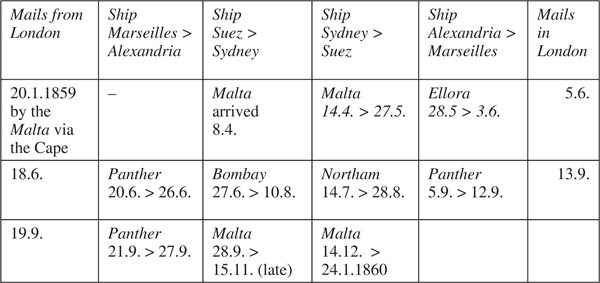
Source: Sailing lists published by Kirk (1989), 57–61, 151–156.
The P&O would have managed the requirement for three consecutive information circles, if their steamer Malta had not been docked at Mauritius for five days in October due to repairs to her air-pump tanks. Now she arrived in Sydney on 15 November, while the Benares had departed the day before. This caused a four-week delay in answers to the letters.981
In 1860, the P&O service enabled three consecutive information circles between London and Sydney, starting on 18 January, 1860, and ending on 12 January, 1861 – but only just. The steamer Emeu arrived at Sydney on 14 March at 4.50 a.m. while the Northam sailed on the same day at 15.14 p.m.982 As the mails had been sorted on board during the voyage, there was some hope of being able to receive the letters and answer them in time. The Melbourne colonists were again luckier, being able to use several more days for their answers. In fact, the P&O ensured three consecutive information circles for Melbourne, but not necessarily for Sydney.
The P&O had received the mail contract to Sydney as a leg for a newly established service from Aden to Mauritius, but they soon realized that there would be several benefits in directing the route via Galle, thus combining several mail routes via one hub. The system had been in use by the Royal Mail Line in the Caribbean since the early 1840s. Although the route via Galle in Ceylon was only 143 miles shorter than the route via Mauritius, 132 hours were saved by proceeding via Galle. And even more important, the stretch of over 3,000 miles between Mauritius and King George’s Sound in Australia could be avoided.983
The route via Mauritius was abandoned, the last mails being dispatched from London on 18 February and from Sydney on 14 February 1860. The next modification to the routine was the change of departure dates, from the 18th to the 26th in London and from the 14th to the 22nd in Sydney, to find a better match with the other Asian mail routes. From now on, the ship from Suez did not sail to Sydney but via Galle to Calcutta, while the Australian mails were transferred to a ship from Bombay, which took the mails from Galle to Sydney. As a result of these adjustments, the average duration of a normal trip from London via Marseilles and Suez to Sydney decreased from 53 to 49 days. In the other direction, the difference was only one day.984
It took about 20 years from the start of the steamship service across the Atlantic to get a working mail service by steamers to Australia. Geography was not on the side of the Australians. While the distance from England to India and China was clearly cut by the Overland route, thus making the use of steamers profitable, the distance to Australia was about the same via Suez as it was via the Cape. Contrary to the India and China routes, or, for example, the route between New York and California in the Western world, there was no ‘leverage effect’ in using steamers on the Australian route. Only when organized as a leg from Galle, could the special costs of the Australian mails be tolerated. With respect to the voyage to Galle, the mails for Calcutta, Bombay or China could share the costs of the Australian dispatches.
FIG. 35. The P&O Australasian mail service network, 1861.
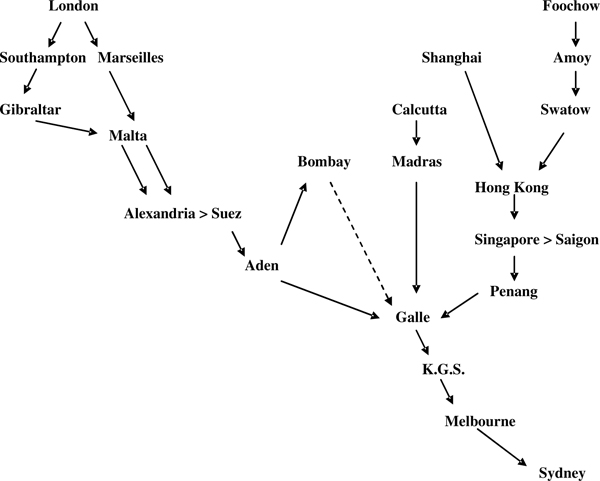
Source: Sailing lists of Kirk (1989), 69, 164; Proud, 76.
Figure 35 depicts how the P&O mail service was organized in the early 1860s. The example is from January–February 1861. The rather new P&O iron screw steamer, the Ceylon, 2,110 tons, sailed from Southampton with the British all-sea mails on 20 January at 2.35 p.m. She made a call at Gibraltar on the 25th and arrived at Malta on the 29th, proceeding for Alexandria on the following day. She arrived there on 2 February at 3.53 p.m.
The express mails left from London by train on the 26th, were taken over the English Channel and across France to Marseilles and there on board the 15-year-old P&O paddle steamer Euxine, of 1164 tons. She departed on 28 January at 10 a.m., calling at Malta on the 31st and arriving at Alexandria on 3 February at 3.25 p.m., one day later than the larger shipment of all-sea mails from Southampton had arrived. Even if both vessels called at Malta, no reloading of mails took place there. It was obviously cheaper and faster to let both vessels continue all the way to Alexandria instead of reloading and continuing by one ship only.
The vessels did not stay long at Alexandria. The Euxine departed with the Australian, Chinese and Calcutta express mails for Marseilles already on 4 February at 4.05 p.m. and the Ceylon with the respective all-sea mails for Southampton five minutes later. They arrived in Marseilles on 10 February at 10.55 p.m. (the mails being in London on the 12th) and Southampton on 16 February at 9 p.m. respectively.
Meanwhile, the mails from Europe were taken from Alexandria by train to Suez on 4 February, the P&O iron screw-steamer Colombo, 1,865 tons, departing from there on 5 February at 0.25 a.m. She arrived at Aden on the 10th and at Galle on the 20th. Having unloaded the Australian and China mails at Galle she proceeded to Calcutta on the 21st. She called at Madras on the 24th and arrived in Calcutta on the 27th.
The China mails were taken from Galle by the Singapore, which departed on the 22nd, called at Penang on 1 March, Singapore on the 3rd, proceeding the next day and arriving in Hong Kong on 13 March. From there the mails for Shanghai were taken by the Aden on 14 March, arriving on the 20th. The mails for Foochow departed on the same day by the Manilla which arrived at Swatow on the 16th, proceeding on the following day, staying at Amoy between the 18th and the 20th and arriving finally at Foochow on the 23rd.985
The Singapore was a ten-year-old vessel of 1,190 tons and the Aden and Manilla were small coastal steamers (the Aden an iron screw) of 812 and 646 tons respectively. They were all owned by the P&O.
The Australian mails were taken from Galle by the 1,330-ton iron screw steamer Northam, which had arrived from Bombay on 17 February. The ship now departed for Sydney on the 21st and called at King George’s Sound on 11 March and Melbourne on the 18th, before arriving at Sydney on the 21st at 1.50 p.m.986
The system was totally in the hands of the P&O and it worked like a clock, mostly. The European mails were sent weekly from Southampton, and six or seven days later from London for the express transmission via Marseilles, in the following order: AC, B, C, B, AC, B, C, B, etc., A being Australia, C being Calcutta and China, and B being Bombay.987
The mails arrived by the two routes – via Gibraltar or via Marseilles – in Alexandria, to be forwarded to one and the same vessel in Suez which took them – excluding the Bombay mails – to Galle, where they were transferred to mail steamers for different destinations. There was no unnecessary reloading on the European side, and the ship from Suez also continued with the Calcutta mails from Galle without reloading.
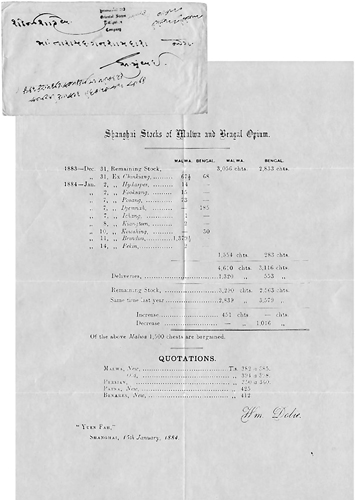
FIG. 36 The letter, written probably in gujarati, includes a bill of lading as well as a circular, dated on 15.1.1884, showing the changes in the Shanghai stocks of Malwa and Bengal opium. Within a two weeks period, no less than ten steamers had brought new opium to the port. The Hydaspes, Brindisi and Pekin were P&O mail steamers, and the Djemnah was owned by the Messageries Maritimes. The letter has been carried by a P&O steamer, as it bears the ship cancellation ‘Peninsular and Oriental Steam Navigation Company’on the front side of the cover.
Galle in Ceylon was the main hub in the Australasian mail service, while Hong Kong served as the hub for Chinese mails. The 3,000-mile sea voyage from Southampton to Alexandria partly in the difficult Atlantic conditions was carried out by the newest and fastest iron screw steamers, which could make 13 knots. The ships for the express service in the Mediterranean were smaller, while the distance between Marseilles and Alexandria was about 2,000 miles.
The vessel which carried the mails from Suez to Galle – some 3,400 miles in varying monsoons – was also a rather large iron screw steamer, while the long Australian run – about 6,000 miles – was conducted by a medium-size steamer. From this we may conclude that most passengers for Australia generally choose the cheaper sailing vessels and that the P&O route was mainly used for mail and fine freight services. For example the Northam could take only 127 passengers.988
The Bombay mails were carried separately from the others, alternating with the Calcutta, China and Australia mails. As in the time of the EIC service, the mails were taken from Suez via Aden to Bombay directly without stretching the voyage to the distant Galle. But also the Suez–Aden–Bombay route actually continued to Galle, as the steamer which carried the mails would continue from there to Sydney. For example the Northam carried the European mails from Suez on 14.1., arrived in Bombay on 28.1. and left for Galle on 12.2., arrived there on 17.2. and proceeded on 21.2. to Sydney. The route between Bombay and Galle, the main hub of transports for China, was obviously not necessary for the mail service. But the P&O had ‘inherited’ the opium business from the EIC and was the chief exporter of Malwa opium from Bombay to China, while Bengal opium was mainly carried by local and American companies.989
Opium earnings brought relative stability over the whole range of the P&O’s lines for about four decades, and finally ceased as late as in 1917, after a ten-year period of reduced trade based on an agreement by the Indian and Chinese governments.990 This lucrative trade was probably one of the basic reasons for competitors’ complaints about the P&O mail contracts. In the late 1860s, when steamship technology had been improved and the Suez Canal had been opened, it was not long before there were several competitors in the Eastern waters, mail contract or not. This will be discussed in the following chapter.
The P&O mail service enabled consecutive information circles between London and the different Australasian ports in 1861 as follows:
TABLE 90. Consecutive information circles on the London–Calcutta–London route enabled by the P&O service, 186
| London departure (express via Marseilles) | Calcuttaarrival | Calcuttadeparture | London arrival (express via Marseilles) | Days |
| 26.1.1861 | 27.2. | 9.3. | 13.4. | 77 |
| 26.4. | 27.5. | 9.6. | 17.7. | 82 |
| 26.7. | 2.9. | 10.9. | 17.10. | 83 |
| 26.10. | 30.11. | 10.12. | 13.1.1862 | 79 |
Source: Sailing lists published by Kirk (1989), 69–75, 162–169.
TABLE 91. Consecutive information circles on the London–Hong Kong–London route enabled by the P&O service, 1861.
| London departure (express via Marseilles | Hong Kongarrival | Hong Kongdeparture | London arrival (express via Marseilles) | Days |
| 26.1.1861 | 13.3. | 16.3. | 26.4. | 91 |
| 26.4. | 6.6. | 12.6. | 29.7. | 94 |
| 10.8. | 21.9. | 15.10* | 28.11. | 110 |
| 10.12.** | 24.1.1862 |
Source: Sailing lists published by Kirk in The P&O Lines…, 54–55.
* There was no departure for Galle at the end of September due to an attempt to reduce the service to a monthly one. The old system continued in October, however. See Kirk, The P&O Lines…, 55.
** The earlier departure date would have been 26.11.
TABLE 92. Consecutive information circles on the London–Shanghai–London route enabled by the P&O service, 1861.
| London departure (express via Marseilles | Shanghaiarrival | Shanghaideparture | London arrival (express via Marseilles) | Days |
| 26.1.1861 | 20.3. | 23.3. | 13.5. | 107 |
| 27.5. | 11.7. | 19.7. | 15.9. | 111 |
| 26.9. | 18.11. | 23.11. | 13.1.1862 | 109 |
Source: Sailing lists published by Kirk (1989), 69–75, 162–169
TABLE 93. Consecutive information circles on the London–Foochow–London route enabled by the P&O service, 1861.
| London departure (express via Marseilles | Foochow arrival | Foochow departure | London arrival (express via Marseilles) | Days |
| 26.1.1861 | 21.3. | 24.3. | 13.5. | 107 |
| 27.5. | 15.7. | 19.7. | 15.9. | 111 |
| 26.9. | 16.11. | 20.11. | 13.1.1862 | 109 |
Source: Sailing lists published by Kirk (1989), 69–75, 162–169.
TABLE 94. Consecutive information circles on the London–Sydney–London route enabled by the P&O service, 1861.
| London departure (express via Marseilles | Sydney arrival | Sydney departure | London arrival (express via Marseilles) | Days |
| 26.1.1861 | 21.3. | 22.3. | 13.5. | 107 |
| 27.5. | 15.7. | 22.7. | 15.9. | 111 |
| 26.9. | 21.11. | 23.11. | 13.1.1862 | 109 |
Source: Sailing lists published by Kirk (1989), 69–75, 162–169.
As can be noticed, the system was cleverly built. It combined the different mail routes in an effective way. All ports (except Bombay) were served via Galle, and the schedules matched well. Calcutta’s location near Galle – only six days sailing – enabled four consecutive information circles per year, each between 11 and 12 weeks. The mail service from London to Shanghai, Foochow and Sydney enabled three consecutive information circles per year. Each circle took about 3.5 months.991 As can be seen, the voyage back and forth from Galle to all these places was calculated so that the mails could be carried from Galle to Suez by one and the same steamer.
For the Hong Kong trade, the system was a kind of lucky wheel. Due to its geographical location nearer Galle than Shanghai, for example, its merchants could occasionally benefit from the second monthly departure, thus shortening the length of the information circle. But as can see from Table 91, this did not always work, and even if it did, the schedule was tight and for practical reasons probably impossible.
In England, the departures from Southampton enabled the same number of consecutive information circles with each of the Australasian ports (except for the ‘extra’ Hong Kong mails) as the express route via Marseilles, but a single journey was some six days longer. The time to answer the all-sea letters arriving via Southampton was naturally short, as they arrived later than the express dispatches and departed earlier. But as a whole, the system worked well. It can be stated that the P&O reached the same level of shipping management in the early 1860s as the Royal Mail Line did in the Caribbean and especially in South America during the same period. And in both areas, this was the time when the French entered the scene.
Competition with the French – The Suez Canal and the compound engine increase the number of rivals – Mails for South Africa – The introduction of the telegraph
Competition with the French
The French had operated in the Mediterranean mail service since the 1830s, but it was only in the early 1860s that the French Government made a decision to extend the service to the rest of the world. As already discussed in earlier chapters, the Government made a mail contract with Compagnie Générale Transatlantique, or the French Line, for a mail steamship service to and from the United States and the Caribbean and with Compagnie des Messagerie Impériales for a service to and from South America and the Far East.
Messagerie Impériales started its service to the ports east of Egypt only after the railway between Alexandria and Suez had been completed, thus avoiding all the trouble with camel caravans, river boats, and related issues. And as in South America, where the French could just copy a tried and true system already established by the Royal Mail Line, so in the East, Messagerie Impériales could easily follow the guidelines set by the P&O in organizing its routes in a well functioning way.
Messagerie Impériales signed a mail contract in June 1861 and the service started gradually over the next few years. French Post Offices were established at Suez, at Saigon in French Indochina, in Vietnam of today, and at Shanghai; postal agents were appointed at several places and, up to July 1864, no fewer than a dozen mail steamers were placed on the principal line and its branch services.992
As can be noted in Figure 35 (see p. 375), the P&O had established an extra mail service between Singapore and Saigon already in 1861. This mail route mainly served the French troops in China, until Messagerie Impériales got their own service started in late 1862.993
TABLE 95. Consecutive information circles on the London–Hong Kong–London route, 1865.
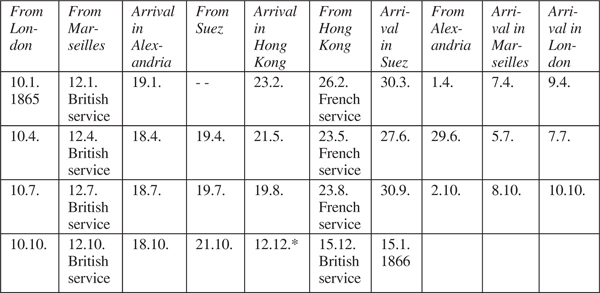
Sources: Sailing lists of Salles, Tome II, 189 and Tome V, 28–29; and Kirk, The P&O Lines…, 63–64.
* The P&O steamer Behar broke a shaft and was towed to Singapore. The mails for Hong Kong were carried by another P&O vessel, the Ottawa, after a notable delay. See Kirk, 63.
The French service included mail transmission from Europe via Marseilles to Alexandria, by train to Suez and from there via Galle and Saigon to Hong Kong. The first mails departed from Suez on 27 October, 1862. A branch line connected Hong Kong with Shanghai from early 1863, and this line was continued from Shanghai to Yokohama in Japan from 1865. Other branch lines served French interests at Calcutta via Galle and Madras from late 1862, and at Bourbon (Réunion) and Mauritius by a direct voyage from Suez from September 1864.994
Did the British - French double service to Hong Kong, or later to Shanghai, speed up business information transmission? Not very much, but it was a minor improvement in the development of communications, anyway. Compared to the P&O service between London and Hong Kong in 1861 depicted in Table 91, the double service enabled four consecutive information circles per year, at least in theory. In late 1865, the machine breakdown of the P&O steamer Behar caused a serious delay in the rest of the chain and made it impossible for merchants to answer the October mails by the November steamer from Hong Kong. Without that incident, the double service would have enabled four full circles that year. On the other hand, the P&O service alone could only accomplish 3.5 consecutive circles. See Table 95.
The French departures from Hong Kong matched nicely with the British arrivals, leaving two to four days’ time for answers. This did not always work the other way round, however. During 1865, four departures of the P&O vessels were on the day of a French arrival, three departures were before a French arrival, and only five departures were well-timed at one-to-four days after a French arrival.995
In Shanghai, the arrivals and departures of the two mail services did not always match in the optimum way for merchants, or anyone else. It should be remembered that, most probably, as in South America, people used any service that would bring their messages as fast as possible to the destination. Nationalistic feelings did not hinder British merchants from using French services, or vice versa. But even if the departure dates from Marseilles were fixed – the British dates being the 12th and the 18th (closing the mail in London two days earlier) and the French date being the 19th – the arrival and departure dates at Shanghai varied, causing both delays and overlapping.
In 1865, an average passage from Marseilles to Shanghai took 47 days, excluding cases where there were two or three machine breakdowns or other major incidents. The British trips varied between 42 and 54 days, while the French service varied between 45 and 50 days. This naturally caused problems in schedule planning.
As can be noticed in Table 96, there were in fact several periods when the French steamers took home answers to mails carried by their own service, as well as to those carried by the British service, but also vice versa. In between, there were ships leaving Shanghai before any new dispatches had arrived from Europe. Even if the French service was only once a month, they always carried the freshest answers back home, while every second British mail steamer actually left on her homeward trip with a minor portion of important letters, the major part having already been taken home a few days earlier by the French service.
The explanation for this was naturally the hard competition between the two companies, not so much concerning the mails (for which they both got paid through their contracts), but more concerning the passengers and cargo. In the coming years, the P&O could not help but notice that the French steamers were newer, more comfortable, faster and more conveniently scheduled. Such things as a laundry on board could do a lot for the comfort of passengers on a six-week voyage. But already in the 1860s, the P&O had to face the fact that the French were taking over not only its passengers, but also its cargoes. Messagerie Impériales increased its silk transportation from Shanghai from 11.7% of the total in 1863 to 42.4% in 1866, ‘because its ships went direct to Suez, and sailed 2 or 3 days before P&O’s’. Silk contributed £119,000 to P&O’s income in 1869, but within two years its freight rates dropped by 65%.996
TABLE 96. Mail arrivals and departures of the British and French mail steamers in Shanghai, January–June 1865.
| Service | Arrival date | Next departure, service | Departure date |
| French | ~15.1. | French | 21.1. |
| British | 19.1. | FrenchBritish | 21.1.26.1. |
| British | 31.1. | British | 9.2. |
| French | ~4.2. | British | 9.2. |
| British | 14.2. | FrenchBritish | 21.2.23.2. |
| British | 28.2. | British | 9.3. |
| French | ~6.3. | British | 9.3. |
| British | 18.3. | FrenchBritish | 21.3.26.3. |
| British | 31.3. | British | 9.4. |
| French | ~5.4. | British | 9.4. |
| British | 15.4. | FrenchBritish | 20.4.23.4. |
| British | 27.4. | British | 6.5. |
| French | ~6.5. | British | 6.5. |
| British | 12.5. | FrenchBritish | 18.5.23.5. |
| British | 27.5. | British | 6.6. |
| French | ~3.6. | British | 6.6. |
| British | 12.6. | FrenchBritish | 17.6.22.6. |
| French | 3.7. | British | 5.7. |
| British | 25.6. | British | 5.7. |
Sources: Sailing lists of Salles, Tome V, 37; and Kirk, The P&O Lines…, 62–64. – Most of the French arrival dates are estimates (Hong Kong departure date + four) as Salles does not always give the exact dates for 1865 and 1866.
The Suez Canal and the compound engine increase the number of rivals
The P&O’s problems did not end with the strong French competition in Far Eastern waters or with several ship wrecks during these years.997 Both the company and the British Government had totally misjudged the importance of the Suez Canal, which the French diplomat Ferdinand de Lesseps had promoted with great enthusiasm from the mid-1850s. Instead, the P&O had invested heavily in the Egyptian railway and in the accommodation and related facilities on the Overland route. The British Government and the press were strongly against the Canal, which they thought could be a political risk during a war, if it were in French hands, as it was planned to be. British investors refused to subscribe for Canal Company shares, wishing that the plan would be forgotten because of the economic and technical risks included. Against all presumptions, the Canal project was completed in 1869. The new route shortened the voyage to and from Asia by thousands of miles compared with the traditional seaway around the Cape, which was still in general use, excluding the mail steamers.998
Simultaneously with the Canal opening, another great invention facilitated steamship trade with the East. The compound engine, even though it had been in limited use since the mid-1850s, had not earlier been fully appreciated by shipowners. It had mainly been used in the Pacific during its earliest period, as coal was expensive there and fuel economy was thus of great importance. Nearer Britain it was not so highly esteemed, as there was plenty of fuel and it was low-priced.999
After 1861, the P&O gradually began to build steamers with compound engines, the Mooltan being the first vessel with the new technical construction.1000 Despite being one of the first to introduce the compound engine, the P&O had an average of 170 sailing ships employed each year to carry coal to the Eastern depots. For example, the company had a coal shed for 6,000 tons at Shanghai, another for 10,000 tons at Hong Kong, and another for 2,200 tons at Yokohama.1001
In the 1860s, coal prices varied greatly in different parts of the world depending on the freight costs. While coal could be shipped to New York for 6 s. per ton and the more expensive Welsh coal for 11 s., a shipment to Gibraltar cost 14 s., to Alexandria 19 s., to Bombay 24 s., to Galle 27 s., to Hong Kong 33 s. and to Shanghai 45 s. Interestingly, the coal freight to Suez was 40 s., more than double the price to Alexandria.1002 This was because the coal was taken to Suez overland across the desert due to the adverse monsoons in the Indian Ocean.1003
The most important innovation of the compound engine was its economical fuel consumption. While the consumption of coal had been reduced from the eight to ten pounds per horsepower per hour used in the 1830s to fewer than four pounds in the mid-1860s, the compound engine further reduced fuel consumption to somewhat over two pounds of good coal per indicated horsepower per hour.1004 Together with the shortened sea route enabled by the Suez Canal, this notably improved the conditions for profitable shipping. It meant that not only the subsidized mail companies but any shipowner could play a role in the Far Eastern business. Among the most important were the Ocean Steam Ship Co. (the Blue Funnel Line) of Liverpool, the Glen Line owned by MacGregor and Co. of Glasgow, the Castle Line owned by Thomas Skinner and Co., the Shire Line founded by Captain D. J. Jenkins, and other companies operating ships in East Indian and Chinese waters, such as the British India Steam Navigation Co. and Jardine Matheson and Co.1005
The hopes of the Mediterranean nations that the opening of the Suez Canal would bring great prosperity to their maritime fleets at the expense of Britain were doomed to disappointment. The advantage of being brought several thousand miles closer to the huge markets and resources of the East by the Canal seemed to have only an illusory cash value for the shipowners of France, Italy, Russia and Austria-Hungary. As far as shipping was concerned, the Canal had been ‘cut by French energy and Egyptian money for British advantage’.1006
But the growing competition caused a remarkable cut in freight rates. In 1866, the P&O carried specie – partly gold, partly silver – worth nearly £11 million, and earned about £230,000 for it. Six years later, they carried nearly double the amount of specie, but received only £60,000. In another example, having carried 46,000 bales of silk for £110,000 in 1868, the company carried 50,000 bales for only £44,000 three years later – equivalent to only 37 percent of the old rate. The highest classes of cargo moving between England and India or China were quickly transferred to the steamship, including cotton goods, cowhides, ginger, indigo and tea. But the steamers also took a substantial portion of low-value, bulky commodities such as jute cuttings or rice.1007
Falling freight rates were a problem not only for the shipping companies trading with the Far East, but everywhere. The decline which started in the 1860s continued right up to the early 1890s, with annual decreases of real freight rates by 2.5 to three percent. According to Harley, the timing of the decline suggests that the introduction of the new technology was the main source of the general decline in rates.1008
For the P&O, the increasing competition on the Far Eastern routes was most unwelcome. A great deal of the company’s investments in the East lost their significance and they were just written off in the accounting. The P&O lost much of its earlier income, and even the British Post Office used the opportunity to tell the company that if it started transporting the mails through the Canal instead by railway as was stated in the contract, the company’s subsidy would be reduced by £30,000 a year. The generously subsidized French, Italian and Austrian shipping companies, which had widened their Mediterranean services east of Suez after the Canal opening, carried all their mails through the cut. Passengers were naturally attracted to these lines and away from the P&O because there was no need for themselves and their baggage to be trans-shipped. The situation led to a farce where the P&O vessels went through the Canal, but the mails were unloaded at Alexandria and taken by train to Suez and there loaded back onto the ship. This continued until a revised contract allowed the mails to be carried through – but only after the company accepted a reduction of the subsidy by £20,000 a year.1009
Despite the bitter claims and competing bids for government mail contracts by the British rivals, the P&O continued to conduct the mail service on the Far Eastern routes.1010 Several branch services were taken care of by other companies, e.g. Mackinnon, Mackenzie & Co.’s British India Steam Navigation Co. had served on the Calcutta–Rangoon route from the mid-1850s and on the Calcutta–Karachi, Bombay–Karachi and Bombay–Basra routes from the early 1860s.1011
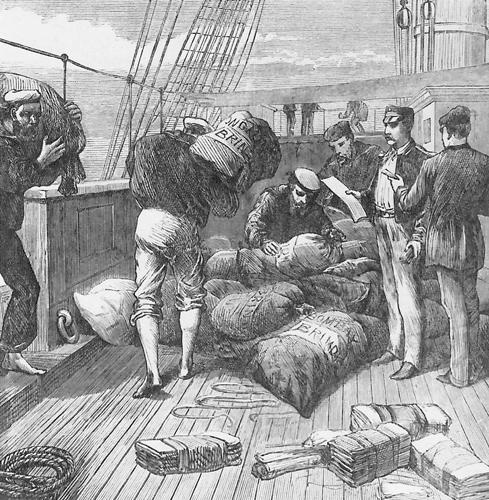
FIG. 38. Mail bags being brought on board a mail steamship at Brindisi, 1872.
In addition to the already mentioned changes in the business environment concerning the mail service to the Far East, there was an additional challenge to meet in Europe. The Franco-Prussian war of 1870 stopped the railway connection from Calais through France to Marseilles. The bridge over the Oise at Creil was blown up in September that year. For a time, other routes were tried, but they were either overrun by the invading Prussians, or their circuitous nature caused unacceptable delays.1012 In early November, a new route was introduced via Brindisi in Italy. The change did not affect the total duration of information transmission. While the trip by train was longer from the Channel coast to Brindisi than to Marseilles, the trip by steamer from Brindisi to Alexandria was shorter than from Marseilles to Alexandria. Thus, an average trip from Sydney to London in 1870 took 50 to 52 days, independent of the railway route in Europe.1013
By the mid-1870s, the speed of the mail services to and from the Far East had reached a level at which it was difficult, and probably unnecessary, to improve it. The systems worked satisfactorily, and the most urgent news could always be transmitted by telegraph. The arrival of the Asian telegraph will be described later in this chapter.
As a final example of the P&O services in the East, Table 97 shows the consecutive information circles enabled by the company’s mail sailings to and from Shanghai in 1875.
TABLE 97. Consecutive information circles enabled by the P&O service between London and Shanghai, 1875.
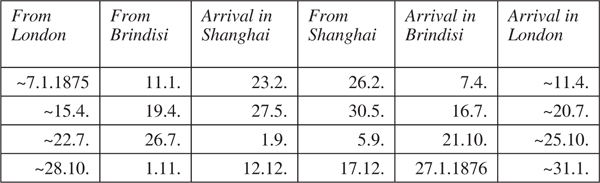
Source: Sailing lists published by Kirk, The P&O Lines…, 86–87. – The London departure and arrival dates are estimates. In the mid-1870s, the railway trip from London to Brindisi probably took three days instead of four, as in 1870. This would leave some more time for answering letters in England.
The P&O service for Shanghai was now working about as well as it could at this time period. The sailings enabled nearly four consecutive information circles a year, and there was no difficulty in answering letters in due time in either Shanghai or England. The one-way trip took about six weeks in each direction. Because the French service was also bi-monthly from mid-1871 and the two companies’ departures took place on alternate weeks, there was now a well-working weekly service to and from Shanghai all year round.1014 This arrangement had been introduced at the same time as Messagerie Impériales doubled their service in July 1871.1015
After this, the speed of business information transmission could not easily be improved due to the long voyage.1016 But using the same model as in the South American mail service, the alternate sailings made it possible for merchants to provide weekly information about their business affairs, even though it took nearly three months to receive a response.
Mails for South Africa
For South Africa or St. Helena, places of such importance during the heyday of canvas, the steamship mail service via the Overland route was of as little significance as it was for Australia. While East India and China had been connected to Europe by regular mail steamers from the early 1840s, South Africa was not considered important enough for subsidised steamship services for a long time. Mails were sent to and from the colony by sailing ships calling at the port, without any certainty of schedule or safe arrival. Prior to 1857, however, there were two attempts to conduct a regular steamship mail service between England and South Africa. From December 1850 to 1854, the General Screw Steam Shipping Company provided a monthly service to the Cape, and from August 1856, there was a contract with the Lindsay Line for less than a year. Despite the £30,000 mail subsidy, both companies ran into trouble and had to abandon the service.1017
In 1857, the British Government awarded the South African mail contract to a new company, to be known as the Union Line. It was to provide a bi-monthly service, and would receive an extra bonus of £250 per day from the Cape Colonial Government each time the mail ship arrived from Plymouth in less time than the agreed 35 days. For this reason, the Union Line mail steamers were ‘more frequently under contract time than any others, the next being those of the Cunard Line’.1018
The progress made in speeding up the voyage over the next few years can be read from the mail contracts. While the Union Line vessels were allowed to use 38 days for a one-way trip in the 1863 contract, the allowed duration of the trip was decreased to 35 days in 1868, 30 days in 1873 and 26 days in 1876.1019
This progression was no less remarkable than in any other place where mail steamships took over from traditional sailing vessels. In the early 1830s, the duration of voyages by merchant sailing ships between England and the Cape of Good Hope had been 82 days outward and 72 days homeward on average. The mails departed only if there was a ship available, which meant that the letters were sometimes waiting at Cape Town for several weeks before they were picked up by a homeward bound vessel. The tea clippers of the 1860s and 1870s made the home voyage faster, but even they used about 50 days between passing the Cape and arriving at London. As the sailing ships did not carry public mail at that time, their speed was not of much importance in this regard, however.1020
Until 1872, the Union Line kept its mail contract without difficulty, sailing from England on the 10th and 26th of each month.1021 The factual sailing dates are not published by Cattell or any other postal historian, but a rough calculation shows that the system enabled four consecutive information circles between England and Cape Town. For the colonialists at Durban in Natal on the East Coast of South Africa, the trip was 800 miles longer than to the Cape and needed a further inter-colonial service. To be able to calculate the duration of these voyages, correspondence from that period would be needed for reference.
The situation changed abruptly in 1872, when the Castle Line, established by Donald Currie of Liverpool (who earlier worked for the Cunard Line), started a regular service between England and South Africa. Their ships were newer and faster and made the trip in 25 days, the sensational record of 1873 being 23 days. At that time, the Union Line ships sailed on the 10th and the 26th of each month, so the Castle Line vessels left from Dartmouth three days before the Union Line steamer and as they were faster, arrived at the Cape almost as soon as the competitor ship, which had left Southampton eleven days earlier. Naturally, people started to endorse their letters to be carried by these steamers instead of the official mail service. While the mails carried by the Castle Line steamers were considered private ship letters, they were also notably cheaper, the ½ oz. letter fee being only four pence against the one shilling rate charged for the official mail.1022
Before the mail contract with Union Line came to an end in 1876, the Cape Colonial Government negotiated with Donald Currie about a supplement mail contract. The Cape colonialists wanted cheap postage, more frequent mails and no amalgamation between the Union Line and the Castle Line, which would lead to a monopoly. The healthy competition led to a satisfactory situation in which the bi-monthly mail service by the two companies was organized so that there was actually a weekly service in both directions.1023 This must have increased the number of consecutive information circles to five or probably six per year, although it cannot be verified here due to a lack of sailing data.
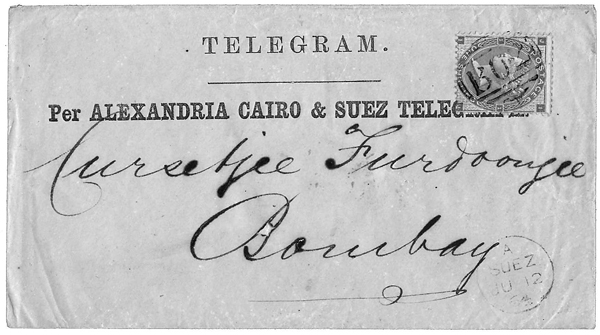
FIG. 39. Combined use of telegraph and ordinary mail. The telegram, sent Overland by the Alexandria, Cairo & Suez Telegraph Company, was forwarded from Suez (note the B02 handstamp) to Bombay by the P&O steamer Benares, which departed from Suez on 12.6.1864 and arrived in Bombay on 24.6.1864. The overland telegraph was most likely built in accordance with the railway, around 1859.
The introduction of the telegraph
As in other parts of the world, the telegraph came to the East in small portions, shortening the duration of communications by a few days here and there. The principal telegraph lines in Europe were completed in the 1850s and 1860s, and internal networks were linked across national borders to form an international system. From the early 1850s, it was also possible to lay submarine cables on shorter routes, e.g. in the English Channel. Due to economic and political reasons, it was mainly the British companies which were behind the laying of cables between the Mediterranean islands and the mainland in the 1850s. The cable which would run the length of the Mediterranean was started at the eastern end of the sea when Glass, Elliot and Co. prepared a line between Alexandria, Tripoli and Malta. It subsequently became the joint property of the company and the British Government. In 1866, a new and modern cable was laid between Alexandria and Malta by the British-owned Anglo-Mediterranean Telegraph Co.1024
With the completion of the cables between Malta and Alexandria, telegraphs from London and other cities in Western Europe reached Alexandria via Sicily and Malta, which had been connected in 1859. In 1870, two important lines were again completed: the line between Marseilles and Malta, which provided a direct link between London and Alexandria via Paris and Marseilles, and the Falmouth, Gibraltar and Malta Company’s cable between England and Malta, which provided a British line all the way from London to Alexandria.1025
The earliest telegraphic communication with India was established in 1864–1865 using a combination of land and sea lines. The route followed the Turkish Government’s line from Constantinople to Fao, via Baghdad. From Fao, the Indo-European Telegraph Department, financed by the Indian Government, laid coastal cables (the Persian Gulf Cables) to Karachi via Bushire and Jask. This line was soon extended by a land line across Persia across Bushire to Teheran. Shortly afterwards a service was inaugurated between Teheran and Moscow via Tiflis. There were now two alternative telegraph communications between Western Europe and India, one via Constantinople and the other via Moscow. However, both these lines proved to be rather week and unreliable, and new options were sought very soon.1026
The new telegraph system was built by the Anglo-German Indo-European Telegraph Company, which was established by Werner von Siemens and registered in Britain. The line was built across Continental Europe, through Prussia, then via Kiev, Odessa and the Caucasus to Julfa on the border between Russia and Persia. From there the line continued to Teheran where it was connected with the Indian Government lines. The line was completed in 1869, but for various technical problems, it was brought into general use the following year. Simultaneously a new rival, the British Indian Telegraph Company, entered the scene, building a submarine cable from Alexandria to Bombay via the Red Sea and Aden.1027
The cable to Bombay was continued by the Indian Government’s land lines to Madras and via Penang to Singapore by the end of 1870. The following year a cable from Singapore to Hong Kong via Saigon was finished and, in addition, Australia and the Dutch East Indies were connected to the British lines. By October 1872, a land telegraph stretched across Australia to the south coast, thus connecting Adelaide and the south-eastern colonies with the mother country.1028
For the Far Eastern trade, the new means of communication was naturally very welcome, although the use of it was limited to the most urgent messages. For example, the number of telegrams sent from India grew from 311,000 in 1867 to 577,000 in 1870 and 907,000 in 1876. The respective numbers of mail items sent during these years were also growing fast: from 69 million in 1867 to 86 million in 1870 and 119 million in 1875.1029 In other words, the number of telegrams sent was 0.45% of the number of items sent by mail in 1867, growing to 0.67% in 1870 and to 0.76% in 1876. It was only in the late 1880s that the number of telegrams sent in India reached 1% of the number of sent mail items. This gives an idea of the nature of telegraph usage. As everywhere else, it was expensive, and often unreliable.
Jorma Ahvenainen describes in an interesting way the political, cultural and economic difficulties met while laying telegraph cables in Chinese waters, as well as building the Siberian line to the East. For further details, his book on the Far Eastern Telegraphs is warmly recommended.1030
From the viewpoint of this study, it may be relevant to note that there does not seem to be a specific date when the telegraph ‘took over’ from traditional business communications. Where the telegraph existed, it was used to shorten the duration of information transmission in critical situations. An early note by Kirk verifies that the new system was immediately adopted by the shipping companies, when such an option was available, and that there also existed an early telegraph line east of Suez: ‘‘Northam’ arrived at Suez on 26.4.59 with the Bombay mails and ‘Emeu’ should have arrived the day after. Both sets of mails should have left Alexandria on 29.4.59 – by ‘Nepaul’ (Marseilles) or by ‘Ripon’ (Southampton). But Alexandria had no news of ‘Emeu’. The submarine telegraph cable was out of action between Aden and the Red Sea Telegraph Station at Suakin (‘the gutta-percha perished’ – British Library records). Thus Alexandria would not know about the ‘Emeu’ until a signal was received from Suakin.’1031
An interesting letter by Alfred Holt gives detailed directions to the Agamemnon’s Captain Middleton for the ship’s first voyage to Shanghai in 1866. In addition to orders regarding schedules, ports, coaling, cargo and various agents to be met, as well as arrangements for separate cooking for Chinese passengers, there were also requirements to send information to the owners from different places. From Mauritius, a letter should be sent to an agent in Alexandria to be telegraphed to England with the following short text: ‘Agamemnon Mauritius Monday twenty eight May’ with the correct date replaced instead of the date given. Holt refers to the foreign telegrams which are sometimes ‘almost incomprehensible’.1032
Holt also writes that if there is a chance of writing to Ceylon before the mail leaves for Suez, the Captain should write to an agent at Galle and request him to send a similar telegram. ‘Of course you will not write to both.’ At Galle, the Captain should write by the first mail to the agent and ask him to send a similar telegraph to the one from Mauritius to inform the owners about the ship’s safe arrival. On the way homewards, the agent at Galle should telegraph the owners about any deviations from the plan. It would also be a convenience if the Captain could telegraph home when passing Lisbon, and if he could not, he should try to telegraph from some place in the English Channel.1033
For the mail contract companies, the telegram was a valuable tool as the problems met by one of their vessels often caused a chain of delays in their service. For any shipowner, the telegraph was a management tool which made it possible to keep better control over their businesses far away. To speed up information transmission between Europe and the Far East, it was now possible to ask the agents in e.g. Alexandria to telegraph the most urgent news to London, while the mails were still on their way for a few days.
Thus, from the 1860s, the real duration of information transmission was often shorter than the fastest steam ship connection. As in the case of the North Atlantic mail route (where the telegraphs shortened the duration of information transmission between Ireland and London, or between Newfoundland and New York, long before the Atlantic cable was laid), or as in the case of South America (where merchants could use the telegram between their positions and the northern coast of Brazil, and between Lisbon and London), so the Far Eastern trade benefited from partial solutions for years before the long intercontinental lines were established.