Earlier studies have already shown that the speed of one-way information transmission grew markedly during the 19th century before the introduction of the intercontinental submarine telegraph. The interesting question which has not been systematically examined to date is: Why? What happened? Was the change from sail to steam and from mail coach to railway the only proper answer? And did the shortening of one-way trips automatically improve the information circulation of business enterprises? For a merchant, it was often critical to be able to reply to letters rapidly, not just to receive news from the other side of the ocean.
Due to their own maritime and trade interests, the British became the forerunners in organizing regular overseas mail transmission, first by sailing packets and, as soon as the technology was developed enough, by steamships. Only a few months after the first successful transatlantic crossings entirely by steam power in 1838, the British Government decided to organize regular mail steamship services on the Empire’s most important trade routes: to North America, the West Indies and East India.
Instead of building and managing a fleet of steamers itself, the British Post Office ‘outsourced’ the overseas mail services by giving a Royal Charter to three shipping companies, which would take care of the mail sailings: the Cunard Line, the Royal Mail Line, and the P&O. This happened simultaneously with a few other revolutionary ideas: the change of British inland postage rates from different fees depending on the length of the journey to a uniform one penny rate, and the introduction of the first pre-paid postage stamp in the world, the Penny Black.
From July 1840, the Cunard Line’s vessels sailed across the Atlantic on bi-monthly schedule, or monthly in winter. The P&O started their sailings first to the Mediterranean in 1840, and then to India, China and even Australia. The Royal Mail Line started their sailings to the West Indies in early 1842.
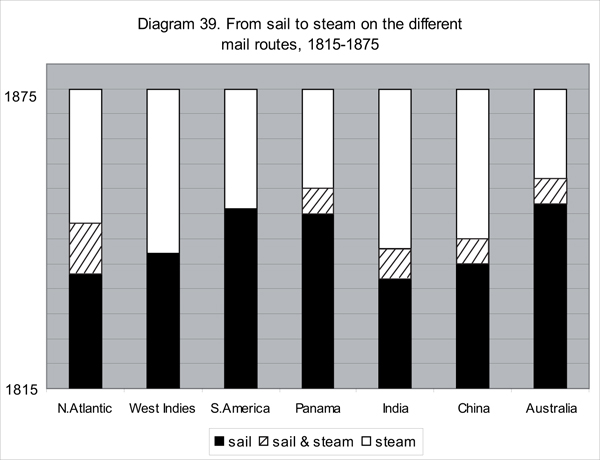
Diagram 39 shows the change from sail to steam in the common mail services on the various trade routes. As can be noticed, steamships were taken in use in mail transport within an approximately 15 years’ period. Whereas the first mail-carrying steamers crossed the Atlantic in 1838, the first mail steamships started their service to Australia in 1852. The first period of steamship service to Sydney lasted only a couple of years, and started again after the Crimean war in 1857.
As can be noticed in the diagram, there was an ‘overnight change’ from sail to steam on the West Indian and South American routes, as the British Post Office replaced the Falmouth sailing packets by the Royal Mail Line steamers in January 1842 (the West Indies) and in January 1851 (South America). Even though the other government-sponsored mail steamship companies started their service on specific dates as well, there was generally a shift period of several years when letters were carried by different means of communication. The reasons for the delays varied. On the North Atlantic route, for example, the American sailing packets could compete successfully with the early steamers on the way eastwards due to prevailing winds and currents. At Panama, the construction of the railway across the isthmus took several years. In India and China, the East India Company could fight against changes for several years. And Australia was just too far away to provide a business for the early steamship companies.
The development of two-way communications, which was important for business correspondence, has been examined in this study by using the method of calculating the consecutive information circles enabled by various means of communication. The following diagrams will show the development of business information transmission on the different mail routes between 1815 and 1875.
North Atlantic
On the North Atlantic route the number of consecutive information circles enabled by the mail systems of the period grew from three to five per year, when the American sailing packets started their line service between New York and Liverpool. The change from sail to steam in 1838 did not bring a major improvement in the information circulation, even though the duration of westbound voyages in particular decreased remarkably. The reason for this was that the steamship voyages were organized by different independent companies which could not afford a regular line service.
While 15 round voyages by the pioneering steamers enabled only six consecutive information circles per year for merchants in England and New York in 1838 and 1839, the 20 annual round trips of the Cunard Line steamers with regular sailing dates enabled eight consecutive information circles already in the early 1840s.
Although there was a more or less regular steamship service in the North Atlantic from 1838, the shift period during which mail was carried across the ocean by both steamers and sailing packets lasted until the late 1840s. This was due to the fact that the eastbound voyages by steamers were not remarkably faster than by sailing ships and there were weekly sailing packet departures from New York, while the steamship departures took place less often. The captain’s fee for carrying a private ship letter was considerably lower than the official postage fee. How relevant the information cost was from the sender’s point of view is difficult to estimate, as it was the recipient who mostly paid for the letter.
The general speed and regularity of sailings, as well as the expectations regarding the safety of the mail transmission, were reflected in the business practices of the merchant houses. It was common practice to write duplicates and even triplicates of letters to ensure that at least one would be received, and preferably as soon as possible. During the shift period from sail to steam, the original letter was sent by steamer and the copy by sailing packet, or vice versa. Later on, the original letter and the duplicate were sent by two consecutive steamers, and finally the steamship service was considered so reliable that duplicates were not sent any longer.
The growing trade and improving steamship technology soon attracted competitors to the North Atlantic route. The U.S. Postmaster General awarded subsidized mail contracts to three shipping lines, of which the most important was the Collins Line on the New York – Liverpool route. When the Cunard Line also opened a direct mail route to New York, there were two weekly steamship sailings in both directions between England and the United States from 1850. These changes alone enabled an increase in annual consecutive information circles from eight to twelve without any notable improvement in the speed of one-way voyages during the period when the companies were competing with each other (see Diagram 40).
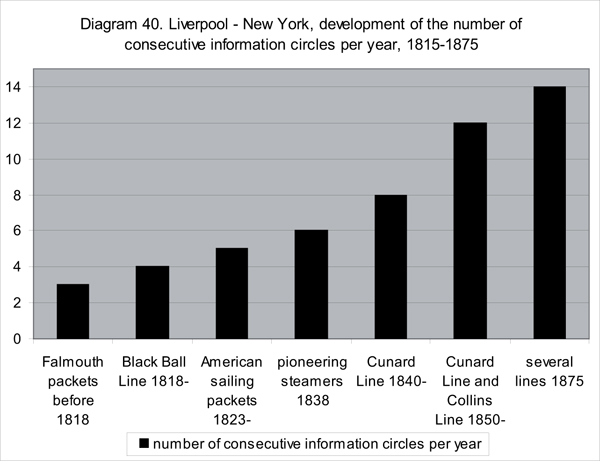
Even though the size and speed of the transatlantic vessels, as well as the frequency of their departures, grew constantly through the period from 1815 to 1875, the number of consecutive information circles enabled by the various services did not improve correspondingly. While there were three times more sailings per year in 1875 than in the early 1850s, the number of options to send letters back and forth consecutively during the year only grew from 12 to 14. Making an allowance for the length of the trip and the number of annual departures, the ideal number of information circles would have been nearly 17. But the transatlantic mail service had reached its maturity and was in fact stagnant at that time. There were several reasons for this.
The steamers had lost their position as ‘news bringers’ to the submarine telegraph in the same way as the American sailing packets had lost their position to the steamers 30 years earlier. In both cases, this led to growing irregularity and length of sailings. Although the mass of carried bulk mails was still growing decades after the introduction of the telegraph, the excitement of being the first to break the news had gone. The speed at which bulk documents or ordinary business letters were carried was not considered that important.
Secondly, no one was paying for the speed of bulk information transmission. After the lucrative mail contracts had been replaced by monthly agreements about carrying mail as normal freight, the shipping companies started to compete in other business areas, especially the passenger service. Saturday sailings from New York became popular and four companies sailed on the same day. Thus there were several days in the week with no mail departures at all.
The West Indies and South America
The Royal Mail Line started their steamship services to the West Indies one and a half years later than the Cunard Line started their North Atlantic service, and to South America at the beginning of 1851. In both cases, the change occurred overnight, though naturally the last Falmouth packets carried mails from their respective destinations on their home voyages. Diagram 41 shows the change in the number of consecutive information circles during this period with respect to the West Indies. The example is from the Demerara route, but the destination could be some other port in the Caribbean region as well and the result would be the same due to the circular mail route system.
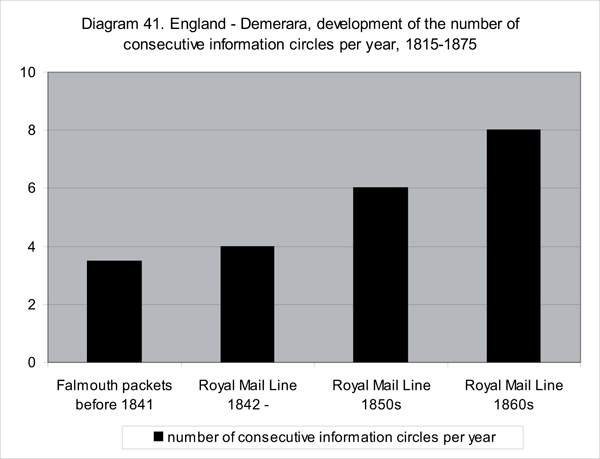
As can be seen by comparing the years 1841 and 1842, the effects of the change from sail to steam were not very impressive on the West Indies route. Even if the duration of one-way sailings from Europe to the Caribbean became shorter, information circulation suffered from the complexity of the inter-island services (see Map 4 on page 238). Improvements took place over the next two decades. By re-routing several inter-island sailings and reducing their number, and by replacing transatlantic vessels with speedier, technologically more advanced ships, it was possible to increase the number of consecutive information circles from four to eight by the early 1860s. The overlapping French service in the Caribbean, starting in 1862, offered an alternative but did not really improve the number of options for faster information circulation.
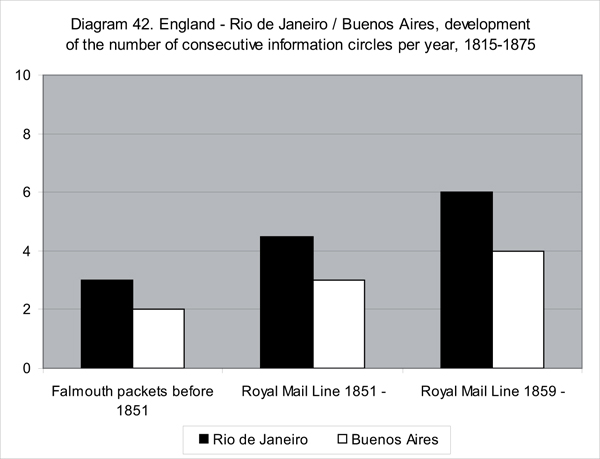
The course of events on the South American route was different. The British government mail contract was awarded to the Royal Mail Line as late as at the beginning of 1851, while the Falmouth sailing packets had taken care of the mail service until then. By that time, many of the early problems with steamship technology and the streamlining of schedules had been overcome. Thus the overnight change from sail to steam in early 1851 immediately improved the number of consecutive information circles between London and Rio de Janeiro from three to 4.5 and between London and Buenos Aires from two to three. Additionally, the improvements in schedules and the speed of vessels enabled an even better service from 1859. The number of consecutive information circles between London and Rio de Janeiro increased to six and between London and Buenos Aires to four per year.
The French service, which was started in 1860 by Messageries Impériales, could not afford extra consecutive information circles due to the long voyage, but it played an important role in information transmission as the sailings were organized to complement the Royal Mail Line’s sailings instead of competing with them by offering simultaneous services.
California
The most striking improvement in the speed of information transmission by traditional means took place between New York and San Francisco. At the time when the Californian gold rush begun in the late 1840s, the only means of communication to the West Coast of the United States was by sailing vessels around Cape Horn. Even by the fastest clippers, it took about four months to sail from New York to San Francisco. When steamship services were established between New York and Colon, as well as between Panama and San Francisco, the one-way travel time was reduced to some six weeks. In 1855, after the opening of the Panama railway, the duration of information transmission between New York and San Francisco was only 3.5 weeks. And finally, in the 1870s, the transcontinental railway took the mails from the East Coast to the West in about one week.
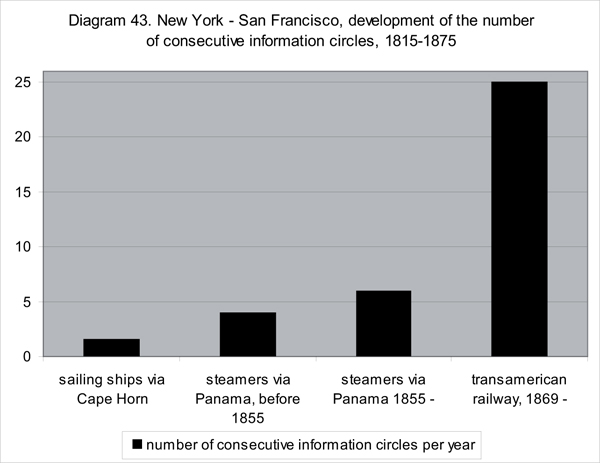
The Panama case includes a paradox: by sailing ship, which was the slowest means of communication, the journey in terms of miles was also the longest. The combination of two steamship lines and the overland crossing at Panama caused a double effect: the length of the journey was significantly shortened, while the speed was greatly improved due to the simultaneous change from sail to steam. The railway across the Panama Isthmus made the overland crossing shorter and easier to manage, again speeding up the journey. And finally, by using the shortest possible route and the fastest possible vehicle of the period, the duration of the journey was reduced to less than a week of the original four months or more (see Map 7 on page 284).
In the United States, the telegraph was brought into transcontinental use in the early 1860s, thus making the mail steamers mainly carriers of documents and confirmatory details instead of the first news of great events. This notably demoted the Panama steamship services, which never recovered to their earlier level of performance after the American Civil War. The significance of the transcontinental railway as the ‘news bringer’ was never recognized, as the telegraph had already taken that place when the railway was completed. From the business information point of view it was nevertheless an important improvement.
East India and other Australasian destinations
On the East India route, the original situation differed from the other routes discussed. There was no government packet service and practically no private merchant ships sailing on the India or China routes due to the monopoly of the East India Company, or the EIC. After the abolition of the EIC monopoly in the India trade in 1813 and the China trade in 1834, great numbers of common merchant ships took over the Eastern routes. They made faster round trips than the East Indiamen and due to their large number, the information circulation between England and the trade ports east of the Cape of Good Hope improved markedly. Due to the long voyage, the number of consecutive information circles increased to only approximately 1.5 per year. The duration of sailings also varied greatly.
The development of the Overland route across Egypt was a major improvement in the communication between Europe and the Asian trade ports. After fifteen years of hesitation between the shorter route with the desert crossing on the one hand and steaming around the Cape on the other, the Overland route was adopted permanently in the early 1840s.
The British Post Office awarded a contract to the P&O for the mail service to India and later to China and other parts of Asia. The European leg, which had been taken care of by the Admiralty, was first transferred to the P&O, while the EIC still took care of the Bombay mails. The P&O started the Calcutta Line in 1843 and the China Line for Hong Kong in 1845.
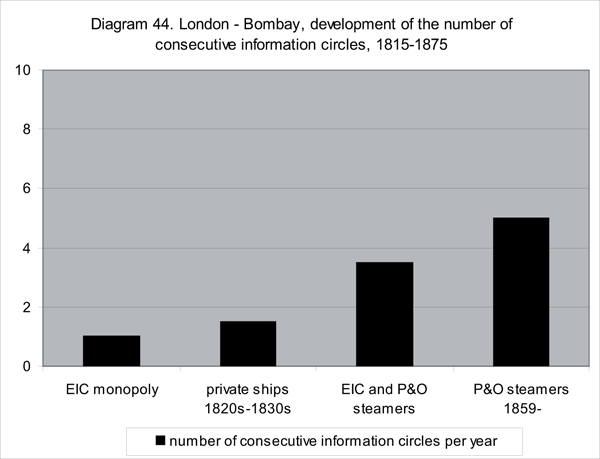
In the early 1840s, the express mails from London were taken across the Channel, then by railway from Calais to Marseilles, by Admiralty packets to Alexandria, by dromedaries and donkeys across the Egyptian desert, by river boats on the Nile, by steamers from Suez to Bombay and by dawk runners across the Indian mainland. The letters were then carried from Calcutta by private merchant ships to China. This chain of varying services could bring the news from London to Hong Kong in less than four months, of which more than 2.5 months were used for the last leg from Bombay to Canton / Hong Kong. Even a merchant ship sailing directly from England could sometimes bring the latest news faster to China than the expensive and complicated government system, and very much cheaper.
In 1843, the P&O opened its Calcutta route via Galle, Ceylon, and when the leg from Galle to Hong Kong was opened in 1845, the overnight change in the speed of information transmission was remarkable. The new arrangement took the London mails to Hong Kong in fifty days, thus halving the previous duration of the mail transmission. This was one of the occasions in the history of world communications, where just a logistical arrangement could revolutionize the speed of information transmission, without radical new inventions but by applying what already existed. In 1859, the London – Hong Kong service enabled 3.5 consecutive information circles per year, one whole circle taking 93 to 96 days.
By 1861, the P&O had organized its sailings with great expertise. All the Australasian ports except Bombay were served via Galle, from where the branch steamers continued to Calcutta, to Hong Kong (and from there to Shanghai and Foochow) and to Sydney in Australia. The ships returned to Galle simultaneously to reach the steamer for Suez, from where the mails were forwarded across the Egyptian desert by the newly opened railway and by ship from Alexandria – the express mail via Marseilles and by train directly to London, and the bulk mail via Gibraltar to Southampton.
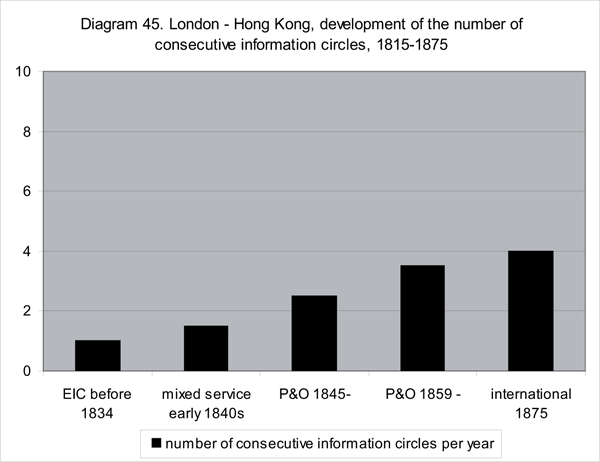
By avoiding loading and reloading when possible and unnecessary waiting for late arrivals of mail-bringing ships at distant ports, the company had produced a smoothly working system which enabled three consecutive information circles per year with Shanghai, as well as with Foochow and Sydney. It took some 3.5 months to receive an answer to a letter sent to these places, but it was only about a quarter of the duration of the information circle of some thirty years earlier. The French service by Messageries Impériales complemented the system from the 1860s, as it had done on the South America route.
There had been notable geographical ‘leverage’ in the case of the Panama route combining New York and San Francisco in the 1850s, and the same phenomenon could be seen in the Overland route regarding information transmission to India and the Far Eastern ports. While the steamers were replacing sailing ships, new mail routes could be brought into use, thus considerably shortening the length of the route in miles, as well as the time used for information transmission. By building railways across critical shortcuts, a notable extra benefit could be achieved, e.g. over the Panama and Suez isthmuses, as well as between Calais and Marseilles, or later Brindisi, and across India to replace the dawk runners.
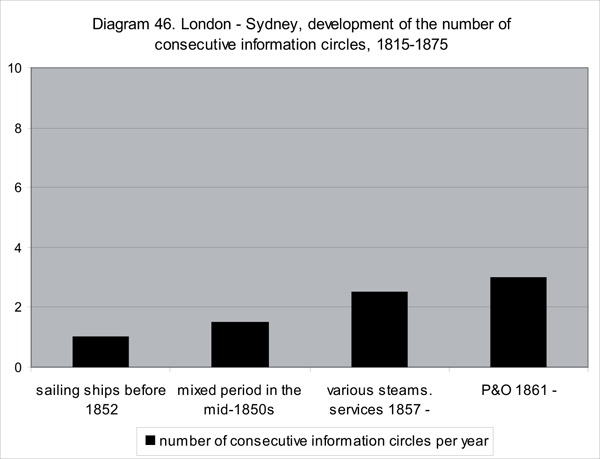
But not all regions benefited from the shortcuts. For example, the Suez Overland route was a disaster for Australia. When ships travelled from Europe around the Cape of Good Hope, Australia was located almost as near the Cape as the East Indian ports or China – in fact many ships nearly passed Australia on their way to Canton or Manila. But when viewed from Suez, the geography was very different and Australia was thousands of miles away from the main trade routes.
The early steamers were not able to manage these distances and Australia was left alone for many years. The gold rush finally encouraged some companies to try, although with rather weak results. After the Crimean War, 16 years after the company had begun its mail service to Calcutta, the P&O finally started a permanent line service for Australia. By 1872, only a dozen years later, Australia was connected by telegraph with the mother country. When the modern systems finally reached Australia, they entered rapidly.
The submarine telegraph did not cause a sudden revolution in overseas communications, but became an integral part of communications over a longer period. As the telegraph had been partly used for urgent inland connections from the late 1840s, it had benefited communications to some degree for years before direct overseas connections were established. Thus, the duration of information transmission across the Atlantic had been shortened years before the successful Atlantic cable was laid in 1866 by inland telegraph connections both in Britain and Canada / United States. The trip to South America was shortened by a telegraph line between London and Lisbon on the European side, and by a coastal telegraph line in Brazil. There were also several partially working land lines to India before the direct line was opened in 1870.
The laying of submarine telegraph cables between continents caused a shift period in information transmission that was similar to the change from sail to steam. Due to high prices and unreliable services, the telegraph was used only in urgent cases. The use of the telegraph was not usually an alternative to written letters, but these means of communications mainly complemented each other, as letters were needed anyway for sending instructions, explanations and business documents. Thus the information costs were not alternative; the choice was not usually made between sending a letter or a telegram but between sending only a letter, or a letter and a telegram. When the prices of telegrams were reduced, the latter alternative became a part of normal business practice.
Summary
The most notable changes in overseas business information transmission took place in the 1850s or early 1860s, depending on the distance of the region from the mother countries in Europe. This did not occur immediately when sail was transformed to steam but several years later when the shipping network had been organized in a more effective way and there were enough – but not yet too many – companies sharing the market for mail transmission. Additionally, several geographical hurdles were overcome by building railways across critical overland shortcuts like Panama and Suez.
As most of these improvements took place within a decade in the mid-19th century, this period must have been experienced as truly revolutionary by contemporaries. Without the wars and uprisings which consumed a great part of the mail steamship capacity for several years, e.g. the Crimean War, the Indian Mutiny, and the American Civil War, progress could have been even faster.
As long as the ships were considered as important news bringers, they acted accordingly. The departures were punctual and spread more evenly over a time period (offering one weekly departure instead of two simultaneous departures every second week, for example) which was more useful from the business information transmission point of view. The ideal situation was typically based on services by two or several competing companies each having a mail contract. In contrast, mixing a major passenger and freight service with mail transport generally caused declining interest in the speed of information transmission.
The North Atlantic was often the testing field for new information transmission systems, not only due to its economic importance but also because of the shorter run compared to the other routes. The struggle between the Cunard Line and the Collins Line obviously did not speed up specific voyages by more than one or two days, if at all, but their way of organizing sailings on alternative weeks, in the similar way as the American sailing packets had done, led to the same effectiveness of information circulation. Their combined performance was almost equal to what could be achieved 25 years later by much more effective vessels operated by several companies on a nearly daily basis. If there was a revolution in early communications, it was probably in the North Atlantic in around 1850.
The more extensive was the geographical distance, the longer it took before a similar ‘revolution’ could take place on the other mail routes. The regular and frequent-enough line system conducted by several identical mail carriers was built up all over the world by the early 1860s – only a few years before the laying of the first intercontinental submarine cables. Thus the ‘revolutions’ followed each other. For contemporaries, it must have been a logical chain of improvements instead of one single event which changed it all.
In our days, the globalization of real-time international communications, first by fax and international phone calls, and then by mobile phones, text messages and the Internet, has changed our way of conducting business or even our personal relationships. Those who saw the development of regular steamship services with strategic overland shortcuts by railways at distant colonies and the speeding up of information circulation coupled with the increasing opportunities to use telegraphs for the most urgent messages, must have felt as we do now. While information and capital were moving faster than ever, people had to adapt their lives to the new communication systems. Hopefully someone will also examine this aspect of the development one day.