IX Epilogue
The introduction of the intercontinental telegraph did not stop the improvement of ocean steamship services but complemented the communication, speeding up world trade and capital movements. For ocean shipping, the development up to 1875 was just the beginning.
The speed of mail steamers, especially on the North Atlantic route, grew steadily through the whole steamship era. While the Sirius made her first voyage in 18.5 days, by an average speed of only eight knots, the Germanic of the White Star Line doubled that speed to almost 16 knots in the 1870s. By the end of the 19th century, the average speed had risen to 22 knots, and the last record holder, the United States, crossed the Atlantic from the Bishop Rock lighthouse at the entrance to the English Channel to the Ambrose lighthouse ship off New York in 3.5 days in 1952, at an average speed of 34.5 knots.1034
There clearly was a correlation between the size of the vessel and her speed. From 1838 to 1899 almost all record holders were at the same time the largest ships in the world, excluding the giant Great Eastern, built in 1860, which never was a Blue Riband holder, even if she definitely was the largest passenger ship ever built until the 20th century.
The rapid change after 1880 was mainly due to the increasing competition, which started in the 1870s. The ships were built larger and larger, partly to meet the needs of growing masses of emigrants and cargo transport, but also because first class passengers were tempted by more space and comfortable surroundings during their travel.
Luxury indeed became critical in the growing competition, and for instance the new Cunarders of the 1880s provided some 60% of the total net tonnage for cabin class accommodation, compared with only 20% for steerage.1035 The image of steamship travel in the early 20th century given to the general public by the books and films about the ill-fated Titanic of the White Star Line was therefore not incorrect. But in addition to the well known details of the ship’s history, it should be remembered that also the Titanic bore in her name the abbreviation RMS – Royal Mail Steamer.
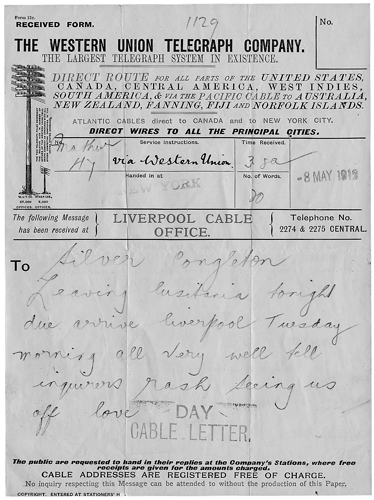
FIG. 40. The Atlantic cable telegraph from New York to Liverpool on 8.5.1912 informs the family members at home that the senders are going to travel by the Lusitania: ‘Leaving lusitania tonight due arrive liverpool Tuesday morning all very well tell inquirers rash seeing us off love.’ The couple who sent the telegraph had arrived in New York three weeks earlier by the Mauretania simultaneously with the Titanic’s sinking on the same route.
Diagram 47 shows the trend in steamship size and speed from the period of the contest between the Cunard Line and the Collins Line in the 1850s to the end of the 19th century. Later development was even more impressive, as can be seen in Diagram 48.
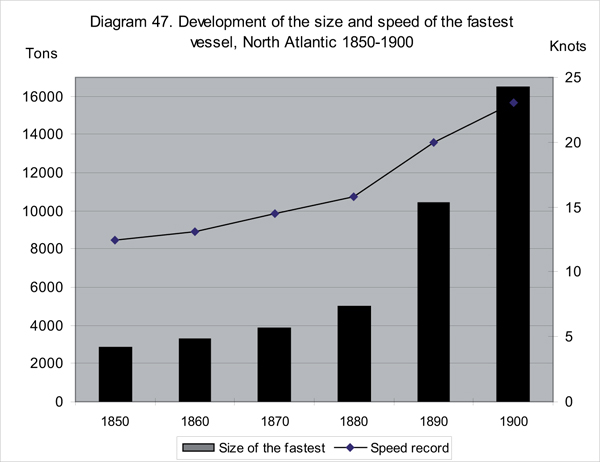
Source: Kludas, 36, 41, 49, 54, 72, 87 and 146–147.
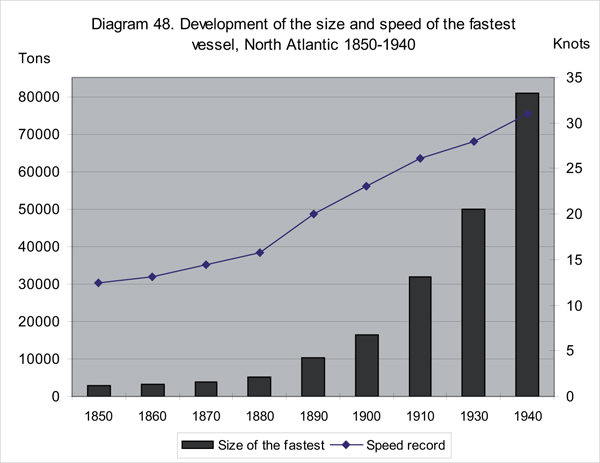
Source: Kludas, 36, 41, 49, 54, 72, 87, 105, 114, 131, 136 and 146–147. – The Mauretania kept the record both in 1910 and 1920.
But the progress was not as straightforward as could be assumed by looking at the diagrams. After a period of fast improvement in steamship building around 1910 – including the Cunard Line’s Lusitania and Mauretania in 1907 and Aquitania in 1914, the White Star Line’s Olympic in 1911 and Titanic in 1912, the French Line’s France in 1912, and HAPAG’s Imperator in 1913 and Vaterland in 1914 – WW1 set back progress for years.1036
The period of stagnation in the development of speed can easily be noticed from the fact that the Mauretania kept the Blue Riband for almost 20 years, from September 1909 to July 1929, until finally the German vessels Bremen and Europa of Norddeutscher Lloyd took over.1037 Only a few years later, in 1936, improved maritime technology reached its peak in the form of the Queen Mary, 80,774 tons, which was more than a hundred times larger than the first transatlantic mail steamer, the Sirius of 703 tons, one century earlier.1038 The Queen Mary’s normal Atlantic crossing from New York to Cherbourg took less than 4.5 days at an average speed of almost 30 knots.1039 During WW2, she once crossed the Atlantic with 15,740 troops and 943 staff – a total of 16,683 people on board, which is still a record.1040
The frequency of sailings depended very much on the emigrant flows. One of the peak years was 1913 with almost 1,200 passenger steamship arrivals in New York, over 170 arrivals in Boston, over 90 in Philadelphia, and over 50 in Baltimore – in total more than 1,500 passenger steamship arrivals from Europe at these ports during one year. The Cunard Line’s Mauretania made 15 round trips that year, arriving in New York every third week. Alone, she could have run more consecutive information circles than all the steamers together that plied the same route in 1875. There was a regular service to New York from Glasgow, Liverpool, London and Southampton, from Antwerp, Bremen, Hamburg, Havre and Rotterdam, and from several Mediterranean and Scandinavian ports.1041
Despite the Atlantic cable, which had existed for more than 60 years, fast mail transmission across the ocean was still important and the number of mails was still increasing. The speed was still important and something to be proud of, as well as handling the mails at port.
Whereas all the Cunard vessels together had carried 2.6 million letters in 1851, their steamer Aquitania took 16 million letters on a single trip in 1925. According to a newspaper article, the ship’s captain ‘wirelessed’ from the sea that the vessel would reach Quarantine, off New York, at 2.15 p.m. with more than 6,700 bags of mail (each containing 2,000 to 3,000 letters). Three mail boats were sent for the bags, and they were handled, separated and checked to be immediately taken to the Post Office stations and railroads. According to the article, this was done in 84 minutes. The largest single cargo of mails had been carried by the White Star Line’s Olympic in December 1924, more than 14,000 mailbags. The total number of mailbags handled by the mail boatmen of New York that year was over 960,000.1042 In 1929, the three Cunard vessels Aquitania, Berengaria and Mauretania carried some 255,000 mailbags from Southampton to New York, with at least 510 million letters in total.1043
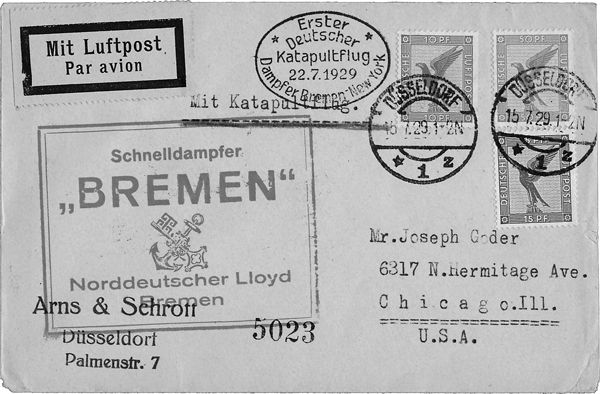
FIG. 41. Catapult mail was once again a combination of the fastest possible means of carrying mail across the Atlantic. In the late 1920s, despite the fact that the submarine telegraph had already existed for more than 60 years, it was thought to be worth the trouble to organize a system to take the express mails to an ocean steamer by small aircraft when the ship was already at sea, to be sent to the shore by the similar way in the other end. A letter from the first German catapult flight by the NDL steamer Bremen in July 1929 arrived from Düsseldorf to New York in seven days, having spent less than five days at sea.
While the transatlantic mail-carrying steamers continued to increase in size and speed up to WW2, there was no major need for such development on the Asian routes. For example the P&O vessels, which carried mails between London and Shanghai via the Suez Canal in 1913, were about 10,000 tons each, and their service speed varied between 15 and 17 knots. The average journey from London to Shanghai via Gibraltar, Marseilles, Port Said, Aden, Colombo, Penang, Singapore and Hong Kong took nearly 38 days.1044 The list of ports visited depicts well the different nature of the sailings in the Indian Ocean compared to the Atlantic.
However, in 1929, the P&O’s Viceroy of India of nearly 20,000 tons made the trip between London and Bombay in 16 days, and the Australia route would see even larger vessels in the long run.1045
It was not the telegraph that finally took over the important overseas mail transmission from ocean going vessels, but it was aircraft.
In the 1930s, when air planes were not yet improved enough to carry mails across the Atlantic, a mixed system was developed to combine shipping and flights as had been done earlier with shipping and telegraph. ‘Catapult flights’ by small aircraft took express mails from shore to steamships that had departed the day before, and at the other end of the journey a similar system was carried out to bring catapult mails to shore before the ship arrived at port (see Fig. 41).
Aircraft started regular transatlantic flights in the 1950s and finally became the means of communication that took over the lead from the steamers after a successful 100-year period of mail transport across the oceans. In taking over the important fine freight, mails and passengers, air planes did not leave much to passenger liners. They died one after another, or merged to stay alive, changing their business to cruising, cargo transport or port systems.
Thus the final ‘revolution’ in the bulk of business information transmission actually took place several decades after the introduction of electric communications, at a time when telephone, radio and automobiles were already in common use everywhere, and even the TV was taking its first steps in world wide news transmission.