Chart. 1: Reported and Anticipated Student Spending, Virginia Tech Spring Semester 2016
Source: Walz, A., Spring 2016 Virginia Tech Student Survey (n=312) (Unpublished) and Virginia Tech, Department of Admissions.
Anita Walz
Virginia Polytechnic Institute and State University, arwalz@exchange.vt.edu
Editors’ Commentary
There are a wide range of faculty responses to open; everything from curiosity to resistance. Some of these reactions are due to professional tradition, guild thinking, and lack of awareness about open. Academic libraries offer a unique context for exploring open. They do not fall prey to disciplinary concerns and, as such, are hotbeds of collaboration and innovation. It is no wonder that libraries are a natural home for open educational philosophy. In this chapter, author Anita Waltz offers her personal insights into the current state of open education. She candidly shares her thoughts on faculty adoption of OERs, the current cost of learning resources, and the promise of open pedagogy.
In the Spring of 2014 I began trying to enlist faculty for an Open Education Week panel discussion – our first at the Virginia Tech’s University Libraries. I talked with seventeen faculty members regarding their thoughts on textbook adoption and selection of learning materials with the hope that faculty members would freely and publically share their thoughts about selection or design of learning materials. One said yes right away. Some never replied. Some were, themselves, textbook authors and told me of their experiences writing, designing, and formatting their textbook and the resulting miniscule royalties – which they did not want to lose. Several had adopted ‘custom textbooks’ but did not want to talk about this publically. Several would have been interesting contributors to a panel discussion but suggested I talk with their colleague instead. A panel with one panelist is not a panel. Hours of interesting conversations − yet none of these knowledgeable people were interested in speaking publically on this topic. I was bewildered and frustrated. I concluded that discussing problems regarding teaching and learning resources is somehow uncomfortable or otherwise not rewarding. And so, this is how I started my exploration of open educational practices at Virginia Tech.
Open Education is a philosophy which prioritizes identification and removal of many types of barriers to education and learning. In its very broadest sense it may mean high quality educational opportunities freely accessible by anyone regardless of location, enrollment status, or ability to pay. Many people ask if ‘open education’ is synonymous with free tuition or with the removal of admissions barriers so that anyone can learn. This is the case with MOOCs (Massively Open Online Courses), though very few are accredited. In the case of The Open University (UK) payment of tuition is required but no admission or entrance exam requirements exist for undergraduate level courses. In higher education contexts, at least in North America, free tuition and no admissions requirements are typically not what open education means. In North American contexts, open education typically aims to reduce access and cost barriers to learning materials, prioritizes student engagement, agency, access to information and ideas, and relevance of course work to the real world. Overall, open education practices seek to improve educational quality and access.
I’ve been a librarian for over fourteen years in many different settings, mostly in international, and subject-specific ‘special’ libraries, often with a very specialized role. In terms of consultation services, collections, research, and teaching responsibilities my past roles felt similar to academic libraries. Six months into my new position at Virginia Tech, I realized that academic libraries − especially in research universities with tenure tracks − are a completely different animal than I had encountered before. Unlike other types of libraries, librarians in academic librarians enjoy full participation in institutional governance, enabling access by librarians to the interests and concerns of non-library faculty – and deep information regarding how a University actually works. Due to their tenure path, academic librarians may have more agency than other types of librarians. This allows academic librarians to interpret their role in order to fit program and institutional needs. Further, the culture shift in some academic libraries towards innovation and collaboration lend academic libraries a broad landscape for creative opportunities in scholarship, teaching and service. These realities require deep understanding by academic libraries of teaching and research faculty roles, values, pressures, and processes, each of which are relevant to my journey. As Virginia Tech’s Open Education, Copyright and Scholarly Communications librarian I’m tasked with exploring potentials for and disseminating information, resources and support regarding Open Education at Virginia Tech and beyond. This brief narrative summarizes my experiences learning about and advocating for open education efforts over the last several years.
Open Education Immersion: Sink or Swim?
My first introduction to open education was not that long ago. I attended the OpenVA conference in the Fall of 2013. The two-day event, including the ‘Minding the Future’ preconference was packed full of faculty excited about teaching, technology, and reducing access and cost barriers to student learning materials. It was fun. It was mind blowing. Some of it seemed crazy. Some of it was crazy – such as an online class without an instructor! Or asking students to create digital identities on their own domain! I now realize it was a good kind of crazy; nevertheless one I was not ready for at the time. At that time, the reduction in learning material costs of Tidewater’s Zero Textbook Degree was the only thing I could wrap my brain around; the ideas of open pedagogy were a bit too much for me as part of my first introduction. But clearly other people were excited about these ideas and I have since worked to better understand and appreciate these aspects of open education.
Attending the OpenVA conference created a strange chasm between what I heard there and the realities of the institution to which I was beginning to acclimate. In contrast to the large number of faculty excited about open educational practices at Open VA, I could not find any faculty members at my institution talking about open educational resources or open pedagogical practices. It was challenging enough for me to understand and describe what I was looking for. Are any faculty members adopting these methods of authentic assessment or asking students to create things that are viewable or have value outside the classroom? Who are they? How do I find them? Are any faculty authoring or using open educational resources? I still hadn’t seen any of these seemingly-mythical open educational resources people were talking about. What are these? Are they books or something else? Are they bit of this and that cobbled together? Could that be any good? Why would someone want to give away something they spent a lot of time and effort to create? Some answers came through philosophical conversations with my new supervisor and reading Lawrence Lessig’s Remix, Kevin Kelly’s New Rules for the New Economy, and other books and articles. Some came when I realized I could integrate a discussion of Creative Commons into Copyright education sessions. Some answers came when I was introduced to OpenStax College, a project of Rice University, which creates full, complete textbooks for high enrollment, intro level courses. They create textbooks then put the most open (i.e., least restrictive) Creative Commons license (CC BY) on them and post them to the web in multiple formats (see Chapter 17 in this volume). I met faculty who authored them (and told me they were paid), and faculty who were using them in courses. Wow! This is great. These would be really helpful for students – if they are as good as those who are currently using them say that they are. Some answers came thru joining SPARC’s LibOER Listserv and being graciously granted permission to lurk on the Community College Consortium’s OER Listserv and attend their free webinars.
The openly licensed books were amazing. Full color, real, around US$40 in print and free in PDF and other electronic formats, as well as extensively peer reviewed. My faculty will snap these up – I thought. I introduced a few faculty to the books – and waited and asked. Nothing happened. Why aren’t people clamoring over no-cost learning resources? Is it me? Is it them? It is because I’m new and they don’t know me? I wasn’t sure. I thought these would be welcome. This would be good for students and student learning. Why aren’t my faculty interested? I certainly did not expect faculty disinterest regarding open education resources. Though given my recent move to academic libraries, I also knew that I had a lot to learn regarding the nature of faculty work.
Information about faculty concerns came from unexpected places. I was invited to speak about my first year working as a librarian on Open Education, ironically at the OpenVA 2014 conference. I felt very isolated in my exploration of open education yet persisted believing it to be of value; I knew what I thought was just a little bit and was willing to share it. I was thrilled to find out that were three or four other librarians at OpenVA 2014. More importantly, I found some clues regarding faculty concerns at OpenVA 2014. One faculty member gave a presentation on how she got started in open education. She reported covertly ‘becoming a little OER-ish’ as she stealthily explored and implemented open resources and open practices in her courses. The fact that a faculty member would be nervous about how her colleagues would respond was new to me; It finally dawned on me − maybe I couldn’t find faculty at my institution doing the same, because they didn’t want or weren’t ready to be found. Again, this is not what I expected but meeting this faculty member was an important clue in my search.
[Mis]understanding Faculty
I decided that I would be transparent about my challenges in obtaining faculty interest. My presentation at the Open Education 2014 conference was titled ‘What Faculty are Actually Doing.’ In actuality, my presentation was about dealing with failure, encountering resistance, adapting a learning posture, and choosing to persist. I had made several false assumptions: I assumed that faculty would be eager to talk about and would clamor to adopt OER; I had also assumed that I understood campus culture and faculty needs. Both of these assumptions were erroneous and my seventeen conversations with faculty members as I was planning the Spring 2014 panel discussion still resonated. While this list is by no means exhaustive, there seem to be three main themes emerging that described reasons for faculty indifference and even resistance:
First, low faculty awareness of open educational resources is well documented; skepticism regarding openly licensed resources is also a common first response. ‘Free and high quality’ seems to invite a good deal of healthy skepticism. I resisted initially too: are OER ‘real’ learning resources? Why would someone freely give something away if they could make money off of it? What’s the catch? In general, the idea of openly licensed content is a bit shocking. We tend to think that things we get ‘for free’ are junk. It’s fairly revolutionary that one can now find peer-reviewed, lengthy, legally posted, complete, and because of CC BY licensing, editable textbooks and other types of learning materials. (Apparently over 2,000 people on Twitter thought this was exemplary as well.) Nearly every week I have the privilege to tell faculty or students about OER, open licensing or Creative Commons, and how they can use or author such resources. Sometimes I think we won’t get past this introduction stage, but I’m committed to explore this topic with people for whom it is brand new. It is always ‘day one’ for someone to learn about OER. It’s a lot to absorb.
The second reason for indifference is risk-aversion. Asking people to change how they do something is a big deal – not just in terms of time or effort – we’ll get to that later, but because it’s uncharted territory. It’s new. It can be scary. The consequences are largely unknown. On more than one occasion a faculty member exploring or using open educational resources has told me they don’t want ‘to go public’ or ‘Please don’t tell anyone I’m exploring open textbooks.’ Some faculty are risk-averse presumably out of concern that adopting or authoring open educational practices will reflect poorly on their reputation or career. One anonymous faculty member reported that his colleagues would look down on him if he chose an open text instead of one from a prestigious publisher (unpublished 2015 survey). While I’m not privy to all faculty members’ pressures, I do know that reputation, peer and administrative relationships, and tenure pressures weigh heavily on faculty. Faculty do not have uniform knowledge or expertise regarding learning resources in their disciplines. Some may never have taken time to review an open textbook. But perception of quality or lack thereof can be very influential even if it is unfounded. An even more risk adverse group of faculty are faculty authors of commercial textbooks. I don’t go out of my way to talk about OER with authors of commercial textbooks as I find these conversations to be very awkward! Authors rightly take pride in their hard work and investment as an author. They often enjoy the collaborative support of editors and publishers who recognize their accomplishments and value their work. While only the top few authors in a field receive substantive royalties from commercial textbooks, and most authors don’t write textbooks for the income it can be very difficult for an established author to change course. Once a revenue stream is established it certainly is hard to shut it off! Then, there is the issue of the author’s agreement with their publisher. Some publication contracts I’ve seen assign the publisher rights for every future edition of the book and waive rights to publish a similar work elsewhere. Depending on the agreement and short of author rights reversion, there are not many options for creating OER unless the created work is on a different topic than the textbook. When the inevitable conversation occurs, the first thing authors usually mention that open textbooks might undercut their potential profits − and then they take a defensive stance. I’d love to find better ways to work with these hardworking, potential authors of open educational resources.
The third reason relates to inertia and investment, or the lack thereof. When the status quo seems to be working (for faculty) authoring materials or integrating already-created openly licensed content into an existing or new course requires one to prioritize making a change. Exploring or adopting or openly licensed works, reviewing open textbooks, and spending effort required to make courses adjustments may be difficult when the status quo seems to be working. While some faculty chose to pilot an open text as an option for their course as a way to test the waters, I’ve also had multiple faculty tell me ‘what we’re using works for us.’ I’m grateful that something is working for them, but I’m also very hesitant especially when there are many openly licensed options for certain courses, and when I know that many students are very frustrated by the cost of textbooks, homework software codes, and are either sharing books, going without, or taking on extra hours of work to afford it all. That said, faculty academic freedom clearly puts curriculum materials and teaching methods in the purview of the faculty member(s) teaching the course or of a departmental committee. My role regarding this area is to inform faculty of options available to them and offer review, authoring, and course-adjustment opportunities. Some of this reticence to make changes may be related to institutional type, tenure-status, and perceptions of whether or not the cost of learning materials are really that severe for students. Within a research institution promotion and tenure-related requirements often take precedence over other types of activities. There is never enough time and the many responsibilities of being a faculty member can be overwhelming. Even at institutions that do not emphasize research and publication as much as research institutions, there is always competition for time and effort.
Then, there are faculty who wish to explore and adopt open educational resources for which only limited content exists. Faculty teaching specialized topics or upper divisional courses often face an insufficient amount of openly-licensed content. This is logically the time to develop new openly licensed content as time allows, which it does not always allow. Other options include assigning an older edition, finding a lower-cost work, conducting a Fair Use analysis for portions of copyrighted works, or finding an interim solution of using no-additional-cost library subscribed resources. Neither of these are perfect solutions. The library solution merely shifts costs from the student to the institution’s library, which some but not all libraries can or want to handle. For those which can afford buying multiuser site licenses at the moment, this is probably not sustainable in the long run. Further, multiuser site licenses are not available from all publishers, and students lose access to important works after they graduate. As an interim solution, the mix of openly licensed and commercial licensed works is somewhat inevitable due to a lack of content, but should ideally be considered an interim solution. In summary, resistance and indifference come down to effort. It’s easier not to take on the effort to explore and consider change.
In addition to raising awareness, one of my main roles is to find ways to support faculty exploring and adopting open educational practices, so understanding these points of indifference and resistance are very important. Librarian roles around Open Education are still emergent. Not many librarians have the luxury of devoting more than a little of their time to open education related work. Most librarians, including myself have multiple responsibilities which compete for time and attention. Contrary to popular impressions, librarians don’t have time for leisurely reading during the work day and some of us don’t touch a physical book for weeks on end. We are involved in teaching, subject liaison activities, program and instructional design, inventing, mastering, and leveraging new technology. Many of us are involved in web development, building systems and processes, collaborative partnership building, research, consulting, curating data and collections, purchasing, conducting research, writing, giving presentations, and on it goes. Our real and existing roles as problem solvers, user advocates, teachers, and those who seek to make sense of information and research trends and tools give us a tremendous foundation on which to build and innovate.
To the open education movement, we bring a tremendous wealth of knowledge and expertise in copyright and licensing, inquiry-based learning, user advocacy, systems thinking, project management abilities, and expertise in teaching. Many of us work hard to ensure that we have a place at the table when learning resources, educational technology, rights, and pedagogy are discussed. And many of us lead institutional initiatives in these areas. Depending on our main roles and the needs of our institution we may implement and connect open educational practices very differently. There is no single model for librarian involvement in open education; I think this is a good thing. I have seen extraordinary, inspiring librarians working in open education in their areas of strength in instructional design − conducting what we call ‘reference interviews’ for curriculum topics and training librarian leaders. An increasing number of librarians lead, design, and manage faculty development programs with OER author and adopter incentive grants and a huge impact. Many teach and consult on Copyright and Creative Commons licensing. Some librarians engaged in open education lead multi-week faculty development sessions on open education. I see librarians building and running project networks to support faculty in state-wide multi-institutional initiatives, and librarians building and managing impressive national networks to support and train librarians and others regarding this type of work. Librarians are increasingly building collaborative relationships with faculty, instructional designers, academic support personnel, concerned students, and administrators. I am extremely proud of my librarian colleagues’ leadership, creativity, and achievements in this field.
My own work has focused on identifying policy and institutional barriers to open licensing and methods thru which faculty may openly license their work if they choose to do so. I’ve met with our University Legal Counsel and Intellectual Property Committee. I’ve worked as a Co-Principal Investigator on creating openly licensed works for teaching. I’ve been involved in the arduous process of revising an open textbook. I support other units and groups who want to integrate information about open licensing, OER and Creative Commons into their courses, and teach and consult with faculty involved in course redesign. I work with student groups exploring these issues. I conduct research to better understand our campus context and suggest implementation options that may fit better than some others. I serve on a state-level committee and have prioritized making outside speaker events and open education week events open to the public, this year taking the step to live stream public programs.
A large part of my role beyond other job duties is advocacy and raising awareness around open education. This includes events showcasing the work of Virginia Tech and nearby faculty and students. It also includes research.
Students’ Learning Resource Buying Patterns
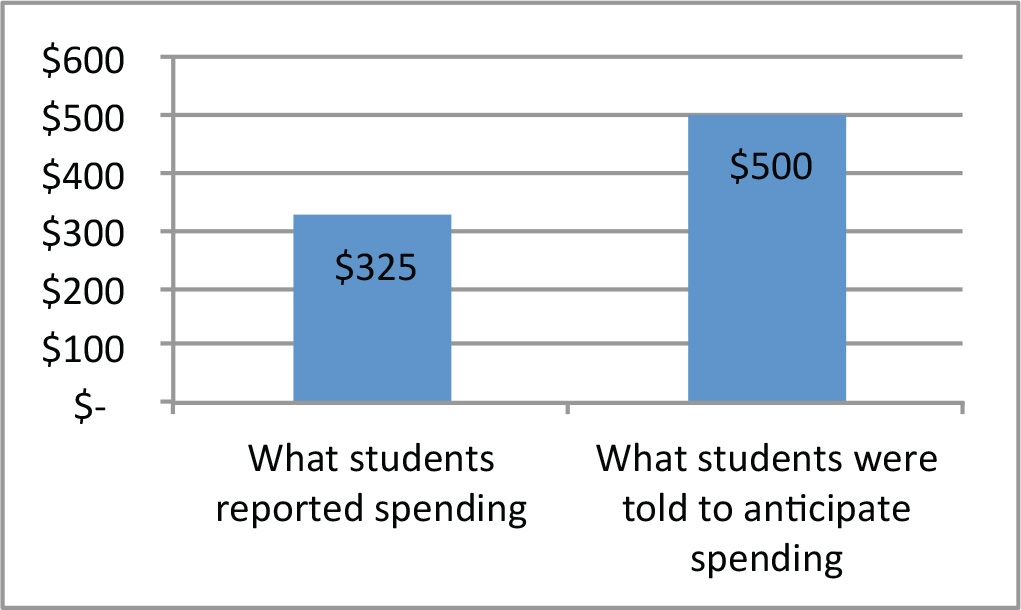
I knew from past work with the Student Government Association that students had a lot to say about textbook costs, and I wanted to get beyond anecdotes. At Virginia Tech the Admissions office indicates that students should expect to pay US$1,000 per year on textbooks and supplies. I believe this to be somewhat of a conservative estimate given that the College Board’s estimate for 2015–2016 recommends that students at 4-year universities expect to pay US$1,298 on books and supplies. So, during weeks 3−7 of Spring 2016 I invited a representative sample of 3,000 Virginia Tech undergraduate and graduate students to take an anonymous survey regarding learning resources. While this is just one data point, I think the illustration is important; what I found surprised even me. I thought that students would report spending only slightly less than US$500 per semester on learning resources; students reported spending an average of US$325 on textbooks, required learning software, and supplies in Spring 2016.
Chart. 1: Reported and Anticipated Student Spending, Virginia Tech Spring Semester 2016
Source: Walz, A., Spring 2016 Virginia Tech Student Survey (n=312) (Unpublished) and Virginia Tech, Department of Admissions.
This US$325 is 35% less than what admissions office indicated they should budget. While this is surprising, it also affirms national survey findings in which students increasingly view textbooks as optional. This tells me that students are even more price sensitive than I suspected.
Disclosure of costs of required learning resources are mandated by the Higher Education Authorization Act (2008) at the point of course registration, and institutions Admissions offices disclose anticipated costs. Somehow the costs of learning resources are still overlooked or come as a surprise. Perhaps this is because of they are a much smaller cost, at less than 10% the cost of tuition at Virginia Tech, though a much higher percentage of overall cost at Community Colleges. Perhaps students or parents are not budgeting to pay for learning resources. Perhaps the responsibility and cost of learning resources are passed directly on to students for them to deal with after their first semester or first year. While proportionally smaller than tuition in cost, learning resources (or the lack there of) can have an enormous impact on one’s academic achievements. In courses where textbooks are strongly recommended but not required, faculty have mentioned that students without access to the textbook consistently earn lower grades. Is it any surprise? There is another area of impact: for first generation, low income, and the first child in a family to enroll in college these costs may come as an unwelcome surprise and create a barrier to academic achievement. I suspect that these costs may disproportionately affect the academic achievement of an institution’s most vulnerable students. It may also interfere with institutional efforts to increase socio-economic diversity on campus.
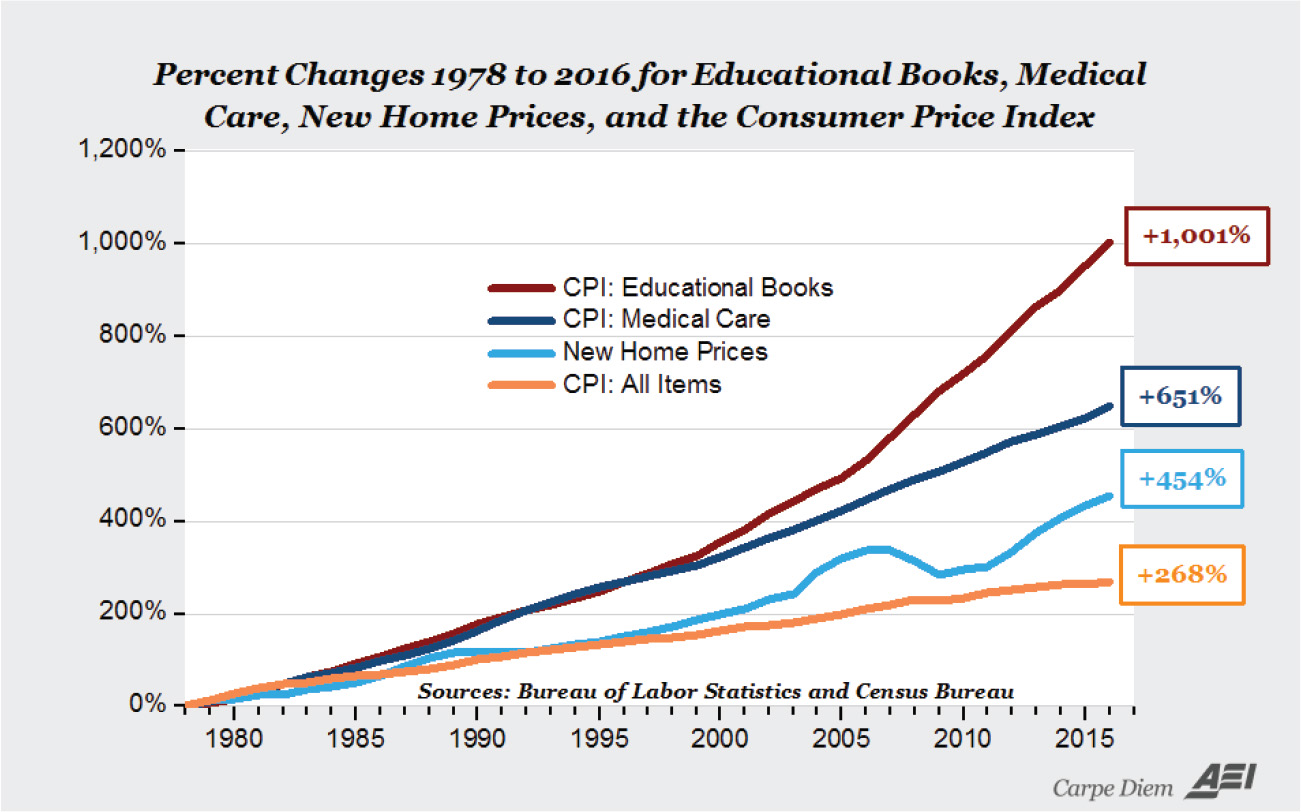
I have initially been very hesitant to talk about cost of learning resources as a motivator for openness. The details were very vague; economic issues of students felt too personal and maybe too political. Who wants a rant to listen to another rant about cost? In the context of higher education though, cost is a central issue for nearly everyone: University budgets of public institutions are a topic both in the State legislature, University and Departmental level. Administrators concern themselves with how to strategically budget in for current needs and strategically invest in facilities, programs, and personnel for the future good of the University. Families with students, students, and students with families face a financial calculus of their own. A recent spate of books on the topic including: Why Does College Cost So Much?, Is College Worth It?, and other titles aim to dissect the college cost situation and question at what point paying for a college education is still a wise use of resources. Neither the cost of tuition nor the cost of learning materials are like they used to be. If you attended college between 1980 and 1990, your textbooks cost roughly one-quarter to one-third of what textbooks cost today. The cost of college textbooks has increased nearly four times the rate of inflation since 1978.
Chart. 2: Percentage Change from 1978 to 2016 for Educational Books, Medical Care, New Home Prices, and the Consumer Price Index (CPI).
© 2017. Mark Perry, Professor of Economics, University of Michigan-Flint and Scholar, American Enterprise Institute. All Rights Reserved. Used with permission.
Many students are increasing required to purchase homework software access codes. Students in courses where an access code is required cannot get a grade without purchasing an access code. And, unlike used textbooks, used codes are not transferable or reusable. Software codes, depending on the cost, can also present barriers for students.
While software codes are required, faculty mention that ‘Can we share the textbook?’ is the first question students ask about the textbook, ahead of ‘Do we really need the textbook?’ Students respond to textbook costs in many different ways. As Dave Ernst from the Open Textbook Network taught me, ‘they either have the money, borrow the money, or earn the money.’ Some will obtain an older edition, in hopes that it will be similar enough. Some will share books. Some will expand their paid working hours or get a second job. Some will wait until they are behind in the course to buy or rent the material. Others, as exemplified by the survey data above choose to go without. Even though learning material costs are a smaller cost than tuition, these proportionally smaller costs are often overlooked and can have a disproportionate impact on academic achievement.
Faculty Awareness and Decisions Matter
Unlike tuition and room and board, faculty decisions have a direct impact on these barriers. Some faculty members are attuned to student costs; some are not. Even though I thought I was in tune with student price sensitivity, I was not nearly enough aware. Students are even more price sensitive than I thought.
There are many things faculty members can do to aid students with regard to cost, many of which have been alluded to earlier or in other chapters of this book. Getting buy in first from one’s department and colleagues, especially if teaching in a sequence of courses and recruiting assistance from a knowledgeable colleague, librarian, or instructional designer are excellent steps. Including cost as one criterion for learning resource selection by committees or your own course is a good start. Ask students what they consider to be ‘expensive.’ Giving students more choice is another; some faculty require students to obtain a textbook and allow students to choose one of three different options – one being an openly licensed, no cost option. This is a low-barrier way to pilot an open textbook or other open learning materials. While not randomized, this may also lead to interesting research regarding student choices and academic achievement. Supplementing courses with no-cost, openly licensed materials or to asking students to locate articles and evaluate other resources which are freely-available to them (at least while they are affiliated with the educational institution) is yet another way to test the waters. Many faculty have copious amounts of course notes already written. Turning these into a series of learning resources is a lot of work, but some faculty choose to do this. Other faculty involve students in creating openly licensed materials, such the student-created Project Management for Instructional Designers created in an Intro to Project Management course in 2011 and revised in 2012. This leads me into the next topic of open pedagogy.
Immersion into Open Pedagogy
As I mentioned earlier, my first instruction to Open Education at OpenVA 2013 included learning about Tidewater’s Zero Textbook Degree and the reduction of student learning material costs. I knew that there was more to Open Education, this practice called ‘open pedagogy’ but it seemed inaccessible to me for a variety of reasons. However, that changed relatively quickly. In Fall 2015, I attended the Open Education Conference in Vancouver. It was there that ‘textbook costs’ and the ideas of ‘open pedagogy’ crashed together in a rather uncomfortable way. Criticism of the work of textbook affordability advocates seemed to go viral as seen through this collection of blogs. As a result, what I view as a synthetic divide was set up between proponents of open pedagogy and those advocating for open educational resources on the basis of reducing costs for students. To be clear, I think that both approaches are important and valid, and that one approach may be more attractive than the other depending on who you are. For students, cost is at times an enormous issue; many students are frustrated by requirement to purchase an access code to complete homework or to buy or rent a textbook they might not use in a course. While students are concerned about cost, faculty are concerned about fit, quality, and ways to facilitate meaningful student engagement in their courses. Both groups are important. Both approaches are valid. In fact, these two approaches are only two of many answers to the same question implied by Christina Hendricks, ‘How can I make my course more open.”’
So what is open pedagogy? As Tom Woodward mentions in a Campus Technology interview ‘Open pedagogy is difficult... to crisply define.’ Open pedagogical approaches seem to be characterized by increased student agency, relevance of course activities to the ‘real world’ (i.e., that they are public, useful, or valuable beyond getting a grade) or course activities and assignments which otherwise could not be implemented without open educational resources (items which adhere to the ‘5Rs’ or are free to access, free to use, free to revise, free to remix, and free to redistribute). David Wiley describes open pedagogical practice as creating assignments that give value to the world which are not merely ‘disposable assignments,’ for example the Project Management for Instructional Designers book mentioned earlier. Really, the sky is the limit when we think of the myriad of ways we can teach and learn using or creating public domain or openly licensed resources that we could not do with resources bound by cost or typical copyright restrictions.
I’m just starting to incorporate discussion of open pedagogical practices in workshops and instructional sessions. Faculty seem more to engage open pedagogy more quickly than they initially engaged with ideas of improving access by reducing cost. In the limited number of conversations I’ve had with faculty on this topic, there seems to be a lot of interest in planning ways to assign students more agency, making a course more public, creating assignments which are meaningful or useful beyond the course, or considering other ways to make courses more open or accessible. I’m not sure why this is. Perhaps it’s an adjustment that seems more fun, interesting, and less overwhelming than selecting, adapting or authoring course content. Perhaps they are looking for an approach like this. I hope to more thoroughly explore this area in the coming months.
Conclusion
So, the panel discussion from the Spring of 2014 turned out fantastic. I was probably more relieved than anyone. Three faculty from two different institutions each discussed open and commercial works they created and why they created them. They also discussed what happens in a publishing ecosystem which combines both commercial/paid/royalty generating works and works which have no cost and are openly licensed. It was a fascinating discussion and a great first celebration of Open Education Week at Virginia Tech. This was a great start to the conversation about Open Education!
I’m hoping to keep the conversation going and to welcome additional faculty and students. I’ve spent quite a bit of the past year working to raise the level of awareness regarding open educational practices among administrators, departments, and groups that support teaching and learning. Several courses have committed to using open resources for the first time starting in Fall 2016. One of these is a pilot of the OpenStax Biology text in one of Virginia Tech’s large enrollment courses. Another is a newly updated version of an openly licensed Business textbook.
Open Educational initiatives at the University Libraries will deepen as we plan to pilot a small grants program for open education resources in 2016 to 17. And work with students will be ever changing as some key student leaders and advocates graduate and others take their place. On the research front, two other librarians and I, via the Association of Research Libraries will publish a SPEC Kit on Affordable Course Content and OER in July 2016. The monograph is based on a survey of Association of Research Libraries (ARL) Library practices regarding Affordable Course Content and OER initiatives. I also hope to see some research results related to a free online but not-quite-fully openly licensed learning resource developed at Virginia Tech for a metabolic nutrition class. On a state and national level, I look forward to further service with OpenVA, the State Commission on Higher Education’s Open Virginia Advisory Committee and service to the Open Textbook Network. It will also be exciting to see colleagues have the opportunity for further professional development and network building as part of the Open Textbook Network which the Virginia Virtual Library (VIVA) has joined. And the Open Education 2016 conference will be in Richmond, Virginia in November 2016. There are also a number of national and international projects and initiatives that coalesce with this work and are expanding access to research and scholarly works, such as Knowledge Unlatched, Open Library of the Humanities, Open Access Network, philpapers, OpenGLAM, and RightsStatements.org.
I have many hopes for faculty, administrator, and student engagement in making their courses less costly and more open. I hope that faculty leaders and administrators will be ready to voice public support for faculty engaging these practices. I’d very much like to see a campus-wide group form around open educational practices with leadership and broad engagement from teaching faculty.
In closing, I would be remiss not to mention that even though there is a great deal of work to be done that I’m very honored to be part of this movement. I’m grateful for mentors and friends who are so willing to share of their knowledge and expertise, faculty and administrators who engage these issues. Much of getting this work done depends on the continued sharing of both successes and failures, ideas and workplans across broad networks, and the continued engagement, persistence, and cooperation of faculty, students, administrators, librarians, instructional designers, information technology experts, and other concerned parties.
References
Amado, M., Ashton, K., Ashton, S., Bostwick, J., Nan, V., Nisse, T., Randall, D. (2016). Project management for instructional designers. Retrieved from https://web.archive.org/web/20160310104102/ http:/pm4id.org
Association of Research Libraries. (2016). SPEC kits: Overview. Retrieved from http://publications.arl.org/SPEC_Kits
Cabrera, N., Ostroff, J., & Schofield, B. (2015). Understanding rights reversion. Retrieved from https://web.archive.org/web/20160321233809/ http:/authorsalliance.org/wp-content/uploads/Documents/Guides/Authors%20Alliance%20-%20Understanding%20Rights%20Reversion.pdf
Exploring Innovative & Open Educational Resources. [Video file]. Retrieved from https://vtechworks.lib.vt.edu/handle/10919/46998
Grush, M. (2014). Open pedagogy: connection, community, and transparency. Retrieved from https://web.archive.org/web/20150915045516/ http:/campustechnology.com/articles/2014/11/12/open-pedagogy-connection-community-and-transparency.aspx
Hendricks, C. (2014). Presentation on open education at AAPT. Retrieved from https://web.archive.org/web/20160414215952/ http:/blogs.ubc.ca/chendricks/2014/08/08/open-ed-aapt/
Minding The Future. [Video file]. Retrieved from https://www.youtube.com/watch?v=VJSkr1HA2mw&feature=youtu.be
Open Access Network. (2016). Homepage. Retrieved from: http://openaccessnetwork.org/
OpenVA. (2016). Homepage. Retrieved from http://openva.org/
Open VA – Open Pedagogy / Curriculum Panel. [Video file]. Retrieved from https://www.youtube.com/watch?v=0yYAMrqk6NI&feature=youtu.be&t=19m36s
Perry, M.J. (2012, December 24). The college textbook bubble and how the “open educational resources” movement is going up against the textbook cartel. [Web log comment]. Retrieved from https://web.archive.org/web/20140924011718/ http:/www.aei-ideas.org/2012/12/the-college-textbook-bubble-and-how-the-open-educational-resources-movement-is-going-up-against-the-textbook-cartel/
Perry, M. J. (2014, April 24). Status 459395162032988160. Retrieved from https://twitter.com/Mark_J_Perry/status/459395162032988160/photo/1
RightsStatements. org. (2016). Homepage. Retrieved from http://rightsstatements.org/en/
Virginia.gov. (2016). Open Virginia advisory committee. Retrieved from http://www.schev.edu/adminfaculty/advisoryCommittees.asp#OVAC
Walz. A. (2015, March 23). University libraries host open education week 2015. [Web log comment]. Retrieved from https://blogs.lt.vt.edu/openvt/2015/03/23/university-libraries-host-open-education-week-2015/
Walz. A. (2016). Virginia Tech Student Survey. Unpublished manuscript, Department of Admissions, Virginia Polytechnic Institute and State University, Blacksburg, Virginia.
Web Archive. (2014a). OpenVA live stream 2014. Retrieved from https://web.archive.org/web/20160414213654/http:/openva.org/openva-live-stream-2014/
Web Archive. (2014b). Open education 2014. Retrieved from https://web.archive.org/web/20141223164224/http://openeducation2014.sched.org/event/db13570a116d6f2b64834835a9922711#.VxaiKGNcABg
Web Archive. (2014c). Faculty survey finds awareness of open educational resources low. Retrieved from https://web.archive.org/web/20141102002942/http:/www.babson.edu/News-Events/babson-news/Pages/141028-faculty-awareness-of-oea.aspx
Web Archive. (2015a). Academics. Retrieved from https://web.archive.org/web/20160414212714/http:/web.tcc.edu/academics/zdegree/
Web Archive. (2015b). Virginia tech: Cost of attendance. Retrieved from https://web.archive.org/web/20151023152536/http:/www.admiss.vt.edu/cost
Web Archive. (2016a). Admissions and applications. Retrieved from: https://web.archive.org/web/20160324030737/http:/www.openuniversity.edu/study/admissions-applications
Web Archive. (2016b). About ds106. Retrieved from https://web.archive.org/web/20160330170415/http:/ds106.us/about/
Web Archive. (2016c). A domain of one’s own. Retrieved from https://web.archive.org/web/20160326093739/http:/umw.domains/about/
Web Archive. (2016d). Lauren Pressley. Retrieved from https://web.archive.org/web/20160321034104/http:/laurenpressley.com/lauren
Web Archive. (2016e). OpenStax college. Retrieved from https://web.archive.org/web/20160408155206/https:/openstaxcollege.org
Web Archive. (2016f). Creative commons: About the licenses. Retrieved from https://web.archive.org/web/20160413074147/https:/creativecommons.org/licenses
Web Archive. (2016g). Creative commons: Attribution 4.0 international. Retrieved from https://web.archive.org/web/20160413070720/http:/creativecommons.org/licenses/by/4.0/
Web Archive. (2016h). Sparc library OER forum. Retrieved from https://web.archive.org/web/20160414213909/http:/sparcopen.org/our-work/sparc-library-oer-forum/
Web Archive. (2016i). OER consortium. Retrieved from https://web.archive.org/web/20160408164804/http:/oerconsortium.org
Web Archive. (2016j). Archived webinars. Retrieved from https://web.archive.org/web/20160322203024/http:/oerconsortium.org/cccoer-webinars/
Web Archive. (2016k). Twitter: Uberfacts: Status 611054921484472320. Retrieved from https://web.archive.org/web/20160414213408/https:/ twitter.com/uberfacts/status/611054921484472320
Web Archive. (2016l). Searching for open materials. Retrieved from https://web.archive.org/web/20160404114514/http:/libraryasleader.org/searching-for-open-materials
Web Archive. (2016m). Average estimated undergraduate budgets, 2015–16. Retrieved from https://web.archive.org/web/20160205031457/http:/trends.collegeboard.org/college-pricing/figures-tables/average-estimated-undergraduate-budgets-2015–16
Web Archive. (2016n). Higher education opportunity act. Retrieved from https://web.archive.org/web/20160325222957/https:/www.gpo.gov/fdsys/pkg/PLAW-110publ315/html/PLAW-110publ315.htm
Web Archive. (2016o). Academics. Retrieved from: https://web.archive.org/web/20160420161814/http://httparchive.org/web.tcc.edu/academics/zdegree/
Web Archive. (2016p). Open textbook network. Retrieved from https://web.archive.org/web/20160330011436/http:/research.cehd.umn.edu/otn/
Web Archive. (2016q). The virtual library of Virginia. Retrieved from https://web.archive.org/web/20160306201611/http:/www.vivalib.org/
Web Archive. (2016r). 13th Annual open education conference. Retrieved from https://web.archive.org/web/20160327035025/http:/openedconference.org/2016/
Web Archive. (2016s). Knowledge unlatched. Retrieved from https://web.archive.org/web/20160408191331/http:/www.knowledgeunlatched.org/
Web Archive. (2016t). Open library of humanities. Retrieved from https://web.archive.org/web/20160410073902/https:/www.openlibhums.org
Web Archive. (2016u). PhilPapers. Retrieved from https://web.archive.org/web/20160410155047/http:/philpapers.org/
Web Archive. (2016v). OpenGLAM. Retrieved from https://web.archive.org/web/20160311193059/http:/openglam.org
Wiley, D. (2016, April 7). Conversations prompted by #OpenEd15. [Web log comment]. Retrieved from https://web.archive.org/web/20160407060749/https:/storify.com/opencontent/opened15-post-conference-blogging
Wiley, D. (2014, March 5). The access compromise and the 5th R. [Web log comment]. Retrieved from https://web.archive.org/web/20160307064127/http:/opencontent.org/blog/archives/3221
Wiley, D. (2013, October 21). What is open pedagogy? [Web log comment]. Retrieved from https://web.archive.org/web/20160308004928/http:/opencontent.org/blog/archives/2975
Young, J.R. (2015, July 9). In students’ minds, textbooks are increasingly optional purchases. [Web log comment]. Retrieved from https://web.archive.org/web/20150910151009/http:/chronicle.com/article/In-Students-Minds-Textbooks/231455/
How to cite this book chapter:
Walz, A. 2017. A Library Viewpoint: Exploring Open Educational Practices. In: Jhangiani, R S and Biswas-Diener, R. (eds.) Open: The Philosophy and Practices that are Revolutionizing Education and Science. Pp. 147–162. London: Ubiquity Press. DOI: https://doi.org/10.5334/bbc.l. License: CC-BY 4.0