# Map anything 🗺

 ```
npm i map-anything
```
Array.map but for objects with good TypeScript support. A small and simple integration.
## Motivation
I always want to do:
```js
someObject.map((val) => someFunction)
```
But this doesn't exist for objects, you need to do this instead:
```js
Object.entries(someObject).reduce((carry, [key, value], index, array) => {
carry[key] = someFunction(value, key, array)
return carry
}, {})
```
So I made a wrapper function for that. 😃
`map-anything` has very good [#TypeScript](#typescript) support as well.
## Usage
Provided Functions:
- `mapObject` takes an object and maps over the values of each key
- `mapObjectAsync` takes an object and maps a promise over the values of each key, after which you can just do a single await
- `mapMap` takes a map and maps over the values of each key
### Basic Usage
```js
import { mapObject } from 'map-anything'
const pokemon = {
'001': { name: 'Bulbasaur', level: 10 },
'004': { name: 'Charmander', level: 8 },
'007': { name: 'Squirtle', level: 11 },
}
const levelUp = mapObject(pokemon, (pkmn) => {
return { ...pkmn, level: pkmn.level + 1 }
})
// results in:
levelUp ===
{
'001': { name: 'Bulbasaur', level: 11 },
'004': { name: 'Charmander', level: 9 },
'007': { name: 'Squirtle', level: 12 },
}
```
### Access the propName in the map function
A function passed to `Array.map` will get the value as first argument and an **index** as second. With `mapObject` you will get the **propName** as second argument.
```js
import { mapObject } from 'map-anything'
const pokemon = {
'001': { name: 'Bulbasaur', level: 10 },
'004': { name: 'Charmander', level: 8 },
'007': { name: 'Squirtle', level: 11 },
}
const addIds = mapObject(pokemon, (pkmn, propName) => {
const id = propName
return { ...pkmn, id }
})
// results in:
addIds ===
{
'001': { name: 'Bulbasaur', level: 10, id: '001' },
'004': { name: 'Charmander', level: 8, id: '004' },
'007': { name: 'Squirtle', level: 11, id: '007' },
}
```
### Map Object Async
```ts
const pokemon = {
'001': { name: 'Bulbasaur', level: 10 },
'004': { name: 'Charmander', level: 8 },
'007': { name: 'Squirtle', level: 11 },
}
const result = await mapObjectAsync(pokemon, async (pkmn, propName) => {
const id = propName
const data = await fetchData(id) // hypothetical API call
return { ...pkmn, data }
})
// results in:
result ===
{
'001': { name: 'Bulbasaur', level: 10, data: '...' }, // some fetched data
'004': { name: 'Charmander', level: 8, data: '...' },
'007': { name: 'Squirtle', level: 11, data: '...' },
}
```
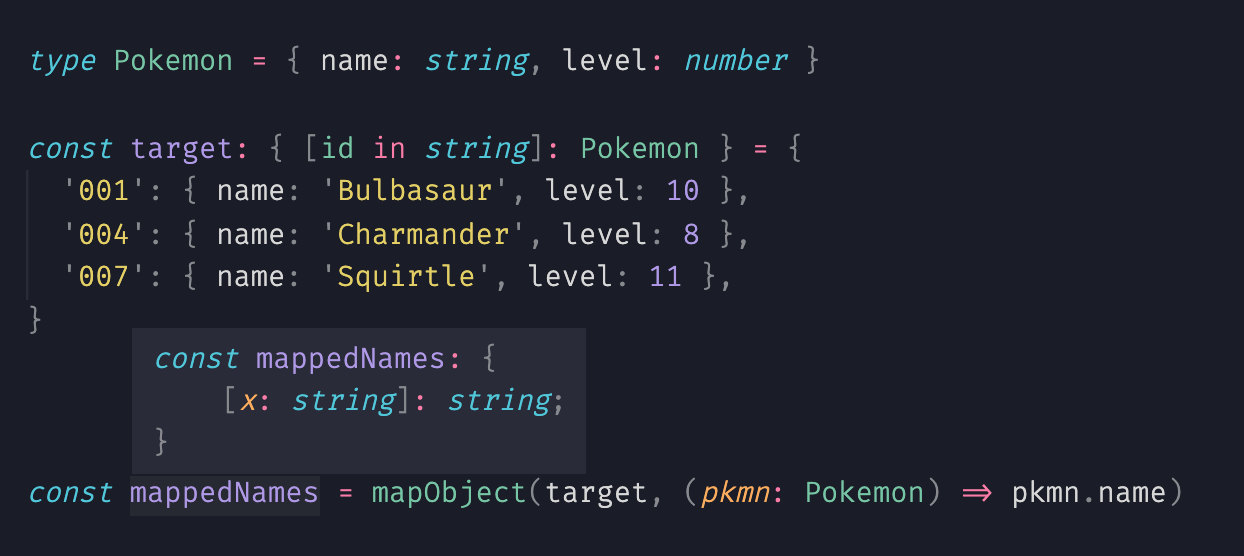
## TypeScript
Without having to specify the return type in the reducer, I've set `map-anything` up so it automatically detects that type for you!
## Meet the family (more tiny utils with TS support)
- [is-what 🙉](https://github.com/mesqueeb/is-what)
- [is-where 🙈](https://github.com/mesqueeb/is-where)
- [merge-anything 🥡](https://github.com/mesqueeb/merge-anything)
- [check-anything 👁](https://github.com/mesqueeb/check-anything)
- [remove-anything ✂️](https://github.com/mesqueeb/remove-anything)
- [getorset-anything 🐊](https://github.com/mesqueeb/getorset-anything)
- [map-anything 🗺](https://github.com/mesqueeb/map-anything)
- [filter-anything ⚔️](https://github.com/mesqueeb/filter-anything)
- [copy-anything 🎭](https://github.com/mesqueeb/copy-anything)
- [case-anything 🐫](https://github.com/mesqueeb/case-anything)
- [flatten-anything 🏏](https://github.com/mesqueeb/flatten-anything)
- [nestify-anything 🧅](https://github.com/mesqueeb/nestify-anything)
## Source code
The source code is rather simple, it's doing something like the snippet show here below.
```
npm i map-anything
```
Array.map but for objects with good TypeScript support. A small and simple integration.
## Motivation
I always want to do:
```js
someObject.map((val) => someFunction)
```
But this doesn't exist for objects, you need to do this instead:
```js
Object.entries(someObject).reduce((carry, [key, value], index, array) => {
carry[key] = someFunction(value, key, array)
return carry
}, {})
```
So I made a wrapper function for that. 😃
`map-anything` has very good [#TypeScript](#typescript) support as well.
## Usage
Provided Functions:
- `mapObject` takes an object and maps over the values of each key
- `mapObjectAsync` takes an object and maps a promise over the values of each key, after which you can just do a single await
- `mapMap` takes a map and maps over the values of each key
### Basic Usage
```js
import { mapObject } from 'map-anything'
const pokemon = {
'001': { name: 'Bulbasaur', level: 10 },
'004': { name: 'Charmander', level: 8 },
'007': { name: 'Squirtle', level: 11 },
}
const levelUp = mapObject(pokemon, (pkmn) => {
return { ...pkmn, level: pkmn.level + 1 }
})
// results in:
levelUp ===
{
'001': { name: 'Bulbasaur', level: 11 },
'004': { name: 'Charmander', level: 9 },
'007': { name: 'Squirtle', level: 12 },
}
```
### Access the propName in the map function
A function passed to `Array.map` will get the value as first argument and an **index** as second. With `mapObject` you will get the **propName** as second argument.
```js
import { mapObject } from 'map-anything'
const pokemon = {
'001': { name: 'Bulbasaur', level: 10 },
'004': { name: 'Charmander', level: 8 },
'007': { name: 'Squirtle', level: 11 },
}
const addIds = mapObject(pokemon, (pkmn, propName) => {
const id = propName
return { ...pkmn, id }
})
// results in:
addIds ===
{
'001': { name: 'Bulbasaur', level: 10, id: '001' },
'004': { name: 'Charmander', level: 8, id: '004' },
'007': { name: 'Squirtle', level: 11, id: '007' },
}
```
### Map Object Async
```ts
const pokemon = {
'001': { name: 'Bulbasaur', level: 10 },
'004': { name: 'Charmander', level: 8 },
'007': { name: 'Squirtle', level: 11 },
}
const result = await mapObjectAsync(pokemon, async (pkmn, propName) => {
const id = propName
const data = await fetchData(id) // hypothetical API call
return { ...pkmn, data }
})
// results in:
result ===
{
'001': { name: 'Bulbasaur', level: 10, data: '...' }, // some fetched data
'004': { name: 'Charmander', level: 8, data: '...' },
'007': { name: 'Squirtle', level: 11, data: '...' },
}
```
## TypeScript
Without having to specify the return type in the reducer, I've set `map-anything` up so it automatically detects that type for you!

## Meet the family (more tiny utils with TS support)
- [is-what 🙉](https://github.com/mesqueeb/is-what)
- [is-where 🙈](https://github.com/mesqueeb/is-where)
- [merge-anything 🥡](https://github.com/mesqueeb/merge-anything)
- [check-anything 👁](https://github.com/mesqueeb/check-anything)
- [remove-anything ✂️](https://github.com/mesqueeb/remove-anything)
- [getorset-anything 🐊](https://github.com/mesqueeb/getorset-anything)
- [map-anything 🗺](https://github.com/mesqueeb/map-anything)
- [filter-anything ⚔️](https://github.com/mesqueeb/filter-anything)
- [copy-anything 🎭](https://github.com/mesqueeb/copy-anything)
- [case-anything 🐫](https://github.com/mesqueeb/case-anything)
- [flatten-anything 🏏](https://github.com/mesqueeb/flatten-anything)
- [nestify-anything 🧅](https://github.com/mesqueeb/nestify-anything)
## Source code
The source code is rather simple, it's doing something like the snippet show here below.
However, it's adding amazing typescript.
```JavaScript
function mapObject (object, fn) {
return Object.entries(object)
.reduce((carry, [key, value], index, array) => {
carry[key] = fn(value, key, array)
return carry
}, {})
}
```