# MicroFrontier · [](https://npm-stat.com/charts.html?package=microfrontier) [](https://www.npmjs.com/package/microfrontier)  
A web crawler frontier implementation in TypeScript backed by Redis.
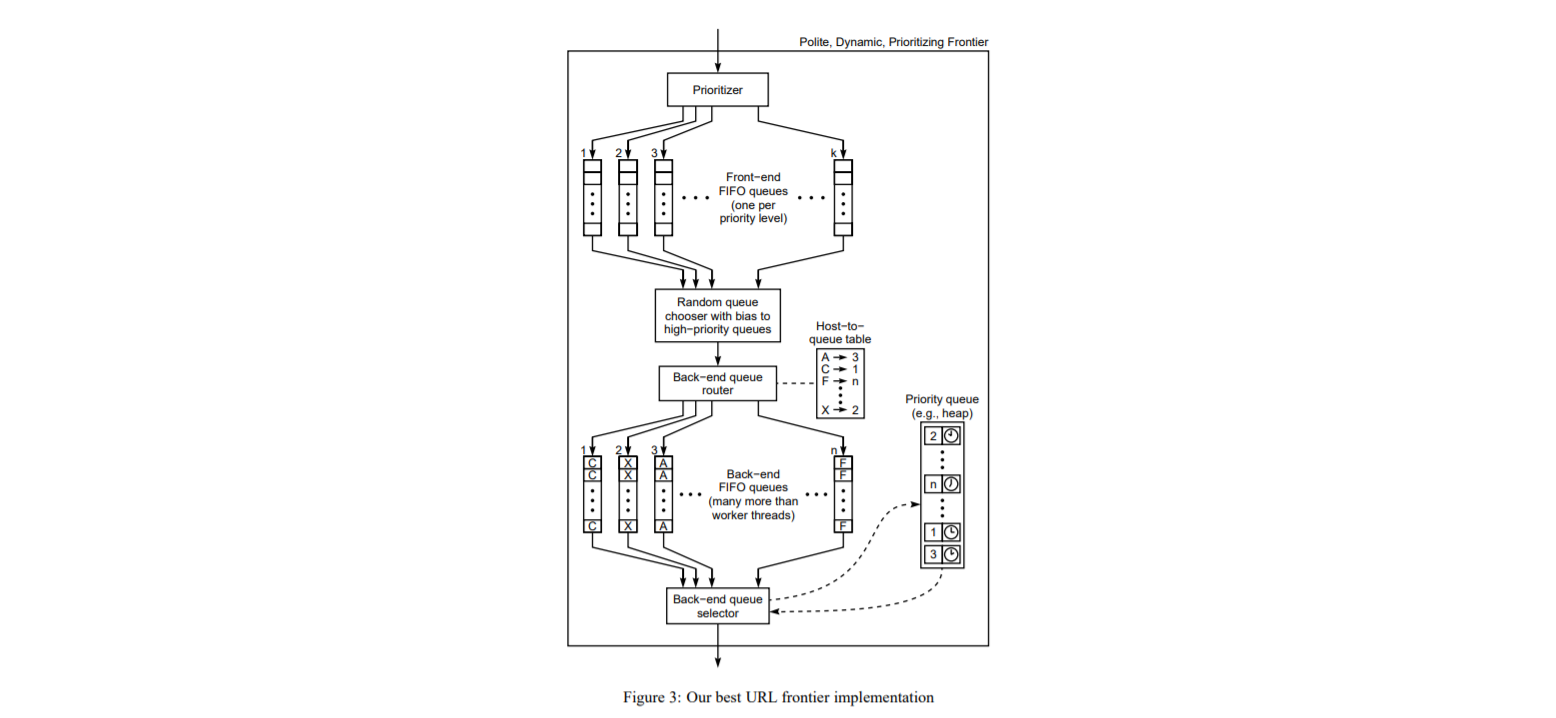
MicroFrontier is a scalable and distributed frontier implemented through Redis Queues.
- [x] Fast Ingestion & High throughput
- [x] Multiple priority queues
- [x] Custom priority strategy
- [x] Per-Hostname crawl rate limit or default delay fallback
- [x] Easy to use HTTP Microservice
- [x] Multi-processing support
Example of Mercator Frontier[1](#footnote1)
## Usage
MicroFrontier can be used both as a Javascript library SDK, from the command line or with a Docker deploy.
### Command Line
Install microfrontier with:
```
npm i -g microfrontier
```
Run microfrontier
```bash
microfrontier --port 3035 --redis:host localhost #see configuration for other parameters
```
### As a package
Npm:
```
npm i microfrontier
```
Yarn:
```
yarn add microfrontier
```
### Docker
```
docker pull adileo/microfrontier
```
## Configuration
| ENV VAR | CLI PARAMS | Description |
| ------------- | --- |------------- |
| host | --host | Host name to start the microservice http server.
Default value: `127.0.0.1`
| port | --port| Port to start the microservice http server.
Default value: `8090` |
| redis_host | --redis:host | Redis server host.
Default value: `127.0.0.1` |
| redis_port | --redis:port | Redis server port.
Default value: `6379` |
| redis_* | --redis:* | Parameters are interpreted by `nconf` and passed to `ioredis` as the client config.
| config_frontierName | --config:frontierName | Prefix used for Redis keys. |
| config_* | --config:* | Parameters are interpreted by `nconf`, default value below. |
```typescript
{
frontierName: 'frontier',
priorities: {
'high': {probability: 0.6},
'normal': {probability: 0.3},
'low': {probability: 0.1},
},
defaultCrawlDelay: 1000
}
```
# How to
## Adding an URL to the frontier
Via HTTP
```bash
curl --location --request POST 'http://127.0.0.1:8090/frontier' \
--header 'Content-Type: application/json' \
--data-raw '{
"url": "http://www.example.com",
"priority": "normal",
"meta": {
"foo": "bar"
}
}'
```
Via SDK
```javascript
import { URLFrontier } from "microfrontier"
const frontier = new URLFrontier(config)
frontier.add("http://www.example.com", "normal", {"foo": "bar"}).then(() => {
console.log('URL added')
})
```
## Getting an URL from the frontier
```bash
curl --location --request GET 'http://127.0.0.1:8090/frontier'
```
```javascript
import { URLFrontier } from "microfrontier"
const frontier = new URLFrontier(config)
frontier.get().then((item) => {
// {url: "http://www.example.com", meta: {"foo":"bar"}}
})
```
# Citations
: [High-Performance Web Crawling](http://www.cs.cornell.edu/courses/cs685/2002fa/mercator.pdf) - Marc Najork, Allan Heydon