Tooling for converting, validating, and parsing OpenAPI, Swagger, and Postman API definitions.





## Installation
```bash
npm install oas-normalize
```
## Usage
```ts
import OASNormalize from 'oas-normalize';
const oas = new OASNormalize(
'https://raw.githubusercontent.com/OAI/OpenAPI-Specification/master/examples/v3.0/petstore-expanded.yaml',
// ...or a JSON object, YAML, a file path, stringified JSON, whatever you have.
);
await oas
.validate()
.then(() => {
// The API definition is valid!
})
.catch(err => {
console.error(err);
});
```
> [!WARNING]
> Support for Postman collections is experimental. If you've supplied a Postman collection to the library, it will **always** be converted to OpenAPI, using [`@readme/postman-to-openapi`](https://npm.im/@readme/postman-to-openapi) before doing any bundling, validating, etc.
### `.load()`
Load and retrive the API definition that `oas-normalize` was initialized with. Every method of `oas-normalize` utilizes this internally however if you would like to retrieve the original API _definition_ supplied (for example if all you had was a URL, a file path, or a buffer), you can use `.load()` to automatically resolve and return its contents.
```ts
const file = await oas.load();
console.log(file);
```
### `.bundle()`
Bundle up the given API definition, resolving any external `$ref` pointers in the process.
```ts
const definition = await oas.bundle();
console.log(definition);
```
### `.convert()`
Convert a given API definition into an OpenAPI definition JSON object.
```ts
await oas
.convert()
.then(definition => {
// Definition will always be an OpenAPI JSON object, regardless if a
// Swagger definition, Postman collection, or even YAML was supplied.
console.log(definition);
})
.catch(err => {
console.error(err);
});
```
### `.deref()`
Dereference the given API definition, resolving all `$ref` pointers in the process.
```ts
const definition = await oas.bundle();
console.log(definition);
```
### `.validate()`
Validate a given API definition. This supports Swagger 2.0 and OpenAPI 3.x API definitions, as well as Postman 2.x collections.
```ts
try {
await oas.validate();
// The API definition is valid!
} catch (err) {
console.error(err);
}
```
#### Error Handling
All errors will be thrown as a `ValidationError` exception with contextual error messages that direct the user to the line(s) where their errors are present:
```
OpenAPI schema validation failed.
REQUIRED must have required property 'url'
7 | },
8 | "servers": [
> 9 | {
| ^ ☹️ url is missing here!
10 | "urll": "http://petstore.swagger.io/v2"
11 | }
12 | ],
```
If you also wish to treat certain errors as warnings you can do so by supplying your `.validate()` call with a [`@readme/openapi-parser`](https://npm.im/@readme/openapi-parser) ruleset:
```ts
try {
const result = await oas.validate({
validate: {
rules: {
openapi: {
'path-parameters-not-in-path': 'warning',
},
},
},
});
if (result.warnings.length) {
console.warn('🚸 The API is valid but has some warnings.');
console.warn(result.warnings);
} else {
console.log('🍭 The API is valid!');
}
} catch (err) {
console.error(err);
}
```
For full documentation on the available rulesets, as well as tooling to transform the the `.validate()` responses into a human-readable strings, check out the documentation for [`@readme/openapi-parser`](https://npm.im/@readme/openapi-parser).
### `.version()`
Load and retrieve version information about a supplied API definition.
```ts
const { specification, version } = await oas.version();
console.log(specification); // openapi
console.log(version); // 3.1.0
```
### Options
##### Enable local paths
For security reasons, you need to opt into allowing fetching by a local path. To enable this supply the `enablePaths` option to the class instance:
```ts
const oas = new OASNormalize('./petstore.json', { enablePaths: true });
```
##### Colorized errors
If you wish errors from `.validate()` to be styled and colorized, supply `colorizeErrors: true` to the class instance:
```ts
const oas = new OASNormalize('https://example.com/petstore.json', {
colorizeErrors: true,
});
```
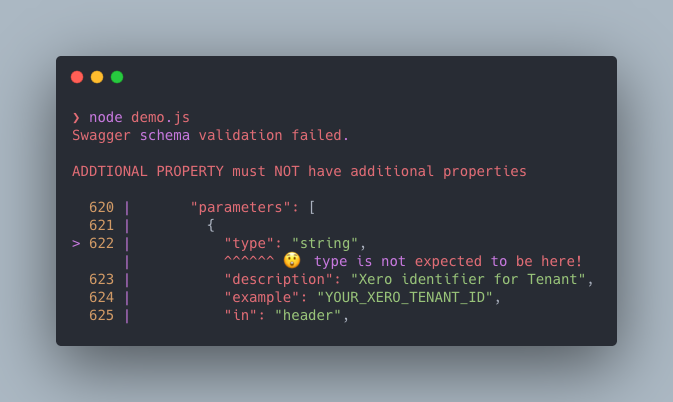
When enabled thrown validation error messages will now resemble the following: