# pegjs-backtrace [](https://badge.fury.io/js/pegjs-backtrace)
 A tracer module for [PEG.js](http://pegjs.org/) which generates a visual backtrace tree.
This module also supports normal tracing output. See [showTrace](#showTrace) option for detail.
# Example
The following example grammar recognizes arithmetic expressions like `2*(3+4)`.
```pegjs
start = additive
additive = multiplicative plus additive / multiplicative
multiplicative = primary mult multiplicative / primary
primary = integer / "(" additive ")"
integer = digits:[0-9]+
plus = "+"
mult = "*"
```
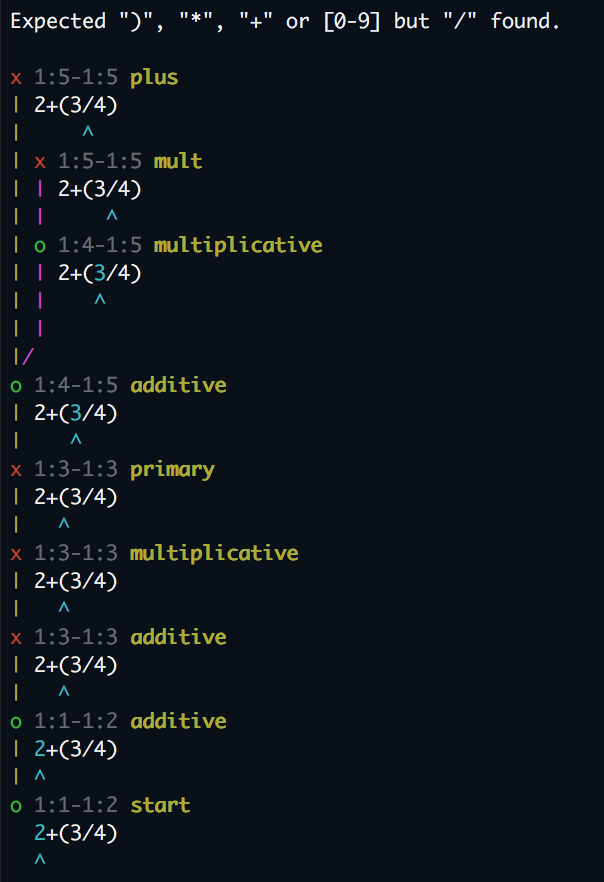
If you give the `2*(3/4)` which the grammar does not recognize, pegjs-backtrace shows backtrace tree from the maximum failure positions to the start rule as follows.
A tracer module for [PEG.js](http://pegjs.org/) which generates a visual backtrace tree.
This module also supports normal tracing output. See [showTrace](#showTrace) option for detail.
# Example
The following example grammar recognizes arithmetic expressions like `2*(3+4)`.
```pegjs
start = additive
additive = multiplicative plus additive / multiplicative
multiplicative = primary mult multiplicative / primary
primary = integer / "(" additive ")"
integer = digits:[0-9]+
plus = "+"
mult = "*"
```
If you give the `2*(3/4)` which the grammar does not recognize, pegjs-backtrace shows backtrace tree from the maximum failure positions to the start rule as follows.
 # Install
```bash
npm install pegjs-backtrace
```
# Usage
pegjs-backtrace is implemented as a [Tracer](https://github.com/pegjs/pegjs/commit/da57118a43a904f753d44d407994cf0b36358adc). When calling the `parse` function, pass the pegjs-backtrace instance to the `tracer` option.
Then, after parser fails, you can obtain the backtrace string from `getBacktraceString()`.
```js
var Parser = require('./parser'); // parser generated by pegjs --trace
var Tracer = require('pegjs-backtrace');
var text = '2*(3/4)';
var tracer = new Tracer(text); // input text is required.
try {
Parser.parse(text, { tracer:tracer });
} catch(e) {
console.log(tracer.getBacktraceString());
}
```
Note that `--trace` option is required to generated parser.js with pegjs command. If the option is not supplied, tracer feature is disabled.
# Options
When creating pegjs-backtrace instance, you can provide some options as follows.
```js
var Tracer = require('pegjs-backtrace');
var tracer = new Tracer(text,{
parent: null,
hiddenPaths: [],
useColor: true,
showTrace: false,
maxSourceLines: 6,
maxPathLength: 72,
matchesNode: function(node, options) { return true; },
output: console.log,
});
```
## parent
This option specifies a parent Tracer instance. Once the option is given, the parent's `trace` method is also called during parsing. The default value is `null`.
```js
var Parser = require('./parser');
var Tracer = require('pegjs-backtrace');
var tracer = new Tracer(text,{
parent: new Parser.DefaultTracer(),
});
```
## useColor
If true, the output is colored with ANSI escape sequence. Otherwise no escape sequence is used. The default value is `true`.
## showSource
If true, quoted source are shown on the trace nodes. Otherwise source is suppressed. The default value is `true`.
## maxSourceLines
The maximum number of lines shown as the quoted source on each trace node. The default value is `6`.
## showTrace
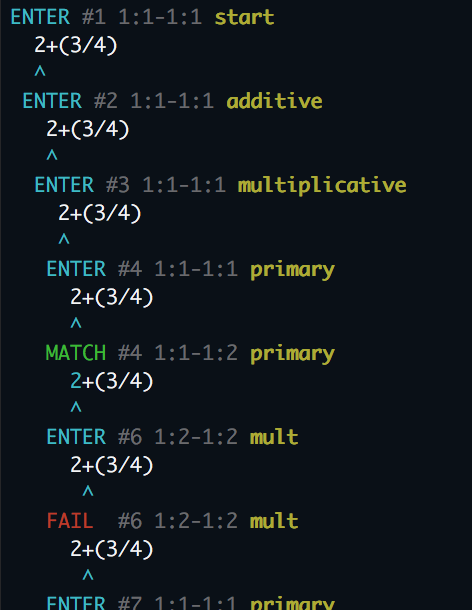
If true, trace log is printed while parsing. The default value is `false`.
# Install
```bash
npm install pegjs-backtrace
```
# Usage
pegjs-backtrace is implemented as a [Tracer](https://github.com/pegjs/pegjs/commit/da57118a43a904f753d44d407994cf0b36358adc). When calling the `parse` function, pass the pegjs-backtrace instance to the `tracer` option.
Then, after parser fails, you can obtain the backtrace string from `getBacktraceString()`.
```js
var Parser = require('./parser'); // parser generated by pegjs --trace
var Tracer = require('pegjs-backtrace');
var text = '2*(3/4)';
var tracer = new Tracer(text); // input text is required.
try {
Parser.parse(text, { tracer:tracer });
} catch(e) {
console.log(tracer.getBacktraceString());
}
```
Note that `--trace` option is required to generated parser.js with pegjs command. If the option is not supplied, tracer feature is disabled.
# Options
When creating pegjs-backtrace instance, you can provide some options as follows.
```js
var Tracer = require('pegjs-backtrace');
var tracer = new Tracer(text,{
parent: null,
hiddenPaths: [],
useColor: true,
showTrace: false,
maxSourceLines: 6,
maxPathLength: 72,
matchesNode: function(node, options) { return true; },
output: console.log,
});
```
## parent
This option specifies a parent Tracer instance. Once the option is given, the parent's `trace` method is also called during parsing. The default value is `null`.
```js
var Parser = require('./parser');
var Tracer = require('pegjs-backtrace');
var tracer = new Tracer(text,{
parent: new Parser.DefaultTracer(),
});
```
## useColor
If true, the output is colored with ANSI escape sequence. Otherwise no escape sequence is used. The default value is `true`.
## showSource
If true, quoted source are shown on the trace nodes. Otherwise source is suppressed. The default value is `true`.
## maxSourceLines
The maximum number of lines shown as the quoted source on each trace node. The default value is `6`.
## showTrace
If true, trace log is printed while parsing. The default value is `false`.
 ## showFullPath
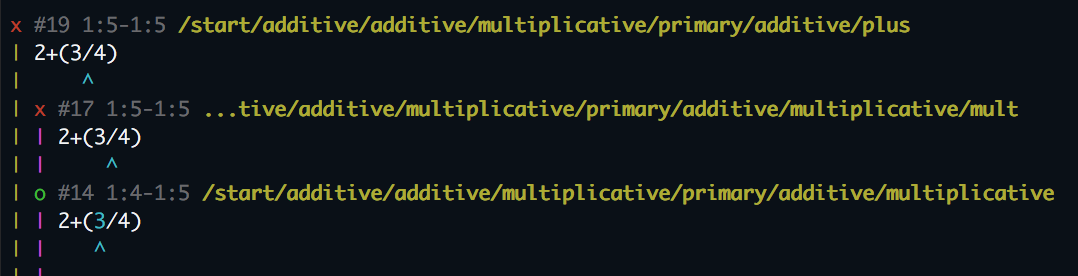
If the options is true, the rule path is shown instead of the rule name. The default value is `false`.
## showFullPath
If the options is true, the rule path is shown instead of the rule name. The default value is `false`.
 ## maxPathLength
The limit length of the displaying path name. When the path length exeeds to the limit, the path is truncated.
## hiddenPaths
This option specifies path patterns to hide. Any node that matches one of these patterns will be hidden from the trace log.
**Note that this option works only with trace log, not for backtrace.** The default value is `[]`.
```js
var Tracer = require('pegjs-backtrace');
var tracer = new Tracer(text,{
hiddenPaths:["integer", "primary/.*"]
});
```
The type of the pattern must be `string` or `RegExp`. Even the pattern is `string`, it may also contain RegExp meta characters.
The `/` character can be used to represent the hierarchcal path of grammar rules. If the pattern is string like `"FOO"`, it is treated as the regular expression `/(^|\/)FOO(\/|$)/`.
## matchesNode
Custom filtering of nodes printed by the graph.
Two parameters are passed, `node` and `options`.
The `node` object is an internal representation which **may be subject to changes**.
The `options` are the options passed to `getParseTreeString()` or
`getBacktraceString()`.
`{ backtrace: false }` is passed when calling `getParseTreeString()`.
`{ backtrace: true }` is apssed when calling `getBacktraceString()`.
```js
{
// example of showing only fail nodes when
matchesNode: function(node) {
if (node.type === "rule.fail") {
return true;
} else {
return false;
}
}
}
```
## output
Sets the output destination for the backtrace. The default is `console.log`.
# Limitation
The cursor symbol `^` may points the wrong position if the prefix of the source line contains East Asian full-width Characters.
The generating tree is based on the observable trace events from the pegjs parser. Any local failure inside a grammar rule is ignored. For example, if parser fails while
reading `"+"` character in the following `additive` rule, we can observe the event that `additive` fails but cannot get any information of `"+"` fails.
```pegjs
additive = multiplicative "+" additive / multiplicative
```
If you would like to see the event on `"+"` failure, the `"+"` should be an explicit rule like:
```pegjs
plus = "+"
additive = multiplicative plus additive / multiplicative
```
## maxPathLength
The limit length of the displaying path name. When the path length exeeds to the limit, the path is truncated.
## hiddenPaths
This option specifies path patterns to hide. Any node that matches one of these patterns will be hidden from the trace log.
**Note that this option works only with trace log, not for backtrace.** The default value is `[]`.
```js
var Tracer = require('pegjs-backtrace');
var tracer = new Tracer(text,{
hiddenPaths:["integer", "primary/.*"]
});
```
The type of the pattern must be `string` or `RegExp`. Even the pattern is `string`, it may also contain RegExp meta characters.
The `/` character can be used to represent the hierarchcal path of grammar rules. If the pattern is string like `"FOO"`, it is treated as the regular expression `/(^|\/)FOO(\/|$)/`.
## matchesNode
Custom filtering of nodes printed by the graph.
Two parameters are passed, `node` and `options`.
The `node` object is an internal representation which **may be subject to changes**.
The `options` are the options passed to `getParseTreeString()` or
`getBacktraceString()`.
`{ backtrace: false }` is passed when calling `getParseTreeString()`.
`{ backtrace: true }` is apssed when calling `getBacktraceString()`.
```js
{
// example of showing only fail nodes when
matchesNode: function(node) {
if (node.type === "rule.fail") {
return true;
} else {
return false;
}
}
}
```
## output
Sets the output destination for the backtrace. The default is `console.log`.
# Limitation
The cursor symbol `^` may points the wrong position if the prefix of the source line contains East Asian full-width Characters.
The generating tree is based on the observable trace events from the pegjs parser. Any local failure inside a grammar rule is ignored. For example, if parser fails while
reading `"+"` character in the following `additive` rule, we can observe the event that `additive` fails but cannot get any information of `"+"` fails.
```pegjs
additive = multiplicative "+" additive / multiplicative
```
If you would like to see the event on `"+"` failure, the `"+"` should be an explicit rule like:
```pegjs
plus = "+"
additive = multiplicative plus additive / multiplicative
```