# Pip.WebUI Getting Started
Step 3. Add global navigation
[Go to step 2](https://github.com/pip-webui/pip-webui-sample/blob/master/step2/Readme.md) to add **pip-webui** references.
### Include navigation components into the application
Add reference to **pipNav** in application module references:
```javascript
var app = angular.module('app', [
// pipWebUI modules
'pipRest', 'pipLayout', 'pipErrorHandling', 'pipWebuiTests', 'pipNav',
// Application templates
'app.Templates'
]);
```
### Add AppBar and SideNav into index.html
Place **pip-appbar** and **pip-sidenav** components under **pip-main** tag. Delete text **'Nothing here yet!'** from **pip-main-body** container:
```html
```
Rebuild the application. You shall see an empty application with a toolbar and sidenav.

### Configure AppBar
Load the default iconset, define global actions and default application title inside the application configuration section.
We will create a page for the global actions later. For now, you can see a routing error page if you try to trigger them.
```javascript
app.config(function (pipAuthStateProvider, $mdIconProvider, pipAppBarProvider) {
// Load default iconset
$mdIconProvider.iconSet('icons', 'images/icons.svg', 512);
// Define global secondary actions (for actions popup menu)
pipAppBarProvider.globalSecondaryActions([
{name: 'global.settings', title: 'Settings', state: 'settings'},
{name: 'global.signout', title: 'Sign out', state: 'signout'}
]);
// Configure states of application
....
// Set default application title
pipAppBarProvider.appTitleText('Sample Application');
});
```
Now configure what will be shown on the AppBar when the application loads.
```javascript
app.controller('appController', function($scope, pipAppBar, pipWebuiTest, pipTestDataService) {
// Show application title
pipAppBar.showAppTitleText('Sample Application');
// Show icon to open sidenav
pipAppBar.showMenuNavIcon();
// Show button with tree dots for secondary actions
pipAppBar.showLocalActions();
// Create test data using pipWebUI services
$scope.dataSet = pipTestDataService.createTestDataset();
});
```
Such actions as signIn, signOut, signUp, users settings reading and editing, etc. are usually carried out with the application server.
We will not use a real server instead of the server (fake server) based on the mock-object.
You can read details about this [here](https://docs.angularjs.org/api/ngMockE2E/service/$httpBackend).
Also, we will run a fake server to test our requests locally `pipWebuiTest.runFakeServer('http://fakeserver.net');`.
You can create fakeServer to any address, we chose **http://fakeserver.net**.
Add the application server definition ** app.config **.
```javascript
app.config(function (pipAuthStateProvider, $mdIconProvider, pipAppBarProvider, pipRestProvider) {
// Load default iconset
$mdIconProvider.iconSet('icons', 'images/icons.svg', 512);
// Define global secondary actions (for actions popup menu)
pipAppBarProvider.globalSecondaryActions([
{name: 'global.settings', title: 'Settings', state: 'settings'},
{name: 'global.signout', title: 'Sign out', state: 'signout'}
]);
// Define application REST API server
pipRestProvider.serverUrl('http://fakeserver.net');
...
});
```
Добавим запуск нашего fake server в **appController**.
```javascript
app.controller('appController', function($scope, pipAppBar, pipWebuiTest, pipTestDataService) {
// run fake server
pipWebuiTest.runFakeServer('http://fakeserver.net');
...
});
```
Теперь нам будет доступна функциональность, которая требует работы с сервером,
например signIn и SignUp, которые мы добавим на следующем шаге.
When you rebuild the application, you will see the following:
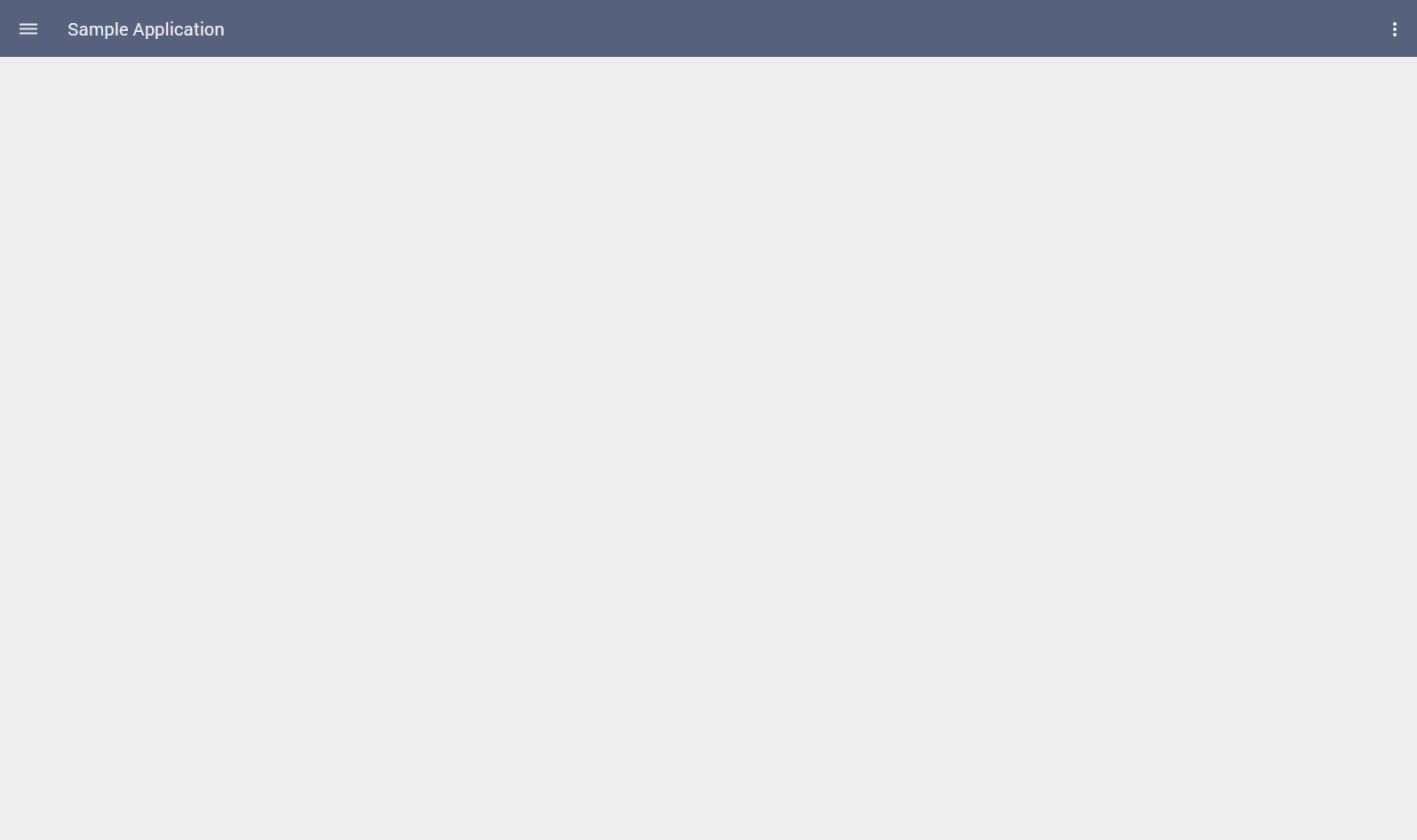
When you click on tree dots on the right, a popup with secondary actions will open:

### Configure SideNav
Configure two links in SideNav inside the application configuration section:
```javascript
app.config(function (pipAuthStateProvider, $mdIconProvider, pipAppBarProvider, pipRestProvider, pipSideNavProvider) {
...
pipSideNavProvider.sections([
{
links: [
{title: 'Nodes', url: '/nodes'},
{title: 'Events', url: '/events'}
]
}
]);
});
```
Rebuild and open the application:

### Configure AppBar for custom pages
Add code to configure the AppBar inside page controllers:
```javascript
app.controller('nodesController', function($scope, pipAppBar) {
// Show page title
pipAppBar.showTitleText('Nodes');
// Show menu icon to open sidenav
pipAppBar.showMenuNavIcon();
// Show local actions in secondary actions popup
pipAppBar.showLocalActions();
});
app.controller('eventsController', function($scope, pipAppBar) {
// Show page title
pipAppBar.showTitleText('Events');
// Show menu icon to open sidenav
pipAppBar.showMenuNavIcon();
// Show local actions in secondary actions popup
pipAppBar.showLocalActions();
});
```
### Continue
For more information on Appbar and SideNav, please, visit [pip-webui-nav module](https://github.com/pip-webui/pip-webui-nav)
[Go to step 4](https://github.com/pip-webui/pip-webui-sample/blob/master/step4/) to add sign in and sign up pages.