[中文](https://pnpm.io/zh/) | [日本語](https://pnpm.io/ja/) | [Italiano](https://pnpm.io/it/) | [Русский](https://pnpm.io/ru/) | [Türkçe](https://pnpm.io/tr/)

Fast, disk space efficient package manager:
* **Fast.** Up to 2x faster than the alternatives (see [benchmark](#benchmark)).
* **Efficient.** Files inside `node_modules` are linked from a single content-addressable storage.
* **[Great for monorepos](https://pnpm.io/workspaces).**
* **Strict.** A package can access only dependencies that are specified in its `package.json`.
* **Deterministic.** Has a lockfile called `pnpm-lock.yaml`.
* **Works as a Node.js version manager.** See [pnpm env use](https://pnpm.io/cli/env).
* **Works everywhere.** Supports Windows, Linux, and macOS.
* **Battle-tested.** Used in production by teams of [all sizes](https://pnpm.io/users) since 2016.
To quote the [Rush](https://rushjs.io/) team:
> Microsoft uses pnpm in Rush repos with hundreds of projects and hundreds of PRs per day, and we’ve found it to be very fast and reliable.
[](https://www.npmjs.com/package/pnpm)
[](https://r.pnpm.io/chat)
[](#backers)
[](#sponsors)
[](https://twitter.com/intent/follow?screen_name=pnpmjs®ion=follow_link)
## Sponsors
Support this project by [becoming a sponsor](https://opencollective.com/pnpm#sponsor).
## Background
pnpm uses a content-addressable filesystem to store all files from all module directories on a disk.
When using npm or Yarn, if you have 100 projects using lodash, you will have 100 copies of lodash on disk.
With pnpm, lodash will be stored in a content-addressable storage, so:
1. If you depend on different versions of lodash, only the files that differ are added to the store.
If lodash has 100 files, and a new version has a change only in one of those files,
`pnpm update` will only add 1 new file to the storage.
1. All the files are saved in a single place on the disk. When packages are installed, their files are linked
from that single place consuming no additional disk space. Linking is performed using either hard-links or reflinks (copy-on-write).
As a result, you save gigabytes of space on your disk and you have a lot faster installations!
If you'd like more details about the unique `node_modules` structure that pnpm creates and
why it works fine with the Node.js ecosystem, read this small article: [Flat node_modules is not the only way](https://pnpm.io/blog/2020/05/27/flat-node-modules-is-not-the-only-way).
💖 Like this project? Let people know with a [tweet](https://r.pnpm.io/tweet)
## Installation
On macOS, Linux, or Windows Subsystem for Linux:
```
curl -f https://get.pnpm.io/v6.16.js | node - add --global pnpm
```
On Windows (using PowerShell):
```
(Invoke-WebRequest 'https://get.pnpm.io/v6.16.js' -UseBasicParsing).Content | node - add --global pnpm
```
Using npm:
```
npx pnpm add -g pnpm
```
For other installation options [visit our website](https://pnpm.io/installation).
We also ship a version of pnpm that may be used even with no Node.js installed on the system, see [@pnpm/exe](https://www.npmjs.com/package/@pnpm/exe).
## Usage
Just use pnpm in place of npm/Yarn. E.g., install dependencies via:
```
pnpm install
```
Also, `pnpm dlx` instead of npx:
```
pnpm dlx create-react-app my-cool-new-app
```
For more advanced usage, read [pnpm CLI](https://pnpm.io/pnpm-cli) on our website, or run `pnpm help`.
## Benchmark
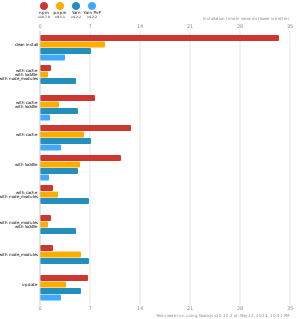
pnpm is up to 2x faster than npm and Yarn classic. See all benchmarks [here](https://r.pnpm.io/benchmarks).
Benchmarks on an app with lots of dependencies:
## Support
- [Frequently Asked Questions](https://pnpm.io/faq)
- [Chat](https://r.pnpm.io/chat)
- [Twitter](https://twitter.com/pnpmjs)
## Backers
Thank you to all our backers! [Become a backer](https://opencollective.com/pnpm#backer)
 ## Contributors
This project exists thanks to all the people who contribute. [Contribute](../../blob/main/CONTRIBUTING.md).
## Contributors
This project exists thanks to all the people who contribute. [Contribute](../../blob/main/CONTRIBUTING.md).
 ## License
[MIT](https://github.com/pnpm/pnpm/blob/main/LICENSE)
## License
[MIT](https://github.com/pnpm/pnpm/blob/main/LICENSE)


