React bindings for the [Sign in With Google for Web][gsi-overview] API.
[Demo][storybook]
## Installation
```shell
npm install --save react-gsi @types/gsi
```
## Usage
To enable _Sign In With Google_ on your website, you first need to [set up your
Google API client ID][gsi-setup].
You must have a client ID to configure _Sign In With Google_ and to verify ID
tokens on your backend.
A client ID looks like the following example:
`1234567890-abc123def456.apps.googleusercontent.com`
```tsx
import {
GsiButton,
GsiClient,
IdTokenProvider,
useIdToken,
useOneTap
} from 'react-gsi';
const idConfiguration: IdConfiguration = {
client_id: '1234567890-abc123def456.apps.googleusercontent.com',
auto_select: true // automatically sign in, see: https://developers.google.com/identity/gsi/web/guides/automatic-sign-in-sign-out
}
const buttonConfiguration: GsiButtonConfiguration = {
type: 'standard',
theme: 'outline',
size: 'large'
}
export function App() {
return (
}>
)
}
function Page() {
const token = useIdToken();
const signedOut = token === null;
useOneTap({
show: signedOut
})
if (signedOut) {
return (
<>
)
}
}
```
## Components
### ``
Details
The `` component loads the [client library][gsi-library].
Fallbacks can be provided whilst the library is loading or if it has failed to
load.
Once loaded, the [Sign In With Google JavaScript API][gsi-api] will be
accessible via `google.accounts.id`.
```tsx
function LoadingFallback() {
return Loading...
}
function ErrorFallback() {
return Error
}
function App() {
return (
Library Loaded
);
}
```
---
### ``
Details
The `` initializes the API with the supplied
[`IdConfiguration`][gsi-IdConfiguration].
When the API invokes the [`callback`][gsi-callback] to indicate a successful
sign-in, the ID Token returned is stored and passed to the children of the
`` via an ``.
Children may access the token in the current context by using the
`useIdToken()` hook.
```tsx
const idConfiguration: IdConfiguration = {
client_id: '1234567890-abc123def456.apps.googleusercontent.com'
}
function App() {
return (
);
}
function Page() {
const token = useIdToken();
...
}
```
---
### ``
Details
The `` will render the [Sign in with Google button][gsi-button].
```tsx
const buttonConfiguration: GsiButtonConfiguration = {
type: 'standard',
theme: 'outline',
size: 'large'
}
function App() {
return (
);
}
```

---
## Hooks
### `useGsiClient()`
Details
The `useGsiClient()` hook loads the [client library][gsi-library].
The status of the script can be accessed via the return type.
Once loaded, the [Sign In With Google JavaScript API][gsi-api] will be
accessible via `google.accounts.id`.
```tsx
function App() {
const { status } = useGsiClient();
switch (status.type) {
case 'idle':
return Idle...;
case 'loading':
return Loading...;
case 'loaded':
return ;
case 'error':
return Error;
}
}
```
---
### `useOneTap()`
Details
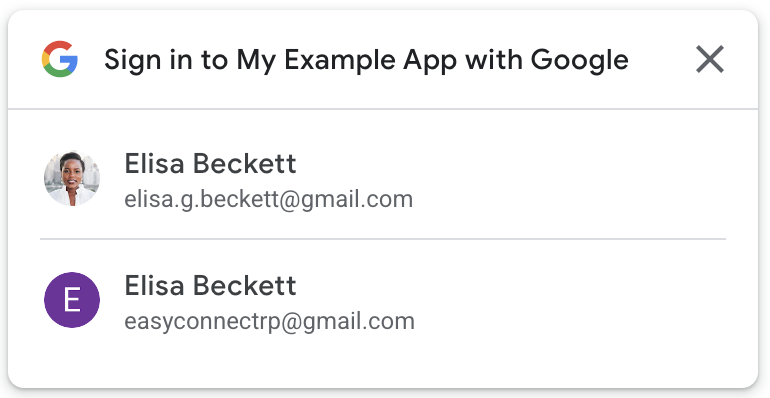
The `useOneTap()` hook controls the [One Tap][gsi-onetap] flow.
The flow can begin by calling `prompt`, and can be stopped by calling `cancel.`
By default, the prompt will show automatically on mount. This can be changed by
setting the `show` flag to `false`.
```tsx
function App() {
const { prompt, cancel } = useOneTap({
show: false // don't show on mount
});
return (
<>
)
}
```
---
## Contributing
Bug reports and pull requests are welcome on [GitHub][github].
## License
This project is available under the terms of the ISC license. See the
[`LICENSE`][license] file for the copyright information and licensing terms.
[npm]: https://www.npmjs.com/package/react-gsi
[github]: https://github.com/michaelbull/react-gsi
[license]: https://github.com/michaelbull/react-gsi/blob/master/LICENSE
[storybook]: https://michaelbull.github.io/react-gsi/?path=/story/examples
[gsi-overview]: https://developers.google.com/identity/gsi/web/guides/overview
[gsi-setup]: https://developers.google.com/identity/gsi/web/guides/get-google-api-clientid#get_your_google_api_client_id
[gsi-library]: https://developers.google.com/identity/gsi/web/guides/client-library
[gsi-api]: https://developers.google.com/identity/gsi/web/reference/js-reference
[gsi-IdConfiguration]: https://developers.google.com/identity/gsi/web/reference/js-reference#IdConfiguration
[gsi-callback]: https://developers.google.com/identity/gsi/web/reference/js-reference#callback
[gsi-button]: https://developers.google.com/identity/gsi/web/guides/offerings#sign_in_with_google_button
[gsi-onetap]: https://developers.google.com/identity/gsi/web/guides/offerings#one_tap


