 _Find and replace strings, regex patterns, or template outputs in text files (CLI tool designed for use in npm package.json scripts)_
[](https://github.com/center-key/replacer-util/blob/main/LICENSE.txt)
[](https://www.npmjs.com/package/replacer-util)
[](https://github.com/center-key/replacer-util/actions/workflows/run-spec-on-push.yaml)
**replacer-util** searches for text to substitute with a replacement string or with values from your project's **package.json** file, such as the project version number.
It can also insert path metadata and concatenate output to generate content such as an HTML file of `
_Find and replace strings, regex patterns, or template outputs in text files (CLI tool designed for use in npm package.json scripts)_
[](https://github.com/center-key/replacer-util/blob/main/LICENSE.txt)
[](https://www.npmjs.com/package/replacer-util)
[](https://github.com/center-key/replacer-util/actions/workflows/run-spec-on-push.yaml)
**replacer-util** searches for text to substitute with a replacement string or with values from your project's **package.json** file, such as the project version number.
It can also insert path metadata and concatenate output to generate content such as an HTML file of `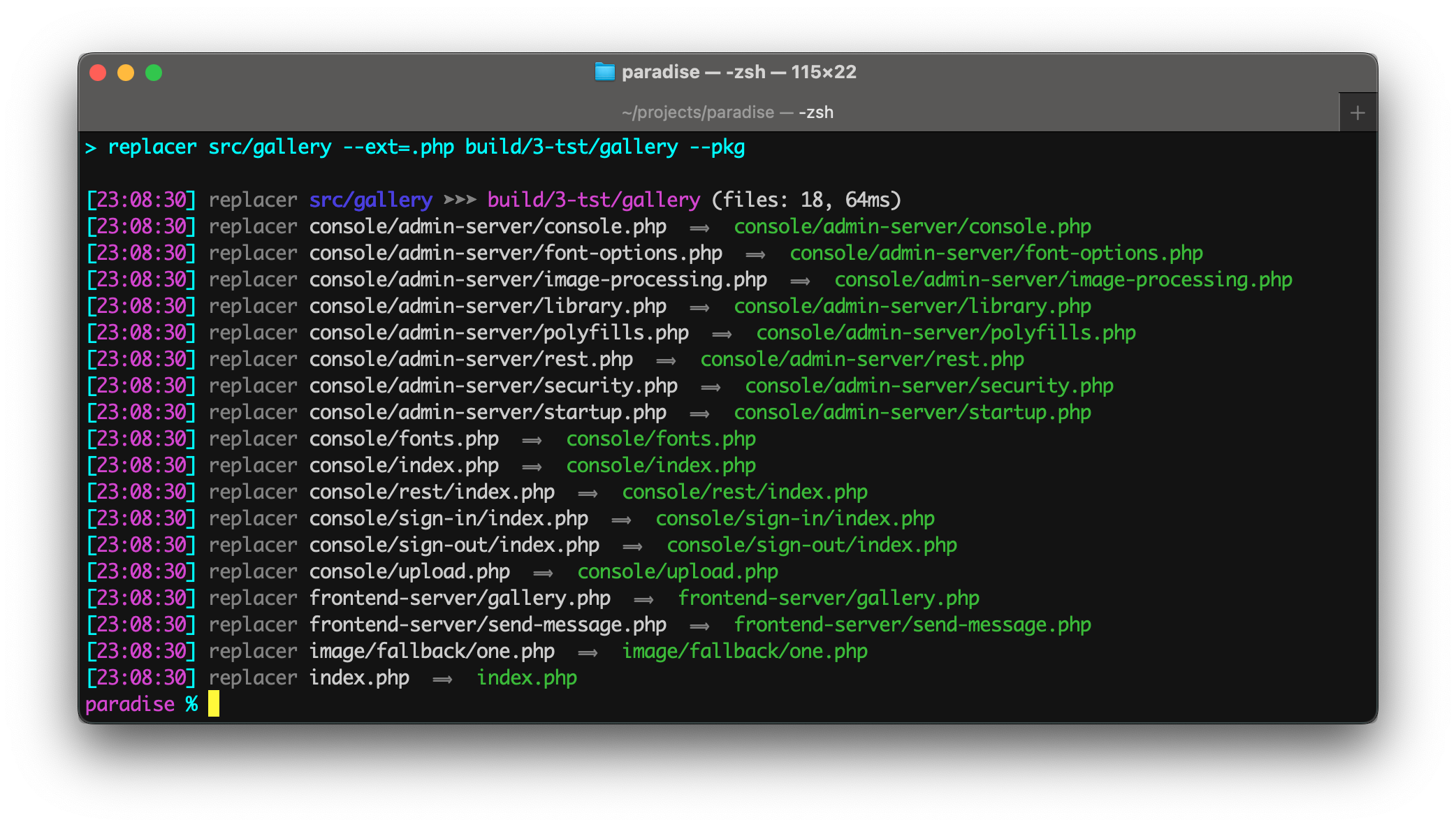 ## A) Setup
Install package for node:
```shell
$ npm install --save-dev replacer-util
```
## B) Usage
### 1. Synopsis
```
replacer [SOURCE] [TARGET]
```
Parameters:
* The **first** parameter is the *source* folder or file.
* The **second** parameter is the *target* folder.
### 2. npm package.json scripts
Run `replacer` from the `"scripts"` section of your **package.json** file.
Example **package.json** scripts:
```json
"scripts": {
"build-web": "replacer src/web --ext=.html dist/website",
"poetry": "replacer poems --find=human --replacement=robot dystopian-poems"
},
```
In addition to the `--find` and `--replacement` CLI flags, template outputs in the source files will be replaced with their corresponding template variable values.
The template variable `package` points to the **package.json** object, enabling `{{package.version}}` in the source file to be replaced with the project's version number.
### 3. Command-line npx
Example terminal commands:
```shell
$ npm install --save-dev replacer-util
$ npx replacer src/web ext=.html docs/api-manual
```
You can also install **replacer-util** globally (`--global`) and then run it anywhere directly from the terminal.
### 4. CLI flags
Command-line flags:
| Flag | Description | Value |
| ----------------- | ----------------------------------------------------- | ---------- |
| `--cd` | Change working directory before starting search. | **string** |
| `--concat` | Merge all files into one file in the target folder. | **string** |
| `--content` | String to be used instead of the input file contents. | **string** |
| `--exclude` | Skip files containing the string in their path. | **string** |
| `--ext` | Filter files by file extension, such as `.js`.
## A) Setup
Install package for node:
```shell
$ npm install --save-dev replacer-util
```
## B) Usage
### 1. Synopsis
```
replacer [SOURCE] [TARGET]
```
Parameters:
* The **first** parameter is the *source* folder or file.
* The **second** parameter is the *target* folder.
### 2. npm package.json scripts
Run `replacer` from the `"scripts"` section of your **package.json** file.
Example **package.json** scripts:
```json
"scripts": {
"build-web": "replacer src/web --ext=.html dist/website",
"poetry": "replacer poems --find=human --replacement=robot dystopian-poems"
},
```
In addition to the `--find` and `--replacement` CLI flags, template outputs in the source files will be replaced with their corresponding template variable values.
The template variable `package` points to the **package.json** object, enabling `{{package.version}}` in the source file to be replaced with the project's version number.
### 3. Command-line npx
Example terminal commands:
```shell
$ npm install --save-dev replacer-util
$ npx replacer src/web ext=.html docs/api-manual
```
You can also install **replacer-util** globally (`--global`) and then run it anywhere directly from the terminal.
### 4. CLI flags
Command-line flags:
| Flag | Description | Value |
| ----------------- | ----------------------------------------------------- | ---------- |
| `--cd` | Change working directory before starting search. | **string** |
| `--concat` | Merge all files into one file in the target folder. | **string** |
| `--content` | String to be used instead of the input file contents. | **string** |
| `--exclude` | Skip files containing the string in their path. | **string** |
| `--ext` | Filter files by file extension, such as `.js`.Use a comma to specify multiple extensions. | **string** | | `--find` | Text to search for in the source input files. | **string** | | `--header` | Prepend a line of text to each file. | **string** | | `--no-liquid` | Turn off LiquidJS templating. | N/A | | `--no-source-map` | Remove any `sourceMappingURL` comment directives. | N/A | | `--non-recursive` | Only read files in the source folder not subfolders. | N/A | | `--note` | Place to add a comment only for humans. | **string** | | `--quiet` | Suppress informational messages. | N/A | | `--regex` | Pattern to search for in the source input files. | **string** | | `--rename` | New output filename. | **string** | | `--replacement` | Text to insert into the target output files. | **string** | | `--summary` | Only print out the single line summary message. | N/A | | `--title-sort` | Ignore leading articles in `--concat` filenames. | N/A | | `--virtual-input` | Do not read any files, use `--content` instead. | N/A | To avoid issues on the command line, problematic characters can be _"escaped"_ with safe strings as listed below. Escape characters: | Character | Safe stand-in string | | --------- | -------------------- | | `'` | `{{apos}}` | | `!` | `{{bang}}` | | `}` | `{{close-curly}}` | | `=` | `{{equals}}` | | `>` | `{{gt}}` | | `#` | `{{hash}}` | | `<` | `{{lt}}` | | `{` | `{{open-curly}}` | | `\|` | `{{pipe}}` | | `"` | `{{quote}}` | | `;` | `{{semi}}` | | ` ` | `{{space}}` | Alternatively, escaping for the command line can be avoided with [macros](#9-macros) you define in your project's **package.json** file (see documentation below). ### 5. Examples - `replacer src build`
Recursively copies all the files in the **src** folder to the **build** folder using the data in **package.json** to update the template outputs. - `replacer src/docs --ext=.md --find=Referer --replacement=Referrer output/fixed`
Fixes spelling error in markdown files. - `replacer src/docs --ext=.md --find=Referer --replacement=Referrer --no-liquid output/fixed`
Same as previous example but disables LiquidJS templating (useful in case source files contain characters inadvertently interpreted at templating commands). - `replacer web '--find=cat dog' '--replacement= cat{{pipe}}dog ' target`
`replacer web --find=cat\ dog --replacement=\ cat{{pipe}}dog\ target`
`replacer web --find=cat{{space}}dog --replacement={{space}}cat{{pipe}}dog{{space}} target`
Replaces all occurances of the string `'cat dog'` with `' cat|dog '` (note the _3 different_ ways to _"escape"_ a space character). - `replacer src --ext=.js --no-liquid --concat=bundle.js build`
Merges all JS files into **build/bundle.js**. - `replacer app/widgets --ext=.less --content=@import{{space}}{{quote}}{{file.dir}}/{{file.name}}{{quote}}{{semi}} --concat=widgets.less app/style`
Creates a single LESS file that imports the LESS files of every widget component. - `replacer app/widgets --ext=.less --content={{macro:less-import}} --concat=widgets.less app/style`
Identical to the previous command assuming the `less-import` macro is properly defined in the **package.json** file. - `replacer src --summary build`
Displays the summary informaion but not informaion about individual files copied. - `replacer src --regex=/^--/gm --replacement=🥕🥕🥕 build`
Finds double dashes at the start of lines and replace them with 3 carrots. Note the `g` and `m` [regex options](https://developer.mozilla.org/en-US/docs/Web/JavaScript/Guide/Regular_Expressions#advanced_searching_with_flags). - `replacer build/my-app.js --rename=my-app.browser.js build`
Copies **my-app.js** to **my-app.browser.js** without making and changes. - `replacer src/web --ext=.html --rename=index.html dist/website`
Renames all HTML files, such as **src/web/about/about.html**, to **index.html** while preserving the folder structure. - `replacer --cd=spec fixtures/web --find=insect --replacement=A.I. target/web`
Removes all insects. See: [fixtures/web/mock1.html](spec/fixtures/web/mock1.html) and [target/web/mock1.html](spec/target/exclude/mock1.html) - `replacer node_modules/chart.js/dist/chart.umd.js --no-source-map build/1-pre/libs`
Removes the `//# sourceMappingURL=chart.umd.js.map` line at the bottom of the **Chart.js** distribution file. - `replacer . docs --rename=robots.txt --virtual-input --content={{hash}}{{space}}Allow{{space}}bots{{bang}}`
Creates a **robots.txt** file with the line `# Allow bots!` in the **docs** folder. - `replacer --virtual-input . --rename=CNAME docs --content=example.com`
Creates a **CNAME** file with the line `example.com` in the **docs** folder. For examples of using `replacer` as part of front-end build process, check out the `"runScriptsConfig"` section of:
https://github.com/dna-dom/data-dashboard/blob/main/package.json > [!NOTE] > _Single quotes in commands are normalized so they work cross-platform and avoid the errors often encountered on Microsoft Windows._ ### 6. Template outputs and filter formatters The source files are processed by LiquidJS, so you can use [template outputs](https://liquidjs.com/tutorials/intro-to-liquid.html#Outputs) and [filter formatters](https://liquidjs.com/filters/overview.html). Custom variables are created with the [assign](ttps://liquidjs.com/tags/assign.html) tag. Three special variables are available by default: * `file` ([path](https://nodejs.org/api/path.html#pathparsepath) and date information about the source file) * `package` (values from your project's **package.json** file) * `webRoot` (relative path to root folder: `.`, `..`, `../..`, `../../..`, etc.) For example, a TypeScript file with the lines: ```typescript const msg1: string = 'The current release of {{package.name | upcase}} is v{{package.version}}.'; const msg2: string = 'This file is: {{file.base}}'; ``` will be transformed into something like: ```typescript const msg1: string = 'The current release of MY-COOL-NPM-PACKAGE is v1.2.3.'; const msg2: string = 'This file is: my-app.ts'; ``` Example outputs and formatters: | Source file text | Example output value | Note | | ------------------------------ | -------------------------- | ---------------------------------------------- | | `{{package.name}}` | `my-project` | Value from `name` field in **package.json** | | `{{package.version}}` | `3.1.4` | Value from `version` field in **package.json** | | `{{package.version\|size}}` | `5` | Length of the version number string | | `{{file.path}}` | `src/web/sign-in.html` | Full path to source file | | `{{file.folder}}` | `web` | Name of parent folder of the source file | | `{{file.base}}` | `sign-in.html` | Source filename with the file extension | | `{{file.name}}` | `sign-in` | Source filename without the file extension | | `{{file.ext}}` | `.html` | File extension of the source file | | `{{file.modified}}` | `April 7, 2030` | Formatted date of when file was last modifiled | | `{{file.date\|date:"%A"}}` | `Sunday` | Date object for when file was last modifiled | | `{{file.timestamp}}` | `2030-04-07T07:01:36.037Z` | Value for the `datetime` attribute of `